Choreographic Copyright – by “Jennifer W”

Choreographic works were not recognized as copyrightable until the Copyright Act of 1976. Although many choreographers have taken the opportunity to register their works in the thirty-five years since then, many have not and for this reason and the nature of the dance community, few cases have come to the court on this subject; leaving little precedence for future cases to rely on.

But given that registrations are on the rise, it stands to reason that the complications of choreographic works need more investigation in order to predict future case outcomes. Therefore, after reviewing Horgan v. MacMillan, Inc. and many articles covering that case, we’ve put together a short video about choreographic copyright and the way in which photography may or may not infringe on such works.

Using video and still screenshots from the dance movie Center Stage, we compile a few examples of photography based on choreography and ask you to decide what you think might be infringement.

After studying the video and photographs, if you believe that photography could plausibly infringe on copyright, ask yourself what other example could be created to show photography crossing the line.

Enjoy!

Jennifer W. & Kendall W.

Video from which screenshots were taken:
Center Stage

Music on YouTube – by “Adam P”

Given the recent emergence of YouTube as a major channel of expression for musical artists, we decided to film a short Q&A documentary on one of Yale’s own YouTube celebrities – Kurt Schneider and Jake Bruene. Initially brought together by a short-film project called College Musical, the group rose to fame through the Michael Jackson Medley, performed by Sam Tsui and written by Schneider, which currently has 25 million views. These YouTube artists have continued to collaborate on many other works, including College Musical the Movie, which just premiered last Sunday, May 1, at the Yale Whitney Humanities Center. With nearly 1 million subscribers, KurtHugoSchneider is currently the fifth most popular channel on YouTube. Here’s a quick look at their thoughts on YouTube as a medium of musical expression.

The film was made by Daniel Ayele, Daniel Esannason, Lynn Wang, and Adam Payne.

Special thanks to Jake Bruene, Kurt Schneider, and TJ Smith.

Yale Pwnership? – by “Misbah U”

How much does Yale Pwn you?

We wondered how Yale, Stanford, MIT, and Harvard’s intellectual property policies have affected the process of launching a start-up as an undergrad at these schools, and we wanted to know how students have had to negotiate with their school’s tech transfer offices on the terms of IP rights ownership, licensing, and royalty sharing.

After talking with several students & start ups at each of these universities, what we found is that most student start-ups simply avoid the tech transfer offices. In general, the IP policies are not well publicized, but most students who are trying to launch a venture have the foresight to investigate the policy and then operate outside of its bounds.

In the process, we created a short video that seeks to give you a glimpse into how much students know about intellectual property policies (specifically, Yale’s patent and copyright policies) and what misconceptions they may have surrounding student start ups.

Please do visit YalePwnership.info for more on what the policies are on paper versus reality and concepts established by students concerning them.

-Misbah Uraizee, Anna Doud, Camille Chambers, & Charles Amoako

Censorship in the Digital Age – by “Nathan B”


For my final project for CPSC 184, I created an infographic exploring internet censorship around the world. I used information supplied primarily by Reporters Without Borders, a free speech advocacy group which monitors freedom of expression worldwide. They publish an annual list of “internet enemies” detailing the actions of the internet’s most aggressive censors and discussing trends in online freedom.

I chose to create an infographic because, first, I believe existing infographics on the subject failed to use the medium to its fullest potential and, second, there are many poorly-understood parts of the issue which could be better explained using visual communication. For that reason, I chose to make the centerpiece of the infographic a diagram depicting different ways of circumventing government censorship of the internet. In order to make the, I not only had to research the different ways online communities have found to evade censors (e.g. anonymizers like Tor and proxy servers), but also designed the glyphs used by hand and went through several iterations of the diagram before arriving at the final product.

Additionally, I examined the different kinds of websites governments try to censor and, perhaps most importantly, how they actually go about blocking access. Some particularly interesting findings were the Russian government’s abuse of anti-piracy laws to seize the computers of opposition groups (thanks to Grace for finding that one) and Western IT companies’ willingness to not only follow censorship laws, but to even provide oppressive governments with technology and information which they could use to attack dissidents.

Check out the full infographic by clicking the thumbnail below and be sure to tell your friends about it (especially if your friends live under freedom-hating regimes).

Uploaded with ImageShack.us

PS- if anyone can find me a more permanent host for the infographic, please let me know (free image-hosting websites don’t tend to like 1200×2000 pixel, 1.75 MB jpegs).

New Style Game Ranking Project – by “Brian S”

There are lots of video game ranking sites out there. They judge games on a wide variety of criteria, ranging from graphics to replayability. However, there isn’t much information about how much freedom the user has when playing various games. This is highly relevant in the digital age, where “code is law” – the game’s code, whether intentionally or unintentionally, often limits what players are able to do in a way that was never possible in the era of board games. Additionally, companies are sometimes very eager to protect their intellectual property by imposing restrictions on the user’s freedom and creativity. Sometimes a user cannot actually play a game he has purchased – what kind of “ownership” of a game is that?

We sought to create a new rankings system that judges games on five freedom-related, digital-age criteria : accessibility, customizability, ease of sharing, game company control, and cost. For each game we looked at we assigned scores for each of these metrics, on a scale from 1 to 10.

More information and, of course, the actual rankings can be found at our blog.

This is the final project for Brian Senie, Benjamin Gossels and Wesley Wilson.

Unsell Yourself — A Protest Model Against Facebook – by “Max C.”

Facebook’s a monopoly that abuses its users: you and me. But we’re left without a way to retaliate. I propose a way to contaminate their database with false information, limiting the usefulness and resale value of our own information, while maintaining as much Facebook usefulness for the rest of us. It’s called Unsell Yourself, and I’d be honored if you’d give it a read.

[Edit: Reposted from my own blog in full, but formatting/CSS is better on my blog]

This is the story of how Facebook uses the information you put into it against you, and how you can unsell yourself. I believe Facebook is an exciting product and I hope that the company succeeds. But I also think Facebook’s monopoly has permitted them a business model which is bad for its users.

Not all stories of businesses harming their consumers begin with a man in a top hat, but it sure makes it easier to. Is Facebook a monopoly? Here’s a graph of Facebook’s web market share compared to hi5, friendster, orkut, linkedin, plaxo, & ning as assembled by Bill Tancer in 2007.

Since 2007, network effects have pushed Facebook into an even more dominant position. Facebook now claims that they have

More than 500 million active users
50% of our active users log on to Facebook in any given day
Average user has 130 friends
People spend over 700 billion minutes per month on Facebook

Alexa.com names Facebook the #2 top site in the world, with 42% of the world’s entire Internet population having visited Facebook. The next social network doesn’t come up until #17: LinkedIn, with a meager 4% of the world’s Internet population.

Here at Yale, in a recent poll of people connected with the class Control, Privacy and Technology (tech savvy 18–22 yr olds, generally), 98.9% of the respondents had a Facebook.

Obvious truth number one: Facebook is the most dominant social network. Facebook alone is in exclusive possession of 500 million people’s communications, demographic data, location, and social habits. Since I’m not even close to being familiar with the nuance of antitrust law, I’ll leave that speculation to other people, noting only that Wikipedia says that the Sherman Antitrust Act doesn’t forbid innocent monopolies, but only those who achieve their monopoly through misconduct.

How Facebook’s Monopoly Harms Users

You might be asking (reasonably), “So what, who cares?” that Facebook is a monopoly. But Facebook’s definitely not been perfect, and their monopoly has permitted them some egregious abuses of their users that a competitive environment would not have permitted. As many Internet-based businesses know, it’s very very dangerous to abuse your users: they’re fickle, and can change services easily by merely navigating to their browser bar. Just look at Digg versus Reddit. So why hasn’t Facebook suffered user base drops when they rolled-out despised changes, like a redesign (the irony of linking Gawker isn’t missed), less default privacy, or ever more tailored behavioral ads. (Full disclosure: I recently got a Facebook behavioral ad for “bedwetting”. Not really sure what I’m doing to signal that one.)

Recently, even spookier things have surfaced. Julian Assange noted that Facebook is an FBI agent’s wet dream:

Facebook in particular is the most appalling spying machine that has ever been invented. Here we have the worlds most comprehensive database about people, their relationships, their names, their addresses, their locations, their communications with each other, their relatives… all accessible to US Intelligence… [Yahoo, Google and Facebook] have built in interfaces for US Intelligence. It’s not a matter of serving a subpoena.

Facebook users should get a Miranda warning:

And Mark Zuckerberg likes looking at more than merely the data you post. By reading between the lines, he’s worked out an algorithm with 33% success rate for predicting who you’ll date next.

Why Users Don’t Quit

I don’t quit Facebook because Facebook is a valuable network, one that can’t be easily replaced. That’s the natural strength of a monopoly combined with Metcalfe’s network benefits, the nature of walled garden web platforms, and their inability to control and remove their own data from Facebook. Walled garden web platforms like Facebook with embedded APIs and developers, along with Facebook-specific applications mean that users can’t easily replace or extract what could be valuable data to them. In other words, quitting Facebook means quitting Farmville and all the other applications you use. As more and more websites use Facebook as the only login system (for the best example, see Canv.as), the web platform expands its power. These kinds of platforms also lead to a new, special kind of hurt of users: the AOL effect. Users’ lack of control over their Facebook data also makes it impossible to quit the platform. Not only is it truly impossible to delete messages (the delete button merely obscures them from user view, but enables them to be re-discovered via Facebook’s “Download Profile” tool and of course they remain on Facebook’s servers for subpoena or hackers and Facebook themselves, but it’s also impossible to pull Facebook contact information out of the roach motel. Even Google has lashed out against Facebook, criticizing Facebook’s design choice that makes users’ unable to export their data back out.

How Users Can Strike Back

Not a single user pays to use Facebook, and yet the company is valued at $50 billion dollars. Not bad: that means that of their users is worth $100, by my math! Which is to say that investors believe that your information, your time on the site, and your clicking is worth $100 to Facebook. To encourage a more competitive marketplace and discourage Facebook from abusing its users, there’s an easy way to reduce your value to Facebook while simultaneously reducing your legal vulnerability and privacy problems, without quitting Facebook, or even losing a valuable component of Facebook’s services!.

You keep all of your Facebook contacts, the ability to message or chat or use your wall and apps— but behavioral advertising, Facebook’s bread and butter dollar revenues and the short term thing that keeps them Wall Street’s darling— you can kill all of that just by adding a “Teen Vogue” to your interests. Or Teletubbies. Or Tiffany’s.

Here’s my current profile:

The trick is to populate your Facebook with just enough lies as to destroy the value and compromise Facebook’s ability to sell you. Collectively, users could use misinformation with “features” that they don’t like being used against them in order to guide Facebook’s future. (This is already done by FB’s user base with new some new features: Facebook places seems to effectively have been a flop. Among my 1000+ Facebook friends, only one person uses it.)

How Google is Different from Facebook

I’m wary of Google, but for now will say it’s not worth populating their data with false information yet, and not just because it’s harder. This stems from three major differences between Facebook and Google:
1. Long term monetization strategy
2. Competitors
3. Data Freedom

I don’t see Google’s long term monetization strategy being pimping your data out to the highest advertising bidder. That might be how you build a $50 billion dollar company, but it’s not a way to build a lasting $200 billion dollar company. Instead, I think they’re collecting data to get into a product development business via big data and simple algorithms.

Nor is Google’s monopoly even close to as complete as Facebook’s dominance. Bing apparently now has 29% of the search market, and Baidu won’t let up the Chinese market easily. There are innumerable competitors to Gmail, and they all have heavy user bases. Online documents is an area Microsoft won’t cede easily, since it’s one of their core products and one of their two sources of profit (Office). Mobile phones are obviously an extremely competitive arena, with RIM, Apple, Microsoft, and HP all fighting for OS market share in smartphones. And even in Google’s stronghold of display ads, Apple’s attacking (though the success of iAds remains to be seen).

Perhaps most important is that Google’s exportability of your data remains high. You aren’t locked in or integrated in the same way that Facebook joins all of your data to a persistent single identity, users can download calendars and quit Google Calendar or extract contacts onto a new framework. The integration also doesn’t lock users into Google: you can continue to use Google Docs even if you discontinue Gmail use.

Conclusion

Ultimately, I see inputting false data into Facebook’s “likes” pages a form of sit-in, a kind of CAPTCHA to prevent a Facebook data mining bot to freely pillage and extrapolate results from the data you put in to Facebook. It’s a good response in a scenario like today, where Facebook has a monopoly that almost everyone has to jump in on anyway, no matter how much they might be reluctant to. Hopefully though, the longer term solution is for a real competitor to emerge, offering users the things that they want, and the ability to migrate effortlessly from Facebook without paying Metcalfe’s prices. In the meantime, protect yourself and express a bit of discontent: unsell yourself from Facebook.

The Future of Control in Legislation: An Examination of Online Privacy Bills in the 112th Congress – by “Cynthia W”

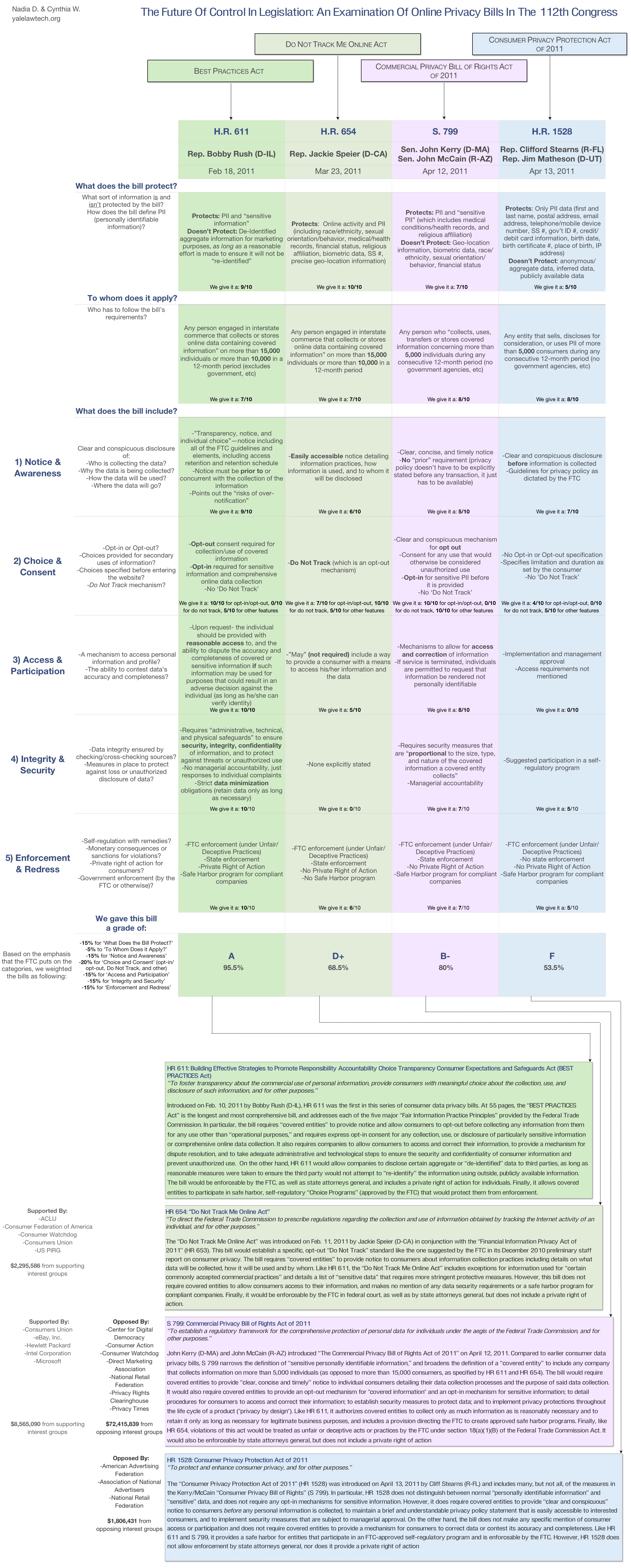
As a final project for Brad Rosen’s Yale seminar—Control, Privacy, & Technology—we took on the task of close-reading and comparing four recently proposed online privacy bills. The inspiration from the project comes from President Obama’s recent historic call for a privacy bill of rights.

The proceeding chart is meant to present all of the bills’ key features, providing a sense of each bill’s thoroughness and effectiveness. Rather than coming up with our own ideas about what the ideal privacy bill should and should not include, we relied on the FTC’s principles as a guide.

After parsing all of the information presented in the bills into categories, we gave each section a score out of 10, based on how many of the FTC’s guidelines the bill adhered to. We gave each section an individual weight, based on how much emphasis the FTC puts on its relative importance. After coming up with this percentage score (points out of 10 multiplied by section weight), we gave each bill a traditional letter grade. We actually ended up curving the scores by adding 10 percentage points, because the highest grade turned out to be a B. While this does speak of the need for even better privacy legislation, we did feel that at least one of the bills received an A grade because it generally conformed with all FTC guidelines.

While the chart should speak for itself, we did want to point out a few interesting points that became apparent after combing through all of the data:

1) Notice how the bills became less strict over time. While H.R. 611 seems to be the bill which would be enacted in the FTC’s ideal world, one can infer (from the fact that there were no contributions reported) that it never got off the ground, perhaps because it was indeed overly idealistic.

2) At least a couple of the bills include exemptions which make them a lot less effective. For example, the Kerry-McCain bill includes an exemption for the use of information within the context of “established business relationships.” Many bloggers have written that this creates a special loophole for social networks, calling it the “Facebook Loophole.”

3) Notice the way that “sensitive data” gets redefined over and over again, becoming less strict. While the most stringent bill includes the protection of data such as biometric data or precise geo-location data, other bills make no mention of this, offering a lot less protection.

—Nadia Danford ’12 and Cynthia Weaver ’12

The Gavin Project – by “Julie S”

In Ontario v. Quon, Justice Scalia encouraged legislature to consider the difference in privacy expectations between laptops and cellphones and to do so quickly, considering law’s seemingly futile rat race against technology.  That brought us to the question that spurred The Gavin Project: what’s more private – our cellphones, email accounts or Facebook messages, and what particular tidbits and facets of our personality and will seep through each of the media we so depend on?

Who is Gavin? It depends where you look.

According to Google’s search engine, Gavin was born and raised in his hometown Townville where he lived his entire life. His mother is Margaret Project and his father is Richard Project. He has a terrier named Jake. At 18 years old, Gavin was publicly honored in his Townsville newspaper as having graduated first in his class.  In high school, Gavin participated in music, fine arts and political organizations. He hung out with friends at parks or local restaurants and enjoyed nerding out.

But a simple Google search won’t reveal the extent of Gavin’s romantic encounters, his music tastes, grades and questionably legal activity.  Each of Gavin’s technological media that most of society would regard as private – his cell phone, Facebook account, and Gmail account – exposed different aspects of Gavin’s private life. His Gmail said he liked the Decembrists.  His cellphone said he liked Avril Lavigne.

If in order to have privacy protection under our legal system we need to demonstrate a subjective expectation of privacy society is willing to recognize, our polled public showed that society was willing to protect each of these different media, and as such The Gavin Project consensually violated one man’s privacy.  We created dossiers of each of our different Gavins, examining what we could learn about him through each of the media.  Ultimately, each of the media revealed information many would consider personal and private.

Perhaps the more philosophical question should be where is the real Gavin? Is he most himself on Facebook, Gmail, or on his cellphone?  We encourage you to decide for yourself as you read and partake in the gross privacy violation that is The Gavin Project.  We can judge for ourselves which privacy violation is most revealing and disturbing for Gavin and in that way help answer Scalia’s normative question of which technological venues should require the most protection by deciding which venues we, society, are most willing to protect.

Check out www.thegavinproject.com and follow @theGavinProject on Twitter for updates.

Jeonghyun Kim – Class of 2011
Julie Shain – Class of 2013
Matthew Everts – Class of 2013
Michael Clemente – Class of 2011
Sebastian Park – Class of 2013
Zachary Maher – Class of 2013

Android IP Project – by “Victor W”

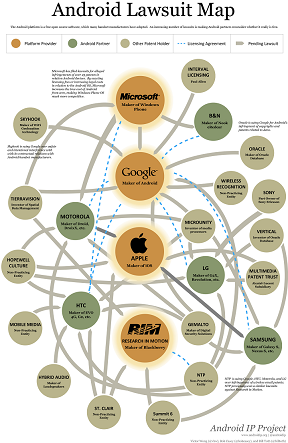
The Android IP Project (http://androidip.org) outlines the the legal challenges to the open source Android platform and its partners such as handset manufacturers and carriers.  Android is the focus due to its prominent position in the technology world.  Its dominance of the smartphone market owes a lot to the value delivered to partners — it’s free and has a lot of features.  However, those very aspects and its history of development have made Android the focal point of numerous intellectual property disputes.  About 40 different lawsuits have been filed against Google and its partners for various intellectual property issues relating to the Android.  Many of these lawsuits stem from non-practicing entities (aka patent trolls), but several of these lawsuits come from large competitors.  How the court rules on these cases will drastically shape the development of mobile technologies.

Check out AndroidIP.org for more information on Android’s copyright issues, trademark issues, and patent issues.  You can also view a full size version of the lawsuit map.  Follow @androidip on Twitter for updates on pending lawsuits too.  Everyone is welcome to contribute.


Intellectual Property in Online Journalism – by “Dennis H”

Our project looks at intellectual property issues in the realm of online journalism, along the lines of Jonathan Stray’s recent study. Using Google News, we tracked two distinct stories to see how much of the news is being originally researched and reported. Watching the stories unfold over time allowed us to see which outlets add original content to a given story, which credit their sources, and how they do so. We used our data to draw some insights about the proper copyright model for online news.

Check out our data here.


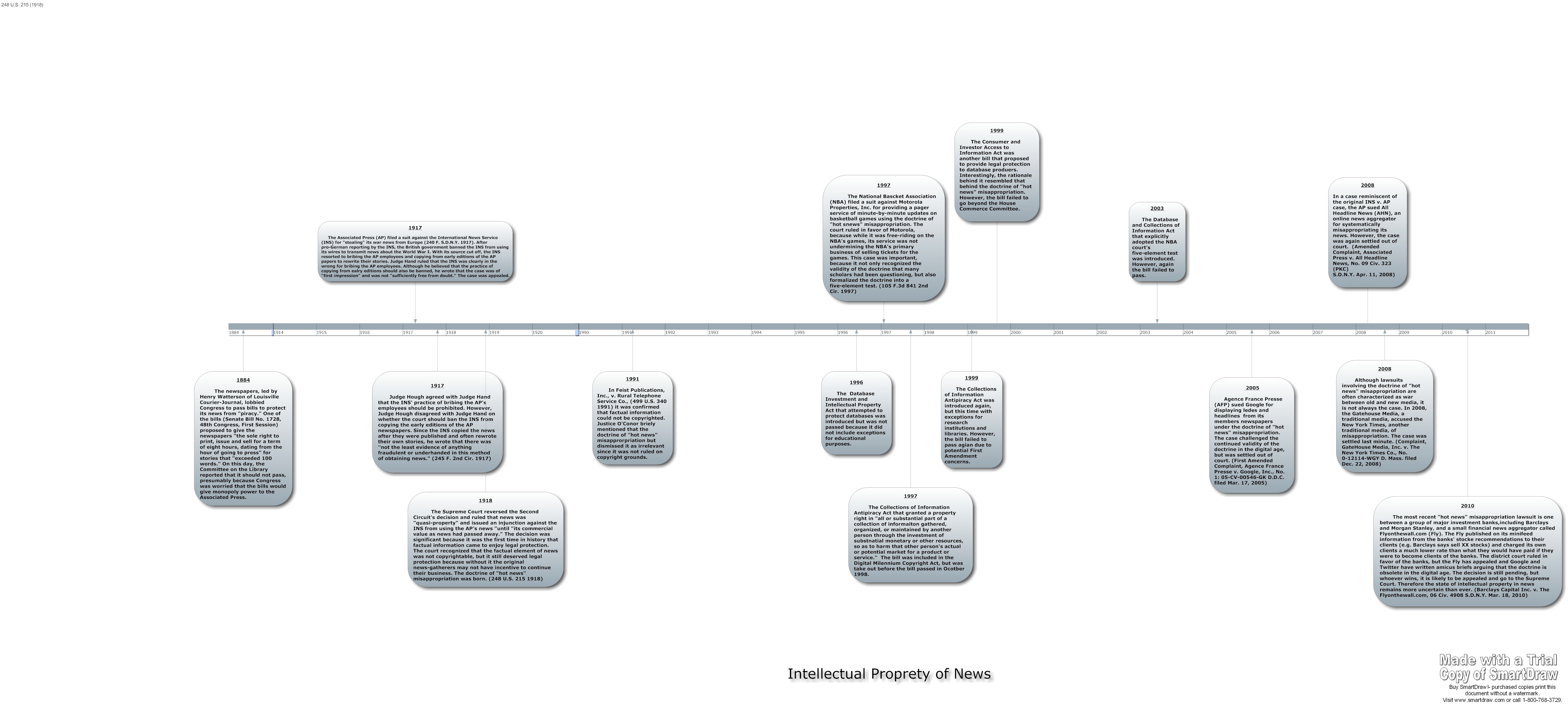
Our graphic analysis of the data, our written report, and a timeline of major events in the history of intellectual property issues in journalism, are attached.

-Grace Kim and Dennis Howe

FinalProject

FinalProject