Are funny memes impeding on our fun? – by “Kate F”

A couple of years ago, Nicholas Carr wrote an article in The Atlantic about how the internet changes the way people take in information and think about it.  In fact, the way you read my last sentence may well have illustrated his point: if you’re an average modern internet-media-consuming reader, you may well be reading this sentence as the article loads in the next tab, preparing to read about a page of the article, click on some more links in it, skim those, and (I hope) somehow find your way back here.  In fact, according to a University College London study that Carr cites, the average user of a research site only reads about 1-2 pages of any given article before bouncing off to another one.  Arguably, Google and hyperlinks are making it hard for us to focus on serious, lengthy books or even full blog posts.  Ironically, the more information we have easy access to, the harder it is to really use it.

But so what, you might ask?  For the purposes of this blog post, let’s concede that the internet isn’t the best research tool.  You could still argue that the internet is a veritable trove of music, trivia, funny pictures, funny videos, audio recordings of guys messing with telemarkers, and status updates from everyone you’ve ever met.

Yet I wonder if perhaps these vast resources of fun suffer the same pitfall that Carr attributes to the internet’s research tools.  Does this wealth of entertainment options make us incapable of engaging with lengthier entertainment, or even of focusing on any one option?  Anecdotally, I for one have realized lately that I struggle to focus for the duration of a tv show, let alone an entire movie.  When I watch tv online, I might start browsing some Texts From Last Night or checking my email or reading the newspaper in the next tab during a particularly slow scene. A good portion of the time, I get distracted and never even return to finish what I was watching.  In fact, I can’t make it through a Youtube video without getting distracted by the “suggested videos” on the side panel.

It’s an odd experience, because I don’t “have to” do any of those things, so it’s not as though I’m trying to more efficiently work my way through my entertainment to-do list.  Presumably, if I’m rational, the only reason I’d be multi-tasking during my leisure time is if twice as much media means twice as much fun.  But oddly, I’m not so sure that’s the case.  My tendency to multi-task online feels almost like a compulsion, as if the “new tab” button is calling out to me at all times against my own will.  The more I accustom myself to bounce through lots of quick blips of fun, the less I remember how to home in on just one leisure activity even if I wanted to.

Of course, blippy fun exists in the real world too (for example, comics), and the internet contains more developed entertainment as well (for example, feature-length films streamed online).  By definition, a “meme” is merely an idea, which could be about anything from weighty subjects like religion to trivial ones like LOLCats.  Yet I think it’s fairly clear that the entertainment-related memes that go viral online do not tend to be the long, time-consuming ones.  The most popular Youtube videos are almost always only a few minutes long; the viral email jokes your grandfather forwards to you are not book-length.  Perhaps the internet could theoretically help hour-long TED talks go viral to the general public, but in practice, it doesn’t.  We come to the internet for immediate laughs.

This desire for some instant humor as a break in a busy day isn’t in and of itself scary.  What I find frightening is that this might increasingly be the only type of pleasure and humor that we can appreciate.  I used to think there was something enjoyable about watching a sitcom every week, about knowing the characters and their histories and personalities in depth.  I feel that I’ve lost something when my entertainment comes primarily from a constantly changing cast of new, funny characters (Hoodrat kid! Fake Hitler! Miss Teen South Carolina!) or, alternatively, ripoffs of characters I came to know and love back when I actually read books and watched tv.  It’s only because I committed the time to read all 5,000 pages of Harry Potter fifteen times, gaining a nuanced and intimate understanding of Hermione’s psyche, that a parody video on YouTube makes sense.  It’s only because I watched a lot of Sesame Street that the irony of an obscene Count von Count is funny.  Parody is the fodder of many popular internet memes, and it feeds on the sorts of deeper-level cultural knowledge that a population with an attention span of 3 minutes can never gain.  What can we parody when we can no longer focus for long enough to really engage with characters in their original works?

I won’t argue that it’s bad to enjoy the occasional YouTube video.  But I will argue that if our enjoyment of short, popular memes on the internet shortens our attention spans to the point that it’s difficult for us to enjoy books, movies, and even tv, we are suffering a real loss.  At least for now, that claim isn’t scientifically proven, and I recognize that I rely primarily on anecdotal evidence in this discussion.  Hopefully further research will shed more light on the effects of blippy entertaining memes on the way we enjoy our free time.

But hey, perhaps by the time someone publishes an article about it, we’ll be too busy watching a baby sing Taylor Swift medleys in French to care.

Are We Wikiaddicts? – by “Kristin B”

One of the first things that comes to mind when we think of Wikipedia is the collaborative, democratic effort of the project. Basically, because we like democracy, we like Wikipedia. We like the anonymity, the ability to access millions of articles in one convenient place about anything we ever wanted to know very quickly. We browse the website for leisure, and we even check it during class to check facts (or even to seem smarter than we actually are). It’s permeated our culture in such a way that it has become a verb, like “to Google.” It’s accessible, common, and we use it. A lot.

However, the democratic nature of the site is actually its biggest fault: people that post and edit may not be technical, unbiased experts on particular subjects, and that leads to a lack of full information. A main highlight of the site is the ability to edit articles, but, when it is unclear who is behind the text, it is uncertain how much we can rely on what the text says. It’s true that there are checks in place for some of these things, such as new software that can more accurately find and correct fallacious information. There are internal and well-known checks as well, such as the familiar call for re-editing or note about bias with the familiar broom icon at the top of a contentious article. However,While Wikipedia does highlight bias and invite re-editing, it is true that, especially if there is a reference cited, Wikipedia often does not catch mistakes. Furthermore, it is unclear that the re-editing will actually be more accurate and solve the initial problem. Even worse, we usually don’t react when we see an article designated as such. We realize that the bias or inaccuracy may be there, but we read it anyway as an initial source of information.

To us, these problems should not matter. We are definitely smart enough to ascertain that a popularly-edited site probably contains mistakes, right? We have always been taught that “Wikipedia is NOT a valid source, but a good starting point for background knowledge,” expressly BECAUSE of this collaborative nature. Unsuprisingly, that fails to be the case in many circumstances.

Take, for example, a recent article from the UK in The Register that discusses just how lazy we are becoming. Apparently, even our journalists, the last bastion of accuracy and doggedness in finding out the truth, are relying on Wikipedia as a primary source. Journalists in The Guardian and The Mirror apparently used Wikipedia to write the obituaries of Norman Wisdom, who was a comedian, singer, and actor (yes, I DID just Wikipedia him to figure out exactly who he was). There  were several inaccuracies in the entry, and the Guardian still had not corrected the mistake at the time of the article. Additionally telling is the fact that it was widely known that a reference to and reliance upon Wikipedia caused the errors to occur, but neither publication has acknowledged that this was, in fact, the case.

Poor Norman Wisdom is not the only person to be misrepresented by the inaccuracies of Wikipedia. Some inaccuracies are a little more devastating to one’s reputation than having been mistaken as the author of a song or said to have been nominated for an Oscar. In an interview with NPR, the founding editorial director of USA Today defends that he is not, in fact, likely culpable in the assassinations of JFK or RFK.

In another story, golfer Fuzzy Zoeller sued to find the author of his Wikipedia page, who had slandered him in a number of ways. This brings up a host of legal issues. The anonymity is the selling point, but, at the point that things are inaccurate, how anonymous should things on Wikipedia be? What are the future legal implications of this suit? Does the fact that Zoeller sued at all, clearly caring about a characterization of himself via this PARTICULAR channel show our continued dependence on it? Should Wikipedia be treated like any other news source? How much of our First Amendment rights extend to a place like Wikipedia and the internet?

While this is a humorous example, it does highlight the issue of collaboration: anyone can write anything (at least for a time). The process of tracking these mistakes is slow, and the inaccuracies often go unnoticed, especially if tied to ANY reference (it’s unclear if the references have to be “reliable” or “expert” sources, although Wikipedia likes to claim it won’t allow any unpublished references to contribute to entries). The worst part is that those whom we expect to seek the truth and keep us informed when we can’t do so ourselves are using it as ironclad truth.

Wikipedia is a great tool, but are we addicted and blinded in such a way by the communitarian nature and the ease of access that we fail to see when something is wholly inaccurate?

Conservative collaboration and the Wikipedia model – by “Zachary M”

Below is an interview from The Colbert Report of Andy Schlafly, the founder of Conservapedia, a conservative version of Wikipedia, and more recently the wiki-based Bible translation, the Conservative Bible Project. (I’m not sure the embedding is working; you can view it here.)

The Colbert Report Mon – Thurs 11:30pm / 10:30c
Andy Schlafly
www.colbertnation.com
Colbert Report Full Episodes 2010 Election March to Keep Fear Alive

First, let’s back up a second and understand what Conservapedia is.  It describes itself as a “conservative, family-friendly Wiki encyclopedia,” “conservative” being defined as someone who “adheres to principles of limited government, personal responsibility and moral values, agreeing with George Washington’s Farewell Address that “religion and morality are indispensable supports” to political prosperity.”  Andy Schlafly, son of Phyllis Schlafly, (known best for her opposition to the Equal Rights Amendment and feminism in general), founded it as a response to the perceived “liberal bias” of Wikipedia.

The articles have such blatant bias that they almost seem comedic most of the time.  For example, the article Barrack Hussein Obama (note the inclusion of the middle name) contains an entire section on evidence that Obama is a muslim, and the central policies are called the Conservapedia Commandments.  When I show Conservapedia to friends unfamiliar with it, they usually think it’s a joke like Encyclopedia Dramatica or Uncyclopedia.

The general encyclopedic part notwithstanding, Schlafly’s Conservative Bible Project (CBP) (hosted through Conservapedia) sounds just plain bizarre (Colbert puts it: “We already have that; it’s called The Bible.”)  It claims to be correcting for the following “errors in conveying Biblical meaning”:

  • lack of precision in the original language, such as terms underdeveloped to convey new concepts introduced by Christ
  • lack of precision in modern language
  • translation bias, mainly of the liberal kind, in converting the original language to the modern one.

The first claim seems to question the original scriptures, which otherwise would violate the purported belief that the Bible is the inspired, inerrant word of God- it suggests that divine revelation is unsatisfactory.  The second is linguistically inaccurate: the first thing you learn in any linguistics course is that all languages and dialects are equally valid; they just use different strategies to express the same things.  The third is what the rest of the article tries to establish, citing a handful of examples ranging in validity.  Schlafly’s general argument is that all of our views should be informed by our religion, largely meaning the Bible, and this is the source of his conservatism.  To then alter the supposed source of conservatism to make it more conservative makes the belief system circular. (Full disclosure here: I’m a committed Christian myself and consider the CBP to be disturbing.)

Andy Schlafly is a Princeton alum.
The Conservative Bible Project Page

Despite referring to itself as a “translation,” the project page doesn’t once suggest that contributors refer to the original Greek or Hebrew, though there is one link to a Greek text at the bottom of the page.  Its desire to fix translation inaccuracies is clearly not shown in a particularly ironic passage, Revelation 22:18-19:

I warn every man who hears the words of the prophecy of this book: If any man adds to these things, God will add to him the plagues that are written in this book. And if any man subtracts from the words of the book of this prophecy, God will subtract his portion out of the Book of Life, and out of the holy city, and from the things written in this book.

The word “Book” here should be “Tree.”  It results from the fact that the Conservative Bible is based on the King James Version, which for the end of Revelation was translated from Greek to Latin to Greek to English.  The Latin words for book and tree are similar, so that’s probably where the error came from.  This is actually theologically significant, since the “Tree of Life” recalls the Garden of Eden and the “Book of Life” creates a new concept, something like “God has a list of people going to heaven in a book,” which I’m pretty sure I heard once or twice in Sunday School growing up.  However, the CBP editors clearly didn’t care about a more accurate translation- when an error could not be corrected to make the passage more conservative, it was ignored.  It also seems that they didn’t read this passage at all, considering it promises them some significant divine punishment.

OK, so the CBP is inherently contradictory as a concept.  But what can we learn about collaboration from it?  Andy Schlafly makes some interesting assertions in his interview with Colbert:

  1. Isaac Newton claimed that work translating the Bible was responsible for his other insights and those of his contemporaries.  Thus, opening this process up to the general public is a major public service.
  2. This Conservative Bible is produced by the “best of the public,” which is better than experts. (“There are no definitive experts.”)
  3. The objective truth “becomes clear with time” through the work of the community.

If this claim about Newton is true, the first point is perhaps actually a justification for the project.  However, I doubt Newton was translating the Bible with an agenda other than understanding its meaning and am pretty sure it would have been from the original texts.  The other two, however, are much more general points about collaboration.  In essence, No. 2 and 3 are similar to the concepts governing Wikipedia.  Schlafly’s wording just happens to reduce the concept almost ad absurdum.  The Conservapedia Constitution opens with the statement: “Editing on Conservapedia is open to the best of the public – and that includes you.”  It does not say “and that could be you”- everyone is the best of the public, which renders the term meaningless.

The Conservapedia article Best of the public goes on to list “examples” of the concept, including many amateurs who rose to important status, including New Testament authors, Ronald Reagan, and one-hit wonders.   Though the selection is perhaps tailored to a conservative audience (except for examples like “Ice Ice Baby”), this is actually one of the most important sentiments in Internet culture.  As the “best of the public” article notes, any amateur can write a blog and dispense important information.  Wikipedia also depends on amateurs to synthesize information in an encyclopedic fashion, “encyclopedic” being identified by the myriad of policies, policies which were written by these amateurs.

This leads back to the fact that best of the public is presented in an absurd way on Conservapedia, showing an underlying tautology in collaborative web communities:  What is reliable information? That which the established members of the community achieve consensus on.  Who  gets to be an established member of the community?  Someone who provides reliable information. Colbert exposed this by having his fans edit him into the Conservative Bible- they created a clearly false consensus, and to overcome this, Conservapedia leaders had to violate the tenets of consensus.  An analogous situation would be issues of repeated vandalism in Wikipedia; articles prone to biased editing and vandalism, like “Christianity” and “George W. Bush,” tend to be semi-protected, meaning only established users can edit them.

If, however, a large group of people were to register Wikipedia accounts and assert on a discussion page something patently false was in accordance with Wikipedia policy, the community would be hard-pressed to go against  the consensus.  This generally doesn’t happen, since there are tons of Wikipedia users with a contrary opinion (who probably know Wikipedia policies well enough to cite them by abbreviation like WP:FU and WP:NOR and WP:NOTPAPER; as you can see, I’ve been inside this process).  This is actually why Conservapedia formed in the first place;  people with extreme conservative views found themselves quickly barred entry by an already-existing community.  We can only hope that the community is “right,” since such a gigantic status quo is hard to shift; the policies themselves are built around it.  Conservapedia, therefore, is no different from Wikipedia in that regard: an established status quo bars edits that violate the beliefs of the community.  It’s just that Wikipedia seems intuitively much more rational to most of us.

So now, all of the concepts behind Internet collaboration are tautological.  Where does that leave us?  Thankfully, there has been some review from outside of the system to help gauge whether it’s working.  A study in Nature found that Wikipedia is about as accurate as Encyclopedia Britannica.  That can give us some comfort that the system is doing its job and that any community-based inertia isn’t necessarily bad.  I don’t think any study has been conducted of Conservapedia or the Conservative Bible.

But I’m sure if a study did find Conservapedia to be less than accurate, Conservapedia would happily point out its liberal bias.

UPDATE: I just remembered that Andy Schlafly’s daughter Phyllis, who goes to Princeton, posted this on PrincetonFML: “My dad is the founder of Conservapedia. MLIG” An interesting discussion resulted, raising some of the points I raised here. (The OP is indeed his daughter; she posted about it on Facebook.)

Free and open source is not always the answer – by “Emily Y”

A recent New York Times article spotlighted a key issue in the world of open source software: businesses using others’ open source code to develop their own products and then failing to follow Open Source Standard (OSS) requirements. Open source issues such as these can be difficult – if not impossible – to overcome in the business sphere.  How can we expect programmers to put years of hard work into a quality program, and then just give it away for free?  But as its benefits to technological growth become increasingly obvious, open source software is becoming more common and accessible.  Is it possible for the future of software to be completely free and open source?

In the past, I’d been skeptical about of free software.  In respect to the quality, the free programs I’d downloaded and tested were fine, but never matched up to the caliber of (pricey) proprietary software programs.  More importantly, however, might have been that the phrase “open source” sounded like something that might appeal to a computer programmer, but not to me, a generally-technologically-capable-but-coding-oblivious student.  Why would I care whether or not I could access software code?

I’m not sure that I will ever have the desire to look at the coding of software.  What it comes down to is that some software on the market just doesn’t fit in a college student’s budget.  Moreover, most of this software is packed with features I’d never use, for techniques I’ll never understand.  When it comes to computers, I’m just a hobbyist.  For example, in working with newspaper design, I love toying around with the abundance of features that Adobe InDesign, Photoshop and Illustrator offer.  However, purchasing Adobe Creative Suite CS5 would set me back anywhere from $300 to $900 – and that’s the Student pricing.  Thinking about all of this led me to go the free route and test out a couple of “alternative” open source programs: GIMP and Inkscape, two major open source rivals to Adobe’s Creative Suite.

GIMP

GIMP is a free graphics manipulation program, with offerings similar to that of Adobe Photoshop.  In several ways, it lacks the power and usability of Photoshop.  Yet there are offshoots of GIMP that have used it to come awfully close to reproducing Photoshop.  The creator of GimPhoto took GIMP and modified it with features and a UI that rival those of Photoshop.  One major issue I held with GIMP was its inability to simply batch process a group of photos (automatically execute the same adjustments on several photos simultaneously).  According to the GIMP Wiki, in order to do this, the user must input commands, such as the one below:

(define (simple-unsharp-mask filename
radius
amount
threshold)
(let* ((image (car (gimp-file-load RUN-NONINTERACTIVE filename filename)))
(drawable (car (gimp-image-get-active-layer image))))
(plug-in-unsharp-mask RUN-NONINTERACTIVE
image drawable radius amount threshold)
(gimp-file-save RUN-NONINTERACTIVE image drawable filename filename)
(gimp-image-delete image)))

Which, to me, is closer to gibberish than a true “command.”

But still, the bottom line is that most of what GIMP doesn’t have, I wouldn’t use anyway.

Inkscape

Inkscape is the GIMP to Adobe Illustrator.  On most levels, Inkscape and Illustrator are identical when it comes to features.  There are a very small number of Illustrator features that are missing in Inkscape, but again, the people who makes use of these features are just a tiny fraction of the software’s users.   And the reverse is also true: Inkscape includes a number of useful features that are unavailable in Illustrator.  In fact, I found the Inkscape UI to be slightly more intuitive than Illustrator’s.   Thus, in my opinion, user interface and personal likings are what should influence one’s decision in this case.  Brand names are irrelevant.

A question often posed on the topic of open source software is whether or not computer programmers would continue to output quality software if there was no profit incentive.  But there is actually a great deal of profit to be made via free, open source software.  Where does the money come from?   Large companies such as Microsoft, Apple, and Google pay licensing fees to use open source software more freely.  For example, MySQL (an open source database) allows users to access and use its software at no cost; however, improvements that users make to the software must be shared with the company.  For individual users, this is generally a non-issue, but businesses rely on keeping the rights to their work to generate profit.  Thus, they pay these licensing fees, which can add up to significant profits for the original creator.

So why (or why not) open source?   There’s incredible room for enhancements in software, and with the increased freedom and flexibility of open source, the possibilities are endless.  Yet at the end of the day, I can’t use OpenOffice (sorry, Maria!).  I like the power of Microsoft Office, and I’m much more comfortable using it — no matter how annoyed I get with its UI changes.  Therefore, I understand if you can’t bear to make the switch to GIMP.  While we shouldn’t let our lives be controlled by proprietary software, we also shouldn’t impose limits on ourselves solely to promote open source.

In the end, a healthy balance between the two is really what we need.  There still is – and, I believe, always will be – a market for proprietary software.  Yet the major advancements made by open source software in the past decade are proof that open source is changing the way we create and use computer software.  The age of assuming “expensive software is better software” has passed; we are realizing that free software is no less advanced than proprietary software, while once-seemingly-impossible barriers to open source are gradually being overcome.

“A lot of people talk about open-source versus commercial, but they’re not mutually exclusive. Don’t view it as an all-or-nothing prospect.” — Steve Gerdt, program manager for open-source strategy at IBM.

Open Handset Alliance far from open by GNU standards – by “Bill T”

Like the previous blogger, I too am in love with my Droid. He is a Droid X. His name is Yeste (after the most famous swordmaker in all of Florin), and he runs Verizon/Motorola’s official OTA release of Froyo (Android 2.2) with Motorola’s MotoBlur skin on top of it. Motorola is a proud member of the “Open Handset Alliance” which is a group of 78 tech companies that seek to propagate Google’s open-source mobile operating system, “Android”. Some of its members are wireless distributors seeking wider access to smart phones, others are phone manufacturers looking to decrease some of its costs, others are developers excited about a popular mobile platform with a low bar for entry. All of them are in the business of technological advancements. All of them are in the business of making money. Many of them are competitors.

Google has set a tone of openness not entirely unlike that in GNU’s copyleft standards, but that tone ends at the conveyance of Android. As the leading producers of Android handsets, Motorola and HTC are the most capable of upholding the attitude of openness begun by Google. Motorola and HTC add the custom skins “MotoBlur” and “Sense UI” respectively  to Google’s stock form of Android, a practice Google adamantly defends, and one clearly aligned with GNU’s policy of allowing modification and redistribution (not that GNU’s rules apply to Android).

HTC has been moderately good about maintaining openness when conveying Android. Though they’ve added Sense, it’s possible to turn off most of it’s features and return to stock Android. Users seeking superuser access will still need to “root” their phones in order to load new firmware, but HTC hasn’t done much to prevent that. In fact, it’s become as easy as downloading an app to root HTC’s phones.

Motorola on the other hand, has shown a proclivity towards limitations on this openness. In order to remove MotoBlur, one must root one’s Motorola phone.  While rooting the Droid X and Droid 2 is possible, it is very difficult in comparison to other Android phones due to Motorola’s inclusion of a “Locked Bootloader” which, though it doesn’t “brick” the phone, takes very strong measures to prevent rooting. This ardent anti-circumvention measure would unquestionably violate copyleft standards, if they applied, and as a result, lowers the bar for openness among members of the Open Handset Alliance.

So what accounts for the difference between Motorola and believers in copyleft? Yes, Motorola is in the business of making money, but profit is not something the GPL disdains, indeed it embraces it by clarifying its definition of “free” as regarding freedom (which MotoBlur lacks) rather than price (which Motorola is happy to include). As the leading manufacturer of handsets, it can’t be that Motorola lacks interest in technological progress. Indeed, many consider Motorola’s Droid to be the first real “iPod Killer.”

Perhaps it’s the desire to beat the competition at either of these factors that drives Motorola’s desire to lock things down. While GNU supports gaining from modifications on open software, it doesn’t appear to support competitive enterprising. While GNU supports technological progress, that is not its primary tenant. Motorola’s desire, first, to lead the way rather than to contribute primarily to the customization of the Android platform is what pushes it so far away from the copyleft standard. Motorola doesn’t seem to want us to truly own the software on our phones.

I’m very happy with my MotoBlur-running Droid X, and even when given the warranty-preserving options of downloading MotoBlur-replacing apps like Launcher Pro or Handcent SMS, I’ve stuck with Motorola’s stock apps. I may not be better off for that, but I’m happy with those functions as they are. I don’t really need free tethering or mobile hotspot capabilities. With the ability to tether via Bluetooth to my MacBook Pro which can use its Airport as a hotspot, I’m satisfied. I don’t plan to root any time soon. Having said that, every once in a while I come across a cool app that says “requires root,” and wish that that wasn’t necessary. None of the apps have been worth voiding my warranty or taking the chance that I’ll brick my phone by screwing up the complicated process of circumventing eFuse, nor have they even been worth remembering. But as members of an Open Handset Alliance, perhaps Motorola should still consider democratizing superuser access.

After all, is there any good to the consumer from such a locked-down device?

The Ultimate Showdown: Blumenthal v. Craigslist – by “Thad D”

“Seeking Partner In Crime”

“looking for fun”

“Looking for some ACTION!!!!!!”

Ranging from apparently harmless to incredibly graphic, the “Adult Services” section of Craigslist has long provided people far and wide with the ability to search for and find others looking for “adult services”, whatever that may mean.  That is, until last week, when Connecticut Attorney General Richard Blumenthal, along with 17 other state attorneys general, told Craigslist to permanently remove their adult services section worldwide.

Before delving into the obvious issues with censoring Craigslist (net neutrality, questions of jurisdiction, website application immunity), it’s important to understand what Craigslist is and its history.  Founded in 1995 by Craig Newmark, Craigslist is a website that serves as a sort of virtual bulletin board for local postings.  With subdomains for major metropolitan areas around the world, users can post solicitations for anything from old TV’s, to job inquiries, to requests for relationships.  Listed as the most used classifieds service in any medium, Craigslist sustains its operating revenue mostly from small fees required to post job openings in major metropolitan areas.  The site’s annual net income is undisclosed.

However, the seemingly noble intentions of Craigslist have not stopped many from abusing its site.  For example, in early 2009, Julissa Brisman, a young masseuse, was murdered in a hotel room by a man who hired her through Craigslist.  Then, earlier this year James Sanders, a father and devout Christian, was gunned down in his home by criminals who responded to an ad he posted on Craigslist to sell his wife’s diamond ring. (Credit to NBC and NewsRoomJersey)

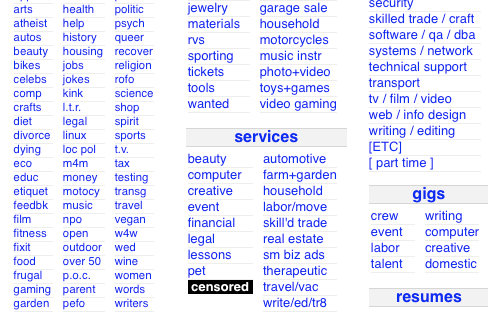
Three weeks ago, 17 state attorneys general jointly wrote to Craigslist telling owner Craig Newmark to permanently remove its adult services section worldwide.   Two weeks after that, four other private, Washington D.C. based non-profit organizations spoke out about their disapproval of the site’s adult services. In response, this past week Craigslist put a black and white “CENSORED” bar where the adult services hyperlink had previously been.  However, as of today, the black and white bar has officially been removed and there is no adult services section on the site’s home page.

Craigslist Adult Services Section Censored
Wait, You Didn't Want to Remove Your Adult Services Section?

So, now that we’re all on the same page, I would like to throw something out there: I believe Richard Blumenthal is putting up this huge front in order to be elected to the U.S. Senate.  What?  “No!” You cry out, “This cannot be!”  Well, consider the following conversation between two average voters:

Joe the Plumber: Gosh, the Senate election is coming up, soon.
Bob the Builder: Well, who’s running?
Joe the Plumber: Looks like it’s **Googles for ten seconds** Linda McMahon and Richard Blumenthal.
Bob the Builder: Wasn’t she a wrestler?  And who is Richard Blumenthal?
Joe the Plumber: I don’t know.  But apparently **Googles for five more seconds** Blumenthal is really against prostitution and human trafficking on Craigslist.  And Linda McMahon never said she didn’t like prostitution or human trafficking.  Looks like I know who I’m voting for.
Bob the Builder: I second that.  I am no fan of the Internets or prostitution.

Take it for what it is, that is my personal opinion.  Beyond the questions of political pandering and insincerity raised by the timing of his attack on Craigslist, Blumenthal’s offensive raises several other important issues.  Unfortunately, I do not have time to discuss all of them, but I would like to discuss what I think is the most important: net neutrality.

What do we mean when we use the term net neutrality?  Generally network neutrality means that for any network (be it peer to peer or the Internet), the principal service provider (i.e. Comcast, Charter), the government, or any other regulatory body should have no right to censor the content posted by members of the network.  In fact, the original design choices of this Internet such as decentralization and the FCC’s Broadband Policy Statement lend the Internet to being an open, neutral network.

Blumenthal and the attorneys general joining his suit are directly challenging the fundamentals of net neutrality by forcing Craigslist to remove its adult services section.  I want to make a very clear and unequivocal distinction.  Telling Craigslist it needs to seek out and remove postings soliciting illegal activities such as prostitution or human trafficking is NOT challenging net neutrality.  Without the rule of law, the Internet would become a safe haven for criminals and create an environment no one would feel comfortable entering.  However, Craigslist should not be told to remove a whole section because certain users abuse the site’s services.

If users demanded content controlled by a single source, with government interference and site material changing based on mere political whims, everyone would still be getting their Internet content from Compuserve.  Think I’m wrong?  Why do we have Google, Facebook, MySpace, Amazon, ESPN.com, streaming video of any sort (thanks porn industry), or all of the amazing web applications we have today?

For now, Blumenthal will not let sleeping dogs lie.  Although Craigslist has removed the whole adult services section Blumenthal insists, “Simply removing one portion of your site where you permitted and profited from prostitution ads is insufficient if ads go elsewhere.”  (Credit to The Associated Press)

Vinton Cerf, father of net neutrality and, the best thing it brings with it, competition on a previously unparalleled scale, we salute you.  Richard Blumenthal may be thinking that Craigslist is “thumbing their nose at the public interest”, but let’s be honest: since when did a 64 year old whose alma maters include Yale and Harvard ever represent the public interest?