There are lots of video game ranking sites out there. They judge games on a wide variety of criteria, ranging from graphics to replayability. However, there isn’t much information about how much freedom the user has when playing various games. This is highly relevant in the digital age, where “code is law” – the game’s code, whether intentionally or unintentionally, often limits what players are able to do in a way that was never possible in the era of board games. Additionally, companies are sometimes very eager to protect their intellectual property by imposing restrictions on the user’s freedom and creativity. Sometimes a user cannot actually play a game he has purchased – what kind of “ownership” of a game is that?
We sought to create a new rankings system that judges games on five freedom-related, digital-age criteria : accessibility, customizability, ease of sharing, game company control, and cost. For each game we looked at we assigned scores for each of these metrics, on a scale from 1 to 10.
More information and, of course, the actual rankings can be found at our blog.
This is the final project for Brian Senie, Benjamin Gossels and Wesley Wilson.
In Ontario v. Quon, Justice Scalia encouraged legislature to consider the difference in privacy expectations between laptops and cellphones and to do so quickly, considering law’s seemingly futile rat race against technology. That brought us to the question that spurred The Gavin Project: what’s more private – our cellphones, email accounts or Facebook messages, and what particular tidbits and facets of our personality and will seep through each of the media we so depend on?
Who is Gavin? It depends where you look.
According to Google’s search engine, Gavin was born and raised in his hometown Townville where he lived his entire life. His mother is Margaret Project and his father is Richard Project. He has a terrier named Jake. At 18 years old, Gavin was publicly honored in his Townsville newspaper as having graduated first in his class. In high school, Gavin participated in music, fine arts and political organizations. He hung out with friends at parks or local restaurants and enjoyed nerding out.
But a simple Google search won’t reveal the extent of Gavin’s romantic encounters, his music tastes, grades and questionably legal activity. Each of Gavin’s technological media that most of society would regard as private – his cell phone, Facebook account, and Gmail account – exposed different aspects of Gavin’s private life. His Gmail said he liked the Decembrists. His cellphone said he liked Avril Lavigne.
If in order to have privacy protection under our legal system we need to demonstrate a subjective expectation of privacy society is willing to recognize, our polled public showed that society was willing to protect each of these different media, and as such The Gavin Project consensually violated one man’s privacy. We created dossiers of each of our different Gavins, examining what we could learn about him through each of the media. Ultimately, each of the media revealed information many would consider personal and private.
Perhaps the more philosophical question should be where is the real Gavin? Is he most himself on Facebook, Gmail, or on his cellphone? We encourage you to decide for yourself as you read and partake in the gross privacy violation that is The Gavin Project. We can judge for ourselves which privacy violation is most revealing and disturbing for Gavin and in that way help answer Scalia’s normative question of which technological venues should require the most protection by deciding which venues we, society, are most willing to protect.
Jeonghyun Kim – Class of 2011
Julie Shain – Class of 2013
Matthew Everts – Class of 2013
Michael Clemente – Class of 2011
Sebastian Park – Class of 2013
Zachary Maher – Class of 2013
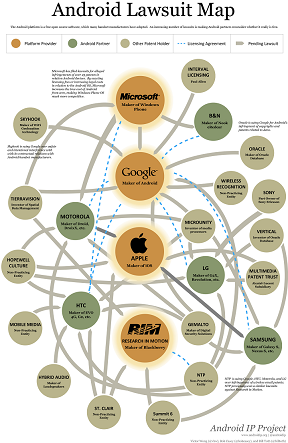
The Android IP Project (http://androidip.org) outlines the the legal challenges to the open source Android platform and its partners such as handset manufacturers and carriers. Android is the focus due to its prominent position in the technology world. Its dominance of the smartphone market owes a lot to the value delivered to partners — it’s free and has a lot of features. However, those very aspects and its history of development have made Android the focal point of numerous intellectual property disputes. About 40 different lawsuits have been filed against Google and its partners for various intellectual property issues relating to the Android. Many of these lawsuits stem from non-practicing entities (aka patent trolls), but several of these lawsuits come from large competitors. How the court rules on these cases will drastically shape the development of mobile technologies.
Check out AndroidIP.org for more information on Android’s copyright issues, trademark issues, and patent issues. You can also view a full size version of the lawsuit map. Follow @androidip on Twitter for updates on pending lawsuits too. Everyone is welcome to contribute.
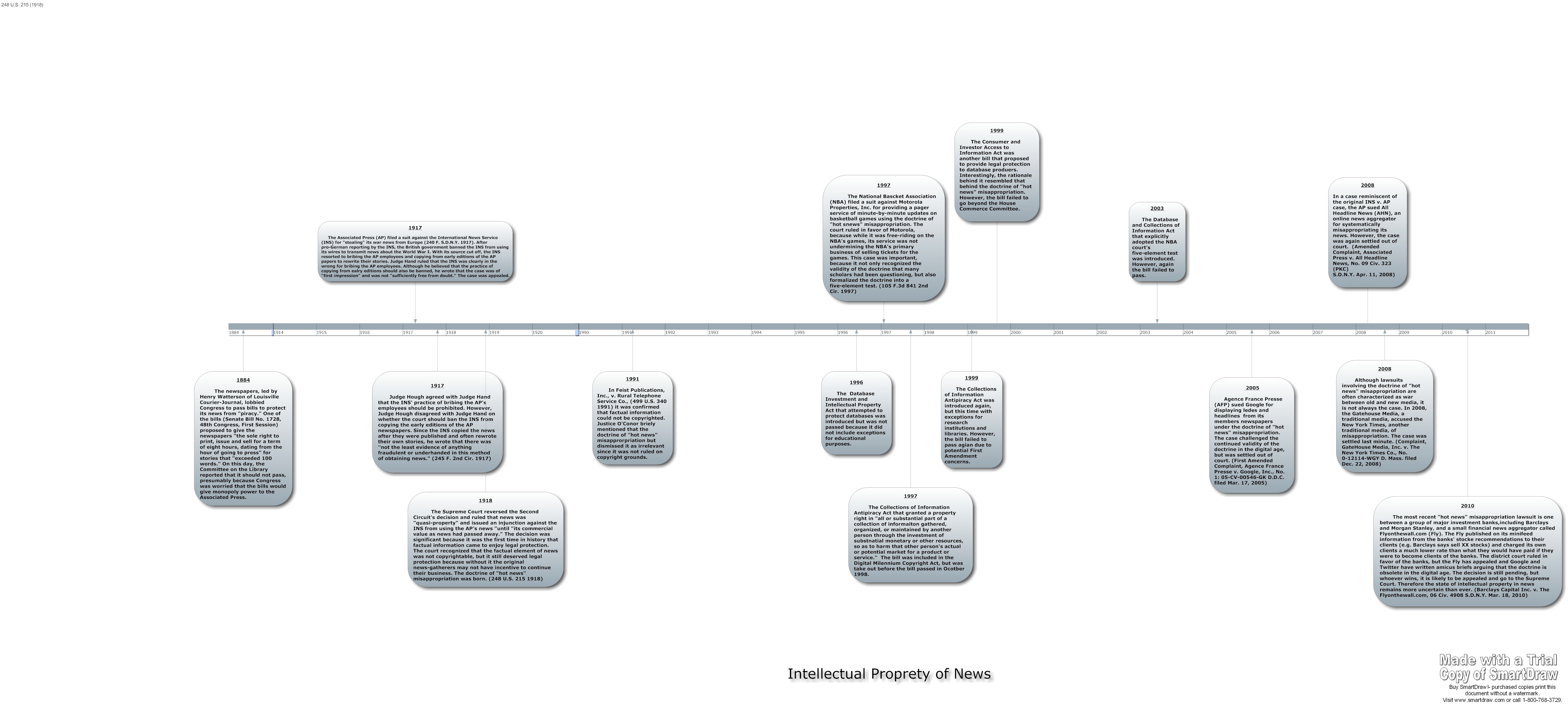
Our project looks at intellectual property issues in the realm of online journalism, along the lines of Jonathan Stray’s recent study. Using Google News, we tracked two distinct stories to see how much of the news is being originally researched and reported. Watching the stories unfold over time allowed us to see which outlets add original content to a given story, which credit their sources, and how they do so. We used our data to draw some insights about the proper copyright model for online news.
Our graphic analysis of the data, our written report, and a timeline of major events in the history of intellectual property issues in journalism, are attached.
“Memory Cream” is a short animation done through collage that explores the idea of imitation through memes.
Memes, for Richard Dawkins (who coined the term), are much more than videos of Keyboard Cat, they are bits of information that survive through imitation and make up what we call “Culture.”
The story imagines the psycho-somatic effects that certain Youtube videos would have on subjects, supposing they applied a “Memory Cream”* which would allow them to mutate (evolve), freely, rapidly. (“all life evolves by the differential survival or replicating entities”). This “evolution” of language and behavior is assumed to be illegal and dangerous for the institutions of Copyright because it builds off, maybe too overtly, from pre-existing culture.
Several instances of “memes” are explored: the almost subconscious repetition of a catchy tune**, the popular “flames of hell” of certain religions, identification and imitation of the Popstar, the origin of fashions, sexual and cultural attitudes learned from transgressive stars (Marlene Dietrich in this case) and the machinery of advertisement and “mass-media.”
It was inspired by Hannah Höch (a pioneer of remix culture), the Cyborg Manifesto, and Carnivore Plants.
* “We need a name for the new replicator, a noun that conveys the idea of a unit of cultural transmission, or a unit of imitation. `Mimeme’ comes from a suitable Greek root, but I want a monosyllable that sounds a bit like `gene’. I hope my classicist friends will forgive me if I abbreviate mimeme to meme.(2) If it is any consolation, it could alternatively be thought of as being related to `memory’, or to the French word même. It should be pronounced to rhyme with `cream’.” (Dawkins)
** “But occasionally Jenkins was privileged to witness the `invention’ of a new song, which occurred by a mistake in the imitation of an old one. He writes: `New song forms have been shown to arise variously by change of notes and the combination of parts of other existing songs … The appearance of the new form was an abrupt event and the product was quite stable over a period of years. Further, in a number of cases the variant was transmitted accurately in its new form to younger recruits so that a recognizably coherent group of like singers developed.’ Jenkins refers to the origins of new songs as `cultural mutations’.” (idem.)
Fragmentr is a collaborative image remixing tool. Users can upload images to the active fragmentation which displays the most recent 5 images. The images are masked into 30 different fragments and shuffled at random. At regular intervals the site generates an archive of the fragmentations that form a visual blog.
Fragmentr beta is open to the public, and welcomes interesting images from your collections.
As a term project, I built and maintained a Piratebox here at school. A Piratebox is a router, unconnected to the Internet, that acts as network accessible storage for any user to connect to, upload, and download from. Click through to read my thoughts about why Pirateboxes are useful and how they fit in to intellectual property and sharing.
Group Members: Logan Mohs, Jennifer Flynn, Jamie VanDyck, Adam Fishman, Maria Altyeva, Daniel Choi
Some background on the project:
Where we got our idea: We decided to make a modern version/parody of the original “Don’t Copy that Floppy” video from 1992. (http://www.youtube.com/watch?v=up863eQKGUI)
Background on CSS:
CSS is a system incorporated into almost all commercially produced DVDs. DVD players have a CSS Decryption system to recognize and allow the playing of these DVDs. In 1999, Norwegian software engineer Jon Johansen created a decryption code called DeCSS that reverse engineered the algorithm. DeCSS quickly became available to the public and DVD CCA (Copy Control Association) began suing individuals who helped distribute the source code and eventually arrested Johansen. Some argued that DeCSS code belonged under First Amendment rights. Ultimately, the Norwegian Supreme Court acquitted Johansen on all charges. The court decided that Johansen was entitled to access information on a personally purchased DVD, and was therefore entitled to use DeCSS to break the code. But don’t be mislead. The bottom line is that DVDs should not be ripped for distribution, and should not be ripped if they are not your own DVD that you purchased.
Lyrics:
(intro)
[B-Rad]: Dude! Look what DVD I found! (Holding Along Came Polly) Let’s copy it onto the computer!
[MCss]: (In agitated voice) Hey, man! Drop that DVD.
Verse:
Listen up B-Rad and be glad,
It’s only me mad, otherwise you’d find yourself in quite some trouble.
(B-Rad: Who are you?)
I go by the name of MCss,
My job is to make students like you second guess,
And realize that CSS is here to protect,
Before the Feds come and make you a criminal reject. (O-o-o-o background)




 Yale Law Tech