We’re still hip! How social media is changing the life cycle of the news. – by “Charles G”

The world of journalism is changing fast. Reporters over the last ten years have been thrown into a rather intimidating world pool of social media and networking developments, faced with the prospect of keeping up with the times or else risking their careers. Lightning fast internet connections combined with far reaching influence of internationally integrated social networks has made information gathering and processing more comprehensive- and trickier- than ever. Social media has indeed changed the very essence of the news, from what is reported and how, to what professional journalists do differently, and how this all affects public perceptions and preferences concerning the news.

It's funny because it's true

To fully understand the impact social media is having on the life cycle of news, we must look at what news gets reported and gains traction, how reporters act, and how public sentiment influences the general direction of content pursued by reporters. Along with these structural implications, it would also be helpful to examine how the journalism industry’s foray into the field of social media doubles back to affect the industry and its actors.


What Gets Reported and How 

First and foremost, social media immediately influences what we see and when we see it. Information easily outpaces even the most proficient journalist, and thus the industry has been forced to adapt to a system that would otherwise render professional journalists obsolete. The Arab Spring was only the latest in a line of social movements that exemplifies a simple idea: news can travel faster than anything else, even the newsgatherers. This significant increase in the speed of information exchange has made social media an invaluable- and perhaps the most valuable- form of news reporting.


The image above illustrates the point perfectly: Twitter waves can outrun seismic waves, and all of a sudden the citizens of Virginia get to learn about the earthquake they are to experience before they experience it. The reason for this is social media’s ability to harness the collective eye of an entire Internet population and direct its efforts at exposing the truth, at least to some degree. Although, as seen above, social media has long played a role in the organization of social movements, the mainstream media’s utilization of social media in this respect is new. Instead of fighting prevalent trends in citizen reporting, as seen with the use of Twitter to relayed real time information concerning the Arab Spring among followers and to the outside world.

Suddenly, an average Joe could serve as a CNN I-Reporter by sending in video of breaking news events to be broadcast on the 24-hour news network. But what did this mean for the substance of the content the media’s consumers would receive? This topic has cultivated much debate among the journalistic community, with supporters of citizen journalism indicating that a journalistic trend that allows readers more choice and transparency justifies the possible decline in journalistic quality encountered when professionals are no longer at the front of a breaking story. It is of little doubt that the people of Egypt would not have seen the sweeping changes they have recently encountered without the presence of large, engaged social media networks with users willing to convey real time information to the outside world. The fact that this information stream was partially cut off during the Arab Spring (below), presumably by some entity that felt threatened, further evidences the extreme influence social media can carry in the context of political movements.

Internet Usage- and non usage- in Egypt

The importance of Social media in the life cycle of the news is apparent from the very beginning- it not only redefines what content can possibly be available in real time, but it also allows citizen reporters to refocus our societal priorities by influencing what news is reported at all, and further influencing what gains traction in the traditional media. This cycle continues once the content reaches a professional, as reporters have had to adapt to the changing information landscape as well.

How this affects reporters

Journalists have only been able to survive with, and not in spite of, social media. The vast improvement in information relay speeds that comes with a large, socially engaged online network efficiently utilizes the disparate placement of its discrete members around the globe, thus acting as a virtual “global news net” that catches any story, no matter how good or bad. Herein lies the main argument against the so called “citizen journalist” trend (ie, a sever decline in journalistic quality). This is where professional journalists find their still existent, but possibly eroding, niche, one in which social media will surely play an increasingly important role in the near future, according to the BBC video below.


BBC Social Media Video


Obviously, this emergence of a new aspect of social media will catalyze changes within the journalism industry. First, there are the passive changes, or those that are a natural product of social media’s emergence onto the journalism scene (as opposed to an active effort by media companies to integrate social media campaigns, which I’ll talk about later). The primary changes are related to social media’s speed. If breaking news delivered so fast as to sacrifice quality of reporting is America’s drug, then social media is the enabler. To illustrate the whole “sacrifice of quality” bit, take the example of Amanda Knox, an American woman convicted of a murder allegedly committed during Knox’s study abroad period there. The Daily Mail waited anxiously to report the result of the woman’s murder appeal, and ran a headline proclaiming the announcement of Knox’s guilty verdict just minutes after the announcement. There was just one problem: Knox had been found innocent. The professional reporters got it wrong. In a rush to publish first that is then hyperized by a need to publish before the collective body of internet users can find information through social networks, professional journalists had royally mucked up a very basic reporting job.


Woops


In past journalistic generations, this phenomenon carried the popular phrase “never wrong for long,” referencing the 24 hour news cycle’s relative lack of need for accuracy, given that corrections to prior incorrect statements could be made at any time. The risk for committing errors was reduced, and thus a greater premium was placed on speed in reporting. Newsrooms have always moved fast. But social media is forcing them to move even faster, just to keep up with the flow of information over social networks. This increase in speed leaves little time for fact checking, and this often falls by the wayside completely when the relative penalty for a mistake is so small.


Or is the penalty so small? The flip side of the internet age coin with regard to journalism is that mistakes, though easily and quickly correctable, are also preserved on hard drives in web archives forever. Worse yet, the ferociously quick spread of information over social media can take on the personality of a wildfire, with sometimes devastating consequences. Consider the recent hacking of a Fox News Twitter account that led to false reports of President Obama’s assassination. The reports were eventually reported to be the product of vandalism and removed, but not before panic spread through the Twitter-verse. This type of hyper-speed response time, of which only internet-based social networks are capable, reflect simultaneously the greatest asset greatest detriment of social media from a journalistic perspective.


Next, one must examine the active changes in the activity of news organizations in response to developments in social media. Journalists, in their attempt to adapt to the ever-changing landscape of information technology, have in some cases used social media to actively bolster their own reporting activities. Social media has allowed journalism to transform into a dialogue between reporter and reader, and this relationship displays influence in both directions. When asked, reporters of all types indicated that social media had changed the way they interact with readers, thus evidencing social media’s growing importance within the journalism industry.


Since audience participation has now become a staple of online journalism, this relationship inevitable affects not only the reporting priorities of the journalist, but also the content covered. Reporters can now put a call out for information relating to a story and build breaking news coverage around a targeted audience that has proven its investment in the journalism provided by actively engaging it in an online setting. Reporters can use social media to direct their coverage and inform their stories, especially with platforms as extensive as Twitter which allows unlimited access to breaking news events through a vast, global user network.

All you can eat?

Some networks and organizations have gone so far as to place social media campaign agendas at the center of their operating strategies, with Time magazine focusing solidly on amassing Twitter based followings for its various top magazines. The synthesis between traditional media modes utilizing new media and the participatory culture of new media lies in programs like CNN’s I-Report, which allows regular viewers to send the network breaking news stories with accompanying pictures and videos. This form of social media acts not only as a type of new wave marketing for CNN, but also as a means of news aggregation for use during the 24 hour news cycle. News gathering has been relegated as a task for the viewers, because their speed as harnessed by a network cannot be matched. The BBC has outlined similar goals for its social media utilization agenda, outlined in its video below.

BBC Media Kits

Perhaps The Atlantic Magazine has embraced audience participation in the creation of media at the most fundamental level by opening its editing process to public comment. This outright endorsement of the effects of citizen journalism, at least during the editing process, signals an approval of the seminal effects this participation can have on the direction of news content. Users can now refocus the material on which news organization must concentrate their efforts, such as with citizen journalists in the Middle East.  The journalists’ underscore this fundamental shift by acknowledging and apparently embracing new media, with sites such as MuckRack.com providing access to the story trends and ideas of reporters that allows user feedback which can help shape story angles and directions. In short, social media has had a dual effect on how reporters operate, both by reshaping the journalistic landscape and allowing reporters to tap into aspects of audience communication and participation that facilitate the growth of reader influence over journalism’s aims and targets.


Changing Answers Change the Questions

With the growth of social media as a method of amassing breaking news, discerning audience opinion and desires, and formulating story angles, the media has begun to change the types of questions it asks and the angle by which it attacks stories.  Primarily, audiences are coming from different places (ie: social media outlets), which naturally affects the marketing strategies (and thus, the types of stories) pursued and pushed by traditional media sources.


With this change in traffic flow comes a change in how media must adapt to find audiences effectively. Integration with social networks is key, though this hyper-connectivity sometimes leads to undesirable instances of information communication. One BBC blog post asks the pivotal question: “What if younger readers start to see their friends as legitimate news sources?” It seems, for many circumstances, that this change has already occurred. This change in reporter-audience dynamic has proved so important as to cause the BBC to refocus its growth agenda with an emphasis on social media.

With all of these significant changes in how news gets reported, what garners attention as newsworthy, how audiences participate with reporters and how this participation shapes the image of modern media, one must ask if the news is better or worse of for the emergence of social media. It is obvious that journalists will have to continue to adapt to this changing landscape as social media becomes more prevalent. More importantly, it appears that the market for journalism no longer necessitates primary discovery of facts- this task has been given to amateur viewers who will provide the information for free through various social networking means. The task of the reporter in the age of social media will be to guide, to provide synthesis where there is only doubt and to shed light on the truth, not just “the facts.” It will also be the task of reporters to ensure that audiences are given fair treatment of what needs to be seen, not just what audiences indicate they wish to see via interactive media platforms. The danger with customized media through reader-reporter interaction is that the news will lose its primary purpose: to inform of the truth. If audiences are given to much sway over the angles and story ideas of future reports, the reports will begin to only resemble the prevailing modes of thought within the audience. It has always been the job of the reporter to challenge the status quo and to facilitate transparency as the best disinfectant. With the emergence of social media, our society waits to see if journalists are up to the task of reinventing themselves in order to face the hurdles inherent in the use of new media systems. Audience participation is here to stay, and this dynamic will obviously influence reporters to produce content tailored toward the engaged audience. This is our dilemma: what we want to hear may not always be what we need to hear. It will be the job of internet generation reporters to help us tell the difference.
Cool Story, Bro: Is Every Citizen a Reporter? – by “Carla G”

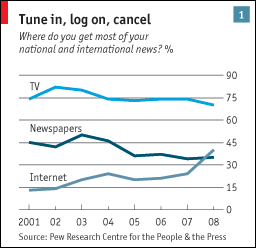
Call me old fashioned, but I’ve always liked the pre-Internet romanticism of reading the paper, opening it up with the dramatic movements of an orchestra conductor, scanning through the world’s personal log of events, and placing it neatly under my cereal bowl for further inspection. I get it, though: no one has time for such an extended, ceremonious process anymore. We’re a generation of multi-taskers. And it is much more difficult to check your email, Facebook, Twitter, and whatever you might be actually working on, while having sections of the paper sprawled around you, than if you were just opening another tab on your Internet screen. So, it is really no surprise that, in 2008, for the first time, more people said they get their national and international news from the Internet than from newspapers (see here, for more stark statistics on the newspaper’s future). The issue is not just that one day I’ll have to permanently adjust my eyes to reading from a screen, or work on not spilling Reese’s Coco Puffs on my laptop, but that online journalism has opened a huge can of worms for the question of citizen journalism, redefining who can deliver the news, how they do it, and who checks for veracity.

The Rise of Citizen Journalists

A 2003 seminal report entitled “We Media”, defined citizen journalism as the concept of members of the public “playing an active role in the process of collecting, reporting, analyzing, and disseminating news and information.” To be sure, citizen journalism is a flawed term. Professional journalists are citizens too, and non-citizens are also included in the debate. I’m not interested in discussing issues of semantics though—there are bigger fish to fry.

With the rise of online journalism, barriers to entry in reporting have completely collapsed. JD Lasica classifies media for citizen journalism into the following 6 types: audience participation, independent news and information websites (ConsumerReports, The Drudge Report), full fledged participatory news sites (NowPublic, OhMyNews, DigitalJournal), collaborative and contributory media sites (Slashdot), other kinds of “thin media” (mailing lists, email newsletters), and personal broadcasting sites (KenRadio). We can disseminate knowledge with the click of a button to not just our friends but to a whole breadth of previously imaginable contacts. This sort of access gives the idea of “disseminating information” a new dimension—and puts it in the hands of new agents.

To paint a more concrete picture for you, on the one hand we have every self-proclaimed Matt Lauer or Katie Couric, pontificating, venting, broadcasting, divulging, transmitting, interfacing, editing, applauding, degrading, commenting, “liking”, tweeting and twatting from the comfort and privacy of their own (or probably their parents’) home, in others’ sites or in their own created blogs. On the other hand, there are the true over-achieving, multi-tasking David Lats and Steven Brills of the world, who initiate and conduct a public service by providing new channels of diversified information for more specified audiences, on the side of their everyday lives and careers. [And, at the very second I was going to move on to my next paragraph, I got an email from the Master of Pierson College, of course, informing us that he too has started a blog for his “hotlines.”]

What does this all mean? Journalism can no longer be defined by appealing to the medium (i.e., print, television, radio) or the basic notion of “disseminating information.” We need more concrete standards for distinguishing between the amateurs and professionals.

Haves v. Have-Nots

One way to peg down the legitimate reporters could be the “reasonable person standard”—who would we reasonably argue to be sharing news for the purposes of informing the public at large. This seems like the easy way out, so I’ll dig a little deeper. What factors constitute journalism? First, there is content. We could outline our standards based on whether the information reported is a matter of public concern and important for our understanding. This yardstick might put some entertainment sites in danger. Would Above the Law’s “Hotties Contest” qualify as public concern? Just about every article on Gawker might fail this standard [visiting the site for the first time, the first article I saw was “Kristen Stewart’s wild ‘thrusting’ almost ruined Twilight.” Interesting?] What about FAILblog of other funny blogs? Even if these subjects constitute “interest” for some people, just about everything might be interesting to someone.

Another factor we could consider is truth. Is the supposed “news” accountable and reliable? Has it been fact-checked? Again, entertainment and gossip sites might run into trouble with this standard. Moreover, it is questionable how much we can even trust printed news especially because nowadays, their sources come from the same place as the sources for blogs—Twitter and Facebook (as we saw in the Twittering the US Airways Plane Crash and the Notre Dame student articles).

Similar to truth, a third factor may be having an editor. Putting an intermediary between author and reader not only creates greater accountability, but also gives journalism the perquisite of an elevated discourse among intellectuals. It would imply that a certain degree of expertise is required in the news-reporting process and, most likely, an affiliation with a recognizable news entity.

None of these factors by themselves or even together, seem satisfactory. To me, the best way to define journalism would be by instituting an “intent” standard, similar to the one Georgetown Law student Laura Layton proposes. If your original intention was to gather news and present it in a manner that the public would acquire information then, congratulations, you’re a journalist.If your intention did not exist at the beginning of the news gathering process then it is a bit more questionable (see Von Bulow v. Von Bulow, 811 F.2d 136 2nd Cir. 1987). Sometimes you would not know that a story is in the making until after you acquire the information. In these cases, a more thorough analysis of the other factors, as well as the means and ends of the story are in order. In any case, we should err on defining too much as journalism as opposed to too little. As we saw several weeks ago, the 1st amendment is a sensitive issue that is best not messed with.

Shielded by Shield Laws?

Again, I am not interested in matters of semantics. The way we define journalism is not important because having the title is just kind of cool, but because it comes with certain privileges. We cannot imagine the White House opening the doors of its press conferences to amateurs and professionals alike. Most notably, there is legislation designed to provide a news reporter with the right to refuse to testify as to information and/or sources of information obtained during the newsgathering and dissemination process—we call that “shield laws.” This is akin to the attorney/client confidentiality privilege or the doctor/patient privilege (although, maybe not for MJ’s doctor). The point of these laws is to encourage open communication so that reporters can better do their job of informing the public.

As of now, there is no federal shield law (despite a bi-partisan bill called the Free Flow of Information Act introduced in 2007 and passed by the House in 2008). [Friends at the YDN: Court’s have already found that student journalists are covered. You’re safe.] State shield laws vary in scope and Hawaii is the only state to specifically include whether bloggers are protected by shield laws. Their conditions hold that: (1) the individual invoking the privilege regularly participates in reporting or publishing news of significant public interest, (2) the person holds a position similar to a traditional journalist or newscaster, or (3) the public interest is served by extending the protection of the statue.

Why do we need to limit the scope of privilege at all though? Why can’t a shield law apply to all citizens if we can, seemingly, all report? Floyd Abrams stated, “If everybody’s entitled to the privilege, nobody will get it.” In other words, the court might be able to find counter-veiling social interest in almost all cases if Joe-blogger releases high priority information, ruining it for the rest of us. This is because the societal interest will almost certainly be greater than the interest of you expressing your personal thoughts and feelings on the Internet. Moreover, we see some natural limits in scope. If their skin is not in the game, so to speak, people can saying anything. If someone had ousted Valerie Plame Wilson on Facebook, they would almost certainly be required to disclose their source. They are not a journalist, just an idiot. This is where privacy and journalistic privileges might get a little fuzzy. But, to me the most important reason for limiting its scope, is to preserve some semblance of legitimate media. We need to (i) incentivize the open flow of information and new sources of media while (ii) maintaining the integrity of valuable news.

The following three cases better illustrate how this plays out in practice:

  1.  Remember Jason Chen? Someone found an iPhone prototype at a German Bar in Palo Alto and sold it to Gizmodo who did a story and video report with full disclosure about the new generation of iPhone. Police then raided the bloggers home, searching his computer files to determine if they could put together evidence of a felony. Such a search upon an ordinary citizen seems outrageous, but it is even more unthinkable if it happened against a news organization. [If you did not see John Stewart’s take on the subject, definitely check it out here.] And, in this case, it seems clear that Gizmodo was intended as a source of news. If shield laws do not apply to Gizmodo, which is owned by Gawker Media, then Lat should watch his back.
  2.   Too Much Media LLC v. Hale: Up against defamation and libel, Shellee Hale, a blogger on a campaign against criminal activity in the online adult entertainment industry, was not protected by the shield law because her posts about the software company TMM, were determined to be “nothing more than rants and complaints about her opinions, rather than the dissemination of truth and news.” This court dismissed the “intent” test arguing that, instead, the shield law requires a link to news media, and the New Jersey statue defines the term. While I still think the “intent” standard, along with the other factors discussed above, could have been employed, I agree with the Court’s decision.  Hale argued that her blog was the “Wall Street Journal” of porn. Still her statements were made on a third party site without ever contacting TMM’s representatives for their side of the story. Nothing in Hale’s actions or comments resembled the activities of a legitimate media reporter. If we narrow the scope of shield laws we can incentivize true journalists to meet a quality as well as an accountability standard—something that will certainly be valuable for the purpose of news.
  3. Glik v. Cunniffe, 655 F.3d 78 (1st Cir. 2011): In this case decided in September 2011,a federal court ruled that recording public officials, including police officers, are protected by the 1st Amendment. This decision marks a new open-mindedness in regards to citizen journalism and demonstrates the value of other sources of information that meet a reasonable standard of news.

Extended protections to citizen reporters might further instigate the proliferation of these forms of journalism. This calls for a brief cost-benefit analysis. What could “bad” citizen journalism, or “good” for that matter, be hurting?

Cost-Benefit Analysis

Conclusion and Looking Forward:

Citizen journalists are on the rise. We must implement some standards to both widen and regulate who is protected by certain journalistic privileges. Citizen journalism has costs and benefits. But it is possible to work on mediating the costs. Future challenges will include considering how to encourage better signal-to-noise ratios so that random comments—the ass lobster aficionados—do not drown out the substantive ones.

Increasingly, indicators of quality will matter. What will the peacock’s tail of journalism be? First, the ability to concentrate on analysis more than simply reporting stories. Second, enabling conversation around stories so that they truly become alive. And, third, differentiating products for particular audiences. I predict that soon new business models will emerge for both the blog-phobes (those overwhelmed by too much content) and blog-feens (those who want to participate). People will gravitate to communities they feel more comfortable in. Subscriptions will be introduced as the value of these connections and communities become more conspicuous.

Now, quick reality check: Only 1/8th of the total population get their main news source from the web. They make up about 2/3 of regular users and more than half of the readership of blogs. They dominate social network sites (see more statistics here). At the same time, there are 7 billion people in the world, and about 2 billion are Internet users, or a little over a 1/4th. So, if I’m doing my math correctly (and there is no guarantee that I am), we are talking about 1/32 or about 3% of the world’s population that read news on screens. Surprise? Not quite. If you believe the World Bank (I don’t), more than two billion people are poor—those would be hard-pressed to spend cash on Internet connections of any kind. My point is just that we have yet to fully realize the full potential of the web as a channel for news, whether those that fill the channels are professionals or not. Everyone, chill out—we still have time to figure out how to tailor online and citizen journalists, to help them be fair, accurate, and useful, before some catastrophic pre-mature demise of print news.

The ISP Oligopoly: Can a User’s Voice Be Heard? – by “Grant P”

While I was researching Net Neutrality I stumbled across a policy analysis written by the CATO institute (the libertarian think tank), which is highly critical of the concept. The article was written just short of seven years ago, and makes several predictions about the trajectory of the Internet and how government regulation could be detrimental to the ISP industry. However, most of its arguments don’t seem to be withstanding the test of time.

One of its main contentions is that the interests of consumers will be able to balance the interests of Broadband Service Providers (BSPs) sufficiently, and that there is no need for FCC involvement to ensure competition and quality in the market:

“BSPs will have to strike a delicate balance, but the profit motive provides them with a powerful incentive to not overzealously police or restrict activities on their networks. That is especially the case as the broadband market grows increasingly competitive and consumers have more options from which to choose.”

Ignoring the particularly troubling spliced infinitive, there are more unsettling things about this statement. Is the consumer really being heard? It seems to me that the industry—which is a bit of an oligopoly—has developed several ways to insulate its profit margins from public opinion and dissatisfaction with its services. In addition to unsavory existing practices, there are several disconcerting, yet plausible business plans that ISPs may yet pursue without at least some degree of FCC involvement.

Bandwidth Throttling

The cat is you. The weird rodent is Comcast. The window behind it is a BitTorrent file. Really, I just wanted to use this picture.

Throttling is an increasingly popular method for controlling bandwidth congestion. In this practice, ISPs target users or downloads that are particularly taxing on bandwidth, and limit data speed. CATO argues that this type of discrimination is no different than “consumers paying more for roses on Valentine’s Day” or giving discounts to senior citizens. But there’s a pretty big difference: a lack of transparency and impenetrable unity within the industry.

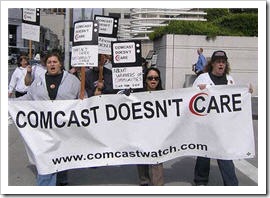
First of all, most of the throttling that’s happening today is pretty surreptitious. Before Comcast admitted to throttling P2P applications, it denied the allegations. If Comcast thought its use of throttling was a legitimate management technique, why’d they feel the need to lie about it? And why didn’t they tell their customers up front? CATO says that this type of discrimination may be “perfectly rational and legitimate” and that “[t]he presumption should be that network operators are the best managers of their networks and will seek to artificially curb network use only when necessary to preserve the integrity (speed and reliability) of their networks.” Sure—maybe throttling is sometimes a legitimate bandwidth management technique, but companies should at least have the integrity to own up to it.

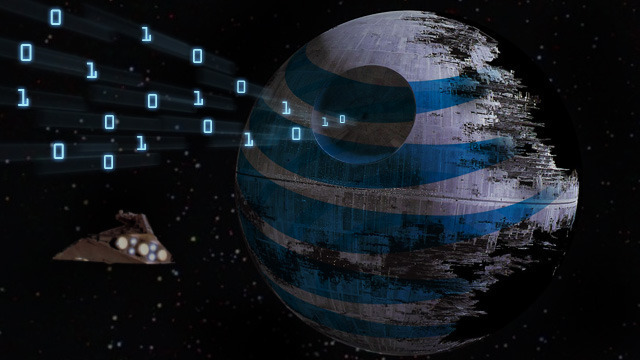
Also, let’s consider the case of smart phone providers. It’s a good thing that the “profit motive” CATO mentions has kept the market in check, otherwise I’d worry that all of the smart phone providers are headed in the direction of bandwidth throttling, even in the face of strong consumer criticism. Wait…AT&T, Verizon, and Virgin Mobile are all implementing throttling plans? Hmm…when it comes to throttling, it looks like the oligopoly—not the people—has spoken.


Traffic Prioritization and Discrimination    

Prioritization is the act of showing favoritism in the distribution of bandwidth. While some present-day prioritization attempts seem to be benign at least in principle—like Comcast’s arguably ill-advised attempt at managing bandwidth scarcity—the practice could be corrupted outright. The FCC is worried that sites and providers may band together to make pay for prioritization agreements. For instance, say some small email service offers better service than a much larger competitor, and begins to win over some of its competitor’s users. Who’s to say that the large competitor couldn’t pay ISPs for traffic to its site to be prioritized over the smaller company’s, effectively degrading the smaller company’s product? Similar practices have attacked other telecommunications services; in the 1940’s and 50’s, it became common for record companies to pay radio stations to play their music in an effort to increase public opinion of it, in a practice called payola.

Fast Food Chains and Fast Lanes

             Why would Pay for Prioritization be bad? In a Slate Magazine article, Tim Wu analogizes the Internet to the interstate highway system, as opposed to a fast food chain. Let’s say a fast food chain has a deal with Pepsi to purchase only Pepsi products. Since fast food is a readily available resource, that’s totally fine; consumers can take their pick of hundreds of other restaurants if they don’t like Pepsi. Several of those are bound to offer Coke.

As a southerner, I sympathize.

Now, let’s say Ford buys an interstate lane and says that only Ford cars can be driven on it. Even if better brands exist, consumers may be more likely to purchase a Ford, simply because it gives them access to the Ford lane. By doing this, Ford blocks useful automobile innovation, and the car industry becomes preoccupied with highway deal-making, not quality improvement. Since access to the Internet—like access to interstate lanes—doesn’t have a very large number of options, it’s important that innovation be protected in the market.

What appears to be CATO’s go-to reasoning tactic is that competition in the market means that consumers can choose their ISP, and if they have an issue with the business practices of one ISP, they can simply choose another. Unfortunately, this laissez-faire approach is unconvincing because the oligopoly of ISPs doesn’t provide a good number of options for most people. While none of us are happy about bandwidth throttling in smart phones, which company are we going to switch to? If not Verizon or AT&T, then whom? Ultimately, CATO’s free-market approach doesn’t work because the ISP market isn’t diverse enough, and threatens to tend towards anti-competitive behavior.

Is Net Neutrality the Right Solution?

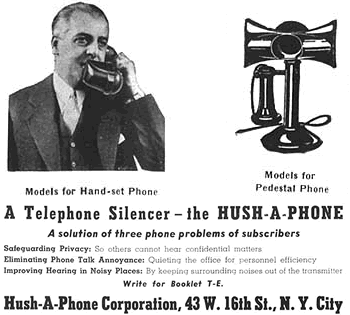
 In the past, the United States has protected openness in telecommunications networks to great success. The United States’ protection of open access—that is, the ability to create new devices that use an existing communications system—started with Hush-A-Phone v. United States. Hush-A-Phone was a device invented to attach onto Bell Telephones to provide a greater degree of acoustic insulation in phone calls. AT&T argued that the Hush-A-Phone was a “foreign attachment” to its network, and that only the network owner should be able to produce such attachments. The FCC initially ruled in favor of AT&T, but was reversed by the D.C. Court of Appeals, which argued that as long as a device “does not physically impair any of the facilities of the telephone companies,” it should be able to connect to the network.

Hush-A-Phone, the world's most poorly named invention

The decision turned AT&T’s network into an open network, and anyone was able to produce any invention that lawfully interfaced with the telephone wire. This paved the way for innovations like the fax machine, answering machine, and eventually the modem—the very device that made the Internet accessible to the modern household.

Why shouldn’t we protect the openness of the Internet in the same way? The oligopoly of ISPs could conceivably threaten the burgeoning free market of Internet sites. Should it not be the responsibility and purview of the FCC to protect it?


The Illusion of Privacy in Web 2.0 – by “Javi S”

As the scope of the Web has continued to increase, so to must our understanding and expectations of privacy in this new era. The last few years has seen an explosion of private information being made public, with millions of people unaware of the scope at which this happening and if they are, blissfully ignorant to the serious consequences this system can have. We are in an era now where even older generations are expected to have a Facebook, a LinkedIn profile, or something of that nature; for younger generations it’s become a staple for social interaction. Sure, there are many positives to this new wave of interaction: for one thing, it connects cultures and societies oceans apart and helps foster understanding and familiarity with people you would otherwise never encounter. The spread of information and networking is a major development in suppressed or emerging countries, as it has in some cases helped them spring free of their captive situations. Running alongside the social media websites are other “social” services; social blogs, social news sites, and social forums, all of which are now linked through plug-ins and information sharing. New technology and services have allowed users to share everything they do throughout the day, ranging from where they eat in the mornings, what news stories they find interesting,  to what jokes and videos they find funny. While all this may at face value seem harmless and just a way to better interact with your friends online(most of whom you already know in person, making this barrier easier to cross) users often forget to think about what the true purpose of all this information might be.


My fellow friends, followers, subscribers, co-workers, stumblers and redditers can ALL know now!

What the information is really about

One of the surprising parts about social media when it was first introduced was the fact that it provided an intuitive, useful service seemingly for free. Thousands of pictures, videos, and files can be uploaded and shared for no cost and unlikely relationships can be formed without the use of subscription based dating services, to name a few examples. As noted here , however, TANSTAAFL(there “aint” no such thing as a free lunch). The price to pay for using these interactive services, is you yourself. The thousands of interactions you make through the Web 2.0—websites accessed and “liked”, places visited and rated, etc—can be brought together into a single digital persona which can be targeted by advertisers or sold to governments, corporations, etc.

How did I miss that caption?


“I always feel like someone is watching me”

The development and connectivity of mobile devices has added a new angle to the debate on how to manage privacy. Our iPods, iPads, iPhone, Blackberrys, Droids, Galaxy’s, etc.,  are all now designed to be functional with the dozens of social services and have even been the framework for new services of their own. While the benefit of this is it allows you to effectively choose the best local services or meet your friends, for example, it opens another door: someone can know exactly where you are and when, opening a Pandora’s box of consequences. The ability to rapidly share information is also effecting public behavior. In the past, the scope of an embarrassing or damaging event could be minimized to a local sphere. Nowadays, anything you do has the possibility of being recorded or tracked and possibly shared with thousands of people

Benefits of Web 2.0

For all the lack of traditional privacy which has become the norm in this new era, and the increasingly little you can do about it, there are a lot of positives to take from Web 2.0. In addition to the increased availability of information and people, the rapid dissemination of information by any actors has lead to increases in governmental transparency, particularly by agents of the government such as the police. One of the first major instances of viral media effecting the public was the Rodney King case, where a video of police brutality on a young African-American male sparked public investigations, lawsuits, and riots. The Rodney King video was captured by a private citizen but publicized by mainstream news, reflecting the fact that the Web at this time was in no position to make a video viral in the same way it can today. Now, nearly everybody carries a device which can record photos or video and many have the ability to instantly upload them to the internet and share with other people. On one hand, it allows people to catalogue every day happenings and funny occurrences, as well as capture embarrassing moments. On the other hand, it has also lead to several, well publicized cases involving police brutality or other forms of misconduct being caught on tape, as well as legal backlash by the establishment claiming these forms of public surveillance are illegal. Recently, Twitter was used as a cornerstone to organize protests in a host of repressive countries such as Tunisia, Libya, Egypt, Syria, Yemen, and many others. In regions like Syria, where media blackouts prevent information for entering or leaving the country, the Web presents the only way to let the world know what is happening.

Philosoraptor, here to answer your daily ponderings.

What Web 3.0 will have in store for users as far as connectivity, interactivity, and its double edged sword privacy, no one can know now. What Web 2.0 presents, however, is the opportunity to reach a middle ground between maintaining an infrastructure to share and store information and a breach of privacy. The ability for users to share personal information should come with the expectation that such information is private and that any use of it has some measure of consent, heralding some of the rules put forth in 1974. It is important for politicians to revisit these privacy rules and update them to a new and evolving landscape, or they risk alienating constituents and losing the battle for privacy all together. At the same time, these laws should not infringe on the free nature of the internet which has made it so unique and successful. The ability for the internet to be used as a public watchdog against corruption, brutality, and repression is one of its key functions and essential to prosperity moving forward.

 Don’t forget!


TMI – by “Tate H”

Throughout your busy day, have you ever stopped to wonder what you had for lunch, where you were 4 hours ago, or what article you read from the Washington Post?  It may shock you, but these small details about your life can actually harm you.

A post on Facebook that says I’m out eating lunch at Pepe’s Pizza, says much more than where I like to order a stuffed crust Hawaiian special.

It implicitly reveals all the places I did not order pizza from, and even worse, it reveals all the other places in the world that I could be at but am not at right now.  I am at Pepe’s Pizza, which means I am certainly not at home.  Seizing his opportunity, any thief with access to this information has a small window of time to rob my home.  Magnifying the situation, what if I post a picture of Stonehenge during the middle of my vacation to Europe from my smartphone?  Leaving the lights on will simply not suffice.

Because of our newfound love for pouring every detail of our lives over the internet, we can now document the smallest details of our day to day routine.  This may not seem like much, but Facebook and the internet reveal much more than what we ate for lunch; they reveal our likes and dislikes, birthplace and current location, employment and interests, and so much more.

This information by itself is not necessarily bad.  If you say on your LinkedIn account that you graduated from Yale University in ’96, earned your Masters in Computer Science from MIT in ’00, and worked at Google from ’03-’05, you probably wanted that information to be accessible, especially to future employers.   However, you fail to realize that that information allows people to see more than your education and work experience.

Our online footprint leaves much more information than we can first imagine.  Privacy settings give us the illusion of control, but these are no more than smoke and mirrors.  They may control who sees your photos and what information non-friends can see, but let’s be honest.  We all have many friends that we have either never met, or only shook hands with once at a party.  We add friends fairly indiscriminately, and we fail to realize what we are showing them.  The Facebook app Take This Lollip easily demonstrates (although exaggerated but still possible) the possible ramifications from posting too much information on Facebook.

For example, let us consider someone who wants to see your transcript, but has no legal right to do so.  Whether it’s a competitive classmate or a nosy parent, they can easily access the information needed to order one directly from the registrar’s office.  Here are Yale’s requirements for ordering a transcript through mail (directly from its website, http://www.yale.edu/sfas/registrar/#transcripts):

Let’s walk through the requirements.  A full name can easily be found on Facebook, LinkedIn, etc.  The actual date of birth can usually be found on Facebook (many people don’t make their birthday private, even to non-friends).  Student ID number does not need to be provided if it is not “available”.  School and year of graduation are both found on Facebook and LinkedIn, and the dates of attendance are likely to be the four years preceding graduation.  The only protection against fraud that the registrar requires is a signature, but is that really secure?  Any Joe-Shmoe working a cash register can see your signature when you sign for a credit card purchase.  The only other requirements necessary to steal a transcript are a temporary address and a small fee.  (And yes, you may pay mail orders in cash, thus hiding the thief’s identity.  Ironic, isn’t it?)

Now for argument’s sake, you may say that process simply takes too much effort for someone to steal a transcript.  Sure, they can do it, but who is actually going to put up with that JUST so they can get someone’s transcript?  And I’d agree; it is somewhat trivial. But it illustrates my point: it is possible and the information is accessible.

However, let’s raise the stakes a little.  What if it were possible for someone to break into your bank account without ever meeting you or without having any physical interaction with you or the bank?  The truth is, it is possible.  Because of our bad habits of presenting information on Facebook and other websites, we are at serious risk of identity theft and some fingerprint-less robberies.

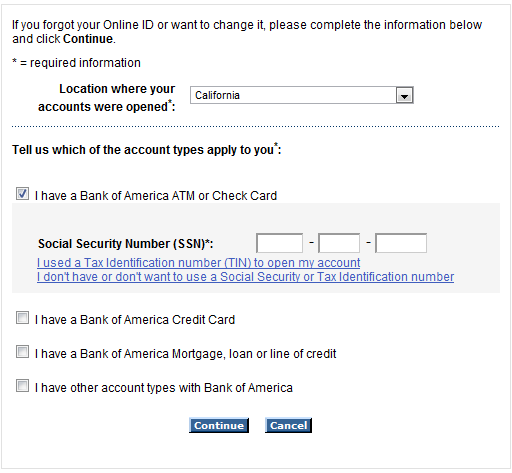
Consider what information an online bank asks for when you log in: only a username and a password.  To a responsible internet-user, this may be enough protection, at least to stay moderately safe.  However, what if you don’t know your password?  The website asks you to submit your social security number and maybe a date of birth.  It will then email your password to your email account, so you can then log in.

A snapshot of Bank of America's website.

We assume that this system protects us from others accessing our account, but does it really?

A social security number (XXX-XX-XXXX) isn’t as secure as you think.  A random sequence of 9 digits is a hard code to crack, but anyone who wants to know your social only needs to guess 2.  That’s right, 2.  So a hacker can essentially break into your bank account once every hundred tries.  This may not sound like much, but entering a social security code 100 times doesn’t take relatively long at all, even considering when the site temporarily shuts down its login after too many failed attempts.

So how are social security numbers chosen?  The first 3 digits are assigned by area.  For example, anyone born in Alaska after 1973 until 2011 will have a social that starts with 574.  Anyone can go on Facebook, see your hometown likely posted next to your name at the top of your profile, and find the first 3 digits with ease.  The middle two digits are labeled the Group Number.  They are harder to predict than the first 3 or the last 4.  The last four digits, which are random, would likely be the most protected part of your social.  Since they are random, no one should be able to guess what your number is.  However, these four numbers are often used on bills and other payment information as identification.  Therefore, someone would only need to steal a bill from your mailbox or email account to have a good shot at cracking your social security number.

These are all simple requirements to fulfill.  It is very plausible that someone can find discover your social security number in less than hour.  Once this is done, the only thing stopping him from hacking into your bank account is a password protected email address, which is probably not the safest thing on the internet.  A simple phishing scam or one email with a misleading link to keystroke capturing software is all it takes to hack an account.  Once inside, the hacker can look at bills that contain the last four digits of a social, find the bank’s email containing its login information, and much, much more.  So, only with a bit of extra computer knowledge and effort, a hacker can find your social security number, hack into your email, and login to your bank account without ever meeting you.  (The government has begun to help the cause by randomizing all digits of social security numbers as of June 25, 2011).

Even worse, if someone were to physically steal your laptop, all those saved passwords on your browser that have offered you the convenience of logging in quickly will allow your personal hacker to steal whatever information you do not want made public.

With all this being said, there are many ways to protect your data and ultimately yourself, but the most secure way to do so is through self-restraint.  HTTPS and SSL encrypted websites may make your data marginally more protected, but you can make sure no one knows your location or birthplace by not posting your location on Facebook.  Even as secure technology becomes more sophisticated to meet the demands of Web 2.0 users, the safest and simplest ways to maintain privacy are not through the “Privacy Settings” page of Facebook, they are maintained through time honored, tried and true web practices.  Create a long password, not a short complicated one.  Log out of websites after you have finished using them.  Do not let your browser save your passwords.  Limit the information you post about yourself.  With these rules of thumb and more, we may maintain our privacy.  Be smart, and don’t let your data destroy you.

The Assumption of Privacy: Unplugged and Plugged – by “a Slade”

As a social good, I think privacy is greatly overrated because privacy basically means concealment. People conceal things in order to fool other people about them. They want to appear healthier than they are, smarter, more honest and so forth.
Richard Posner 

A doctor, a lawyer and a priest walk into a bar.  The bartender looks up and says “What is this, a joke?”

Joking aside, consider the following scenario.

A doctor, a lawyer and a priest walk into a bar.  The bartender recognizes the doctor who had performed tests and diagnosed a fatal illness she had unwittingly contracted from her lover.  The lawyer is the bartender’s attorney, who is defending her for the murder of her (former) lover, claiming self-defense.  That morning, the priest had heard the bartender’s confession, and, while condemning her actions, had offered her absolution.

If you were to ask any scholar of twenty-first century American jurisprudence – by which we mean any regular viewer of the television series Law and Order – this set of facts poses a number of legal issues that might thwart the successful prosecution of the murderer bartender.  The police and the district attorney would no doubt want to solicit the cooperation and testimony of the doctor, the lawyer, and the priest to present the case to the jury and to convict the bartender.  However, in each instance, there are societal norms and professional restrictions that might prevent each of them from testifying.  These prohibitions are, to one degree or another, instances of privacy protections.  These cases illustrate privacy unplugged, that is, privacy outside cyberspace.

The bartender went to the doctor voluntarily and submitted to invasive tests, such as x-rays, blood work, or urinalysis.  The bartender had the expectation that the doctor would not share the results with anyone outside the medical team.  This presumption of confidentiality is a central tenet of medical ethics known as the doctor-patient relationship.  Without this privacy policy, a patient might be reluctant to confide in her doctor.  The patient could of course choose not to disclose private information to the doctor, but the patient realizes that she benefits from letting the doctor know the full story, thus allowing the doctor more effectively to diagnose and treat her.  The bartender profits from this voluntary loss of privacy, albeit with the understanding that the doctor will not reveal the information.

The bartender went to the lawyer voluntarily and revealed the details of her ostensible crime.  Again, the bartender had the expectation that the lawyer would not share her confidential information with others, particularly not with the law enforcement community.  As was the case with medical ethics, the concept of attorney-client privilege is at the heart of the legal profession.  The intent is to encourage the “full and frank” disclosures of clients to their attorneys.  The bartender could of course choose to lie to her attorney, but she might then prevent the attorney from giving her his best professional advice.  The bartender profits from this voluntary loss of privacy, albeit with the understanding that the lawyer will not reveal the confidential information.

Finally, the bartender went to confess her sin to the priest of her own accord.  The bartender once again had the expectation that the priest would respect her privacy and not reveal any confidential information with others, including the police.  This presumption of confidentiality is also enshrined in the professional tenet of priest-penitent privilege.  In the United States, this principle is often considered implicit in the First Amendment protection for freedom of religion.  The bartender was under no compulsion or obligation to confess her sin to the priest.  It was a voluntary admission, presumably with the expectation that the priest could then offer her a path to redemption, that might save her soul, if not her life.  In any event, the bartender (and her soul) benefits from this voluntary loss of privacy, albeit with the understanding that the priest will not turn her in to the police.

Thus, long before the Internet or databases or Wikileaks, there were long standing norms and legal protections of privileged communication between clients and professionals.   In the cases presented here, the bartender (a) voluntarily revealed confidential information, (b) expected to benefit from divulging the information, and (c) expected the professional who received the information not to reveal it to others.


Privacy Plugged In

The issue of privacy protection in the Internet age is not a mere extension of pre-Internet privacy issues.  The difference between unplugged pre-Internet privacy and plugged in Internet privacy is akin to Mark Twain’s observation regarding le mot juste:

The difference between the almost right word & the right word is really a large matter–it’s the difference between the lightning bug and the lightning.
– Letter to George Bainton, 10/15/1888

In the past, a person could keep a diary.  Today, she may post her daily thoughts and activities to Facebook or Twitter.  In the past, a person might unlock her door or open her windows.  Today, she may have a web cam in her bedroom.  In the Internet age, many of these actions are voluntary, though it is now easier for unscrupulous people to invade the privacy of others, for example by hacking into cell phones, as the News International phone hacking scandal has revealed.  Leaving aside such malicious and larcenous invasions of privacy, the Internet has enabled people to share information – arguably, too much information – to millions of faceless strangers.

Following our unplugged analysis, what benefit accrues to the individual by this voluntary disclosure?

We might speculate that posting to Facebook and Twitter has evolved into an accepted standard of behavior.  The social networks are now the social norm.  However, we are interested in examining cases in which the individual who reveals private information has a more tangible benefit.

Publication of Private Electronic Mail
Years ago, Ralph Goren was the administrator of the Stanford University undergraduate computing facility.  As legend has it, he received a considerable volume of daily emails, which he never bothered to read.  However, he chose to make his email file world-readable.  Thus, he reasoned that if anything important appeared in his email, the conscientious Stanford undergraduates would tell him about it.  Goren was willing to sacrifice his privacy in return for saving the time of reading tons of irrelevant emails.

Publication of Private Medical Data
On a Thursday in March of 2010, Jonathan Zittrain, the Harvard Law professor and co-founder of the Berkman Center for Internet University, found himself in the hospital with severe and puzzling symptoms (fevers that came and went, and abnormal blood results).  By that Saturday, since his doctors had thus far been unable to get a diagnosis, he availed himself of an option offered by a colleague: post symptoms and associated data to a medical blog, and see if this community of doctors can come up with a diagnosis.  The posting did not include Zittrain’s name, but just his initials, JZ.  The assumption was that the readers of the blog did not need to know the identity of the actual patient.

There were several results.  First, the crowdsourcing effort quickly revealed a similar case in the literature from South Korea.  Zittrain provided his doctors with the information and subsequently received appropriate diagnosis and treatment.  Second, a subsequent posting on another blog revealed the fact that Jonathan Zittrain was ill and lead readers to connect the dots and conclude that “JZ” was Jonathan Zittrain.  Finally, Zittrain, as a staunch advocate for the benefits of transparency in general and crowdsourcing in particular, saw this episode as a teachable moment, demonstrating the tradeoff between individual privacy and the benefit from collective medical wisdom.  He voluntarily permitted his health information to be revealed on the Internet, and reasoned that he stood to benefit by the diagnosis and treatment of a possibly life-threatening disease.

Publication of Comprehensive Private Data (Sousveillance)
Hasan Elahi is a professor media studies who was detained and questioned by the FBI in 2002, after his name was included on the terrorist watch list.  The FBI interrogated him extensively and had him submit to a polygraph test.  Elahi was able to secure his release.  He could provide detailed answers to the questions concerning his exact whereabouts, as he maintained his schedule on a personal digital assistant.  In response to this harrowing experience, during which Elahi believed that he faced incarceration, albeit unjustly, Elahi concluded that going forward he would not be able to remove his name from the terrorist watch list, and he would proactively catalog every event in his life.  Elahi created a web site to detail his comings and goings every day of his life.  He kept a GPS device on his person which would constantly record his location.  The FBI had provided him with a contact number which he would call ahead of time whenever he traveled, which was often.  Elahi flies over 70,000 miles each year.  Rather than be subject to covert surveillance by the authorities, Elahi initiated sousveillance – a voluntary publication of personal information, not only saving himself the annoyance of being taken in for questioning, but also saving the FBI the expense of following him.

As a media artist, Elahi turned this project into a work of art, which has been exhibited widely.  He gave a TED talk describing his work.  In this case, we have an individual divulging almost every mundane detail of his life, more or less voluntarily.  In return, Elahi benefits from both traveling without interference from the authorities, and also achieving an artistic and professional goal through his exhibits.

Publication of Private Passwords
We may view Elahi as the extreme case of transparency and foregoing all pretense of privacy.  However, he still retained control over his own systems, files, accounts, and passwords.  Only he could update the web site.  He still held the keys to open the door.

By contrast, Richard Stallman, the renowned MIT Artificial Intelligence Lab hacker who developed the emacs text editor, and the GNU open software project, is known to leave his personal account unprotected by passwords.  Thus, like Goren, he allows anyone to view his personal communication, but he goes a step further.  The Stanford undergrads could read Goren’s emails, but could not edit or delete his files.  Stallman, as a matter of principle, willingly accepted these possible adverse consequences.  It is as if Stallman left the door to his house unlocked, advertised the fact, and did not prosecute the burglars who stole his stereo.  Stallman gave up his privacy voluntarily, and benefited by exemplifying the principle of freedom of information.  Stallman, like Zittrain but more so, is an advocate of the free and unencumbered flow of information.  In his days at the MIT AI Lab, he encouraged his colleagues to remove their passwords.   Passwords for computers are akin to locks and keys for apartments.  Stallman wants to live in a house or dormitory in which everyone trusts each other and leaves their doors unlocked.  No keys are required.  Stallman voluntarily sacrifices his privacy in return for the utopian principle of a trusting and just society.  The price he pays is replacing his stereo from time to time.  Not altogether a bad tradeoff.

Privacy Tradeoffs: Plugged vs Unplugged

Almost any technology has adverse consequences.  Miracle drugs cure diseases, while people may die from side-effects.  The airplane transforms modern transportation, while thousands die from airplane accidents.  The Food and Drug Administration acts to insure that drugs are safe and effective.  The Federal Aviation Administration, the Transportation Security Administration and the National Transportation Safety Board act to regulate air travel. Society accepts trade-offs, but creates institutions to mitigate and regulate the adverse effects.

Privacy issues create similar trade-offs.  These issues have been with us before the Internet.  The long-standing unplugged privacy protocols (doctor-patient, attorney-client, priest-penitent) may help inform the debate for the brave new world of plugged-in privacy.  At the least, we should expect the individual to have a choice when revealing private information and to be able to justify that decision with a concomitant benefit.

Obligatory Lame Joke

We feel a duty to fulfill the initial promise of a humorous anecdote.  Here goes.

A doctor, a lawyer, a little boy, and a priest were out for a Sunday afternoon flight on a small private plane. Suddenly, the plane developed engine trouble. In spite of the best efforts of the pilot the plane started to go down.

Finally the pilot grabbed a parachute, yelled to the passengers that they had better jump, and bailed out. Unfortunately, there were only three parachutes remaining. The doctor grabbed one, yelling to the others, “I’m a doctor, I save lives, so I must live.” And out of the plane he jumped.

The lawyer then said, “I’m the smartest man in the world, I deserve to live!” He grabbed a parachute and jumped.

The priest looked at the little boy and said, “My son, I’ve lived a long and full life. You are young and have your whole life ahead of you. Take the last parachute and live in peace”.

The little boy handed the parachute back to the priest and said, “Not to worry, Father. The smartest man in the world just took off with my back pack.”

Deriving the story’s relevance to privacy is left as an exercise to the reader.


Transition from Privacy 1.0 to Privacy 2.0, and a few ways to protect ourselves… – by “Michael A”

As the world and human race have evolved, so has the means by which we communicate. At first, hand signals, cave drawings and the primitive languages of ‘caveman’ marked the earliest forms of communication. This transitioned into fully formed languages and writing. Along with writing, new sources of media such as photos, videos and songs became popular forms of communication. And with the invention of the silicon chip, all forms of communication became available and transferable through computers. This marked the beginning of our shift toward digital data.

Offline dossier to online dossier

Modern information technology trends suggest that we have an insatiable desire to aggregate all of our information through digital means. Companies such as Facebook, Flickr and Google provide useful services to users that participate in these communities. Other products, for whatever reason, seem only to be a nuisance that create no palpable value (See Blippy, Foursquare; and again later). The importances of these products reside in their ability to provide real-world effects, through Internet means. Friends can stay connected through Facebook with common sharing of information and can inform each other of given locations, so as to make the connection come full circle back into the real-world. In the process, small bits of information are left behind.

Important or not, this data is collected, stored and forever connected to our username, or IP address. Companies such as Facebook, Google and Amazon target ads and ‘recommended products’ based on proprietary algorithms coupled with all of their known information. If you look for a few programming books on Amazon, chances are you’re going to get a suggestion for some sort of Tim O’Rielly book next time you log on. Amazon has taken the place of a bookstore employee that suggests the next related book for whatever your interest may be. In this case, it does so instantly and with better-assembled data about a person’s interests. Whether you like it or not, these digital dossiers of personal information are formed based on everything digital. From places you’ve been, websites you’ve visited, products you’ve viewed or mouse movements you’ve made.

Some (myself included) choose to participate in the construction of our digital dossiers. Facebook has become a great way to transform the entire social portion of people’s lives into 1’s and 0’s that are stored on the Internet.  (Watch)  Users actively participate in the construction process by uploading pictures, maintaining conversations through posts, messages or chats or liking certain bands, movies, or books. Ever wondered what all the data might look like aggregated? (Try it out, seriously, download all of your FB data and see the substantiality).  Small tidbits of information observed in pieces may seem inconsequential. But, when aggregated, this information creates a much different situation and it becomes much more valuable. The individual wants to protect the dossier, while other services want to obtain and exploit the dossier.

What if privacy is breached?

With most personal information digitized, such as Facebook likes, bank statements, medical records, or relationship statuses, how can we be sure that it will always remain in a secure location? Sure, server warehouses seem safe (maybe not).  But what if the data is stolen/found/obtained over the Internet? (Firesheep) Imagine the outbreak if Facebook, Google or some other products were found to be emitting data about its users to others. Oh wait…whoops  (Here, Here, Here).  There’s sever backlash when an Internet service fails to make good on its social contract of maintaining tight security of users’ data. On the other hand, Foursquare and Facebook Locations are built on the premise that people want to share their much more with others. The iPhone OS 5 has this feature as well that allows GPS tracking of other phones (sometimes for incriminating purposes).

How can we be sure that this information with always be for the betterment of society? Up to the minute tracking abilities could possible pose security threats to anyone that may be interested exploiting them.

Whatever our obsession may be with sharing personal information, it could pose a substantial threat if used in ways that target the real-world individual from digital information. The interest in uploading, sharing and aggregating all information lies in the movement to digitize the real world. The comfort levels that some experience on the Internet suggests either misunderstanding of the dangers involved, or irrational behavior.

A few ways to protect yourself:

–       For those who maintain personal websites and seek protection, Robots.txt allows the creator to disallow most web-crawling bots to index such sites. While most major search engines support it, it is not perfect. A good start, nonetheless.

–       To create secure files, TrueCrypt provide a free, open-sourced product that will take any file, encrypt and mount it to a disk image with password protection.

–       For a secure email service, Hushmail is considered the best.

–       Good web practices such as disabling cookies or taking note when a certain website is secure (HTTPS or SSL encrypted) will help prevent any unnoticed breached or privacy


Should there even be more protection?

While taking certain precautionary measures is important, such as described above, there is no guarantee that all digital information amassed will be completely protected. The only sure-fire way to make sure is to not participate in the creation of a digital dossier in the first place. But, for most it’s too late. In this case, what else can be done to bring about more protection from potential leaks of data? Government intervention or control won’t work; as they’re most likely those that could best use such information for incriminating purposes. Legislation could only seek retribution after data is already ‘misplaced’ and would not create any new incentives to further protect it. Is there anything that can legitimately protect someone like me?

What about the idea of ‘Mutually Assured Destruction’ in this context? If we all have incriminating, embarrassing, or private information online, then we all at the mercy of those who control such data. Surely there’s someone else out there with worse or more incriminating or more embarrassing information than I have. As such, any exposure will look relatively much worse for them; and as long as I’m not the worst, I’m not a target…Yeah, that’s probably the best way to think about it.

Privacy? – by “William Smith”

-“Oh man, what if there were an app that you could help you find your friends in the city and meet up with them?”

-“Sounds like a good idea”

-“We should make it.”

-“Yeah we should. “

Unfortunately, Apple beat me and my friend to the punch (along with many other apps), and we weren’t able (read: too lazy) to develop the app that is now known to iPhone users as ‘Find My Friends’. But it wasn’t long after ‘Find my friends’ debuted that controversy bubbled to the surface regarding its use. Apparently this tool can be used for all sorts of nefarious purposes like stalking and catching one’s wife having an affair. Who could’ve seen that coming? True, in the “find my friends breaks up a marriage” case the app was installed without the iphone user’s knowledge, but the idea that people would in most cases voluntarily make known their location at all times poses some startling risks. Chief among them letting people know you’re not home and should they wish to rob your home of all your belongings now would be the perfect time to do so.

Apps like these also pose new threats to criminals who, before location services, check-ins, and gps, were able to create steel trap tight alibis can now be tied to their crimes by a simple check in. Imagine foursquare bringing someone to justice!

I suppose in these times of rapidly developing technologies, criminals and those more straight laced in our society must both adapt our thinking to match reality. The fact of the matter is that things that were once private simply aren’t anymore. Things that once took an egregious amount of time to discern about a person can now be analyzed and determined within seconds. And in some cases information we would never expect for someone to see can be intercepted without us having even the slightest clue. For most of us, we have no problem with google knowing every website we’ve ever looked at in chrome. We see incognito mode as a feature reserved only for those lonely late nights where we venture to sites which will one day soon end in “.xxx” (totally SFW).

We all laughed in class when Brad showed us the hilarious Onion piece about facebook being a CIA operation, but does the laughter stop when we realize that the information we put up about ourselves is in fact poured over by CIA analysts? Are practices like that simply in the interest of keeping America safe? Is this the price we pay for wanting to use services like facebook, twitter, and foursquare? Is that price reasonable? These are all questions I’ve answered for myself, but ultimately it doesn’t matter what I alone think. There’s going to come a day on the internet where we accept as status quo that everyone can see everyone.

I’ve had many a conversation with people at parties where the gist of the conversation is that should any of us ever run for office we’ll be ruined by what we did as teenagers and young adults. I always counter with the fact that the people who will try to expose what we did as kids will have just as horrifying things about them on the internet and that at the end of the day that great equalizer that is embarrassment will override the internet’s permanence. Or I could be wrong and we’ll all just end up like this guy

The Internet User: More Than Just a Troll – by “Leticia”

The Power of the User

In the past there has been a huge disconnect between an average person on the street and their source of information. Once that gap began to close up when people began producing information on the internet, everyone was immediately cautioned not to believe anything they read unless it was said or written by a verifiable source (read: professionals). How could a random, unnamed person compete with Dr. X, who received their PhD after Y number of years of studying and doing research at University of Y?

In November of 2000, NASA set out to see if this divide was appropriate. Clickworkers was a project that had the public identify and classify the age of craters on Mars images from Viking Orbiter. These images have already been analyzed by the NASA scientists but decided to run this small experiment to test two things: 1) can the public handle this level of science and, 2) does the public want to get involved? Their findings would revolutionize the users role on the internet as just a recipient of knowledge. After just six months of being launched with over 85,000 visitors, NASA analyzed the public’s data and concluded that the task performed by Clickworkers “is virually indistinguishable from the inputs of a geologist with years of experience in identifying Mars craters” (Benkler).

Wait, wait, wait…did NASA just prove that internet users aren’t just out there looking to troll and that the internet is more than just a medium for porn?!! Sure, the average user is clearly not smarter than the space geologists at NASA but clearly there is knowledge in numbers. Internet users, when provided with a platform and easy-to-use tools, are a force to be reckoned with. This small project has now set the wheel in motion for one of the most controversial yet most used tool of our generation.

The Rise of Wikipedia

Jimmy Wales’s lifelong dream was to create an online encyclopedia. He initially set out to make Nupedia the old-fashioned way:

In attempt to lessen the burden on the experts, Wales launched a Nupedia wiki which was opened to the public. Just like in NASA’s Clickworker, what happened next completely shocked everyone involved. Within just a few days of its launch, the Nupedia wiki, or Wikipedia as it was dubbed, outgrew Nupedia. Wales, though initially worried about the validity of an encyclopedia created by the people, he saw the potential and ran with it. And rightfully so…

The Five Pillars of Wikipedia

In order for any egalitarian community to work effectively, there has to be some common grounds. Though the members of the Wikipedia community are essentially strangers to one another, it still functions because everyone agrees to the terms set out by the Five Pillars of Wikipedia:

1. Wikipedia is an online encyclopedia

2. Wikipedia is written from a neutral point of view

3. Wikipedia is free content that anyone can edit, use, modify, and distribute

4. Editors should interact with each other in a respectful and civil manner

5. Wikipedia does not have firm rules

The first three principles aim to ensure that users do not stray from the original intent of allowing Wikipedia to be a comparable of information as professionally created encyclopedias like Britannica while the fourth is there to make sure that these strangers do not sink to chaos and the extreme cruelty that normally results from internet anonymity. The last principle is a beautiful reminder that although there is an original creator of Wikipedia, this is essentially YOUR project as much as the next editor. There are no rules because the people who are editing have good intention. This is information for the people, by the people.

Wikipedia has changed the way in which people interact with information.  For better or for worst, the general public has subconsciously processed these principles and judge what they read based on the expectation one now has of wikipedia editors to not allow for vandalism and faulty information to stay up for long. There is now a standard that one must adhere to when writing and editing Wikipedia articles. If this standard is ignored, Wikipedia users would catch the error and would self-correct within minutes, hours maximum. The general public no longer takes in information as written and demand that at the very least, this standard of credibility and accuracy to be attempted.


Is Academia a Thing of the Past?

Time and money on education or minutes on Wikipedia at no cost?

Before giving up hopes and dreams of entering this exclusive ranking, think of the importance of having true professional. True millions of users contributing small amounts of time is cool for the layman, we still need the professionals to provide the primary and secondary sources that are necessary for the accuracy of Wikipedia. Projects like Wikipedia and NASA’s Clickworker still need people who know what they are doing behind the scenes. Rather than putting professionals in opposition of users, we could start of a great collaboration — free and motivated “interns” alongside professionals working together to make the world a more knowledgeable place. In doing so, the spread of knowledge is no longer a one-way street controlled by the elite few.

But regardless of this beautiful image, these fear of taking over potential doom of academia and the professional markets that depended on being information privately owned has created much criticism of this open-sourced encyclopedia. As Robert Henry, a former editor of Encyclopedia Britannica, claims “Wikipedia is unreliable because it is not professionally produced.” Professors are also equally against the growing use of Wikipedia because of the threat it poses:

“Why do professors hate Wikipedia so much?”

Many have spread this notion that since it is user-created that Wikipedia absolutely cannot be accurate. NASA’s Clickworker project showed, as well as the self-correcting system held together by the Five Pillars on Wikipedia, have proven after much analysis, user produced does not mean inaccurate and “shallow source of information.” We have yet to move into the era in which Wikipedia is an acceptable source in academic papers but I have a feeling we are not far from it now that it has become much better at regulating and expanding itself.

The Dangers of Wikipedia?

Dangers of the distribution of knowledge for the people by the people? You must be crazy!!! As wonderful as it is that we now can instantly look up information that is fairly accurate, have we created a generation of people unable to retain information? Are we now so dependent on Wikipedia that we no longer feel the need to commit anything to memory? As this XKCD comic suggest, has it all gotten out of hand? It is still too soon to even begin to look at the effect of Wikipedia on society but these are definitely dangerous scenarios that are not too far out of the question. A little support is good but complete dependency on any one source of information can lead to disastrous outcomes.


An extension or a crutch?


10 Things I Hate About Wikipedia – by “Sam H”

Ahh Wikipedia. It’s hard to imagine life without immediate access to understandable answers to the world’s toughest questions. Why is the sky blue? Why is grass green? What is the meaning of life?

(Warning: gratuitous Wikipedia links continue below)

Many of us depend on Wikipedia for all aspects of work and play but, admittedly, it has its flaws. Still, Wikipedia manages to be one of the most visited sites year after year. What keeps us coming back? Is it an addiction to an ever-growing content base and cordial user community? Perhaps a primal urge to voraciously consume and produce knowledge?


Wikipedia Problems = First World Problems?


Are the problems of Wikipedia solvable? Many have been greatly mitigated but have yet to dissapear. As you continue your Wikipedia editing/using career, here are some issues to consider as the network grows.


10. Abuse and Vandalism in Articles

This slots in at 10 as the community controls and norms in place continue to make this less of an issue. Still, if Stephen Colbert believes in change on Wikipedia, it might just happen. Edit wars are still fairly common and can get nasty. While most of the time, users do seem to be acting in good faith, it isn’t always the case.

As the user base continues to increase and people and machines get better at monitoring and fixing abuse, the prospects continue to brighten!


Colbert
Wikiality and Truthiness for All


9. Censorship

Just because content isn’t centrally created and distributed, doesn’t mean it can’t be blocked or censored. And if anyone can edit Wikipedia, the government and private enterprise can edit Wikipedia. While censorship across different types of content and distribution methods is certainly a concern, the right to access factual information is becoming a more pervasive human right. Because of the nature of Wikipedia’s content, any obscenity or other censorship argument is weakened. Expect Wikipedia to remain at the frontier of free information.


8. Neutrality

I know. I know. It’s better this way – presenting facts and the facts of others’ viewpoints but I wish just once we could shake things up and have an article that reads like the YDN editorial page. You can be sure that Paul D. Keane. M. Div ’80. M.A., M.Ed. PS would be very vocal on the discussion page and trolls would abound.

The Neutrality standard, like Abuse and Vandalism above, has continued to be upheld more effectively through norms, moderators, and technological infrastructure. This is no easy task, especially in the case of articles involving current events or controversial issues or both. Like Abuse, this issue is unlikely to be wiped out completely, but its adverse effects are generally felt minimally by Wikipedia users.


Controversial and current! (xkcd.com/545/)


7. Time Waster

Ok, maybe it isn’t as bad as StumbleUpon or Google Reader, but Wikipedia can really eat up time. This is true for both editing and reading; all those in-text links are just so appealing.  On the bright side, you can’t help but feel like you’re learning something. It just isn’t always clear exactly what you’re learning.


6. Not In Paperback

Call me old fashioned, but nothing gets me up in the morning like the smell of leather bound books and rich mahogany. In spite of the efforts of a brave few, it seems unlikely that Wikipedia will be in paperback any time soon. Aside from the obvious factor of not looking like a stud/studette when you pull the Aa-Ac book of encyclopedia brittanica of your knapsack, with Wikipedia you can’t easily see what comes alphabetically before Aardvark!  Fortunately, there’s still the “open the book to a random page and read game” for the 21st century. The benefits of having everything dynamic and on the interwebs is that it can better keep up with our rapidly developing knowledge base. Also, it’s free and available to way more people. Plus it’s packed with way more information (from way more sources). Oh my! I’ll take that tradeoff any day.


5. Incomplete

Have you ever been devastated to discover a mere stub article  on Wikipedia when beginning to write a paper? Or worse, “The Page Does Not Exist” Search Result of Doom. In spite of the concerted efforts of many, the impressive information trove of Wikipedia remains incomplete. As our information gathering continue to outpace our information synthesis, this issue is unlikely to end in the near future. However, that makes the fight even more worthwhile. Similarly, arcane topics in Wikipedia can often be overlooked due to lack of interest or lack of people knowledgeable on the subject. This can create articles strongly influenced (and biased) by certain groups or no article at all. I mean, who uses 29Si NMR these days anyways?


The task at hand is great; the rewards, immeasurable.


4. Innacurate and Untrustworthy

I had to include this as these charges are often levelled at Wikipedia. Fortunately, there is much evidence to suggest high accuracy (roughly comparable to the oft-praised encyclopedia brittanica in science matters). Of course, certain newer articles or articles with less well-known topics  will be of lower quality but they likely aren’t even included in encyclopedia brittanica. Should you need more convincing, I recommend the people of yahoo answers.


3. Free

Have you ever heard the expression “you get what you pay for”? Wikipedia is free so might it not be very good? There’s no advertising and no fee-per-use/subscription fee (Spotify?). Too good to be true? There must be a catch you say? I got it! They want you to contribute money and/or time (voluntarily). That doesn’t sound too bad actually (at least to me). Well done, Jimmy, Well done. But still, be a conscientious consumer of the information you get on Wikipedia. Not everything on the internet is true.


The Man. The Legend.


2. Formatting

There’s definitely something reassuring about the same format, color scheme, and everything on Wikipedia, but sometimes you just want something new and eyecatching.  Sure, there are skins and other websites you could be browsing, but why not be exciting like facebook and change your features and layout every two days? It seems to be working for them. I guess for now we’ll have to live with the search box on wikipedia boringly and predictably sitting in the upper right hand corner of the screen and take the changes we can get.


1. Research Papers

What’s the first step of starting an essay? If you answered D) search the topic on Wikipedia, you fall into an ever-growing category of people/college students. Somehow, it still isn’t okay to cite Wikipedia. I guess we should go and check the information in the original source, but then does that count as original research? Moral, legal and ethical dilemmas are everywhere! Not to mention, why should I write a brand-new reasearch essay on Abraham Lincoln when there’s already a good one here? Wouldn’t it be better if I improved that one or used that as a starting point?


We’re unlikely to see citing Wikipedia as your main source of information become academically acceptable any time soon. That doesn’t mean it isn’t helpful – it sets up an outline for you to better understand the topic.  In conclusion,it looks like EasyBib will be around for at least a few more years and college students everywhere will be forced to research beyond Wikipedia.


Wikipedia and You

In spite of all these grievances, don’t forget one thing! Wikipedia is, in fact, the best thing ever. It makes lives better, easier, and more interesting and demonstrates the immense power of a norm enforced  collaborative network of people with common values. So go have fun and make the world a better place!