For many years, the combination of video cameras, the Internet, and television have enabled many individuals, both talented and not so talented, to gain as much attention and fame as society will give them. Anyone today can easily attain and bask in their “15 minutes of fame”. For instance, there are plenty ordinary people on YouTube who have literally become famous and now earn their living by filming their lives and sharing it with the masses on the interweb. Daily vloggers and YouTube stars, Shay Carl and Charles Trippy, have amassed over 1 million followers each simply by giving people a behind-the-scenes look, so to speak, into their daily lives – their families, their work, their dreams, their highs, and their lows. After watching a few of their videos (or all of them…) you really feel like you know them on a personal level.
However, this isn’t for everybody. A lot of people are not comfortable with exposing the details of their daily lives on the Internet for everyone to see. If you didn’t catch it, that was a joke. One only has to look to Facebook and Twitter to see that this isn’t true. Like Shay Carl and Charles Trippy, we find it easy to share what we are doing every second of the day. All it takes is a status update like “Eating lunch at (insert restaurant name) with (Insert friend’s name) followed by gym, then homework” to let people know what we are doing, where we are, who we are with, and even what our schedule looks like. It should therefore not surprise us that we find our lives and the things we share garnering the attention of both friends and complete strangers. What should surprise you, however, and perhaps is more important to this conversation of online privacy is that the information that we do post online gains the attention of corporations as well, “people” who after getting acquainted with your search history, your wall posts, and your interests for some time also feel they know you on a personal level.
The explosion and popularity of social media has turned the individual consumer into a very visible and digital amalgamation of interests, friendships, likes, geographic locations, pictures, and wall posts which for companies looking to make a buck, is awesome. Companies can freely access our pages, which essentially serve as a gold mine of information that they can use to tweak and perfect their marketing and advertising strategies more effectively target us. Companies will use the information they can access to learn more about our personalities (whether we like traveling, food, sports, volunteering), our stage in life (whether we are married, single, the type of job we have) and even our household (where we live, if we have a pet, if we have a house or an apartment) to try and entice you on a deeper level to purchase their product.
Not only are companies trying to sell products to users with the help of social media, they are also using social media to look at potential employees. People have become extremely conscientious about their Facebook and LinkedIn pages when applying for jobs because they want to make sure that they present themselves in a professional light. Companies look at these sites to get a sense of a prospective candidate for employment and really place a significant emphasis on an acceptable social appearance. This has forced users to try and find the balance between sharing too much and sharing too little to the point that privacy has been commoditized. Too much privacy and an employer can’t get to know you; too little privacy and an employer might be turned away.
Ultimately, the massive collection and dissemination of our personal information has got people wondering – when will we be able to regain “15 minutes of privacy”?
But who is really to blame for our invasion of privacy, the social media giants or ourselves? One could argue that we place ourselves in these predicaments of vulnerability. By making a Facebook profile one is essentially signing away the right to control of one’s personal information and the right to seclusion and secrecy. We cannot complain about our privacy online if we are continuing to post all of our sensitive personal information willy-nilly.
On the flip side, these social media titans should handle the information that we do give them – either directly or inadvertently – responsibly. We should be able to hold these social media sites accountable to some extent. Efforts have been made by Facebook to be more transparent with users about the information that is being used like detailing the types of information that an application will use if approved and used by the Facebook user. But is that enough? Shouldn’t the user have more of say in how their information is collected and disseminated?
So from all us social media users to the social media titans and the information-digging companies:
Online privacy is a growing concern as people become more and more willing to provide social networks with their personal information. Many are especially concerned with what social networks do with our personal information, which may (and definitely does) include selling details to companies for use in targeted advertising. However, I think it is important to take a step back from the behavior of over-zealous advertisers and examine our own online behavior.
Summary of online privacy policies by blogger Dean Shaw (click photo for his blog "Just Stating the Obvious")
Over Sharing
MetaFilter user blue_beetle said it best when he said “if you’re not paying for something, you’re not the customer; you’re the product being sold.” The next time you receive a service for free, take a step and back and think, “What does the company providing this service get?” The answer will almost always be advertising deals with other companies. Media attention to social networks selling user data has raised concerns about the ethics behind compiling “dossiers” on consumers. But while it’s easy to get caught up in companies logging, compiling, and selling our personal information, it’s usually not so easy to recognize our own role in this decrease in online privacy. Some information, like your browser history or the number of seconds you stared at those boots, is unknowingly given out. However, we provide the majority of information that goes up on social networks, and it seems we continue to get more and more comfortable with posting increasingly personal information.
It started simply, with profiles that contained a photo, a few favorite things, and connections to people we had actually met. Now we have entire networks dedicated to sharing a user’s location in real time. Two such sites are Foursquare and Google Latitude. For those unfamiliar with these sites, both allow users to share their physical location with other users on their network; Google Latitude even stores histories of locations. While some users may find this a fun and novel way to interact with friends (by the way I don’t get it…if I’m at restaurant and I’d like a few people to join me, why can’t I just text them?), I find it disturbing that users are so willing to share their exact locations. So do Frank Groeneveld, Barry Borsboom and Boy van Amstel, the creators of pleaserobme.com, a site dedicated to re-posting users’ locations.
Pleaserobme.com is a website that hopes to alert people to the unintended dangerous of over-sharing personal information
The idea is that if you have posted your location and it’s anywhere but home, your home is currently empty, and now everyone on your network knows it. What troubles me most is the willingness to share this much information without a second thought. Admit it, most of us have friends on social networks that we haven’t met or don’t know very well. If the ability for a company to know every website you visit is a violation of privacy, then the ability of someone to know every place you went last week is certainly a violation too. And the worst part: we provide that information ourselves. By over-sharing personal information, we assume some responsibility for the death of online privacy. I think it’s time we start to recognize that we have a hand in reducing our own online privacy.
In her article “Are We All Asking to be Robbed?” Jenner Grovel makes an excellent point: we can also unknowingly reveal information about our friends. Grovel writes that many people using sites like Foursquare think nothing of posting a friend’s address when at his or her house. Not a faceless company, but a trusted friend. Friends can tag us in pictures, comment on our walls, and easily release our personal information to the world. It’s time to accept the role we play in violating our own online privacy. As long as we continue to openly provide so much personal information, others will take advantage of it.
What Can We Do?
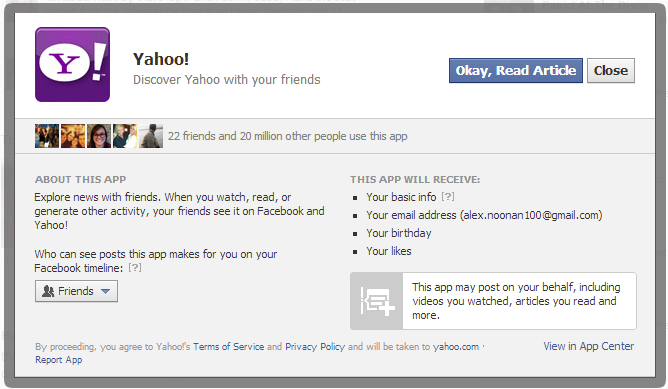
Over-sharing is not something people do consciously. A really simple way to reduce oversharing of your personal information is just to check your privacy settings. While it is difficult for most people to stop tracking of their online activity, it is relatively simple to reduce releasing your personal information. For example, say I see this article on my Facebook news feed. (All these pictures are taken from my Facebook)
When I click on this article to read it, the app tells me exactly what it will do with my personal information.
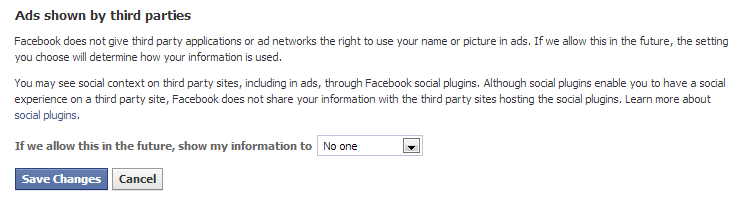
This app is requesting a lot of personal information. But many social networks like Facebook are making privacy settings more transparent. It’s now up to me to decide whether I want this app to know my birthday or to be able to track and share what I’m reading. Assuming some responsibility for the distribution of our personal information can help us take back some control. Further, taking the time to examine privacy policies and settings can sometimes give us information about what a social networking site may do with our information in the future. This shot was taken from Facebook’s ad settings:
The fact that Facebook feels the need to ask me for this setting tells me that very soon, they plan on letting advertisers use my name and pictures in their ads, presumably to convince my friends that since I like something, they should buy it too. It only took me four clicks to find this page and prevent advertisers from plastering my friends’ Facebooks with pictures of me endorsing some product.
Fortunately, we are currently seeing an increase in user discretion with personal information. A survey taken by Princeton Survey Research Associates International in February showed that 63% of people have deleted people from their “friends” lists in 2011, and 56% have deleted others’ comments.
While it’s important that we be concerned about how much of our information businesses take, now is the time to begin reexamining just exactly how much information we give out. It can be difficult for the average user to control how some information (like browser histories) is disseminated to companies. But we can control the information that we post.
When you navigate to a website, you’re usually going there to get information. Maybe the news, whether it’s political, sports, cultural, or whatever else it might be. However, something that we don’t often consider is the price at which that supposedly free information comes.
As the title of the author suggests, “if you’re not paying for it, you’re the product.” Simply put, you may think you’re accessing an Internet site for free. However, in reality, those websites might actually be selling access to you, the consumer, the average reader. What exactly are you selling though?
When you’re accessing these websites, you’re selling your search history, your personal information, your tendencies, your preferences, your approach to the internet as a whole. As a result, the companies who place advertisements on the ESPN’s, New York Times’, Facebook’s of the world are paying millions of dollars to gain access to our subconscious, to place their ads strategically to make the most of our attention.
Now, this might be a bit outrageous, but should the companies who aggregate our data, and monitor our Internet traffic actually pay us to monitor our activity? It might seem absurd, but sites such as Google sell advertisements to other companies, making millions of dollars of our shopping tendencies, observing and monitoring the sites we visit.
If they’re profiting from our browsing the Internet, why shouldn’t we? I’ve got some concerns about what I perceive as certain websites trafficking in personal information, which is a very real and pressing problem. It’s one thing to sell access to data traffic, and the websites consumers are accessing. It’s quite another to trade in, and gain from the personal information of your consumers. There might be some fine print in Google’s numerous user agreements that make it “technically legal” for them to disseminate one’s personal data. But how can they actually rationalize it…
The Internet seems to care less about privacy than it used to. Sure, there’s a minor uproar every time Facebook is called out on releasing some personal data, but the web isn’t the idealistic bastion of anonymity John Perry Barlow declared it as in the 90s. The key phrase here is every time. People make noise for a few days, then go right back to using it.
At first this seems like a lack of interest, but that’s not necessarily what’s going on. It could just as well be a sign that the supposed breach of privacy wasn’t actually a problem, or that it has been fixed. To their credit Facebook has responded well to specific privacy complaints (see this and this). And even if they hadn’t, the information in question wasn’t particularly dangerous – the worst that could happen is that advertisers get your name and some things you’re interested in.
To me the brief uproars show that people do care about privacy, but it hasn’t yet become a real issue. The phrase “if you’re not paying for something, you’re not the customer; you’re the product being sold” contains a grain of truth, but it’s an overly negative way of looking at the situation. It would be more accurate to say that you are paying, just with your personal information rather than cash. To me this is an acceptable arrangement. Advertising is essential to Internet companies, and if they can make more revenue by tailoring ads rather than making them more obnoxious I’m OK with that. As long as people are aware of the transaction, there’s nothing wrong with the Internet working this way.
That people seem to care less than they once did about privacy and other related tech issues isn’t a sign of growing complacency as much as changing attitudes toward technology. There was an issue in the 90s with the “Law of the Horse” on the Internet, the conflict between whether tech issues should be treated as entirely new or if they can be dealt with using existing laws and social norms. We struggle with this today when we complain about online privacy issues even when the Internet gives us more control than we have in the real world (I don’t mean to say that this invalidates the issue; it’s not unreasonable to argue that the Internet should be a place with more privacy).
As a matter of personal preference, I think the Internet should be kept more private than the outside world. I like that ideas can be judged on their own merit without reference to a specific speaker. But as long a privacy policies are clear, there’s nothing ethically wrong going on here. In my view, what has been framed as a legal or ethical issue comes down to what kind of place you think the Internet should be. This is a difficult question, one that I don’t think a lot of people have thought about, but it’s extremely important. That debate might never definitively end (and it shouldn’t), but if we want to answer the privacy question that’s what we need to talk about.
You go to a coffee shop wearing your favorite sundress. You sit, sip your latte, and try to finish a fantastic 18th century British novel. Don’t let the seasonal cups, peppermint aromas, and Imogen Heap music fool you—you may be in danger of becoming the next girl featured on Creepshots, a subreddit on which men post photos of random girls they see in public. Most of the time the pics are taken right out in the open. Sometimes, however, strategically placed camera angles go beyond simply what the other coffeehouse patrons would be able to see. Simply going out in public can make you a target for invasive photographers.
Reddit has attempted to ban Creepshots, but new iterations of the subreddit have come back—first as CreepSquad and even (apparently) as a fashion critique reddit.
2. Is Anyone Up? exposes bodies and ruins lives
One of the most controversial sites on the web, Is Anyone Up? specialized in posting nude pictures of men and women along with their real names and Facebook profiles. Ex-beaus often sent in pics of their former lovers, exposing them and their bodies to the World Wide Web. The implications this site could have on one’s career, relationships, and mental health were quite large. The site became the bane of anti-bullying groups, who would later pay the site’s creator to shut down the page.
While a huge invasion of privacy, some attributed the site’s success to how it made nude pictures “real” by showing the unsuspecting “models” in their sexual and non-sexual states. Some even think it was within Hunter Moore’s rights to express his notion of human sexuality by posting these photos of others. This is a prime example of how privacy rights can come into conflict with claims of free expression.
3. Predditors attempt to combat Creepshots
It seems brilliant: The creation of a tumblr called Predditors that identifies the men on Reddit who take creepy photos of non-consenting women. Posting their information is a surefire way to stop them, right?
At first glance, what may seem like an amazing means of revenge may be troubling. While Predditors attempts to do much legwork to ensure that they are accurate, there are disturbing implications should someone on the site be misidentified. While these guys who post creepshots are doing a horrible thing, outing them may not be sufficient to stop their misdeeds and could even be taken as acceptance of a lower standard for Internet privacy expectations.
4. Do not track? Do not care
Tracking is big business, with whole companies solely devoted to providing targeted advertising based on a user’s site history. It can often be a creepy experience to see ads for Calvin Klein after searching through underwear sales on a department store website. In its new iteration of Internet Explorer, Microsoft made sending “Do Not Track” signals more than just an option—it was the default setting on the browser.
While privacy advocates applauded Microsoft for the move, web advertisers were unhappy. Ultimately, companies decided that they would simply ignore these signals. After appearing to be a successful tool for consumers looking for a little more privacy, this exercise in web negotiations shows that tracking is not going away any time soon.
5. Queer users outed via Facebook
While Facebook offers its users many privacy settings, not all users have taken to making sure that Grandma doesn’t see the photos of you with a Solo cup. In fact, Facebook has become a new way that many queer people have been outed to friends and family. Simply getting added to a group can be seen by all one’s friends (depending on privacy settings), which leaves one open to someone getting included in an LGBT-related group and having that posted on their News Feed for Facebook friends (even non-knowing family members) to see. According to the recently Wall Street Journal article on this trend, Facebook is working with GLAD to offer special guidance to LGBT users.
Facebook isn’t the only site to come under scrutiny for potential outings. Netflix was sued in 2009 for releasing data on viewing habits that could potentially identify users as LGBT. These stories show just how much the digital era has changed the ability for young queer individuals to maintain privacy during the coming out process.
6. Nude pictures stolen off a phone by Verizon employee
When we get a new phone, most of us thinking nothing of handing over our old phones for the data transfer process. Even though our phones contain some of our most personal data, we think that cell carriers have to be honest folk, right? Unfortunately, not every employee respects the sanctity of one’s cell phone privacy. Just this past week, employees were caught stealing nude pictures off of a cell phone that they were doing a data transfer on.
What makes this story super scary is that we cannot avoid handing over our phones (and, with them, our sensitive data) when our phones break. In the smartphone era in which we practically have our entire lives on our devices, we ultimately just have to put our trust in someone and hope that instances like this are rarities.
(Disclaimer 1: The linked videos and those related to it may contain offensive content, sudden loud noises, flashing effects, and really offensive content)
(Disclaimer 2: Based on comments received from much more knowledgeable people, this article may not fully represent the current state of YouTube Poop. I have therefore made some edits. Please refer to the comments for more info.)
Imagine how Dorothy must have felt when she was swept up by that cyclone and plopped into the bright land of Oz. Now imagine if, two minutes before the storm, she had drunk three Four Lokos, eaten a large pizza topped with shrooms, and done a thousand jumping jacks. The result is probably something resembling YouTube Poop, a thriving art form that lurks in the underbelly of YouTube. As its name implies, YouTube Poop involves video remixes that reduce their source material into nonsense. The resulting video (called a “poop”) subverts its original content by slicing and dicing the video and audio, adding visual effects, and mashing several videos into one. Far from an incidental outgrowth of the YouTube culture, YouTube Poop draws from a heritage of the vidding community (not to mention being a sterling example of the fair use doctrine). And it’s a large community; there are craploads of poops on YouTube for our viewing (dis)pleasure. A good place to start may be “The Valley Place What Contains Some Dinosaurs” by the venerated (and retired) pooper WalrusGuy.
It's like a cross between a pineapple!
Poops are usually humorous, whether intentionally or not. Most of the humor draws from the pooper’s reinterpretation of memes. In WalrusGuy’s poop, an episode of “Valley of the Dinosaurs” gets outfitted with sex jokes, dark humor, and general absurdity. Another example of YouTube Poop’s memetic flywheel is found in one of the most common sources used for poop: the cutscenes of the CD-I computer game “Zelda: The Wand of Gamelon” and “Zelda: The Faces of Evil.” For whatever reason – the terrible animation or the absurd dialogue, most likely – these cutscenes are popular among poopers. Take a look at the opening scene from “The Wand of Gamelon.”
The visuals have been twisted beyond belief, disorienting the viewer. Madanonymous’ other works draw on this same technique, heavily manipulating familiar sources into oblivion. Other poops may take a more story-oriented approach, such as CaptainOhYeah’s “Bubble Buddy slaughters his victims without pity or remorse,” which uses another popular source: Spongebob.
Bubble Buddy is evil.
Given YouTube Poops’ close relationship with memes, it’s not surprising that they generate their own memes. These memes, or “fads,” involve a short source video that spawns hundreds of remixed responses. One fad, from 2010, used a short clip from a “Rugrats” episode, in which Stu Pickles has an existential crisis about chocolate pudding.
Because I've lost control of my life.
Fads answer the question “What else can you do to this 21-second clip?” by providing response after response after response. It’s here where the community behind YouTube Poop is in full force. It’s best to consider YouTube Poop as an art, a collaborative medium in which video culture is the hero, reinterpreting a source to often hilarious effect. Yes, it’s bizarre, but it’s a wonderful example of the sharing culture that YouTube has created, the cross relation of obscurities and tropes.
For the history and general theory of poops, read here. For more poops, type “youtube poop” into the site’s search bar and enjoy your trip to Oz. refer to the suggestions given by commenters below.
Yalies are career-oriented, ambitious people and while I find it heartening that a growing number of students are deciding not to sell their souls to investment banks, it could be problematic that more and more people have decided they have what it takes to be entrepreneurs. As a form of guidance to these people (many of whom are my friends), I have created a flowchart to give them a good idea of what their career goals should really be if they are considering becoming entrepreneurs.
If people end up being well-suited to be entrepreneurs as indicated by the flowchart–or are convinced that I’m a moron (not exactly a crazy assertion)–and they have an idea they believe solves an important problem, then they should apply to a variety of accelerators, incubators, and seed venture groups in order to launch their products. To be of assistance, I have compiled another flowchart to let them know which programs to apply to; if they find a statement true, then they should apply to the corresponding program.
The movie The Social Network chronicled the creation of the social media site we are all familiar with today, Facebook. Although I believe the intended purpose of the movie was to tell the dramatic story behind the creation of the website, including the back-stabbings, lawsuits, and flaws in the founders’ characters, the movie had a much more redeeming and influential effect in the long run: The Social Network sparked an increase in interest in entrepreneurship, with young people especially, as viewers were exposed to the journey that a typical startup venture follows and come to feel that they can start a venture themselves. Furthermore, The Social Network shows viewers just how possible (and easy) it is to be an entrepreneur on the Internet today. But why would anyone want to be an entrepreneur?
The Social Network sparked interest in entrepreneurship among young people especially.
The Perks
What exactly are the perks of becoming an entrepreneur, especially when you have to take on a large amount of risk? Well, for one, being an entrepreneur means that you won’t have to take orders from an annoying boss. You and your friends (if you choose to start something with your friends) will be in charge of all of the business decisions. You will be your own boss, which means you set your own deadlines, decide what your work environment is going to be like, create your own product, find capital to fund your own business, and learn from your everyday experiences. (Sounds almost like college, but as a job). Already sounds enticing, right?
You also have the chance of solving “the money problem” for yourself. By “solving the money problem,” I mean never having to worry about living expenses or retirement ever again…I mean getting rich fast. By completely devoting yourself to your startup for a short span of time, assuming your venture is successful, you can avoid the situation of taking a drab job that doesn’t suit your interests because you want/need to cover your own expenses and save for the future.
Outside of the possibility of big money and the ability to tailor your workspace and work patterns, the true perk of being an entrepreneur is that you get to work on what you are truly passionate about. You get to build a business around your own idea. You are the creator (just like in The Sims or in Minecraft, but in real life!). Just think about how cool this is. Let’s say you’re a “hacker” (aka a computer programmer) and you code this new social media website that millions of people flock to daily. Or, let’s say you love ice cream, and there’s no acceptable ice cream parlor in your area, so you decide to start a new ice cream parlor that makes its own homemade, delicious ice cream and offers a friendly, sitting environment.
Coney’s Cones brings a new type of ice cream parlor to Coney Island”
No matter whether your idea is a new invention or just an improvement on an existing product or even just business practices, it all spawns from you. You get to see your idea grow from a tiny company made up of just a few people, to a company that is profitable and that could very possibly change the way business in the market conducted for years to come. All of the greatest entrepreneurs and inventors agree: the keys to being a successful entrepreneur are enjoying what you are working on and always striving to improve your product/vision. In case you don’t believe me:
“You have to be very diligent…Know in your heart that you are a good person with good goals…Always seek excellence.” -Steve Wozniak [3]
“Good ideas are out there for anyone with the wit and the will to find them.” -Malcolm Gladwell [2]
So as a quick refresh, the perks are:
You are your own boss
You can get rich fast
You can work on what you are passionate about, and
You can even change the way society works
The Drawbacks
There aren’t many drawbacks to being an entrepreneur. The first and main drawback is that there is always the chance of failure. Even if you work tirelessly, and you have an amazing idea, your company always has the potential to fail. Why? Well business depends on the market, and if consumers do not buy your product/service, or if some competitor sneaks from under you and captures your market, then its kaput.
Another drawback to entrepreneurship is that your work becomes your life for matter of time. This is because startups are usually created by a small team, and since there are only a small number of people to do a tremendous amount of work, this leads to extra long hours, and sometimes even a life of “work, work, work.” The unfortunate implications of this are that you might have to put your social life and even relationships with friends and family on hold.
“Instead of working at an ordinary rate for 40 years, you will work like hell for four. And maybe end up with nothing…During this time you’ll do little but work, because when you’re not working, your competitors will be. [Over 3 years] I went to visit my family twice. Otherwise I just worked.” -Paul Graham [4]
Despite this, I think the benefits outweigh the costs. An intense work routine only lasts for a few years max, and even if you do fail, you still learn a lot from the experience. In fact, in Silicon Valley, failing is a badge of honor since it teaches you how to be more successful the next time around. Furthermore, once you do succeed, you have created something (you have created something) awesome.
How to Innovate
There are many ways to innovate and come up with ideas for potentially successful ventures, but in this section I will briefly discuss a few of the more common ways that some of the best entrepreneurs utilize.
Improving Something
The easiest way to come up with ideas for ventures is to look at the world around you, think of things you use often, and then to think of ways to improve upon them. I’m sure you have those moments when you say,
“I wish this were like this, now that would be great.”
Write down what you think of, these moments provide precisely the types of ideas you want to build off of. With this in mind, it is easy to see that there are countless things that need improvement. Paul Graham claims that by reading the newspaper one can find many ideas. The newspaper itself is something that needs to be enhanced; it is a dying medium! [4]
Improvement ideas don’t even need to be dramatic, profound, or even visible to the common consumer. Steve Wozniak, cofounder of Apple, designed and built the Apple II (the best selling computer at the time that it was on the market), a computer that was, among other things, innovative in its simplistic internal design and in its minimization number of chips. Such simplicity guaranteed that fewer bugs could ever be in the software (and hardware), and also minimized the costs for producing the cutting-edge computer, helping Apple generate profits more easily than its competitors because it had to spend less on producing its computers. Another example of an innovative startup that stemmed from improving an already existing product is Flickr, the online photo-sharing gallery. Although there were already many similar products online, Flickr improved upon them by adding a cleaner user interface, adding tagging of photos, and, most importantly, by moving away from pushing prints and giving more value to just sharing photos online. One last example is the Swiffer, which drastically improved upon the idea of the mop by creating a “mop” that uses disposable sheets, rather than old, smelly, disgusting reusable sponges/rags like older mops. (Of course, there’s also Facebook, which enhanced the social network idea of MySpace by creating a more organized, uniformly designed site with a better user interface.)
Startups Built Off of Improvement
Looking for the Obvious
Another way to find an idea for a successful venture is to look for things that are “obvious,” but that we cannot immediately see because we look at them with the wrong perspective. Although this may at times tie in with improving a product, past “obvious” products are usually those that draw the thought:
“Wow, I could have invented that, that’s so obvious!” or “It’s not that special, anyone could have invented that.”
Ideas similar to these are fairly difficult to see without pondering upon something for a while. It is usually something that can be improved upon or that is missing that we overlook everyday. One way to more easily discover these types of “obvious” ideas is to look at something you do not know very much about (or know well), to come understand it in a new way with what you do know well, and then to use your new, different perspective/understanding to examine what needs to be added or changed. An example would be to design special software for small businesses. Another example that I’m sure a lot of us overlook are the twist-ties that are used to keep breads and other foods fresh for longer. One last, brief example discussed in Malcom Gladwell’s article, “In the Air: Who says big ideas are rare?” is a filter that captures cancer cells, which actually circulate through the body thousands of times (a fact that had been overlooked for years until a physicist realized this by doing easy calculations), stopping them from settling in a new place (metastasizing).
Obvious, right?
Inventing Something New
You can also come up with an idea that is completely revolutionary. This form of innovation usually ties in with both improving something that exists and/or finding something obvious that is missing from society. A few examples are telephones, the Internet, personal computers, cars, etc. These are the most notable inventions, and most come from combining a new perspective, going against the opinion that something is “impossible,” and finding how to drastically improve some part of society.
Finally, entrepreneurs must always keep a few things in mind when considering ideas. For one, ideas should not be so narrow that if the market shifts, the company fails. Two, entrepreneurs should cater to and listen to users, because consumers decide which businesses survive. If you do not listen to them, or understand what they want, then your company will be doomed to fail.
In sum, to really stress these points, in order to be and to become a successful entrepreneur, you must be passionate about your goals and visions, you must want to create something, and you must truly understand what consumers want.
Who among us hasn’t observed a teacher sneer at the thought of a student referencing Wikipedia over traditional, non-digital sources? These teachers laud the immutability and consistency of books over time; however, this great strength of books can also be a significant drawback: they lack the generativity and adaptability to incorporate changing historiographical opinions, cutting-edge scientific research, and innovative discoveries that a more flexible medium provides. Indeed, while a biology textbook from the 1940’s or an NBA records almanac from the 1980’s is certainly “consistent,” each fails to incorporate new information as it becomes available.
Generativity and informational accuracy don’t have to be mutually exclusive though. Indeed, a study by Nature in 2005found that in a representative set of 42 scientific articles Wikipedia contained 162 factual errors or misleading remarks, while Encyclopedia Britannica contained123. (1) To realize just how remarkable it is that a website that relies on a decentralized, peer-production process could rival an information source with 100 paid, full-time editors and 4,400 contributors, it is necessary to look at the underlying framework of Wikipedia. (2)
Background
Using money earned from his humble beginnings in “erotic photography,” Jimbo Wales sought to create a free, online encyclopedia. In 2000 he conceived of Nupedia, which in the vein of traditional encyclopedias hired experts to write articles. Over the course of 3 years, Nupedia managed to churn out 25 articles. At this juncture, Jimbo Wales sought relief in Postel’s Law (“Be conservative in what you do; be liberal in what you accept from others”) and created a revamped version of Nupedia called Wikipedia, which allowed the general public to create and edit articles using wiki software. The rest is history. Today, Wikipedia contains 23 million articles, spans 285 languages, and appeals to 365 million readers around the globe. Currently, Wikipedia is the most widely used general reference website with 2.7 billion page views monthly. (3) The triumph of Wikipedia over traditional, pay-for-use encyclopedias can be partly attributed to Gresham’s law, which can summarized colloquially as cheap and convenient drives out expensive and high quality.
Wikipedia Model
Encouragement that the Wikipedia model—a model that relies on the collective wisdom of a large number of unpaid volunteers—could be viable was provided by the NASA ClickWorkers experiment, which ran from November 2000 to September 2001. In the experiment by NASA, unpaid volunteers visited NASA’s website to mark and classify craters and “honeycomb” terrain on Mars. (4) The study produced two surprising and interesting results. First, people are willing to engage in an unpaid, novel, and productive experience merely for the fun of it. Second, an amalgamation of data contributed by many unskilled volunteers can be virtually indistinguishable from the output of a trained worker. Thus, large groups of people are capable of producing high-quality work for free.
A Counterintuitive Proposition
It seems hard to fathom that a website that allows users cloaked in a veil of anonymity to edit the content of articles could rival the quality of Encyclopedia Britannica. In an attempt to understand the success of Wikipedia, it is interesting to observe a city in the Netherlands, Drachten. The city has chosen to forgo basic traffic regulations in an attempt to increase safety on the roads. The experiment in Drachten initially has shown promise. Some attribute this to the difference between the effects of rules and standards. While a rule is a regulation that stipulates precise boundaries and is either followed or broken, a standard is more ambiguous and up to interpretation, calling for people to exercise sound judgment. While people might try to circumvent rules that they perceive to be imposed by arbitrary, external forces, they can become more considerate of others when their personal judgment is called upon. As a result, relaxing rules can have the paradoxical effect of causing people to adhere to the desired behavior more closely. (5)
Putting It All Together
So what do NASA and traffic regulations in the Netherlands have to do with Wikipedia, you might ask? These two anecdotes lend credence to the basic assumptions of the Wikipedia model—that the general public is capable of yielding nearly scholarly work with minimal regulation. While the notion of many small contributions forming a remarkable finished product seems strange with respect to encyclopedia articles, consider the analogy of evolution: slight genetic mutations over time in individual agents within a population lead to the betterment of the species as a whole. A similar model is used in scientific research: major breakthroughs rest on the small contributions of many scientists. While this model may seem strange for information compilation, it is certainly not novel.
The Good, the Bad, and the Ugly
It is unsurprising that many of the flaws that arise concerning Wikipedia are quickly ameliorated; indeed, Wikipedia relies on the procrastination principle—rather than trying to forecast potential problems, it waits for a particular problem to arise and then fixes it. For example, immediately following initial reports of Michael Jackson’s death, “edit wars” ensued on Wikipedia regarding the veracity of these claims. In response to such edit wars, Wikipedia adopted the three-revert rule, which stipulates that an editor should not make the same correction to an article more than three times in one day. Another example of Wikipedia’s remarkable ability to adapt lies in its response to criticism by a former editor-in-chief of Encyclopedia Britannica, Robert McHenry. When McHenry pointed out that Wikipedia failed to note the ambiguity associated with Alexander Hamilton’s birth year, a mistake of which Columbia and Encarta were also guilty, users on Wikipedia corrected the error in under a week, a testament to how dynamic the website can be. These are just a couple of the controversies that Wikipedia has responded to effectively and expediently. (For more see Essjay Controversy and Wikipedia Biography Controversy)
My Take
When passing judgment on Wikipedia, I think it is important for us to view it in its proper context. Wikipedia is not meant to be a compilation of flawlessly written, perfectly crafted articles. When such a high threshold for quality is set for content, a bottleneck ensues, leading to an inability to cover certain relevant topics of interest. The three pillars that make Wikipedia so desirable—it’s free, convenient, and unparalleled in the breadth of its information—necessarily lead to a softening of stringent requirements for content quality and review. (You can’t have your cake and eat it too…) As an anecdote in support of the incredible amount of interconnected information on Wikipedia, consider a game that I’m sure most people are familiar with: given topic X and topic Y, start at topic X on Wikipedia and get to a page about topic Y in Z clicks or less. As an example, starting at Harvard Law School I was able to get to Lady Gaga in 4 clicks. (Harvard Law School-> United States->American music->American pop music-> Lady Gaga. Can you beat me?)
I do not understand Wikipedia “hata’s.” I think it is a losing battle to try to argue that due to a small number of factual errors (3.86 per article as determined by Nature), (1) Wikipedia is completely without redeeming value. At a bare minimum, I think one must concede that Wikipedia is beneficial for obtaining background information on a topic. To return to my initial anecdote, this rationale should at least preclude a teacher from scoffing at a student who includes Wikipedia in his or her works cited page. (Note that I have almost exclusively adhered to citing Wikipedia articles for this blog post.) If you are personally unsatisfied with the content of Wikipedia articles, you can ignore them entirely, contribute towards improving the articles, or pursue litigation against Wikipedia (although you almost certainly will be unsuccessful…).
Personally, one of my favorite qualities of Wikipedia is that it provides a consistent format across articles that are (at least to a degree) targeted towards the general public. As a student interested in technology and the natural sciences, I often have to read about scientific discoveries that occurred in the last couple of years: frequently, I only have two sources to turn to: the original research paper and Wikipedia (a testament to Wikipedia’s generativity). Bearing in mind the complexity of the topics, I seek to wrap my brain around the concepts by skimming Wikipedia before delving into the highly esoteric research papers. I believe that using Wikipedia in this manner is an appropriate use of the website. While many people possess a take it or leave it mentality when it comes to Wikipedia, I believe that it is important to apply basic common sense and reasoning when deciding whether to use the website—if you can tolerate 3.86 errors in your reading on the Heisenberg Uncertainty Principle, then have it; if not, put your laptop up and embark in the direction of the nearest university library.
At the beginning of my senior year of high school, something amazing happened: San Diego Unified School District (SDUSD) finally lifted its years-long block of Wikipedia from its Internet networks. Ever since I was in sixth grade, teachers used to tell my classmates and me about the terrors of Wikipedia, saying it is unreliable and characteristic of bad research.
SDUSD’s policy on Wikipedia, 2001-2010
To SDUSD’s credit, Wikipedia seemed like a pretty sketchy idea back then. The concept of a free-to-access encyclopedia that anyone can edit understandably made administrators wary. The risk of students being misinformed by Wikipedia seemed very high, and so we were taught to avoid the site at all costs and Wikipedia was blocked from school servers. And given some of Wikipedia’s early blunders, like the Seigenthaler incident in which a journalist was inappropriately labeled as a suspect in the murder of JFK, these concerns were not unwarranted.
Of course, this didn’t stop us from using Wikipedia. It was so much easier to just read the extensive and highly informative Wikipedia page on the American Revolution (or any other topic) than it was to peruse hundreds of links on Google. And it was easy to trick your teacher into thinking you didn’t do so thanks to the fantastic “References” and “External links” sections of every article.
Basic strategy for fooling your teacher
It wasn’t until Wikipedia’s 9th year that SDUSD lifted its ban on the website. The response by most students (and teachers too) was “It’s about time.” By 2010, everyone was using Wikipedia for research, whether they admitted it or not. It was easy, informative, and, with time, it was becoming much more reliable. As Wikipedia grew into an increasingly larger community of editors and volunteers, and as its leaders implemented new policies to assure accurate information, incidences of misinformation became exceedingly rare. Vandalism is now practically a non-issue on the site. Try messing around with a Wikipedia article right now. I guarantee it will be fixed within five minutes.
Of course, this doesn’t mean Wikipedia is now flawless, nor will it ever be. No encyclopedia is without errors, and we shouldn’t expect Wikipedia to be either. Temporary issues arise now and again. There are still probably hundreds of Wikipedia articles with inaccuracies that editors won’t pick up on.
The secret to Wikipedia’s popularity
I once met a graduate student who TAs a course in African history at University of California, Berkeley. She was telling me about how she instructs her students never to use Wikipedia as a resource when writing a research paper. She told me that every year, a specific research topic is assigned, and the Wikipedia article on this particular topic happens to have a factual error in it (I believe the error is the date of a battle). And every year, she uses this error to find out which of her students did not heed her advice.
In response, I asked this person why she hasn’t corrected the Wikipedia article. She didn’t know how to reply; clearly, she wanted to continue to exploit the error to uncover the Wikipedia users. I think this example illustrates exactly what is most wrong and what is most amazing about Wikipedia.
In my opinion, this person is as backwards-thinking as SDUSD’s old policy. Wikipedia thrives on its community of users, and it depends on these users to correct inaccuracies. When individuals choose not to do so, the community suffers and that is Wikipedia’s biggest problem.
Yet, at the same time, giving that editing power to the community makes Wikipedia the most powerful and dynamic encyclopedia in human history. When Denis Diderot began compiling the Encyclopédie with Jean le Rond d’Alembert in the 18th century, one of his main goals was to compile the works of many different philosophers and writers in an effort “to change the way people think.” In that regard, Jimmy Wales is the modern-day Diderot, compiling the knowledge of millions of individuals into one of the most extensive projects in recent years. But that project’s success depends entirely on whether we, the community, choose to accept it and allow it to advance.








 Yale Law Tech