The Evolution of Facebook Privacy – by “Michael C”

Facebook. The social network. The site that we all (well, most of us) use and love (or tolerate, at least). The site that some of us even name our babies after. Since its inception in 2005, Facebook has gone through an evolution that has moved it from being a networking site shared amongst students at Harvard to a global phenomenon used by 1 out of every 13 people in the world. For me, it’s more difficult than it should be to remember past versions of the site. I’ve been on Facebook since May 2007 (a few months before I started college), but when I think of the way Facebook looks, I can only recall the current design.
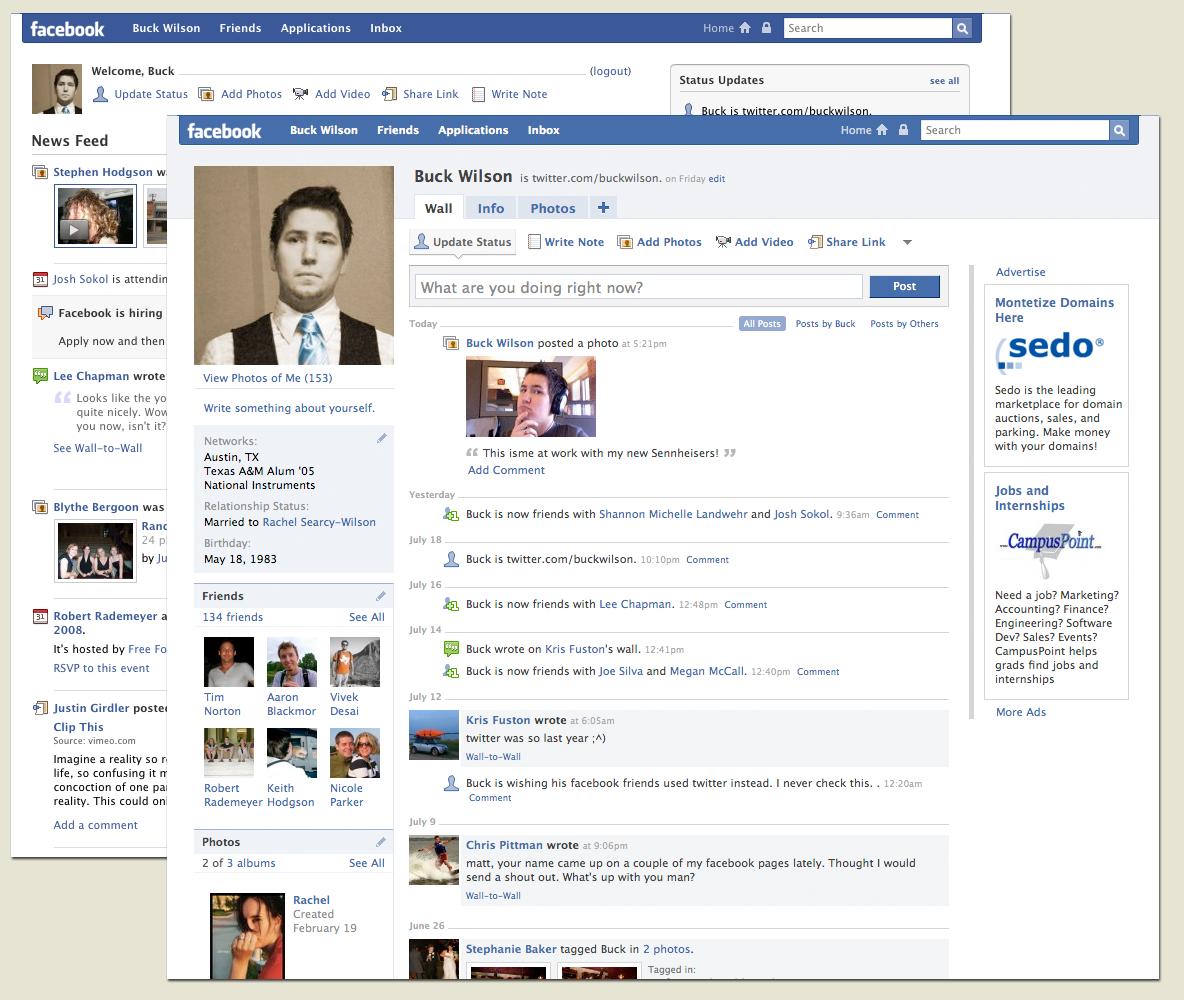
Old Facebook profile
I think this is how it looked before the recent changes…I honestly can’t really remember.

Anyway, every time that Facebook performed a revamp of its site, they also made a less apparent change—they adjusted the default privacy settings. This is important as many people on Facebook have probably never checked their privacy settings and just accept the default settings, whatever they may be. In that sense, it’s very interesting to think about how Facebook has changed the default privacy settings over time. Just like the old site interfaces, it’s difficult for me to recall old Facebook privacy options and defaults. Luckily, there are a number of informative sites that do just that.

About a year ago, Kurt Opsahl of the EFF wrote an informative article entitled “Facebook’s Eroding Privacy Policy: A Timeline” which gives us an idea of how Facebook’s privacy policy has changed over time. The differences become pretty apparent when you compare the 2005 privacy policy:

“No personal information that you submit to Thefacebook will be available to any user of the Web Site who does not belong to at least one of the groups specified by you in your privacy settings.”

to the privacy policy from April 2010:

“When you connect with an application or website it will have access to General Information about you. The term General Information includes your and your friends’ names, profile pictures, gender, user IDs, connections, and any content shared using the Everyone privacy setting. … The default privacy setting for certain types of information you post on Facebook is set to “everyone.” … Because it takes two to connect, your privacy settings only control who can see the connection on your profile page. If you are uncomfortable with the connection being publicly available, you should consider removing (or not making) the connection.”

If the change isn’t apparent enough from the text, Matt McKeon created a handy infographic that illustrates how Facebook’s default privacy settings have changed over time. You should go to his site to see the full interactive infographic, but take a look at the difference between 2005 and April 2010:

Evolution of Facebook Privacy
Woah.

The changes are clear, and to be honest, somewhat alarming. Currently, the majority of the information found in one’s profile—one’s wall posts, photos, likes, etc.—is visible to the entire internet by default. Only friends can see one’s contact information, but Facebook would have no privacy whatsoever if contact information was available to everyone. However, with so much other information out there in the public, it is entirely possible that someone could still glean one’s contact info from the site. As Facebook has expanded, becoming not just a site for Harvard students to interact on but a site for literally everyone to interact on, it seems logical that Facebook might increase the default privacy settings, as there are many more people with access to the site that one would want to keep their information private from. Back when the only people on Facebook were your classmates, having conservative privacy defaults probably was not as big of an issue as it is now, when anyone in the world can use Facebook.

Of course, not all of these changes are Facebook being evil; rather, it seems that some of them are the result of Facebook simply being ambivalent about one’s privacy. A lot of the expansion in the infographic comes from the fact that Facebook’s audience has greatly expanded since 2005. Back in 2005, there was no such thing as a “public profile” that everyone on the internet could see—you were either on Facebook (and you could only get access if you were in a select group of people) or you weren’t. As Facebook has opened up to more and more people, rather than “pulling back” on privacy settings to maintain the privacy that Facebook had when it was much more exclusive, Facebook has simply let privacy slide along with the site’s access. Perhaps this is due to Mark Zuckerberg’s lack of understanding about people’s desire for privacy. Even in Time’s “Person of the Year” article about Zuckerberg, it said “Zuckerberg has a talent for understanding how people work, but one urge, the urge to conceal, seems to be foreign to him….Sometimes Zuckerberg can sound like a wheedling spokesman for the secret police of some future totalitarian state. Why wouldn’t you want to share? Why wouldn’t you want to be open — unless you’ve got something to hide? ‘Having two identities for yourself is an example of a lack of integrity,’ Zuckerberg said in a 2009 interview with David Kirkpatrick, author of The Facebook Effect.”

Zuckerberg’s comments stand in stark contrast with the themes of our class. This week, we read Warren and Brandeis’s The Right to Privacy, which states “The intensity and complexity of life, attendant upon advancing civilization, have rendered necessary some retreat from the world, and man, under the refining influence of culture, has become more sensitive to publicity, so that solitude and privacy have become more essential to the individual; but modern enterprise and invention have, through invasions upon his privacy, subjected him to mental pain and distress, far greater than could be inflicted by mere bodily injury.” The real question is, can we use Facebook and cell phones and all the other facets of the modern age and still maintain our privacy? Naturally, we must be willing to give up some privacy simply by virtue of using a “social networking” site. Yet, at the same time, we shouldn’t have to give up more privacy than necessary. Perhaps Facebook shouldn’t be allowed to use an opt-out system of privacy, where most of a user’s profile is shared with the entire internet by default and the burden of selecting more restrictive privacy settings is placed on users. Perhaps, through legislation, we can put the burden on corporations like Facebook, so that the default behavior of the site is in users’ best interests, not Facebook’s. After all, Facebook is a social networking site, existing for the people who use it to communicate and connect; it has no one but its millions of users to thank for its success.
It’s 5:00. Do you know where your iOS device is? Because Apple does. – by “Evin M”

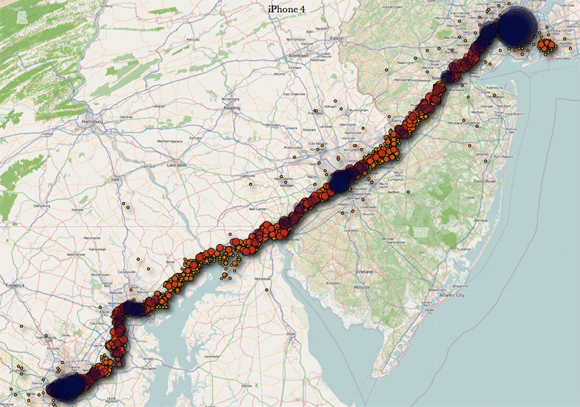
Today, Alasdair Allen and Pete Warden announced that “[e]ver since iOS 4 arrived, your device has been storing a long list of locations and time stamps.”  Your device’s longitude and latitude have been recorded hundreds of thousands of times with timestamps getting backed up to iTunes, transferred to new devices and restored across backups.  It’s not encrypted, it’s not protected, and it’s pretty easy to access.

A visualization of iPhone location data, from Alasdair Allan and Pete Warden

Let’s recall US v. Maynard, a 2010 case where FBI agents planted a GPS tracking device on a car when the car was on private property, and then recorded its location every ten seconds for a month without obtaining a warrant.  The US Court of Appeals for D.C. held that obtaining such information required a search warrant, and rejected the Bureau’s claims that their actions didn’t constitute a search.  The Bureau cited US v. Knotts, in which police used a beeper device to track the discrete movements of a suspected conspirator’s car over a limited period of time.  In this case’s opinion, the court only addressed the use of such tracking technology for a single car trip–not limitless access to GPS data, regardless of previously specified time or place.

Accessing aggregated GPS data in an investigation constitutes a search and requires a warrant.  However, we’re only familiar with this situation when a third party is seeking that location data.  What’s unique about Apple as the original collector?  They’re not going after data collected by another party–it’s a function built into the software, and it’s covered in the terms of service.

Indeed, Apple’s iOS 4 TOS says

To provide location-based services on Apple products, Apple and our partners and licensees may collect, use, and share precise location data, including the real-time geographic location of your Apple computer or device. This location data is collected anonymously in a form that does not personally identify you and is used by Apple and our partners and licensees to provide and improve location-based products and services. For example, we may share geographic location with application providers when you opt in to their location services.

So what’s next?  The blogosphere is feeling squeamish, but is that the extent of the response? Thoughts, guys?

As an aside, Apple’s capitalizing upon the buzz with advertisements on Google, perhaps employing the same publicity tactics that BP did, post-oil-spill (I blogged about it here). I’d be interested to see if the content of these word-triggered ads changes to be more actively positive in Apple’s favor as more eyebrows are raised in response to this latest discovery.

But I Just Have to Infringe! – by “Adam P”


An undetermined number of months ago, I was browsing the internet as I often do, and I stumbled upon a pretty interesting ad for Samsung. While it may require a thick stomach toward some adolescent humor, it was very well done and even a bit inspirational.

Attack helicopters and uncomfortably misogynistic depiction of bosoms aside, I found myself fascinated by the technique of taking something traditionally two-dimensional and making it three-dimensional. I’d since been developing a sense of just how animation and special effects are done, and I never could shake that 3D image of the Girl with the Pearl Earring fighting secret agents, so I eventually I tried my own hand at doing what Samsung had done. It was a simpler take on the idea, with fewer models and no sound, but it’s an project I’d become quite proud of.

The piece it’s based on is M. C. Escher’s Hand with Reflecting Sphere*. This is unfortunate.

You see, there is a key difference between Hand with Reflecting Sphere, and the famous historical paintings featured in the Samsung ad. Hand with Reflecting Sphere wasn’t printed until 1935, which is well after January 1st, 1923. Thus, the piece wouldn’t conveniently turn out to be in the public domain. This was by no means my only encounter with copyright infringement. Oh, not even close! In high school I had made a music video for a song called Haitian Fight Song by Charles Mingus about two students fighting with trash pick-up sticks, and later on I’d make a reckless driving PSA using images and footage found entirely online without paying the rightful dues to their original author. Nevertheless, my teacher at the time, the wonderful Mrs. Gaulke, encouraged the infringements because for whatever reason, those images and that song brought about some creative impulse in me, and in her mindI was growing as an artist. Throughout the years I couldn’t separate myself as an artist wanting to create something new from myself as a spectator constantly influenced by the images and art around me, and the spectator in me would always try to gauge how exactly a certain song or image or reference could alter a film piece that I was working on.

Perhaps it’s my own lack of originality, or perhaps there are many other filmmakers like me that break copyright laws with the purpose of making something interesting and original. If the initial purpose behind copyright was to encourage creativity, then certainly any proposal for copyright reform should take a look at how modern filmmakers treat copyright.

Browsing various video uploading sites and video aggregator sites alike, it’s clear to find that copyright concerns are not highly regulated. There are plenty of montages of celebrity photos and clips ripped from television stations, but these are not the users that copyright laws were meant to encourage because these videos simply take another person’s work and recreating it. However, videos that take an artist’s work and recontextualize it so that it works towards an entirely new project don’t belong in the same category. Take Skyler Page, the mind behind Crater Face.

Skylar is an animator with very few short films to his name. For the most part, he has a series flipbook animations and silly live-action shorts about animating on his youtube channel, most of which only have a few hundred hits. He is by no means a large name, and it’s doubtful that he supports himself on his art. In other words, he’s in the same situation as so many aspiring filmmakers, yet he managed to create a deserved hit with the above video. Nevertheless, the video appears to infringe a copyright by using the Dan Deacon song Pink Batman, and for the purposes of this argument, we’ll assume that it does.

Hopefully one can understand that it’s the freedom of choice in selecting a song which allowed Skylar to experiment. By ignoring copyright, he was free to make precisely the video that he wanted. Now of course, no copyright reform would have allowed Skyler to use a song only three years old without paying some sort of royalties, but in an age in which it’s so simple to use another person’s copyrighted material it’s an inevitable fact that artists will use others material. Regardless of the current, past, or future legality, the appeal of this freedom of choice is impossible to ignore for anyone that calls him or herself an artist.

Current copyright legislation seems to see this current culture of misuse as a growing threat, and reform is targeting the same mentality that I just deemed to be inevitable. Rather I believe copyright reform should do more to understand the usefulness of this freedom of choice. Whether or not that means increasing the number of works in the public domain as proposed with the Public Domain Enhancement Act or lessening the gravity of the proposed punishments for copyright infringements it doesn’t so much matter because there will inevitably be people breaking the law regardless of how it’s reformed. Although if there copyright reform allowed for my three-dimensional M. C. Escher Orb to live in its hole of the internet without fear of a takedown notice, that’d be just fine by me.

Lock’em out – by “Jennifer W”

As Charles Kenny shouts in the headline of his latest entry to ForeignPolicy.com, U.S. cartoons are holding the developing world hostage via copyright reforms that cripple creation while strengthening copyright holders’ dominance. That is to say, no one in the world (that expects to stay in good relations with the U.S.) can build upon the creations of U.S. companies until those creations fall into the public domain and with the recent barrage of extensions to the length of copyright protection, that’ll be awhile.


[I release the above cartoon into the public domain for you to do what you will with it…but I can’t swear that Disney won’t sue for the use of gloves on my characters. hmm…]

As anyone worried about finding a DMCA notice on their virtual doorstep knows, copyright is complicated, and it’s only getting worse as large corporations continue to push copyright laws down a road of vaults and locks on all things they see as being profitable. But if copyright as it stands is complicated, reform may be even more complicated. As typically happens anywhere a governing body forms, the good intentions of an original system slowly get twisted, bound, reinterpreted, edited, and otherwise convoluted so that no sense of the original intentions can be derived. It’s like a legal mash-up that if subjected to copyright law itself would likely fall under fair use since the derivative is so transformative…but it’s not often healthy for society, and its definitely not where the framers intended it to go.

For instance, New Zealand just passed a bill that could terminate internet accounts if their respective holders can’t prove that they didn’t file-share copyrighted materials. It’s a bold ‘guilty until proven innocent’ move that puts large corporations on top of the file-sharing game while simultaneously threatening internet users’ lifestyles by putting their internet phone, mail, and business functions on the line. It’s reasonable to ask, how would someone defend against an accusation of file-sharing in New Zealand? Can you image having your internet disconnected leaving you without email, Skype, search engines for an unknown quantity of time for something that perhaps you simply couldn’t defend against? Something tells me we haven’t heard the last of this one but it nevertheless begs the question, were copyright holders ever intended to have the right to cut infringer’s connection to the world off for an offense? That’s an incredible power! The next think we’ll know, anyone found to be plagiarizing will be banned from reading books. That’ll improve society.

While copyright law may have initiated as an incentive plan for all creators, more and more stringent and restrictive copyright laws now show that copyright today only stands to ensuring compensation for copyright holders–which often [sadly] isn’t even the creator. This message strongly opposes that which copyright classes around the nation enforce–that copyright law is not intended to ensure one ‘makes money’ off of creations but rather incentivize the production of new works through ensured limited control over the use of those works. Well given all the copyright reforms in the works, good luck convincing students of that in the future!

It seems that law makers around the world have forgotten that culture is collaborative and therefore creation is always going to build upon prior creations. Hence, incentivizing creators by giving them rights to control how their work is used for a limited amount of time, gives the creators an upper hand on furthering their own creations–which at one point was a great source of pride and yes, sometimes revenue but not necessarily the latter. But, of course, this was always meant to be a temporary right to control because the longer items are kept out of the public domain the fewer building blocks other creators have to build upon and that inherently slows the advancement of creations. Law makers seem to have forgotten that part. Instead of coming back to the goal of optimizing the creative environment, more and more governments are simply creating civil deviants out of our culture’s creators by punishing them for being influenced by those who come before them.

And now not only will they be civil deviants but they may be angry, disconnected deviants in New Zealand should they be found to say, file-share a mash-up of their favorite recordings.

Good move out there, governments! Allow our prisoners access to the internet but not file-sharers; that’s just logical! These are the criminals that are ruining our society [file-sharers]! Cut off their access to the world until they come up with a spontaneous stroke of genius that creates their own copyrighted creation over which they may hover.

Sounds like we’re on the right track. [Check, please!]

One Troll Down… Many More To Go – by “Anna D”

Righthaven is a copyright holding company that has been menacing website owners in Nevada, Colorado, and South Carolina for the past year, filing lawsuits against them on grounds of copyright infringement of newspaper material. The company started suing in 2010 after signing a confidential agreement with Stephens Media, LLC (publisher of the Las Vegas Review-Journal), and it has subsequently filed 265 cases of copyright violation on behalf of Stephens Media and, Media News Group, and Stevo Deisgn Inc. Righthaven also has an agreement with WEHCO Media, but has not brought any suits on their behalf.

The troll got some bad press after suing the Las Vegas Review-Journal‘s own sources, a reporter writing about a Righthaven lawsuit, charities (including a non-profit supporting immigrants rights), and poor bloggers (including a 20-year old on disability). The Las Vegas Review-Journal has responded to the public criticism without remorse. On the topic of copyright infringers, Review Journal columnist Vin Suprymowicz is quoted as saying, “I hate them with a passion. Lawsuits? They should have their godd**ned hands cut off and nailed to the wall of City Hall,” and a threat from the publisher, Sherman Frederick, seems equally ominous: “I’m asking you nicely once again– don’t steal our content. Or, I promise you, you will meet my little friend called Righthaven.”

So the “little friend” trolled on, pressing for domain name forfeiture and $75,000 before even sending a DMCA takedown notice to the website owner. Even though many cases were dismissed on the basis of fair use, and the average settlement was probably $3,500 (much lower than the requested $75,000 but still a substantial sum for many hobby bloggers), Righthaven was tireless.

The Electronic Frontier Foundation stepped in to challenge the sham after Righthaven sued Democratic Underground (a political satire and commentary blog). EFF provided the Democratic Underground with lawyers, and, last Friday, these lawyers convinced a federal district court to unseal Righthaven and Stephens Media’s “Strategic Alliance Agreement.” The court found that, under the agreement, the Review Journal was pocketing half of the litigation proceeds and Righthaven’s lawsuits were resting on very shaky legal grounds. In its lawsuits, Righthaven had alleged that 1) it held the exclusive right to reproduce the work in question, 2) it held the exclusive right to prepare derivative works, 3) it held the exclusive right to distribute copies of the work, and 4) it held the exclusive right to publicly display the work. Unfortunately for Righthaven, according to the confidential agreement, the Las Vegas Review-Journal had not actually conferred any of these rights. It only gave Righthaven “the right to sue,” which simply does not exist.

The Court made the Agreement public, giving all other defendents Righthaven had sued a powerful legal weapon and, essentially, spelling the demise of the Righthaven troll.

This image taken from here.

We can celebrate the death of Righthaven, but we’ve still got many more trolls on the loose, and the court’s decision in this case hurt many of them. This case was special because Righthaven and the Las Vegas Review-Journal set up a shoddy legal document in which no intellectual property rights were actually transferred, and their operation only lasted as long as it did (a little over a year) because they managed to keep the document under wraps.

But other trolls are already or now will be smarter. As long as they actually own the rights (we’ve heard of sample troll Bridgeport Music), they can track down and extort the ignorant and, often, the innocent (fair users).

What policy could we enact to protect ourselves against this other kind of troll? To start with, I’d vote for making copyrights non-transferable (except in the case of works for hire and, possibly, for kin), though still licensable. To me, this seems reasonable. We’d still be incentivizing creators, and thus “promot[ing] the Progress of Science and useful Arts,” but we’d stop allowing non-creators to build entire business models on the exploitation of our IP system and the people that don’t understand it.

Will Classesv2 be taken down with COICA? – by “JeeYoung K”

Course packets are slowly disappearing from the Yale Campus. This term, I did not have to buy a single course packet for any of my classes, because all the course material was uploaded online. For some of them, course materials were uploaded to the resources section in Classesv2 site and for others, the links to the reading were posted on a separate site like this one. Even TYCO, which has a near monopoly on selling course packets to Yale students, in an interview with the Yale Daily News has said that it is diversifying its business to survive the decreasing demand for printed course packets.

Even as course material begins to migrate from offline to online, the copyright issues that surround distributing course material have remained the same. Most of the time, including copyrighted works in the course material, whether they are uploaded files or printed packets, are not likely to be cases of copyright infringement, because educational uses often fall under the fair use exception.

The prospect of Combating Online Infringement and Counterfeits Act (COICA), however, poses a new challenge for professors and students who want to share course material. The bill purports to authorize the U.S. government to shut down sites “dedicated to infringing activities.” The intention is to shut down sites the main purpose of which is to engage in sales of counterfeit goods, but the bill is likely to be used more broadly to target hosting sites in general and Classesv2 may not be an exception.

As the New York Times reported, even under the current law, the U.S. government has  seized websites that facilitate file sharing (and some of them did not even host the content themselves). In at least one of these cases, the Immigration and Customs Enforcement has arrested someone for criminal copyright infringement for a domain which at the time of the arrest only had embedded content from other sites. If the bill passes, the scope of the government’s crackdown is likely to only increase. In a post about COICA, the Electronic Frontier Foundation has listed hosting sites such as Dropbox and Rapidshare as potential targets of the bill. Then, who is to say that Classesv2 is to be excluded? Who is it to say that the Yale Law & Tech site is not to be seized?

One may find the idea of Classesv2 site being redirected to the government’s seizure notice ridiculous. Of course, the scenario is only a hypothetical, but it still highlights potential problems with COICA. First, it is not practical. The seized sites could simply change their domain names. Can you imagine Yale playing a cat and mouse game with the Department of Justice? Second, it conflicts with the safe harbor created by Section 512 of Digital Millennium Copyright Act. The Section 512 protects online service providers from becoming liable for copyright infringements by their users as long as they have a system of taking down infringing materials expeditiously. It has been proposed to amend the bill to provide greater protection to internet service providers, but the bill as it stands does not and has a potential to shut down useful services which have substantial non-infringing uses. Third, the bill overlooks fair use and friends and family exceptions. It is difficult to tell whether a particular content is being shared for fair use purposes or among friends and family and can only be determined on a case-by-case basis. By shutting down entire websites, COICA has the potential to depress free speech by not leaving room for users who use the site for non-infringing purposes to make their cases.

If the bill were to pass, we might have to go back to using good old course packets. Just imagine not having any excuse to have your laptop out and check your gmail during class. We must stop the COICA bill.


Hide your account settings, Hide your email, cuz Facebook’s changing everything up in here – by “Evin M”

mysideproj3ct.wordpress.com

Last spring, Facebook rolled out a new interface with oodles of novel functionality and a handful of big flashy security holes.  In At In April 2010, we met the Open Graph, which utilized Facbook’s Social Graph technology to transform your stated affiliations and affinities from static comments to active connections–literally, your favorite books and music became hyperlinks.  If you didn’t agree to hyperlink your lists of favorites, interests, etc., they were deleted (and so it was that I had a rather blank profile).  This change both made profile information infinitely easier to manipulate on the back end (and thus package and distribute to third parties), and rolled in with a LOT of default rules.  The power of the default capitalizes upon laziness–if a new element of your profile is introduced with a default setting, odds are you won’t change it (unless you’re neurotic like me and check your account and privacy settings every few weeks).  The biggest baddest April ’10 default of them all was Instant Personalization, which handed over your connections to recipients like Windows Docs, Yelp and Pandora because it was originally an opt-out feature.  Only later did Facebook take a step back and change the default rule–but discussion about it didn’t die down before, due to a glitch, some users were able to creep in and see the live chats of their friends.  It was a scary bug, but one what got fixed after it was flaunted in the NY Times.  And so began a renewed wave of privacy freakouts and Facebook hating in the general public–one that, I’ll wager, is about to make another comeback.

What concerns me more than mistakes in code is when they team up with the deliberate integration of opt-out settings.   It seems that the quick-quick-forget-the-debugging-just-push-the-fun-new-toys-out-there mentality has again taken Mountain View by storm, and we’re getting a repeat of last spring.  I think I’m been deemed either hip or unlucky by the Facebook team, because my profile currently seems to be sporting more new tricks than some of my friends’.  The spelling and capitalization of my status updates and chats are automatically corrected, I’ve got e-mail integration in my private messages, and my account settings show an option for suggesting profile pictures to friends.  Nifty!   Except….hey, wait.  I had painstakingly gone through all of my account settings to uncheck the boxes permitting email and SMS notifications for various apparently noteworthy events (you’ve been tagged in a picture, your status has 9088 new comments, grandma just liked your link, etc.).  However, ALL of the boxes were checked–including the new options and the old ones that I had previously unchecked.  I was irritated, so I unchecked all of the boxes, hit save, and let out a sigh of relief when Facebook affirmed that my new settings were saved.

I returned to my account settings page a minute later, to find that a large majority of the aforementioned boxes under the notifications heading were still checked.  I unchecked them, saved my settings, and refreshed the page.  To find these boxes checked again.

There’s not TOO much at stake right now–I’m just going to receive an annoyingly large amount of email in the future informing me that I have notifications.  That said, I’m still concerned.  What if this happened to my privacy settings?  Not cool, Facebook.  Not cool.


Edit: Tuesday, April 19th, 2011. 10:20 pm.

Yet again, I entered my account settings to find this:

UGH.

Are you a Clarence Thomas or a Ruth Bader Ginsburg? – by “Ryan W”

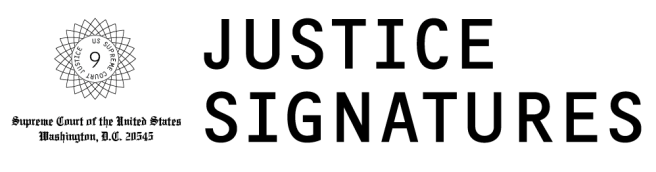
Are you a Ruth Bader Ginsburg, a Clarence Thomas or an Elena Kagan?? Now you can rep your favorite Supreme Court Justice with a JUSTICE SIGNATURE mug. This week’s topic of Trademarks and Brands on the internet got me interested in names— more specifically signatures— and their potential for use in a visual identity. Signatures are generally not trademark-able, and the visual language used on supreme court documents is in the public domain, as it was created by government employees. Yalies should definitely show some Sonia Sotomayor pride by drinking their morning coffee from a Justice Signature mug, featuring Justice Sotomayor’s *real* signature.


Stoller the Troller – by “Charles A”


Perhaps one of the most infamous trademark trolls is Larry Stoller. As part of the new line of “intellectual property entrepreneurs”, Stoller’s entire business strategy was to amass a portfolio of ambiguous trademarks he would then use to pursue and threaten as many offenders as possible. Below is a sample of just some of the trademarks Stoller registered.


File:Rentamark-trademarks.gif


Stoller is most famously known for aggressively pursuing his trademark of the word “stealth”. In 2005 he entered a legal battle with Sony’s Columbia Pictures after their release of the summer movie Stealth. Stoller sent a cease and desist letter to Sony claiming to have registered and owned the rights to the movie title and insisted that the title of the movie be changed. While he wasn’t successful with this particular venture, other big companies such as Kmart, JVC, and Panasonic have chosen to remove the term stealth from certain portions of their websites and products rather than deal with Stoller at all. Regardless of whether or not these companies feel as though they have a legitimate case, it’s simply easier to settle as many issues as possible outside of course. As one Panasonic lawyer stated “if you can solve problems without going to court, you’re better off”. If even huge corporations aren’t always willing to fight for their actual right’s, how much more can we expect of the smaller companies and start ups who receive a threatening cease and desist order from people like Stoller. This is clearly not in the service of the consumer.

Once again we have another example of an area of IP law that is being abused by trolls for pure economic benefit. Trademark trolls, like patent trolls, are abusing a system meant to protect the consumer and stimulate innovation.  While Stoller wasn’t very successful in his ventures (he was recently stripped of all his trademarks and banned from making any further claims) this is exactly the kind of practice that companies like Intellectual Ventures are turning into a viable industry. The end consumer needs to be put back at the forefront of lawmaking to ensure that practices such as these do not continue.

Original New York Times article


The TDRA and Being “Famous” – by “Misbah U”

The Trademark Dilution Revision Act of 2006 (TDRA) was signed in 2006 by President Bush as an amendment to the Federal Trademark Dilution Act of 1995;  it further clarified the standard proof trademark owners must meet in order to claim dilution of the famous TM, how use by another can “dilute” a trademark, and finally, it made it easier for owners to prove dilution.

Specifically, the TDRA defined a trademark to be “famous” if it is “widely recognized by the general consuming public of the United States as a designation of source of the goods or services of the mark’s owner.” The owner of such a famous TM can thus prevent its use by others that can be proven to be “diluting” the mark. Diluting, under the TDRA, occurs when the famous mark is “blurred” or “tarnished” as a result of an “association arising from the similarity between a mark or trade name and a famous mark that impairs the distinctiveness of the famous mark.” Essentially, with this Act, it was made clear that owners can stop potential dilution without showing that the current diluting use is actually causing harm.

Recently, trademark parodies have been at the forefront of cases involving the TDRA. In my opinion, despite further specifying the original Federal Trademark Dilution Act, courts remain conflicted and inconsistent when it comes to interpreting the TDRA—especially when it comes to trademark parodies which, naturally, aim to reference prominent trademarks.

For example, with the Louis Vuitton Malletier, S.A. v. Haute Diggity Dog (4th circuit, 2007) case, Louis Vuitton, a manufacturer of high end luxury luggage, leather products, and other accessories, claimed trademark infringement and dilution against Haute Diggity Dog because of its Chewy Vuiton plush dog toys that were modeled after the LV handbag. Here, despite acknowledging that Chewy Vuiton had indeed based their design and name off of Louis Vuitton, the Court went on to find that Haute Diggity Dog was actually engaged in a successful parody, and, as intended, it would be perceived as such:

“Finally, the juxtaposition of the similar and dissimilar—the irreverent representation and the idealized image of an LVM handbag—immediately conveys a joking and amusing parody. The furry little ‘Chewy Vuiton’ imitation, as something to be chewed by a dog, pokes fun at the elegance and expensiveness of a LOUIS VUITTON handbag, which must not be chewed by a dog… The satire is unmistakable. The dog toy is a comment on the rich and famous, on the LOUIS VUITTON name and related marks, and on conspicuous consumption in general.”

Similarly, with the Charbucks case (Starbucks Corp. v. Wolfe’s Borough Coffee Inc.), the Second Circuit found there was no likelihood of dilution—even though Starbucks claimed that Charbucks for coffee products was likely to blur the distinctiveness and/or harm Starbucks’ reputation. This decision was heavily based on the TDRA. Interestingly, when weighing the degree of similarity, the court stated that the marks be substantially similar (and thus created a new requirement) in order to attain protection against dilution via blurring. Moreover, in terms of the “intent to create an association,” the court accounted for bad faith when it came to determining whether there was an actual intention behind unlawfully associating with a well-known trademark.   At the end of day, despite Starbucks’ appeal Charbucks wasn’t found to be likely of diluting the Starbucks TM.

With Hershey Co. v. Art Van Furniture, Inc., however, Michigan’s largest furniture retailer, Art Van began an online campaign where visitors could vote for their favorite couch design—one of which happened to be a brown sofa, emerging from a wrapper, with “ART VAN” centered across. Hershey decided to file a lawsuit claiming that it’s chocolate bar packaging was being diluted and infringed upon. Art Van, of course, argued that this was merely a parody and its amusing nature would therefore diffuse any risk of it being mistaken as a sponsorship, for example. Fortunately for famous TM owners here, the district court rejected the parody defense (differing it from Chewy Vuiton mentioned above) by stating that Michigan retailer’s design was “neither similar nor different enough to convey a satirical message…it’s not biting.” Thus, playing on someone else’s trademark as a parody is by no means a guaranteed defense.


As of November 2010, I think Facebook vs. Lamebook is one case that will be particularly interesting to follow given past cases where parodies have been established as defense.  Lamebook.com is a parody compendium of funny facebook content that recently decided to sue Facebook.com in the federal district court of Western Texas, after seeking 1st amendment protections, so that Facebook couldn’t go ahead and file against them first. Facebook, however, ignored this and filed an infringement and dilution suit in Northern California. Only time will tell how the parody defense will play out here—and if privacy issues, which haven’t been addressed by either side as of yet, are raised (even though Lamebook obscures identifying information).