CoderHeap – Where Coders and Entrepreneurs Meet – by “Thad D”

CoderHeap (http://www.coderheap.com) is a web-based service that brings computer programmers, graphic designers, and entrepreneurs within the same college together.  Sign up is completely free, and we will never charge for any of the standard features.  For now, the alpha candidate is doing a closed release to Yale University and Villanova University, so only those with an @yale.edu or @villanova.edu email will be allowed to register and participate.

With CoderHeap, you are instantly connected to talented members of your school instantly.  Here’s how it works.  First you register through the homepage and verify your account using a valid email address.  Then, you instantly have access to “The Stack”, a prioritized feed of network activity to tell you who’s doing what at your school.  When you visit your profile, you have the ability to edit all the relevant information (including what languages you know, what areas of work you are involved with, and creating a portfolio of recent materials).  Finally, entrepreneurs are able to post a job in less than two minutes using the CoderHeap job creation tool.  Once it is live, anyone who wishes to can apply to the job quickly, and entrepreneurs can hand out decisions with a click of a button.

But here’s the best part.  CoderHeap allows you to constantly update your information to reflect your most recent resume.  No more resending resumes to employers, no more checking in about the status of your application, no need to constantly check a website for the decision (CoderHeap emails you instantly once the decision is made).

I hope everyone at Yale and Villanova enjoys the alpha, and we here at CoderHeap look forward to moving to more schools in the future.  Please, if you have any questions, feel free to contact me at thaddeus.diamond@yale.edu at any point.

Thank you,

Thaddeus Diamond

CoderHeap

The Certified Original Human – by “Nathan B”

There may never be another you,” notes the website of the DNAid art project, “but if there ever should be, would you have any legal rights to the original design?” The answer seems like it should be simple enough: of course we own the rights to our own DNA- it’s a part of ourselves that helps fundamentally define who we are. And even if we didn’t necessarily own the rights to our personal genetic code, it’s not like anyone else could.

Experimental artist Larry Miller, however, disagrees. Miller was alarmed by the emergence of genetic patents following the Supreme Court’s 1980 decision in Diamond v. Chakrabartry, which held that living beings and their DNA could be patented under U.S. law; he worried that as genetic technology became more and more prevalent, our rights over the code which makes us us would erode. As a response in 1989, Miller became the first person on record to copyright his own DNA.

Larry Miller's Genetic Copyright Certificate (click the image to make your own)

He was now a Certified Original Human- a man whose genome was no one’s but his own.

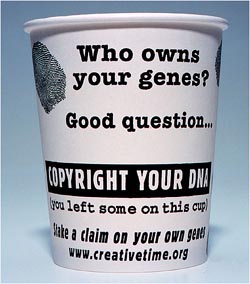
Miller wasn’t content to stop with just protecting his own genes- several years later he made the “Genetic Copyright Certificate” and encouraged others to assert their ownership over their DNA. He sought to generate dialogue over the expanding role that genetic engineering was playing in a society where GMOs were doing everything from feeding us to curing disease.  His genomic rights evangelism expanded as thousands “copyrighted” their genes and word spread via the internet, news media and even, for a time, coffee cups (which is all well and good until Starbucks decides the next logical step in expansion is to do to your DNA what they’ve done to every street corner in NYC).

Who owns your DNA?

The work of genetic artists like Larry Miller certainly raises questions, but does it offer us any answers? The copyrights he helped create have never been legally tested, but would they hold up if they were? The Register of Copyrights explains that “copyright exists from the moment the work is created,” but does that mean we’ve always owned our genes and Miller was just the first to point that out?

Further, supposing that these were enforcible, how would that happen? If someone creates a genetic copy of us (or any other derivative work based on our genome), can they claim fair use? Can we send a cease-and-desist letter (and what would it mean for an organism to “cease and desist” using another’s genes)?  Can we ask them for royalty checks?

These are confusing questions, to be sure, but that’s Miller’s whole idea. He wants to make us ask the awkward and unclear questions about where genetic intellectual property is leading us. He wants us to be confused. He wants us to be concerned.

Even the moniker offered by DNAid, “Certified Original Human,” ends up offering more questions than it answers. If our genes are derived from our parents, can any of us be considered “original?” Even if we can, why should we claim copyright over our DNA if we didn’t create it? After all, it’s our genes that make us- not the other way around.

At least, not yet.

Patent Trolling 2.0 – by “Benjamin G”

According to this NPR article, 86% of wild canola plants in North Dakota contain genetically modified genes. This isn’t a problem for the environment; the pesticide-resistant plants are no more fit in the wild. They basically behave like normal canola unless someone sprays pesticides on them. On the other hand, it is a huge problem for patent law.

Monsanto, the company that developed Roundup Ready Canola, holds a patent on it, and 86% of North Dakota’s wild canola fields are infringing that patent. Patent liability doesn’t require intent, or even knowledge; if you are using a composition of matter that someone else patented, you can be sued. Percy Schmeiser found that out the hard way when Monsanto took him to court for planting Roundup Ready Canola on his farm in 1998.

In 1997 Schmeiser found that some of his crops were resistant to Roundup. He didn’t intentionally plant Monsanto’s product – some seeds might have fallen off a truck or blown on to his property from a neighboring farm. Discovering this happy accident, Schmeiser saved the seeds from those plants and replanted his fields the following year using the resistant seeds. Monsanto sued him for patent infringement and won; luckily for Schmeiser the court found that, since he hadn’t used Roundup on his crops he had received no benefit from the infringement and so owed no damages.

The specific facts of the Schmeiser case are a bit more complicated than that and it happened in Canada, so the legal details of the decision are not important. The main issue, however, is very relevant. U.S. statute and case law explicitly permits patenting living things. And it is one of the defining attributes of a living thing that it can reproduce itself. What happens when a patented organism comes into your posession literally on its own volition? As I said, it’s no defense to show you didn’t know you were infringing a copyright.

Monsanto is certainly not a nice company, but they seem to be just protecting their core business. There are other people out there who are not so benevolent, and the current patent law presents a serious liability issue. We have patent trolls in the tech industry- is it so far fetched to imagine one of them patenting a computer virus? Suppose it actually helps your computer run more efficiently, but is impossible to detect. The troll could come in and sue you for copyright infringement and collect damages for all the benefits you gained from his program.

If it can happen in software, why not in biology? Surely someone could create and patent a new organism whose main goal was to spread itself as widely as possible and implicate as many people as possible in patent infringement. He would of course have to be clever about how he worded his patent application, but I have no doubt it could be done. Depending on how good his organism was, pretty soon he could sue anyone he wanted.

Patents grant their owners a temporary monopoly on their inventions. When we allow patents on things that you can “use” without your knowledge, though, we open the door to people forcing you to pay for goods you didn’t want in the first place. I’m not really sure what the best solution to this problem is. I do think organisms should be patentable, so I guess I would have to take a look at the strict liability aspect of the law. In copyright, for example, if you can prove you never knew about the copyrighted work then you are not liable for infringement. There may be a good reason why patent law is different, though – I just don’t know what it is.

Drug Patents Stifling Innovation by Financially Straining Pharmaceutical Companies – by “Kendall W”

New York Times article

Generally speaking, patents were established to foster innovation and to incentivize creativity.  With most people financially benefiting from patents, this reasoning still holds true.  A patent allows the creator to be the sole seller and profiteer of their product.  A patent allows a company to edge out its competition.  And in the case of biotechnology, a patent allows a biotech company to reap massive financial rewards.  In one year alone, Pfizer yields $10 billion dollars from a single patented drug – Lipitor.  Yet unique to this industry, virtually every dollar made on these mega-brand drugs goes back into research and development to produce other life-saving pharmaceuticals.  Although these drugs are expensive for consumers, this industry as a whole perfectly exemplifies the aforementioned rationale behind establishing patents.  But, with more than 10 drugs, from various pharmaceutical companies, with a combined annual revenue of $50 billion losing their patents this year, the productive cycle may come to a halt.  The Director of the Center for the Study of Drug Development at Tufts University, Kenneth Kaitin, said, “I don’t think there’s a company out there that doesn’t realize they don’t have enough products in the pipeline or the portfolio, don’t have enough revenue to sustain their research and development.”  Without the funds for research and development, pharmaceutical companies can’t test cancer-curing drugs or reduce the symptoms of heart disease.  Some are even going so far as to engage in mergers and acquisitions with smaller companies, which have patents lasting for a few more years, in order to attempt to fund their research and development endeavors.  Even these M&A transactions stifle creativity and the development of new pharmaceuticals by drastically decreasing the number of companies in the industry.

This article and the scenario as a whole raises the question, in the field of biotechnology, are patents hindering what they are supposed to foster, innovation?


America doesn’t run on Dunkin. – by “Sarah C”

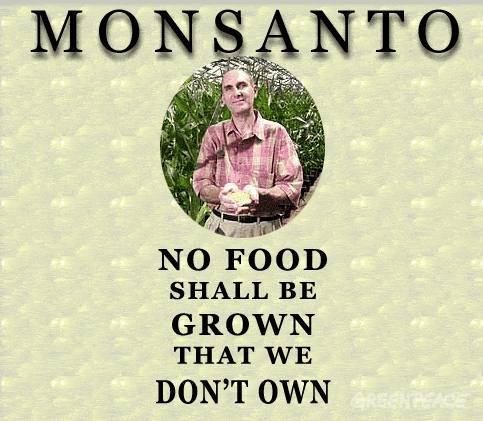
We run on Monsanto. Soon, the world probably will too unless government finally gets out of bed with them. Monsanto is a biotech company specializing in genetically modified organisms, or GMOs as they have come to be known. Lately, Monsanto has been credited with ruining the lives of farmers and developing a practical monopoly on most corn, soybean, cotton, wheat, canola and sugar cane crops. Recent statistics show that about 80% of all genetically modified foods originate from Monsanto.

Here’s a little background information on Monsanto and an introduction to their “mission and accomplishments.” Monsanto has a patent on their genetically modified crops that they tout as factors in saving world hunger and making our world “greener.” Monsanto and many other big agriculture companies use bacillus thuringiensis (BT) in their crops, which is a biological alternative to pesticide and insecticide , thus preventing creatures from destroying a large portion of the crop. BT also increases the crops’ stress tolerance to acidity, drought, etc. Monsanto’s BT cotton saves 2 million gallons of pesticides annually in the US alone. As a result of all biotech crops combines, nearly 300,000 metric tons of pesticides have been avoided and 15 billion kilograms of carbon dioxide saved.

Another example: rice-dependent cultures face major problems with their diets because milled rice has virtually no vitamin A. Hello, “golden rice.” Golden rice is a genetically modified species of rice that includes vitamin A and could potentially save the lives of 200 million people who have deficiencies and over 500,000 victims of blindness each year. So this evidence suggest that agribusiness companies like Monsanto couldn’t be all that bad, right? Especially when you have people like Bill Gates as a member of the support crew.

But, now that I’ve at least mentioned the potential benefits of Monsanto’s efforts, I can begin discussing the much longer list of problems that these efforts are causing. A court case that received huge media attention was Monsanto vs. Schmeiser. Percy Schmeiser was an organic Canadian farmer against GMO crops. However, his neighbor was growing Monsanto’s GMO crops and wind, water, or something swept some of his neighbor’s seeds into his crop. The seeds cross-pollinated and on one of Monsanto’s routine spying sessions, they discovered Schmeiser’s farm contained their patented seeds and Monsanto sued Schmeiser. Schmeiser had no idea this was happening, not did he want it to happen Though Monsanto seeds contaminated his crop, he was sued for patent violation. The court initially ruled that the seed was Monsanto’s property and it did not matter how it ended up on Schmeiser’s farm. In the end, Monsanto paid for clean up on Schmeiser’s farm, but he had already gone practically bankrupt spending his life savings on litigation.

Since this case, over 2000 Canadian farmers have been sued by Monsanto and over 1000 have filed suit against them for contaminating their crops. The seed patent prevents anyone from making, saving, using, or developing the patented product. Monsanto requires that farmers buy seeds each year and forbids the saving of seeds. A farmer saving seed is treated as an intellectual property thief even if his land is unknowingly contaminated. So, basically Monsanto has control of the seed through patents, and control of the rest of the food through contamination.

Fun Fact: Monsanto sets aside $510 million a year to pay for investigations and suits against farmers who aren’t paying their patent royalties. The company literally sends detectives to collect samples from farms and have helicopters that roam over farmers’ land to inspect.

If what Monsanto is doing to small farmers is legal, what does this say about our patent system? Despite not knowing about their accused infringement, farmers are charged and prosecuted for something that was entirely out of their control. It appears that companies like Monsanto are simply using the patent system to acquire monopoly control of products that we have used for hundreds of years. Who would have thought we would actually start patenting our food? And when a corporation clearly in search of profit is controlling something necessary to sustain human life, this becomes a much more serious issue than patenting software, etc.

And despite the scale of this issue, government has yet to take action and has left it up to small farmers to try and make any changes. Obviously, small farmers do not have the deep pockets to litigate against big corporations like Monsanto and are forced back into submission. Hopefully now that Monsanto’s patent abuse is on the national and international radar and their patent term is coming to a close, the government may be more willing to reform.

As more bad media attention targets Monsanto, people have hope that they might actually get a slap in the face. In 2009, Forbes named Monsanto Company of the Year. After America had a collective aneurism, Forbes retracted their selection and admitted its mistake. Regardless, Monsanto is currently encouraging farmers to commit to planting their second version of soybeans, because its existing patent on the first version will expire in 2014. We’ll see what happens there.