Tea Party and Net Neutrality? – by “Joshua K”

In this blog, Eliza Krigman at Nextgov argues that the Tea Party could actually help advance the cause of network neutrality by supporting Rep. Henry Waxman’s (D-CA) proposal, which basically would have restored the pre-Comcast status quo without requiring a reclassification of broadband under Title II of the Communications Act. Though Tea Party activists would like to see no new federal regulation of the Internet, according to Krigman, many of them view the Waxman bill as the lesser of two evils by limiting the FCC’s authority to reclassify broadband  and thus impose more extensive regulations. As conservative blogger Neil Stevens puts it at Redstate, “We need [legislation] to stop this ever-expanding scope that the FCC is claiming for itself.”

Politico released a list of 10 Tea Party candidates to watch, so I decided to check out their websites to learn the Tea Party’s stance on Net Neutrality.

  • Joe Miller-No mention
  • Jesse Kelly-No mention
  • Ken Buck-No mention
  • Dan Maes-No mention
  • Marco Rubio-No mention
  • Rick Scott-No mention
  • Raul Labrador-No mention
  • Rand Paul-No mention
  • Sharron Angle-No mention
  • Mike Lee-No mention

None of Politico’s list of most influential Tea Party candidates have a mention of network neutrality on their website. Seeing that Krigman’s piece references only think-tank analysts, it is hard to see if the actual members of the Tea Party, the voters and the candidates they support, will use their influence to advance network neutrality legislation in Congress. Since network neutrality requires some level of government interference in the marketplace of the Internet, I can’t imagine any serious Tea Party candidate supporting either the FCC’s or Rep. Waxman’s proposal. With Rep. Waxman’s proposal gaining little momentum in the current Congress, we can expect even less work to happen after the election and a likely Republican takeover. Nate Silver at Five Thirty Eight has the Republicans winning the House at 73 percent and 18 percent in the Senate. Thus the future of the Internet and network neutrality most likely now lies in the hands of the FCC and the Obama administration.

The biggest fear might be a Republican Congress actively legislating against any new federal regulations to enforce network neutrality. Senators Kay Bailey Hutchinson, John Ensign, Sam Brownback, David Vitter, Jim DeMint, and John Thune have already introduced an amendment to an appropriations bill that would block FCC funds from developing or implementing new Internet regulations. Though this attempt may have failed, under a different Senate, Hutchinson’s amendment might get passed. The network neutrality debate is far from settled.

Coffee and Filthy Words – by “Frances D”

I didn’t drink coffee until the end of high school. I had actually listened when my mom said, “Coffee will stunt your growth.”  Even though I was staying up late and waking up early, I wanted to be tall.  Put more articulately, I didn’t want to artificially constrain my growth.1 I feel similarly about language and culture, which develop through fluid, indirect, and subtle means.  Likewise, efforts to control verbal expression only artificially hamper the development of culture. Any legislative attempt to create a list of inappropriate words is like coffee to language—it stunts growth.

In FCC v. Pacifica Foundation, the Supreme Court upheld the Federal Communications Commission’s ability to regulate the afternoon radio broadcast of George Carlin’s monologue “Filthy Words.” 2 Its indecent content was broadcast during a time of day when children might overhear. What exactly made this 1,751 word monologue so offensive? To illustrate, I’ve removed the filler – the acceptable words of polite language – this is left3, 4:

Fuck…bitch…bitch…bastard…hell…damn…shit…piss…fuck… cunt…cocksucker… motherfucker…tits…fuck…motherfucker…fuck…cocksucker…sucker…cock…cock…cock…cock…cock-fight…shit…fuck… shit… shit… shit…shit…shit…Shit…shit… shit…shit…shit…shit …shit…shit…shit…shit…shit-house…shit’s… shit… shit… shit… shit…shit-eating…shit-eating…Shit…shit …Shitty… shitty…shitty …shit-fit…Shit-fit…shit…shit… shit… shit…shit… shit… shit… shit… shit…shit…Shit… shit-load …shit-pot …Shit-head… shit-heel… shit … shit…shit-face…shit…shit-face…Shitface …shit…fuck …fuck…Fuck. …Fuck…FUCK FUCK…FUCK…fuck …fuck…fuck…fuck…fuck… fuck…fuck…Fuck …fuck…Madfuckers…fuck …Fuck… fuck  …fuck…fuck …fuck…fuck… shit …shit…shit. …shit…shit…shit …shit …shit …shit …shit…shit …ass…shit… …fart…turd…twat…Fart…tits… Turd…twat… Twat!… twat…Twat…snatch, …box…pussy…snatch…pussy…box…twat…ass …ass

This monologue was created to be offensive in 1975. Yet in its offensiveness, it betrays its temporal nature. True, some words are still considered incredibly rude, but many no longer pack the same punch as they did in the 1970’s. Words fall along an acceptability spectrum. Over time, American culture relocates words within the spectrum. While words such as “colored” have become unacceptable with time, many swear words have transitioned towards acceptable. This transition along the acceptability spectrum occurs in one of two ways. First, a general exposure to a word can accustom a society; this method led to butt, ass, hell, and damn to be generally accepted.  The second method is the reclamation of the offensive word by the offended group.  The gay community has successfully reclaimed the word “queer” from its historical roots as a derogatory term for gay males. “Queer” is so widely accepted now that few people bat an eye at the show “Queer Eye for the Straight Guy.”

The fluidity of language will be fettered by legislative attempts to define what is acceptable and unacceptable for broadcasting.  Supreme Court and lower court rulings in FCC v. Pacifica Foundation and FCC v. Fox Television Stations have created a foundation upon which government can control offensive language in broadcasting.  The only stipulation is that these regulations must not be as vague as the regulation contested in FCC v. Fox Television Stations.  This possibility for future legislation could quickly lead to television and radio broadcasting that are permanently stuck in the time period that the legislation’s last amendment; it would be as if current television could only air Leave It To Beaver and I Love Lucy–esque dialogues. Therefore, the Supreme Court missed a great opportunity in FCC v. Fox Television Stations—namely, the opportunity to create the foundation for cultural fluidity by overturning FCC v. Pacifica Foundation and declaring the regulations unconstitutional, instead of leaving the constitutionality to be determined by a lower court.

1) I’m aware now that coffee does not actually stunt growth. Looking back, I realize my mom probably just didn’t want to deal with a twelve year old hyped up on caffeine.

2) “Filthy Words by George Carlin.” UMKC School of Law. Web. 13 Oct. 2010. <http://www.law.umkc.edu/faculty/projects/ftrials/conlaw/filthywords.html>.

3) No modification was done to the transcript besides replacing the polite words with ellipsis. All emphasis is original.

Facebook Memes: Where do you like it? – by “Luke H”

Facebook, when contrasted to the plethora of social media sites out there, has an incredibly vast output of and a potential for the creation of memes. Facebook today is a massive influx of information and opinions regarding social lives and ideas, and it is only natural that some of these ideas are found amusing or funny etc, and subsequently are imitated by others, and variations are made of it. The funny thing about Facebook is as wide ranging and encompassing as it is, it still is quite limiting when it comes to the structure of its memes. Far and away the most common is the status update. Status updates on Facebook assist people in identifying, learning, and comprehending their friends and the people around them. It is a brief window into the individual; it lets us in on what they are thinking, what they are doing, and how they are feeling. Another staggering part to status updates is their rampant popularity: Every day, hundreds of thousands of people across the world write new updates, using millions upon millions of words to describe one thing or another. The memes that take place here can offer an interesting take on all of the things thoughts and feelings that connect people.

Take a trend that began earlier this month on Facebook that consisted of a flooding of updates that spelled out where women “like it”. (Although some people claim the “it” refers to purses, and where they like to put them, I don’t think I have to spell out for you what was implied by these posts.) Evidently, all these posts were supposed to go hand in hand with National Breast Cancer Awareness month (this October!) to promote awareness, to encourage efforts for the search for a cure, and to egg women on to get breast exams.

Some criticism and disapproval has been levied against the posts, and on one level, it’s very difficult to fight against breast cancer awareness. How does one voice their opinion against these posts without sounding far too prim and proper? Is it even possible to voice opinion against these posts without sounding against breast cancer awareness? But on the other hand I don’t necessarily like the feeling of using breast cancer awareness as a front to make funny, sometimes mocking jokes on Facebook. It doesn’t feel right, it doesn’t carry the right message, and it really isn’t even related to breast cancer awareness.

The incredible thing at hand here is the polarization, and immediate judgment making and opinion forming that takes place all because of a silly little meme on Facebook. People and advertisers have been putting out their opinions and products into the open for a very long time, with everyone competing for attention. The creation of memes – that is, ideas that replicate themselves in the common social collective – has been harnessed by people everywhere to spread their ideas.  The question is, are memes like the ones we can find in Facebook valuable? Are they taken seriously enough to force you to think about X, Y, or Z? Do they last long enough to even have an impact in our lives? I suppose only time can tell.

My First Vist to 4chan.org – by “Matthew E”

Anyone familiar with internet culture has heard of the infamous 4chan.org.  Many are probably equally familiar with the sort of content that comes out of 4chan.  As a member of other online communities (namely gaming forums), I have encountered numerous memes and image macros, many of which have originated at 4chan, including the list from Meme Factory in the New York Times article we read for class: Boxxy, David After Dentist, Star Wars Kid, “Downfall,” Advice Dog, “Imma chargin mah lazer!” Crasher Squirrel, “This is Sparta!”  I even went to see moot at the Calhoun Master’s Tea last year as well as Meme Factory’s presentation in Davies Auditorium.  Yet I have never actually visited 4chan.org.  That having been said, I’ve seen screenshots of a typical thread.  But I decided that, for the sake of my blog post, I would boldly go where most internet goers dare not go.

Once I had typed the URL into Chrome’s browser bar, I was greeted with a tame-looking page.  With a friendly-looking four-leaf clover logo on top, a list of the image boards, and a sample of recent images and posts, everything looked pretty normal.  The recent images posted included an animated pig with a sock, a Gundam-looking mech, and a Canadian flag (probably the most offensive thing on the page).  The recent post and popular thread list didn’t include any posts or threads from the hentai or random (/b/) boards.

I clicked open the rules in a new tab before I proceeded into any image board.  There were 14 global rules that applied to all image boards as well as board specific rules.  The rules looked to be well-ordered and similar to rules you would find at any reputable site with one notable exception, Global Rule #3.  “Do not post the following outside of /b/: Trolls, flames, racism, off-topic replies, uncalled for catchphrases, macro image replies, indecipherable text (example: “lol u tk him 2da bar|?”), anthropomorphic (“furry”), grotesque (“guro”), or loli/shota pornography.”  Hmmm, I thought, this is more of what comes to mind when I think of 4chan, and especially when I think of /b/.  I should also mention that some of the board-specific rules were quite funny, including: “ZOMG NONE!!!1” for /b/, “There is to be no discussion of Ayn Rand” for the literature board, and “GOTTA CATCH ‘EM ALL.  This will be severely punished and strictly enforced” for the Pokémon board.  I then moved on to the FAQ’s for the website, which were also written in a helpful, light-hearted tone.  I couldn’t help noticing the Culture section of the FAQ’s, especially the humours entry for “Who is ‘Anonymous’?”.  You can read it for yourself here.

Having read the required documentation, I continued into the weapons board /k/. I decided I would work my way up to /b/ and I figured /k/ wouldn’t have anything I didn’t want to see.  .  Upon entering the page, I found a relatively humorous thread with the following picture and the comment “post your shoops.”

/k/ image

Being the savvy internet community user I am, I expected some funny Photoshopped (shooped) pictures.  I wasn’t disappointed when I found pictures of the guy holding a large tuna fish, a golden gun, the broom from the picture, and (the least safe for work image on the page) an oversized black dildo.  My assessment of the image board is that the posters posted in good taste, using language comprehensible to most people.  The images posted were in good taste and not anything worse than I’ve seen posted on other forums.  While I noticed the occasional foul and bigoted remark on the board, I reminded myself that this is the internet.  I’m just as likely to find that in the Fox News comments section.

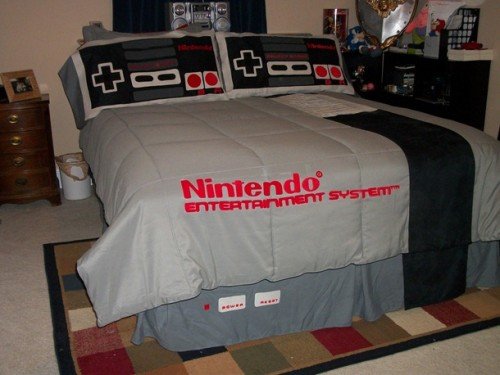
Next I proceeded to /v/, the video games section.  While the blue color scheme suggested it would be SFW (safe for work), I was greeted with what appeared to be a transvestite about halfway down the page.  Other than that one picture, the rest of the image threads seemed on topic, including a NES-themed bedspread (link) complete with NES controllers for pillows, a nostalgic (for me at least) picture from a Spyro game, and a thread about your favorite video games past and present.  After viewing the threads posted in this image board, my opinion of the 4channers of /v/ increased quite dramatically (except for the one who posted that NSFW pic).  Also of note was that almost all people in /v/ posted as Anonymous as opposed to people in /k/, many of whom posted using a name with a “tripcode,” or pseudo-authentication mechanism.

Before I take the final leap into /b/, I thought I would just point out that there is an indecently exposed anime-styled female on the top of the /v/ page with a miniaturized 4chan logo and name.  I didn’t know 4chan outright sponsored that, especially in /v/ but whatever floats their boat, I guess.

And then there was /b/:  Allow me to say that the name random was pretty appropriate for the content I saw on the site.  Pictures included everything from image macros, troll faces, boobs, mazes, x-ray goggles, and disfigured bodies to boobs, naked women, more image macros, math problems, and boobs.  As for the text of the comments: well, I didn’t read most of it.  I can say it was pretty similar to what I’d seen on other boards, although possibly more hostile.  Apart from the porn, there were also some images that made me say “Oh God,” shudder, and move on.  I didn’t end up spending much time on /b/.  Because of its random nature, it wasn’t incredibly entertaining.  Still, I feel like I saw what was there to see.

The following are a list of my conclusions after visiting 4chan:

  • It’s not as bad as I imagined.  I guess most of my image of 4chan was based on the bad reputation of /b/.  The other boards I glanced over looked reasonable and were often somewhat funny.
  • It’s not something I plan to take part in any time in the future, although it sure looks like a way to kill a couple of hours.
  • Through my exposed to online culture, I was able to understand most of the goings on of 4chan
  • The community of 4chan isn’t as hostile to each other as one might be lead to believe, and most of them have a good sense of humor.

I survived the browsing of 4chan with my sanity mostly intact.  For anyone that hasn’t looked at the site yet, I suggest you at least take a look at the rules and FAQs to get a better understanding of how the site works.

Are funny memes impeding on our fun? – by “Kate F”

A couple of years ago, Nicholas Carr wrote an article in The Atlantic about how the internet changes the way people take in information and think about it.  In fact, the way you read my last sentence may well have illustrated his point: if you’re an average modern internet-media-consuming reader, you may well be reading this sentence as the article loads in the next tab, preparing to read about a page of the article, click on some more links in it, skim those, and (I hope) somehow find your way back here.  In fact, according to a University College London study that Carr cites, the average user of a research site only reads about 1-2 pages of any given article before bouncing off to another one.  Arguably, Google and hyperlinks are making it hard for us to focus on serious, lengthy books or even full blog posts.  Ironically, the more information we have easy access to, the harder it is to really use it.

But so what, you might ask?  For the purposes of this blog post, let’s concede that the internet isn’t the best research tool.  You could still argue that the internet is a veritable trove of music, trivia, funny pictures, funny videos, audio recordings of guys messing with telemarkers, and status updates from everyone you’ve ever met.

Yet I wonder if perhaps these vast resources of fun suffer the same pitfall that Carr attributes to the internet’s research tools.  Does this wealth of entertainment options make us incapable of engaging with lengthier entertainment, or even of focusing on any one option?  Anecdotally, I for one have realized lately that I struggle to focus for the duration of a tv show, let alone an entire movie.  When I watch tv online, I might start browsing some Texts From Last Night or checking my email or reading the newspaper in the next tab during a particularly slow scene. A good portion of the time, I get distracted and never even return to finish what I was watching.  In fact, I can’t make it through a Youtube video without getting distracted by the “suggested videos” on the side panel.

It’s an odd experience, because I don’t “have to” do any of those things, so it’s not as though I’m trying to more efficiently work my way through my entertainment to-do list.  Presumably, if I’m rational, the only reason I’d be multi-tasking during my leisure time is if twice as much media means twice as much fun.  But oddly, I’m not so sure that’s the case.  My tendency to multi-task online feels almost like a compulsion, as if the “new tab” button is calling out to me at all times against my own will.  The more I accustom myself to bounce through lots of quick blips of fun, the less I remember how to home in on just one leisure activity even if I wanted to.

Of course, blippy fun exists in the real world too (for example, comics), and the internet contains more developed entertainment as well (for example, feature-length films streamed online).  By definition, a “meme” is merely an idea, which could be about anything from weighty subjects like religion to trivial ones like LOLCats.  Yet I think it’s fairly clear that the entertainment-related memes that go viral online do not tend to be the long, time-consuming ones.  The most popular Youtube videos are almost always only a few minutes long; the viral email jokes your grandfather forwards to you are not book-length.  Perhaps the internet could theoretically help hour-long TED talks go viral to the general public, but in practice, it doesn’t.  We come to the internet for immediate laughs.

This desire for some instant humor as a break in a busy day isn’t in and of itself scary.  What I find frightening is that this might increasingly be the only type of pleasure and humor that we can appreciate.  I used to think there was something enjoyable about watching a sitcom every week, about knowing the characters and their histories and personalities in depth.  I feel that I’ve lost something when my entertainment comes primarily from a constantly changing cast of new, funny characters (Hoodrat kid! Fake Hitler! Miss Teen South Carolina!) or, alternatively, ripoffs of characters I came to know and love back when I actually read books and watched tv.  It’s only because I committed the time to read all 5,000 pages of Harry Potter fifteen times, gaining a nuanced and intimate understanding of Hermione’s psyche, that a parody video on YouTube makes sense.  It’s only because I watched a lot of Sesame Street that the irony of an obscene Count von Count is funny.  Parody is the fodder of many popular internet memes, and it feeds on the sorts of deeper-level cultural knowledge that a population with an attention span of 3 minutes can never gain.  What can we parody when we can no longer focus for long enough to really engage with characters in their original works?

I won’t argue that it’s bad to enjoy the occasional YouTube video.  But I will argue that if our enjoyment of short, popular memes on the internet shortens our attention spans to the point that it’s difficult for us to enjoy books, movies, and even tv, we are suffering a real loss.  At least for now, that claim isn’t scientifically proven, and I recognize that I rely primarily on anecdotal evidence in this discussion.  Hopefully further research will shed more light on the effects of blippy entertaining memes on the way we enjoy our free time.

But hey, perhaps by the time someone publishes an article about it, we’ll be too busy watching a baby sing Taylor Swift medleys in French to care.

Wikipedia: Creating a Generation of Thinkers – by “Laure F”

I’m not sure how many times a day I refer to Wikipedia.  Maybe 10-15 times on an average day.  A glance through my Internet history in the past week reveals Wikipedia searches as varied as Scientology, Cauchy’s Theorem, Twyla Tharp, and Queen (band).

Everyone seems to be using Wikipedia these days. It is the automatic go-to source of information whenever people are faced with a question or a cultural with which they are unfamiliar. Famously, even Rush Limbaugh (not that Rush Limbaugh should be taken as any kind of indicator of national trends) who has often told his listeners not to believe what they read on Wikipedia was caught referencing information obtained from Wikipedia.  The information, which was about a federal judge, later turned out to be false, having been posted by some Wikipedia prankster.  The misinformation was corrected shortly after it was posted. Limbaugh simply had the misfortune of checking the site while the false information was still posted (I never thought I would see the day when I would feel sympathy for Rush Limbaugh).

http://www.nytimes.com/2010/09/16/us/16judge.html?scp=1&sq=wikipedia%20rush&st=cse

In talking to people over the last few days about their experiences with and attitudes towards Wikipedia, I have found that people’s feelings about Wikipedia are pretty uniform.  The first reaction I got from everyone was how useful Wikipedia is.  They all told me how they use Wikipedia for random factual searches as well as for writing papers. People talked about how often they use it for classes: whether for math classes, science classes, English classes, or sociology classes.  It seems to be the number one resource used for questions like: “Now what is exactly is the formula for integration by parts?” as well as for questions like: “Now how many years has it been since Patrick Swayze died and what kind of cancer exactly did he have?”

However, with all of the people that I talked to, they immediately followed their praise of Wikipedia’s usefulness by adding that Wikipedia cannot be trusted.  They all went on at length about the problems of letting anyone edit a page. Many people talked about how companies and individuals could edit their own Wikipedia pages to portray themselves in a positive light.  Some people even showed me examples of pages that were clearly taken from company promotional materials or pages that were simply poorly written and lacking in impartiality.  (For an example, check out the Pierson College Wikipedia page http://en.wikipedia.org/wiki/Pierson_College.)  Everyone seemed to have some kind of anecdote about the untrustworthiness of Wikipedia.  Many of them admitted to having purposely changed Wikipedia articles to make them contain false information. However, when pressed, they conceded that the pages they had edited had quickly been restored to their former form.

I find this contrast incredibly fascinating.  People do not trust the accuracy of their main source of information and yet they continue to use it because nothing else can compare to Wikipedia in terms of breadth of information and easy accessibility. General wisdom says that this contrast is a bad thing.  Everyone I talked to went on at length about how bad it is that Wikipedia has found such a strong foothold in our society when one cannot trust the veracity of all of the statements it makes. However, I beg to differ on this point.

Before the days of Wikipedia, when people had a question about something they turned to news media or encyclopedias. However, in actuality, these sources really aren’t any more trustworthy than Wikipedia is. A recent study (albeit a controversial one) found that articles on Wikipedia on average had the same number errors as equivalent articles in the Encyclopedia Britannica. Similarly, news media gets things wrong all of the time and is incredibly biased in its presentation of things. Whenever I have seen a news story about something I actually know about, I have been horrified at the inaccuracies of the story.  I can only assume that the stories I don’t know anything about are just as inaccurate.

In my mind, this not only demonstrates that people are learning to navigate the world of Wikipedia, thus better detecting areas of false information and so helping to make Wikipedia a more reliable source, but that Wikipedia in being the main source of information for a lot people, is helping to produce a generation of critical thinkers.  It is creating a generation of people who don’t just blindly accept information, but who remember that all of the information with which they are presented whether on Wikipedia or in the news is presented by people, people who may not always be the most trustworthy sources.

Thus, I think Wikipedia has done an enormous service to society in more ways than one. Yes, creating a vast database of easily accessible up-to-date information is important and incredible and worthy of all kinds of praise. But I think that another one of the really important legacies of Wikipedia is one that people don’t think about much. That is, that Wikipedia has created a generation of critical thinkers.  It has created a generation that questions where information comes from and is fluent at fleshing out areas of bias and inaccuracies.

I think Wikipedia teaches people incredibly important skills, namely the ability to ask: Who is writing this, what are their motivations, what might they not be saying, is this really true, what evidence is there to support this statement? These are skills that people then apply to other areas of their lives.  I think this generation, when watching a news story, or reading blog, or even reading a textbook—all resources whose accuracy people normally might not have questioned—now asks these same questions.  Wikipedia has thus created a generation that does not just blindly accept, but analyzes and criticizes and thinks.  And I think that is the true legacy of Wikipedia.

Are We Wikiaddicts? – by “Kristin B”

One of the first things that comes to mind when we think of Wikipedia is the collaborative, democratic effort of the project. Basically, because we like democracy, we like Wikipedia. We like the anonymity, the ability to access millions of articles in one convenient place about anything we ever wanted to know very quickly. We browse the website for leisure, and we even check it during class to check facts (or even to seem smarter than we actually are). It’s permeated our culture in such a way that it has become a verb, like “to Google.” It’s accessible, common, and we use it. A lot.

However, the democratic nature of the site is actually its biggest fault: people that post and edit may not be technical, unbiased experts on particular subjects, and that leads to a lack of full information. A main highlight of the site is the ability to edit articles, but, when it is unclear who is behind the text, it is uncertain how much we can rely on what the text says. It’s true that there are checks in place for some of these things, such as new software that can more accurately find and correct fallacious information. There are internal and well-known checks as well, such as the familiar call for re-editing or note about bias with the familiar broom icon at the top of a contentious article. However,While Wikipedia does highlight bias and invite re-editing, it is true that, especially if there is a reference cited, Wikipedia often does not catch mistakes. Furthermore, it is unclear that the re-editing will actually be more accurate and solve the initial problem. Even worse, we usually don’t react when we see an article designated as such. We realize that the bias or inaccuracy may be there, but we read it anyway as an initial source of information.

To us, these problems should not matter. We are definitely smart enough to ascertain that a popularly-edited site probably contains mistakes, right? We have always been taught that “Wikipedia is NOT a valid source, but a good starting point for background knowledge,” expressly BECAUSE of this collaborative nature. Unsuprisingly, that fails to be the case in many circumstances.

Take, for example, a recent article from the UK in The Register that discusses just how lazy we are becoming. Apparently, even our journalists, the last bastion of accuracy and doggedness in finding out the truth, are relying on Wikipedia as a primary source. Journalists in The Guardian and The Mirror apparently used Wikipedia to write the obituaries of Norman Wisdom, who was a comedian, singer, and actor (yes, I DID just Wikipedia him to figure out exactly who he was). There  were several inaccuracies in the entry, and the Guardian still had not corrected the mistake at the time of the article. Additionally telling is the fact that it was widely known that a reference to and reliance upon Wikipedia caused the errors to occur, but neither publication has acknowledged that this was, in fact, the case.

Poor Norman Wisdom is not the only person to be misrepresented by the inaccuracies of Wikipedia. Some inaccuracies are a little more devastating to one’s reputation than having been mistaken as the author of a song or said to have been nominated for an Oscar. In an interview with NPR, the founding editorial director of USA Today defends that he is not, in fact, likely culpable in the assassinations of JFK or RFK.

In another story, golfer Fuzzy Zoeller sued to find the author of his Wikipedia page, who had slandered him in a number of ways. This brings up a host of legal issues. The anonymity is the selling point, but, at the point that things are inaccurate, how anonymous should things on Wikipedia be? What are the future legal implications of this suit? Does the fact that Zoeller sued at all, clearly caring about a characterization of himself via this PARTICULAR channel show our continued dependence on it? Should Wikipedia be treated like any other news source? How much of our First Amendment rights extend to a place like Wikipedia and the internet?

While this is a humorous example, it does highlight the issue of collaboration: anyone can write anything (at least for a time). The process of tracking these mistakes is slow, and the inaccuracies often go unnoticed, especially if tied to ANY reference (it’s unclear if the references have to be “reliable” or “expert” sources, although Wikipedia likes to claim it won’t allow any unpublished references to contribute to entries). The worst part is that those whom we expect to seek the truth and keep us informed when we can’t do so ourselves are using it as ironclad truth.

Wikipedia is a great tool, but are we addicted and blinded in such a way by the communitarian nature and the ease of access that we fail to see when something is wholly inaccurate?

Two love letters to Wikipedia – by “Joel S”

May 2010:

Dear Wikipedia,

As a senior in high school, about to close the book on this remarkable journey, I feel the pressing need to profess my deepest adoration and gratitude for you. Frankly, you have been an indispensable asset, nay, a lifesaver throughout these past four years. I would be remiss if in thinking about the end and all who helped me get here I didn’t acknowledge you.

Seeing as I have no background in technological law, I care not about the legal questions that your services beg. Instead, I concern myself only with what you provide for me – a seemingly endless bounty of information, free of charge, and full of knowledge. You are an ostensibly omniscient being, providing information on almost any topic, be it acalculia, a calculator, or calculus. From the extensive to the esoteric, no topic seems too big or too small for your cavernous amphora of genius. Time and time again, topics, theories, and historical figures have bemused me. After flipping through the book, scouring the Internet, and nearly giving up, you are so often the one who helps me find what I’ve been searching for.

You’re also a time saver. Take that assignment in US history for example; remember all the way back to junior year? We had to identify less well-known civil war generals whose names were scattered throughout hundreds of pages of text. Rather than sift through the book, I consulted your services, and found all of the information that I needed for every last one of the generals – brigade commanded, side for which they fought, battles in which they participated. I even threw in some extra information that the teacher regarded as going “above and beyond” what was asked for in the assignment. Yes, Wikipedia, you are a bastion of efficiency.

Additionally, you satisfy my intense thirst for knowledge. If ever I find myself in a situation in which I desire to know more about a specific subject, you are the source to which I turn. When I wanted to learn what the WHIP statistic measured in baseball, I read your page. When my comparative government teacher discussed Ad Nauseam about Weber’s Modernization Theory, your page helped make sense of what exactly it was she was talking about. And, just a few days ago, when I found out what residential college I had been placed into at Yale, your page convinced me that Trumbull is indeed the best college at the school. Thank you Wikipedia for providing me, and countless others, with a free and rapidly evolving database of both useful and inane trivia.

Teachers may question the veracity of everything that you say. They are incredulous that a website monitored and maintained by the public can consistently result in fair, unbiased, and useful information. I understand their concerns, but throughout our four-year relationship, you have yet to let me down. I just want to say, in closing, that I love you Wikipedia, and I’m so happy that we get to go to college together.

Sincerely,
Me

October 5, 2010

Dear Wikipedia:

It’s been a little while since we have last spoken. I did not mean to neglect you; it’s just that, well college work is different than high school assignments. Also, I’m taking this intro to law and technology class that is reshaping the way that I view the Internet. It’s not that my feelings about you are any different; I still love you. It’s just that, well, the reasons for my loving you have changed.

No longer do I consider you the ‘be-all-end-all’ source of knowledge. The constant refrain of my high school teachers was in fact true: you are a good starting off point. For high school assignments where a rudimentary understanding of basic concepts was normally sufficient, you were all that was needed. That’s all changed now though, as classes go deeper in depth on more specific topics. It turns out you’re not as powerful as I used to think you were.

Though, in a technological sense, you are a paradigm-shifting database. A true embodiment of the auspices of the free software movement, your survival relies on the work of countless volunteers. As a manifestation of peer production, your work is a true testament to the power of collaboration, and signals a substantial cadre of people hoping to use the Internet as a communal tool, rather than simply a source from which you can readily access desired information. Upon reflection and further research, you were created to act as a discussion board among scholars and students alike, working together to create fair and balanced articles on all subjects that merited recognition. Your administrators, editors, and viewers to a lesser extent have adopted an esprit de corps that is founded on trust, curiosity, and an investment of trust in Internet users. If nothing else, you serve as an interesting social experiment as to what benefits and detriments arise out of increasing the role of the average Internet user in shaping widely read material. In terms of pure technology, your function is basic but noble. You recognize the human desire for immediate updates, and the near instantaneous dissatisfaction that comes with obsolete facts. In essence, you create a program that enables technologically inept users (such as myself) to make a difference in a domain in which they know very little.

Legally speaking, you also are an interesting case study. It makes sense that one of the few instances in which you censor material is when users post material that is an infringement of copyright. You create a culture in which the public decides the reputation of individuals by eschewing any tampering of one’s own page. Though, many reputation wary individuals (politicians come instantly to mind) ignore this cultural law and tamper with pages to enhance their accomplishments and downplay their pitfalls. Many subsidiary companies have started up, contrary to the non-for-profit nature of your endeavors, and consistently attempt to buffer the effects of bad press by editing their client’s pages. This creates an interesting quandary for you, and I wish I could tell you of some panacea to make it go away. I will say though, that through it all, I admire your commitment to assuming that all who use your services do so in the best interest of the general public.

Additionally, as Zittrain points out, your editors hold true to a certain ethos when working on your site (http://futureoftheinternet.org/static/ZittrainTheFutureoftheInternet.pdf, p. 142). Your dedication to neutrality signifies that readers most often find articles devoid of any noticeable bias. While that is a near impossibility, the technical style in which your articles are written come close to representing a fair account of the subject. Also, your stance on verifiability ensures readers that, while they should still be cautious, the majority of information found in your most frequently read articles is cited. And lastly, as an organization that conducts no original research, you uphold the purpose of an encyclopedia, and aggregate the work of many into one convenient, central location

In closing, I want to thank you again for all of your help, both as a source of information, and a beacon of hope for the future of the internet. Hopefully one day soon, people will put truth above stature, and care more about the accuracy and fairness of information on your site rather than what way to best enhance their own image on your pages.

Until next time,
Me

Conservative collaboration and the Wikipedia model – by “Zachary M”

Below is an interview from The Colbert Report of Andy Schlafly, the founder of Conservapedia, a conservative version of Wikipedia, and more recently the wiki-based Bible translation, the Conservative Bible Project. (I’m not sure the embedding is working; you can view it here.)

The Colbert Report Mon – Thurs 11:30pm / 10:30c
Andy Schlafly
www.colbertnation.com
Colbert Report Full Episodes 2010 Election March to Keep Fear Alive

First, let’s back up a second and understand what Conservapedia is.  It describes itself as a “conservative, family-friendly Wiki encyclopedia,” “conservative” being defined as someone who “adheres to principles of limited government, personal responsibility and moral values, agreeing with George Washington’s Farewell Address that “religion and morality are indispensable supports” to political prosperity.”  Andy Schlafly, son of Phyllis Schlafly, (known best for her opposition to the Equal Rights Amendment and feminism in general), founded it as a response to the perceived “liberal bias” of Wikipedia.

The articles have such blatant bias that they almost seem comedic most of the time.  For example, the article Barrack Hussein Obama (note the inclusion of the middle name) contains an entire section on evidence that Obama is a muslim, and the central policies are called the Conservapedia Commandments.  When I show Conservapedia to friends unfamiliar with it, they usually think it’s a joke like Encyclopedia Dramatica or Uncyclopedia.

The general encyclopedic part notwithstanding, Schlafly’s Conservative Bible Project (CBP) (hosted through Conservapedia) sounds just plain bizarre (Colbert puts it: “We already have that; it’s called The Bible.”)  It claims to be correcting for the following “errors in conveying Biblical meaning”:

  • lack of precision in the original language, such as terms underdeveloped to convey new concepts introduced by Christ
  • lack of precision in modern language
  • translation bias, mainly of the liberal kind, in converting the original language to the modern one.

The first claim seems to question the original scriptures, which otherwise would violate the purported belief that the Bible is the inspired, inerrant word of God- it suggests that divine revelation is unsatisfactory.  The second is linguistically inaccurate: the first thing you learn in any linguistics course is that all languages and dialects are equally valid; they just use different strategies to express the same things.  The third is what the rest of the article tries to establish, citing a handful of examples ranging in validity.  Schlafly’s general argument is that all of our views should be informed by our religion, largely meaning the Bible, and this is the source of his conservatism.  To then alter the supposed source of conservatism to make it more conservative makes the belief system circular. (Full disclosure here: I’m a committed Christian myself and consider the CBP to be disturbing.)

Andy Schlafly is a Princeton alum.
The Conservative Bible Project Page

Despite referring to itself as a “translation,” the project page doesn’t once suggest that contributors refer to the original Greek or Hebrew, though there is one link to a Greek text at the bottom of the page.  Its desire to fix translation inaccuracies is clearly not shown in a particularly ironic passage, Revelation 22:18-19:

I warn every man who hears the words of the prophecy of this book: If any man adds to these things, God will add to him the plagues that are written in this book. And if any man subtracts from the words of the book of this prophecy, God will subtract his portion out of the Book of Life, and out of the holy city, and from the things written in this book.

The word “Book” here should be “Tree.”  It results from the fact that the Conservative Bible is based on the King James Version, which for the end of Revelation was translated from Greek to Latin to Greek to English.  The Latin words for book and tree are similar, so that’s probably where the error came from.  This is actually theologically significant, since the “Tree of Life” recalls the Garden of Eden and the “Book of Life” creates a new concept, something like “God has a list of people going to heaven in a book,” which I’m pretty sure I heard once or twice in Sunday School growing up.  However, the CBP editors clearly didn’t care about a more accurate translation- when an error could not be corrected to make the passage more conservative, it was ignored.  It also seems that they didn’t read this passage at all, considering it promises them some significant divine punishment.

OK, so the CBP is inherently contradictory as a concept.  But what can we learn about collaboration from it?  Andy Schlafly makes some interesting assertions in his interview with Colbert:

  1. Isaac Newton claimed that work translating the Bible was responsible for his other insights and those of his contemporaries.  Thus, opening this process up to the general public is a major public service.
  2. This Conservative Bible is produced by the “best of the public,” which is better than experts. (“There are no definitive experts.”)
  3. The objective truth “becomes clear with time” through the work of the community.

If this claim about Newton is true, the first point is perhaps actually a justification for the project.  However, I doubt Newton was translating the Bible with an agenda other than understanding its meaning and am pretty sure it would have been from the original texts.  The other two, however, are much more general points about collaboration.  In essence, No. 2 and 3 are similar to the concepts governing Wikipedia.  Schlafly’s wording just happens to reduce the concept almost ad absurdum.  The Conservapedia Constitution opens with the statement: “Editing on Conservapedia is open to the best of the public – and that includes you.”  It does not say “and that could be you”- everyone is the best of the public, which renders the term meaningless.

The Conservapedia article Best of the public goes on to list “examples” of the concept, including many amateurs who rose to important status, including New Testament authors, Ronald Reagan, and one-hit wonders.   Though the selection is perhaps tailored to a conservative audience (except for examples like “Ice Ice Baby”), this is actually one of the most important sentiments in Internet culture.  As the “best of the public” article notes, any amateur can write a blog and dispense important information.  Wikipedia also depends on amateurs to synthesize information in an encyclopedic fashion, “encyclopedic” being identified by the myriad of policies, policies which were written by these amateurs.

This leads back to the fact that best of the public is presented in an absurd way on Conservapedia, showing an underlying tautology in collaborative web communities:  What is reliable information? That which the established members of the community achieve consensus on.  Who  gets to be an established member of the community?  Someone who provides reliable information. Colbert exposed this by having his fans edit him into the Conservative Bible- they created a clearly false consensus, and to overcome this, Conservapedia leaders had to violate the tenets of consensus.  An analogous situation would be issues of repeated vandalism in Wikipedia; articles prone to biased editing and vandalism, like “Christianity” and “George W. Bush,” tend to be semi-protected, meaning only established users can edit them.

If, however, a large group of people were to register Wikipedia accounts and assert on a discussion page something patently false was in accordance with Wikipedia policy, the community would be hard-pressed to go against  the consensus.  This generally doesn’t happen, since there are tons of Wikipedia users with a contrary opinion (who probably know Wikipedia policies well enough to cite them by abbreviation like WP:FU and WP:NOR and WP:NOTPAPER; as you can see, I’ve been inside this process).  This is actually why Conservapedia formed in the first place;  people with extreme conservative views found themselves quickly barred entry by an already-existing community.  We can only hope that the community is “right,” since such a gigantic status quo is hard to shift; the policies themselves are built around it.  Conservapedia, therefore, is no different from Wikipedia in that regard: an established status quo bars edits that violate the beliefs of the community.  It’s just that Wikipedia seems intuitively much more rational to most of us.

So now, all of the concepts behind Internet collaboration are tautological.  Where does that leave us?  Thankfully, there has been some review from outside of the system to help gauge whether it’s working.  A study in Nature found that Wikipedia is about as accurate as Encyclopedia Britannica.  That can give us some comfort that the system is doing its job and that any community-based inertia isn’t necessarily bad.  I don’t think any study has been conducted of Conservapedia or the Conservative Bible.

But I’m sure if a study did find Conservapedia to be less than accurate, Conservapedia would happily point out its liberal bias.

UPDATE: I just remembered that Andy Schlafly’s daughter Phyllis, who goes to Princeton, posted this on PrincetonFML: “My dad is the founder of Conservapedia. MLIG” An interesting discussion resulted, raising some of the points I raised here. (The OP is indeed his daughter; she posted about it on Facebook.)

Wikipedia: The Next Political Battleground? – by “Magic M”

Paul Krugman notes an interesting phenomenon in his Sunday NYT article here – every major contender (save Mitt Romney) for the 2012 Republican nomination who doesn’t currently hold a political office is a paid contributor to Fox News.  There’s undeniably a connection between the network (and its parent News Corporation’s other holdings, like the Wall Street Journal) and the Republican establishment, and there has been for years, but the much more worrying phenomenon is their ability as of late to craft a symbiotic relationship with the populism manifested by the Tea Party movement.  Politicians like Sarah Palin and Christine O’Donnell and personalities like Rush Limbaugh or Glenn Beck have developed an almost messianic aura, and their followers often display cultish devotion to ideas that have only the most tenuous grasp on sanity, chief among them the belief apparently held by a fifth of this country that “Obama is a Muslim!” (forget for a moment the implicitly bigoted suggestion the tone with which such statements are uttered conveys) .

 These leaders aren’t just far-right nutcases, they’re far-right nutcases with rather serious and powerful backers.  In return for supporting policies that probably end up hurting the middle-class Americans they claim to work for but benefit the war hawk (hopscotch from Afghanistan to Iraq to Pakistan to maybe-soon-Iran, anyone?) and business tycoons types, they get massive amounts of network coverage and make their election (and implementation of said policies) all the more likely.  Some commentators have suggested this populist movement is a temporary quirk, a function of the economic situation that will blow over quickly after the 2012 election.  I disagree.  I’m worried it has a little bit more staying power than that, and I’m worried it could be the end of democracy as we know it.

Okay, so maybe that’s a little bit melodramatic.  But a culture war is surely coming, and the next battleground may well be Wikipedia.

Constituents in this country rarely reward the candidates who take nuanced and charitable positions on topics.  The televised presidential debates rarely explore the intricacies of the topics they engage on; candidates instead turn to pre-prepared statements and catch-phrases, all in a ceaseless kowtow to the 24-hour news cycle.  The public simply loves to deal in absolutes.  Either we should go into foreign countries and spread democracy by force in every case because damn it, freedom and justice and apple pie demand it, or our last administration was full of sadistic torturers and Christian zealots plucked right out from the Inquisition or Crusades.  By and large it’s the academics who flesh out arguments for or against these policies more thoroughly in research papers – but it isn’t the academics who govern Wikipedia.   It’s the mob.  And there’s no reason to think they won’t turn to Wikipedia to serve their political interests.

Wikipedia has already seen attempts at manipulation by self-serving interests, of course.  Zittrain’s “The Future of The Internet and How to Stop It” discusses MyWikiBiz, a company devoted to polishing other companies’ public image on Wikipedia by editing articles.  Similarly, politicians have an obvious incentive to make themselves look better by tweaking articles before elections, and some have.  Thankfully, it’s fairly easy to stop that kind of thing.  There are not many of these people, and it is easy to spot them.      

But we’re not talking about these aberrations or random vandalism here – we’re talking about concerted nation-wide efforts made to change the entries surrounding political events and people, to subtly influence the perception that everyone who ever reads those articles will have.  If 20% of the country thinks that Obama is a Muslim and even 1% of those people are committed to influencing Wikipedia, that’s still 6.2 million people who might be willing to edit the Obama article once a day.  People can of course change it back, but I’m not talking about the kind of thing that is blatantly obvious – I’m not suggesting that these people will successfully permanently convert (get it?) the “religion” box on the page to Muslim.  But there are other ways to impact perceptions.  What if people worked together to get the structure of the page changed so that greater emphasis was devoted to the speech in Cairo, statements condemning Israel for a variety of policies, and bowing to the king of Saudi Arabia?  The way you present facts is just as important as the facts themselves for the conclusions people draw.  The neutral point of view policy can be invoked, certainly, but it won’t hold in all instances, only the most egregious changes; similarly, no original research means you merely have to turn to one writer or pundit or another on the Republican payroll to provide your backing.  They have scientists who proclaim that global warming doesn’t exist, remember.            

I realize I’ve created somewhat of an apparent contradiction with my suggestion that political stances are polarized but that Wiki edits will be subtle.  My resolution to this is to suggest instead that the polarized political stances provide the necessary motivation to make tedious and subtle Wikipedia edits, but nevertheless ones that can add up to create a definite political advantage in a world where Wikipedia is increasingly viewed as an authoritative institution of information.  Readers beware.