Illegal to Plug In – by “Kate H”

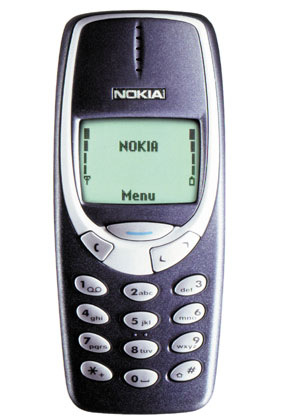
Remember these?

My friend still has one of these...

How about these?

Flip!

Today, the phone market is teeming with options. A consumer can take her pick of smart phone operating systems, if he’s into that sort of thing. Cell phones and phones that connect to landlines come in every color and shape imaginable. Every few months, phone manufacturers release new styles, operating in a market where consumer demand guides innovation. People find their two-year contracts burdensome when new models arrive on the scene.

https://i0.wp.com/www.bigfootsden.com/store.items/bubble.gum.phone.jpg

http://sorgenfrei.files.wordpress.com/2008/07/get_smart_shoe_phone.jpg

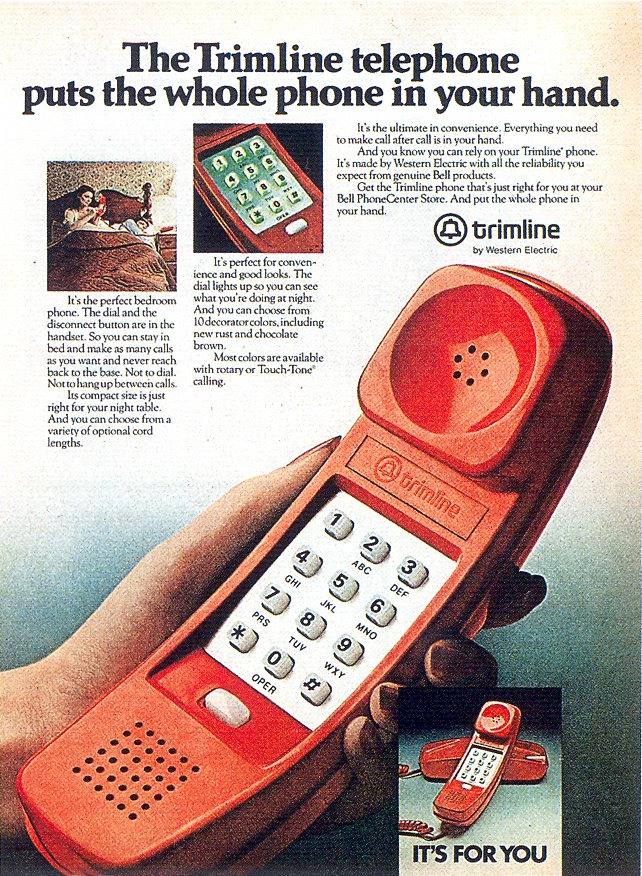
In such an environment of choice, it’s easy to forget that this was not always the case. As Doctorow reminds his readers, “It used to be illegal to plug anything that didn’t come from AT&T into your phone-jack.” (13) Phones were rented from the companies that provided phone service, and due to a lack of competition, innovations were virtually non-existent. With government supporting the monopoly and other gigantic barriers to entry, consumers were left with very few options, beyond the decision to add a second line.

http://www.archive.org/flow/flowplayer.commercial-3.0.5.swf

In this bizarre AT&T advertising musical, the separate beds in the master bedroom are the least of the hilarity. The whimsical housewife dreams of her dream house, sultrily requesting, “I wish I had a stove whose pilot light was always lit… Furthermore, a kitchen phone at hand when friends call to chat a bit!” (Skip ahead to 7:30 to experience this musical gem.)  Later, she croons, “A lady likes to have a chance to change her mind. I might like a yellow room with turquoise and white. And maybe a telephone that lights up at night.” (I’d fast forward to 9:30 for this one.) In reality, in 1956 this leading lady would have had very few options in the case that she decided to “change her mind.” She would have had a limited catalog of colors. If she was lucky, perhaps she’d have the option of renting a princess phone.

Of course, many households worked around the restrictions and set up second lines in their houses, without renting from the phone companies. People will hack. People had more incentive to hack when their only legal option was to pay a ridiculous rental fee for a second phone. Adding an illegal second line was not uncommon: neighbors and friends helped each other to bypass the rental rules.

1983, by government command, AT&T began selling phones to the public, instead of just leasing them. At this time, phones had still not progressed much beyond their original styles.
OldSchool1980

Clearly this opening of the market was good for the consumer. Clearly this was good for everyone except for the phone companies who could no longer collect monthly rental fees for the use of their phones. It’s easy to see the parallels between the phone rental system and the current practice of using DRM to “protect” intellectual property from illegal distribution.

When I purchase music, videos, software, or other media protected by DRM, I feel as though I am renting the material. At any time, the company who manages the protection on my purchases could go out of business, or restrict my ability to use my property –they claim they’re selling, not renting– in whatever way I choose. Even as a not-so-savvy middle school student, I removed the protection on the music I purchased from the iTunes store by burning discs and ripping the songs back onto my computer. It was easy.

As many have pointed out, trying to protect encryption methods through anti-circumvention laws that restrict people from spreading secrets is both inefficient and ineffective. (And come on, the idea of an illegal number is just funny.)  Hackers will hack. Phone owners will add secret second lines. Middle school students will figure out how to circumvent protection through a simple Google search. Continuing to utilize DRM as such will only serve to anger paying customers. And that’s bad for business.

Is Mickey’s interests repressing or fueling? – by “Zak K”

Sollozzo: I need a man who has powerful friends. I need a million dollars in cash. I need, Don Corleone, all of those politicians that you carry around in your pocket, like so many nickels and dimes.
Don Corleone: What is the interest for my family?”

Later on in the story the Don decides drugs are too dangerous a business. He wouldn’t jeopardize his power over the politicians, and therefore lose the superstructure he created for himself. Of course, one wants to relate everything to The Godfather, but the interesting thing for me is the parallels between political influence—in say—the criminal underworld and corporate America. Disney’s handling with the Mickey Mouse act, to me, leads to the question of the role the public plays in intellectual property.

As mentioned in the New York Times article about copyright perpetuity: has Mickey taught us (the public) something? Have we been pushed aside in the interest of corporate motives? The interesting thing about CTEA is the precedence it sets for the future of the term public, being a creativity term, an inventive term, and as a term of civil expansion.

CTEA has solidified its term of 95 years over pubic access, it affirms the idea of keeping corporate works out of reach. This law seems to be a clear step in the direction of copyright perpetuity, and if so, what has been lost, or better yet, what has been gained?

“In 1928, a hero of mine, Walt Disney, produced Steamboat Willie.” Here he showed a clip from Disney’s first successful sound cartoon, in which Mickey Mouse is a roustabout on a river steamer. “And it was from Steamboat Willie that we then got Mickey Mouse. So in a sense it is from Steamboat Willie we got Mickey Mouse, from Mickey Mouse we got the Disney Corporation.

“Now what you might not know is that in 1928 also there was another creative genius doing creative work. His name was Buster Keaton.” Keaton produced a film that year, before Disney’s cartoon, called Steamboat Bill, Jr. The Disney cartoon was heavily based on the Keaton film. “Steamboat Willie was built on Steamboat Bill. So in a sense it is from Steamboat Bill, Jr., that we got Steamboat Willie. From Steamboat Willie we got Mickey Mouse, from Mickey Mouse we got the Disney Corporation.”

—Lawrence Lessig Link

It seems—from looking at the past at least—that copyright perpetuity is inevitable, unless the public takes up it’s own rights. Current Technology, I believe, has now allowed public opinion to be heard. This action, is the transformative qualities of endless referential material. This material will lead to endless creative works, like in the case of pogo’s Alice song. These works will still be produced, but leaves the door open for corporate strong-arming. Sure, the material may never belong to the public, and yes, I think that this will damage some creative growth, but more importantly I think it encourages disregard.

Why is it that copying music seems relatively safe and inconsequential? Or why sharing software, or movies is accepted, even encouraged with the most stringent of people?  Mickey has taught the public a lesson, and not the one intended. The Mickey Mouse act has proven, possibly, the key to exposing the gap between true creative growth and ”family business”.

Zak K.

Interestingly, if copyright would have been kept to it’s original 14 years, these are some things that would be entering the public domain. Makes me wonder, what would be made with these items if they were given over to the public…

Top Movies of 1996

Top Music of 1996

Why Die Antwoord made me care about American copyright law – by “Vance W”

Die Antwoord 'Zef Side'

My current obsession at the moment is with the South African Zef crew Die Antwoord (or, “The Answer”). The group is comprised from a mix of global youth symbols: at a glance one can clearly see homage towards early 90’s rave culture, American hip-hop, the white trash Juggalos movement, and of course, the overt nod to Vanilla Ice. The visual makeup of their debut video “Enter the Ninja” is a hellish mix between the visuals of Roger Ballen and some sort of psychiatric ward version of a Keith Haring mural.

Roger Ballen
Roger Ballen
Keith Haring
Keith Haring
Die Antwoord
Die Antwoord

From Weird Al Yankovic to Chromeo, parody is not a new device in pop music. But what makes Die Antwoord so interesting is their ability to blur the distinctions between what’s real and what’s actually satire. The tension here between aspects novelty and what’s contemporary becomes quite fertile as a mode of production. But what does all of this have to do with copyright?

As a metaphor, Die Antwoord embodies the post-modern attitude by attacking the notion of a static or fixed symbol. Wether in literature, film, art, music, product design, etc, etc, the product in question is never completely original. Instead, it is always built from those cultural forms that preceded it. While this notion was most famously illustrated by Roland Barthes in Death of the Author, it was made truly tangible to my generation by Nicolas Bourriaud in Post Production. In it, he states “with music derived from sampling, the sample no longer represents anything more than a salient point in a shifting cartography. It is caught in a chain, and it’s meaning depends in part on its position in this chain.”

It is within this line of thinking that I advocate for regulation married to James Boyle’s idea of purchasing copyright duration in short durations. Within The Public Domain he states “..if copyright owners had to purchase each additional five years of term separately, the same way we buy warranties on our appliances, the economically rational ones would mainly settle for a fairly short period.” In turn — while still protecting authors from direct plagiarism — cultural symbols so crucial to artistic progress would enter the public domain at accelerated speeds.

My point is this: the idea of a pure work is false. The assertion that I could formulate my ideas centered around copyright and communicate them to you here without reference is of course absurd. The greater the toolset made available to a generation of makers the greater the cultural output. As Umberto Eco wrote in Postscript to the Name of the Rose “I think of the postmodern attitude as that of a man who loves a very cultivated woman and knows he cannot say to her, ‘I love you madly,’ because he knows that she knows (and that she knows that he knows) that these words have already been written by Barbara Cartland. Still, there is a solution. He can say, ‘As Barbara Cartland would put it, I love you madly.'”

Reading the Fine Print – by “Michael C”

Handcuffed by the EULA
"Handcuffed" by the EULA

A few weeks ago, the highly anticipated video game Borderlands was released on video game consoles. Many PC gamers were also eagerly awaiting the release, but were forced to wait a little longer when the PC version was delayed for a week. Despite the delay, some industrious gamers were able to purchase copies from stores selling the boxed PC version ahead of its release date. These gamers excitedly returned home, popped in the disc, and installed the game. However, when they tried to play, the online servers refused to authenticate their copies before the release date, so the game did not work.

Why did this happen? According to Hal Halpin of the Entertainment Consumers Association (ECA), unlike console copies of the game, where a purchaser is buying the actual product, purchasers of the PC game are buying a license. The disc that a gamer purchases is only a means of providing the game’s data, not a product in itself. In purchasing a license, one is restricted to the terms that the publisher includes in the End-User License Agreement, or EULA. In this case, the EULA states that the game requires activation, and that the activation will not be made available until the release date. By agreeing to the EULA, consumers are agreeing to these conditions.

Inevitably, early purchasers of the PC version of Borderlands were quite surprised that their copies were temporarily useless. According to 2K Games, the publisher of Borderlands, they shouldn’t have been—the restrictions on activation were outlined in the game’s EULA, presented to the player during the installation process. Then again, who actually reads the EULA? This particular case speaks to a larger problem involving EULAs. They tend to be long, complicated documents that most people skip right over in their eagerness to install and try out the new application or game that they’ve just purchased. However, these documents are important to the consumer, as they outline the terms of the legally binding license that the consumer is entering into by clicking “yes” (hence the term clickwrap).

Publishers should make these EULAs more user-friendly, by simplifying the language used in them, putting the most important parts at the top (where users are most likely to see them without scrolling), and possibly moving towards some type of standardized EULA. Fortunately, the ECA is working to push publishers to create more open, standardized EULAs. If the EULA is made more accessible to the average consumer, then he or she will be more likely to spend a few moments reading it to understand the terms of the license, rather than automatically hitting “yes” to avoid the complicated and lengthy document.

Technology is no match for laziness. – by “Michelle V”

Its totally a reasonable modern analogue.  Jefferson would have been all about crypto.
It's totally a reasonable modern analogue. Jefferson would have been all about crypto.

From the Oxford English Dictionary online:

cybersecurity n. – security relating to computer systems or the Internet, esp. that intended to protect against viruses or fraud.

Protecting yourself is hard. Nothing we do in the real world is ever perfectly safe and secure, and yet for some reason people expect that when information has been digitized, it should be safe. Maybe the thought is that if you can’t see what happens to your credit card information when you buy things online, then no one else can either. Wireless internet is almost like magic – you type things into your computer, click a button, and poof! The information just sort of whizzes through the air from your computer to someone else’s computer! Look, ma, no strings!

… Right?

Obviously not, but that’s the way most of us treat digital information. Since we don’t see what happens to it, we think that no one else can.

There have always been hackers. There will always be hackers. There exist protection measures we can take to protect our personal information, and they are pretty good. They are not, however, perfect. MD5, designed in 1991 by Ron Rivest, was one of the most widely-used cryptographic hash functions. A flaw was discovered in 1996, and then in 2004, further analysis revealed that it was much less collision-resistant than it had previously been thought to be. A weakness has also been discovered in SHA1, the other widely-used cryptographic hash function. Because of this, these hash functions are being phased out of use (MD5 is no longer used for protocols like digital signatures, which rely on low collision rates), and will be replaced with a similar function, SHA2. Currently, the National Institute of Standards and Technology is in the middle of selecting a new hash function (SHA3) that will replace SHA2 if – or really, when – its weaknesses are discovered. Similarly, AES (having replaced Triple-DES, which replaced DES) will eventually need to be replaced as its weaknesses are revealed and exploited.

Ultimately, there is no perfect technological solution to cybersecurity: we can implement all the provably correct programs we want, but this will not protect us from people standing behind us as we enter our private information. Even so, this doesn’t mean we can’t do anything. Just because someone might take a sledgehammer to your door doesn’t mean you shouldn’t lock it – there is no reason to grant people easy access to your belongings, whether physical or digital. Just because we can find strings that produce collisions doesn’t mean that it’s easy to find a collision for a specific string. Security (read, “cryptographic”) measures exist. Use them. Don’t be stupid. Sometimes bad things happen. Remember that secrecy does not equal security. And enable https on Gmail, lest Brad read your chat logs.

Need Break Up Advice? – by “Heather R”

google

Last year I was writing an email to one of my girlfriends at home. We hadn’t seen each other in a long time, so it was one of those three page long life-update type of e-mails. During the e-mail, I of course updated her on all the obligatory college-kid social life boy drama that had been going on the past few months. When she responded, it was in one of those handy dandy conversation threads that Gmail is kind of enough to provide right next to their insightful advertisements. I had previously been very impressed by their ads. Instead of “male enhancement” offers and incessant reminders about the latest World of Warcraft release, I was greeted by ads that seemed reasonably applicable to my life. It was kind of fun to imagine the key words that Gmail had picked up on to select merchandise especially for me. It seemed reasonable for them to parse my emails and pick up generic information about my consumer tendencies. Amazon and Ebay have been doing it for ages. (Users like me also bought what?!?!) This email, however, had nothing to do with me as a consumer. That afternoon I glanced over at the Gmail ads and was greeted by some particularly insightful advertisements: “Need Break Up Advice?”, “Your Ex will Beg you back!”, “Marriage Crisis Warning”, and “How to Stop a Break Up”. Of course, there were also “Popular Engagement Rings”, “Unique Style Wedding Ring”, and “Cheap Engagement Ring”. So apparently Gmail was rooting for this relationship. I will admit that I initially found this mostly just hilarious. It’s good to know that someone is on your side in a break up, even if it’s Gmail. Looking back on it this week, though, I realized just how much information about me Gmail can access.

When I was reading articles about Fourth Amendment issues relating to email, they kept on talking about the government petitioning for information from ISPs. It was a reminder that the information we are trying to protect from subpoena is already available to . . . a lot of people. Warshak v U.S ruled that a reasonable expectation of privacy extends to emails that would otherwise fall under the SCA’s lower level of protection. The government pointed to the fact that the terms of service of many ISPs permit those ISPs to monitor user activities to prevent fraud, enforce the TOS, or protect the ISP or others, or to comply with legal process. They claimed that if you use an ISP and the ISP may monitor what you do, then you have waived any and all constitutional privacy rights in any communications or other use of the ISP. Luckily, they weren’t successful. So, moment of exhale that the government can’t seize our email, but reading the decision just reminded me how much privacy I do give up when I use the internet.

I will admit I have never read a “terms of service”. Maybe that makes me grossly irresponsible, but I don’t think I’m alone in the practice. Yes, mostly I’m just lazy, but I also just see privacy invasion as inevitable. I use the internet . . . a lot. I make an effort to have reasonably secure passwords, I don’t give my credit card information to anything offered in blinking red font on the side of a website, and I don’t trust advertisements that pop up when I’m watching MegaVideo. Mostly, I try not to be an idiot and that’s about it. I try to keep someone from stealing my credit card, but I’ve thrown in the towel when it comes to Google reading my email. It’s all on their servers, and of course they have to have protection built in so that they can see information on those servers. I don’t read the small font that says they can, because I assume that every email provider will claim the same privileges.

We may have a right to privacy, but do we have any hope of attaining it? Do you we have to give up all privacy to use the internet? I feel like I do. I feel like the privacy invasion is baked into the internet, so I’ve stopped worrying about it. The onion’s alternative does not seem like too much fun. I’m interested in keeping my constitutional rights, lord knows that when I get nailed for insider trading, I’m going to want to keep those “They’ll never see it coming, let’s steal money and then take liquid ecstasy” emails to myself. Until then though, I’m just going to keep using the internet, assume that Gmail is reading my email, and hope that they offer sound advice about my love life.

Why Mens Rea Should Be Applied to Child Pornography Laws – by “Anna L”

When I was a sophomore in high school, I turned on my computer one day and realized I couldn’t access the Internet. An error message appeared that said the FCC had shut down Internet access for our household. When we called the number listed on the error message, we learned that one of the computers in our house had been sending out thousands of pornographic images, and some of them included child pornography. After an FCC official examined all the computers in our house, we learned that the source of these images was my 11-year-old sister’s desktop computer. She never used the desktop computer because it was slow and her laptop was faster. Some Russian hacked her computer and used it to distribute large amounts of pornography. So, my sister was technically in possession of child pornography.

In Flores-Figueroa v. United States, the United States Supreme Court examined a pivotal case involving mens rea. The petitioner, Ignacio Flores-Figueroa, was an illegal immigrant who worked in the United States. When his employer asked for his social security number, he made one up. It turned out that the social security number he wrote belonged to someone else, and he was charged with identity theft (he was also charged with illegal entry into the United States and misuse of immigration documents, to which he pleaded guilty). In 2006, a federal grand jury found him guilty of identity theft. Ignacio Flores-Figueroa’s lawyers argued in appeal that he was unaware that the social security number was someone else’s. The Eighth Circuit upheld his original sentence, arguing that knowledge of whether the number belonged to someone else or not was irrelevant. The Supreme Court overturned the Eighth Circuit’s decision. It held that the government has an obligation to prove that Mr. Flores-Figuerona intended to commit identity theft. Justice Bryer’s majority opinion emphasized that in criminal law, courts apply mens rea to every statute. Bryer wrote, “to the extent that Congress may have been concerned about criminalizing the conduct of a broader class of individuals, the concerns about practical enforceability are insufficient to outweigh the clarity of the text.” The Court’s findings in this pivotal case are inconsistent with current laws about child pornography.

In Osborne v. Ohio, the United States Supreme Court explained that laws making possession of pornography a crime, regardless of the circumstances, were constitutional. It is terrifying to think that you might commit a crime without the intent to do so or even knowing that you committed a crime. Laws regarding child pornography have no clause about intent to receive or intent to distribute it. This has troubling consequences. People who didn’t intentionally acquire porn could be punished for having it. A teenager who receives a picture from his girlfriend without requesting it could be prosecuted. Someone who receives an email with child pornography in it would be in violation of the law. Someone who is trying to download a video on Limewire that has a fake label and turns out to be child porn could be prosecuted.

My sister wasn’t charged with possession of child porn, because prosecutors use discretion when deciding who to prosecute. But due process rights should not be contingent upon the discretion of a prosecutor. The Supreme Court decided long ago that the right of every citizen to due process overrides the risk that the guilty should go free.

Of course, it is sometimes difficult to prove intent to possess the pornography. The result of changing the law to require intent to possess child porn (or perhaps even applying a lower level of mens rea to child pornography, like negligent possession) puts the burden on prosecutors to prove beyond a reasonable doubt that people in possession of pornography intended to be in possession of it. The result is that some people who intentionally acquired child porn will walk free. Still, this is a price we must pay. We should not let prosecutors be the arbiters of who is committing egregious crimes and who is not worth prosecuting. Even though it may be difficult to prove mens rea, it should still be the essential element of any criminal act.

In the Spirit of Protecting the Victim – by “Jonathan G”

Swiffer LoveIn New York v Ferber, the Supreme Court unanimously held that the First Amendment right to free speech does not prevent states from restricting the distribution of child pornography. Indeed, in this uncontroversial decision the Supreme Court held that the “psychological, emotional, and mental health of the child” is of such paramount importance that child pornography need not even be deemed obscene per the test established in Miller v California for regulation to be justified. Public sentiment favoring child pornography laws as applied to adult predators remains strong. Indeed, public sentiment on the issue is so strong that a “my cat did it” defense can seem more likely to succeed than challenging that the behavior is wrong. More controversial however has been the recent application of child pornography laws to protect children from themselves.

Public awareness of “sexting” can perhaps be traced back to the infamous “Swiffer Girl” incident, which involved an eighth grade girl at the Horace Mann School in New York City. The girl filmed herself in three videos engaged in a variety of sexual acts with a Swiffer mop and sent them to a male classmate on whom she had a crush to show him what he was missing. Her classmate, more amused than stimulated by the videos, proceeded to forward the videos to his friends and soon the videos had spread like wildfire, first among the private school elite of New York City and then eventually nationally. The drama that ensued was so severe that the girl was forced to drop out of Horace Mann and move to Florida.

While “Swiffergate” as it became known should have been sufficient evidence of the dangers of “sexting” it seemingly had no such effect. Indeed, according to a survey conducted by the National Campaign to Prevent Teen and Unplanned Pregnancy, one in five teenagers indicated that they have sent or posted naked pictures of themselves. While various educational campaigns such as “Think Before You Click” have been created, police in Greensburg, PA and other localities have taken matters into their own hands and charged teenagers with crimes under the very same child pornography laws meant to protect them. Indeed, while Rick Salomon did not violate any pornography laws by releasing 1 Night in Paris (he did perhaps violate other laws as evidenced by Paris Hilton’s successful civil suit), a child who distributes videos or photographs of sexual acts involving other children can technically be charged as having violated child pornography laws. Interestingly however, the public reaction has been decidedly against this application of child pornography laws.

Despite public opposition, certain applications of child pornography laws to charge children are consistent with both the letter and the spirit of the laws. The “spirit” of child pornography laws that punish dissemination and possession is to protect the child depicted in the pornography (the “victim”) by punishing the distributor or possessor (the “offender”). The application of child pornography laws in the Greensburg, PA case was inconsistent with the “spirit” of the law insofar as it punished, rather than protected, the “victim” creating a sort of “double-victimization” akin to charging runaway children forced into the sex industry with prostitution. Similarly, charging the boyfriends with possession did nothing to protect the “victim” insofar as there was no evidence that they were active instigators, rather than passive recipients. While it is difficult to establish a brightline standard, charging children who have sent a couple of photos of themselves to a couple of people with disseminating child pornography does not make sense.

The application of child pornography laws against children can however be consistent with both the letter and spirit of the law as in the case of Philip Albert of Orlando, Florida. In this case, Albert, after breaking up with his girlfriend, decided to get back at her by maliciously mass e-mailing photos she had “sexted” him. Punishing Albert (the “offender”) is clearly consistent with the objective of protecting his ex-girlfriend (the “victim”). While his ex-girlfriend undoubtedly put herself in a compromising position by “sexting” in the first place, this does not excuse Albert’s behavior any more than a mugger’s behavior would be excused by the fact that his victim opted to take a stroll in a dangerous part of town late at night. Similarly, the fact that Albert is himself a child does not excuse the behavior insofar as we punish children all the time for violating the law (though it might warrant some leniency).

While we should undoubtedly continue campaigns to educate children, so they don’t put themselves in compromising situations in the first place, punishing children who maliciously disseminate child pornography is justifiable as well. Indeed, in the spirit of protecting the victim, charging children who maliciously disseminate child pornography is necessary. If the law were applied as such, “Swiffer Girl’s” crush may have thought more carefully before maliciously forwarding the videos and “Swiffergate” may have been a private learning opportunity, rather than a national life destroying event.

Free Speech Online? Talk to me about Net Neutrality! – by “Evin M”

Without a new law protecting net neutrality, we're trusting dinosaurs like Sen. Ted Stevens and obselete case law to control free speech and govern technological platforms to which they do not apply...also I thought this was funny and tried in earnest to make it link to my blog post about free speech. from http://www.terminally-incoherent.com

At the end of September, FCC Chairman Julius Genachowski unveiled a plan for net neutrality.  This set of rules solidifies the role of internet service providers as pizza guys and not as news networks—that is to say it explicitly disallows blocking or slowing access to specific applications or services.  Net neutrality keeps the “tubes” free from the prying eyes and interests of those who deliver the info packets to consumers, thus allowing free speech to not only occur but to be disseminated.  The proposed rules uphold the four pillars of network neutrality, which allow consumers to access any lawful online content, application, or services with any legal device in an environment that has sufficient competition among network, content, application, and service providers.  It also adds two more basic principles: ISPs will not be able to discriminate against certain applications or information and they must be transparent about their network management practices.

Senator Olympia Snowe and Senator Byron Dorgan are teaming up with Chairman Genachowski, and have begun to discuss legislation that would help scoot along the proposed net neutrality rules.  Dorgan, the senior member of the Commerce Committee, suggested that the congressional contribution to the initial network neutrality efforts could include some deadlines, to help move the process of adoption along.  The good political feelings might extend across the aisle, thanks to an olive branch extended by Chairman Genachowski which halted the development of a Republican-sponsored amendment that would tie up FCC funding.  That bill however, produced in angry response to the GOP’s disapproval of net neutrality, didn’t have much of a chance because of the Democrat’s hold on the senate majority.

Senate support has also been joined with a thumbs up from representatives of corporate world as Amazon, Facebook, and Google have voiced their approval of these rules in a letter to the FCC earlier today.  They make a pretty good point about net neutrality, suggesting that it will allow more applications to be developed and shared because creators will not be deterred by the possibility of having their content blocked or sidelined.  However, the approval is not universal.  AT&T, Comcast, and Verizon have spearheaded the opposition force, citing, among other things, the difficulties of net neutrality in a wireless interface.

We’re in dire need of some governmental commentary on free speech and the web, as the Red Lion v. FCC case becomes increasingly obsolete.  This case, as Prof. Jack Balkin described today in class, relies heavily on the fact that sound information policy is premised on people’s role as passive information consumers.  Before Web 2.0, they didn’t have the opportunity to easily become active producers of knowledge with a readily accessible audience which includes other content producers.  With the entire business model of today’s new media grounded strongly in a participatory consumer culture, we can no longer apply the rules of the game from when media was a one-sided discussion.