The Patriot Act, defining Search and Seizure in the Digital Age? – by “Dylan D”

It may be hard to believe but it has been 9 years since the Patriot Act was signed into law. The legislation was hastily pushed through congress after the September 11th terrorist attacks. It was designed to give the government more power to prevent terrorism in the future. But many have seen the controversial piece of  legislation as a violation of Constitutional rights, most explicitly the Fourth Amendment. What the Patriot Act means today, is that search and seizure in the digital age has the danger of not being defined by the United States Constitution, but rather by a law designed to prevent terrorism. No one should be naive enough to think other wise, the intent of the law is to not only fight terrorism but lay the ground work for establishing search and seizure methods in the rapidly advancing digital age. Through briefly reading the Wikipedia article on the Patriot Act, I have come to the conclusion that the government no longer needs a warrant…….as long as its related to terrorism and national security….basically the law says, fight terrorism any way possible, Constitutional rights be damned. And while that may have seemed important in the aftermath of 9/11, is our fight against terrorism still more important than the Constitution today, 9 years and 5 days later?

Many will argue that the Patriot Act will expire and will not be foundation for search and seizure in the digital age. But to those who have that point of view I ask the fallowing question. Why does Congress keep renewing the Laws that were set to expire in 2005 in the original bill? This is not a Republican or Democrat thing because Congresses controlled by both parties have voted to extend. This is an American thing! We have become so concerned about National Defense and protecting our country from terrorist ( not that either of those things are unimportant) that we are willing to let ourselves be monitored and searched through means that violate our Constitutional right to protect ourselves against unreasonable searches and seizure. What have we as a country become?

This past weekend John Stewart and Stephen Colbert held their much anticipated Rally to Restore Sanity. I will be honest I did not watch one second of it, my plan the whole time was to watch the important parts on YouTube the next day. But that is not the point, the point is the title of their rally could not be more appropriate. Restoring sanity may be the most important step for this country to take as we struggle to move forward. Restoring sanity means waking up and saying the Constitution of the United States is what has guided the country for over 200 years, it has shaped the US into the country it is today, it has made us a great country. The Constitution has lead us through world wars, a civil war, a civil rights movement, and a cold war. If that great document can lead this country through that much, why can it not take on terrorism and the digital age too. The sane thing to do is realize it can and it will……but only if given the chance.

Big Brother’s New Sib – by “Daniel E”

Big Brother’s New Sib

This is a Farewell to the Arms of Big Brother exerting sole control over the media and journalism. Wikileaks is “new model of journalism.” Wikileaks is a website that collects and publishes leaked information typically labeled as “classified.” Yet, this “classified” information exposes corruptions and abuses of governments around the world. The information published is of little threat to national security. It is published so that the public can monitor Big Brother. It operates under the words of the Supreme Court that “only a free and unrestrained press can effectively expose deception in government” (Nyt v. US). Wikileaks has published information on:

  • War, killings, torture and detention
  • Government, trade and corporate transparency
  • Suppression of free speech and a free press

Wikileaks has had measurable success. For instance, they exposed that President Moi of Kenya costs the country $3,000,000,000 in corruption which swung the December 2007 Kenyan election.
Wikileaks is successful obtaining classified information, because of its information collecting policy. It guarantees anonymity to information sources. We have seen this model of anonymity help several internet blogs succeed. Anonymity encourages individuals to freely express their minds and share information because there is little fear of personal identification and subsequent reprisal.

Most recently, Wikileaks has introduced us to modern warfare – attacks and documents only seen in war movies. They have leaked more than 90,000 United States military and diplomatic reports about Afghanistan filed between 2004 and January of this year. In July, Wikileaks released a video showing combat in Iraq:

Collateral Murder

The word “revolutionary” has been used to describe Wikileaks. This seems fit given that “during times of universal deceit, telling the truth becomes a revolutionary act” (Orwell). The media, is often considered the Fourth Branch of government. It censors information of public interest. It works under Big Brother. In the media, we simply get reports containing deceptive words used as propaganda, such as “freedom fighter” and “war criminal” – our modern  “newspeak.” Wikileaks allows us to monitor Big Brother. It can be considered Big Brother’s Big Brother. It can be considered a rogue organizations, such as Al Qaeda. It has no defined geographic base and we do not know when it will strike. However, when it does strike, we know its will help improve transparency between governments and citizens.

The challenge for Wikileaks is to solidify its identify. It has to expand its reach to ensure people can rely on it for news. Wikileaks needs to develop relationships with news media outlets to foster the exchange of information that is important for the public to hear. Furthermore, Wikileaks needs to decide if it does want to adopt a political agenda – a practice that often harms the reputation of news outlets like Fox News. By labeling the video of the Iraqi attack “Collateral Murder” Wikileaks seems to adopt an anti-war stance, which is not beneficial if they want to be an impartial news source. It will be interesting to see the transnational impact Wikileaks has in the future.

Leniency – by “Diego B”

The reaction to fifteen year old children having their lives severely affected by a black and white legal system is one of disbelief. How is it that a young teenager can have their life so drastically changed for (by today’s technological standards) being a teenager? The idea that sending your middle school girlfriend or boyfriend a photograph of yourself can affect your life opportunities decades later is baffling. Yet, there is a necessary reasoning for it all. Child pornography is seen as such a heinous act because of what it does to the child in question, or because of what usually takes place to make a child participate in pornography. This is why teenagers, despite the fact that they usually do not intend to start a child pornography distribution ring, are punished so severely for “sexting”. However, if any sort of leniency were allowed in these cases then the immediate result would be loopholes, which would promptly be taken advantage of by those actually intending to create the distribution rings, or by those with other malicious intents.

Six years ago, a sub-average videogame titled The Guy Game was released for several videogame platforms. The game features guess-based questioning which, when answered correctly, rewards the player with less and less censored imagery of female nudity. Largely brushed aside as bargain-bin lining, the game attained notoriety four months after its release when one of the female participants revealed she was underage (17) at the time she was filmed for the game. She coupled this revelation with lawsuits against the developers and publishers of the game, as well as the owners of the platforms that the game appeared on. At the time of filming, the teenager in question was, presumably, a freely willing participant. What changed between the filming and subsequent release of the game? She could have either planned to file suit all along, or she could somehow have been forced to participate. Regardless of the possibility of the former, the creators of the game are still to blame. It is their responsibility to accurately verify somebody’s age when dealing with such a potentially explosive situation. The law on the matter of child pornography must be kept as strict as possible to help keep situations like these from happening.

When dealing with something considered wrong by the large majority of the population, but highly sought after by a small but desperate minority, the prevention methods must be incredibly strict. This holds true even moreso when the central issue deals with the exploitation of children, or minors. The loopholes possible by being lenient under these cases are unacceptable. In the case of The Guy Game, if the creators of the game had been reprieved or treated in a more fair fashion due to their genuine ignorance, then any studio or developer could claim the same when faced with similar charges. Enticing or coercing a minor into pornography is not something below people that are willing to supply their desperate clients, so these laws must be kept strict in order to prevent these potential openings. The same holds true in the case of “sexting”; many underage teenagers already willingly participate in the activity, so it would not take much threat from the determined to make a child play along in a charade of ignorance for a quick trade-off. It is unfortunate that teenagers with relatively innocent intent are so severely affected, and the process for taking care of those specific cases involving a minor sender and minor recipient should be reviewed, but the alternative of simplifying the process of exploitation is far more dangerous with a more far-reaching potential to cause harm.

Coffee and Filthy Words – by “Frances D”

I didn’t drink coffee until the end of high school. I had actually listened when my mom said, “Coffee will stunt your growth.”  Even though I was staying up late and waking up early, I wanted to be tall.  Put more articulately, I didn’t want to artificially constrain my growth.1 I feel similarly about language and culture, which develop through fluid, indirect, and subtle means.  Likewise, efforts to control verbal expression only artificially hamper the development of culture. Any legislative attempt to create a list of inappropriate words is like coffee to language—it stunts growth.

In FCC v. Pacifica Foundation, the Supreme Court upheld the Federal Communications Commission’s ability to regulate the afternoon radio broadcast of George Carlin’s monologue “Filthy Words.” 2 Its indecent content was broadcast during a time of day when children might overhear. What exactly made this 1,751 word monologue so offensive? To illustrate, I’ve removed the filler – the acceptable words of polite language – this is left3, 4:

Fuck…bitch…bitch…bastard…hell…damn…shit…piss…fuck… cunt…cocksucker… motherfucker…tits…fuck…motherfucker…fuck…cocksucker…sucker…cock…cock…cock…cock…cock-fight…shit…fuck… shit… shit… shit…shit…shit…Shit…shit… shit…shit…shit…shit …shit…shit…shit…shit…shit-house…shit’s… shit… shit… shit… shit…shit-eating…shit-eating…Shit…shit …Shitty… shitty…shitty …shit-fit…Shit-fit…shit…shit… shit… shit…shit… shit… shit… shit… shit…shit…Shit… shit-load …shit-pot …Shit-head… shit-heel… shit … shit…shit-face…shit…shit-face…Shitface …shit…fuck …fuck…Fuck. …Fuck…FUCK FUCK…FUCK…fuck …fuck…fuck…fuck…fuck… fuck…fuck…Fuck …fuck…Madfuckers…fuck …Fuck… fuck  …fuck…fuck …fuck…fuck… shit …shit…shit. …shit…shit…shit …shit …shit …shit …shit…shit …ass…shit… …fart…turd…twat…Fart…tits… Turd…twat… Twat!… twat…Twat…snatch, …box…pussy…snatch…pussy…box…twat…ass …ass

This monologue was created to be offensive in 1975. Yet in its offensiveness, it betrays its temporal nature. True, some words are still considered incredibly rude, but many no longer pack the same punch as they did in the 1970’s. Words fall along an acceptability spectrum. Over time, American culture relocates words within the spectrum. While words such as “colored” have become unacceptable with time, many swear words have transitioned towards acceptable. This transition along the acceptability spectrum occurs in one of two ways. First, a general exposure to a word can accustom a society; this method led to butt, ass, hell, and damn to be generally accepted.  The second method is the reclamation of the offensive word by the offended group.  The gay community has successfully reclaimed the word “queer” from its historical roots as a derogatory term for gay males. “Queer” is so widely accepted now that few people bat an eye at the show “Queer Eye for the Straight Guy.”

The fluidity of language will be fettered by legislative attempts to define what is acceptable and unacceptable for broadcasting.  Supreme Court and lower court rulings in FCC v. Pacifica Foundation and FCC v. Fox Television Stations have created a foundation upon which government can control offensive language in broadcasting.  The only stipulation is that these regulations must not be as vague as the regulation contested in FCC v. Fox Television Stations.  This possibility for future legislation could quickly lead to television and radio broadcasting that are permanently stuck in the time period that the legislation’s last amendment; it would be as if current television could only air Leave It To Beaver and I Love Lucy–esque dialogues. Therefore, the Supreme Court missed a great opportunity in FCC v. Fox Television Stations—namely, the opportunity to create the foundation for cultural fluidity by overturning FCC v. Pacifica Foundation and declaring the regulations unconstitutional, instead of leaving the constitutionality to be determined by a lower court.

1) I’m aware now that coffee does not actually stunt growth. Looking back, I realize my mom probably just didn’t want to deal with a twelve year old hyped up on caffeine.

2) “Filthy Words by George Carlin.” UMKC School of Law. Web. 13 Oct. 2010. <http://www.law.umkc.edu/faculty/projects/ftrials/conlaw/filthywords.html>.

3) No modification was done to the transcript besides replacing the polite words with ellipsis. All emphasis is original.

Facebook Memes: Where do you like it? – by “Luke H”

Facebook, when contrasted to the plethora of social media sites out there, has an incredibly vast output of and a potential for the creation of memes. Facebook today is a massive influx of information and opinions regarding social lives and ideas, and it is only natural that some of these ideas are found amusing or funny etc, and subsequently are imitated by others, and variations are made of it. The funny thing about Facebook is as wide ranging and encompassing as it is, it still is quite limiting when it comes to the structure of its memes. Far and away the most common is the status update. Status updates on Facebook assist people in identifying, learning, and comprehending their friends and the people around them. It is a brief window into the individual; it lets us in on what they are thinking, what they are doing, and how they are feeling. Another staggering part to status updates is their rampant popularity: Every day, hundreds of thousands of people across the world write new updates, using millions upon millions of words to describe one thing or another. The memes that take place here can offer an interesting take on all of the things thoughts and feelings that connect people.

Take a trend that began earlier this month on Facebook that consisted of a flooding of updates that spelled out where women “like it”. (Although some people claim the “it” refers to purses, and where they like to put them, I don’t think I have to spell out for you what was implied by these posts.) Evidently, all these posts were supposed to go hand in hand with National Breast Cancer Awareness month (this October!) to promote awareness, to encourage efforts for the search for a cure, and to egg women on to get breast exams.

Some criticism and disapproval has been levied against the posts, and on one level, it’s very difficult to fight against breast cancer awareness. How does one voice their opinion against these posts without sounding far too prim and proper? Is it even possible to voice opinion against these posts without sounding against breast cancer awareness? But on the other hand I don’t necessarily like the feeling of using breast cancer awareness as a front to make funny, sometimes mocking jokes on Facebook. It doesn’t feel right, it doesn’t carry the right message, and it really isn’t even related to breast cancer awareness.

The incredible thing at hand here is the polarization, and immediate judgment making and opinion forming that takes place all because of a silly little meme on Facebook. People and advertisers have been putting out their opinions and products into the open for a very long time, with everyone competing for attention. The creation of memes – that is, ideas that replicate themselves in the common social collective – has been harnessed by people everywhere to spread their ideas.  The question is, are memes like the ones we can find in Facebook valuable? Are they taken seriously enough to force you to think about X, Y, or Z? Do they last long enough to even have an impact in our lives? I suppose only time can tell.

My First Vist to 4chan.org – by “Matthew E”

Anyone familiar with internet culture has heard of the infamous 4chan.org.  Many are probably equally familiar with the sort of content that comes out of 4chan.  As a member of other online communities (namely gaming forums), I have encountered numerous memes and image macros, many of which have originated at 4chan, including the list from Meme Factory in the New York Times article we read for class: Boxxy, David After Dentist, Star Wars Kid, “Downfall,” Advice Dog, “Imma chargin mah lazer!” Crasher Squirrel, “This is Sparta!”  I even went to see moot at the Calhoun Master’s Tea last year as well as Meme Factory’s presentation in Davies Auditorium.  Yet I have never actually visited 4chan.org.  That having been said, I’ve seen screenshots of a typical thread.  But I decided that, for the sake of my blog post, I would boldly go where most internet goers dare not go.

Once I had typed the URL into Chrome’s browser bar, I was greeted with a tame-looking page.  With a friendly-looking four-leaf clover logo on top, a list of the image boards, and a sample of recent images and posts, everything looked pretty normal.  The recent images posted included an animated pig with a sock, a Gundam-looking mech, and a Canadian flag (probably the most offensive thing on the page).  The recent post and popular thread list didn’t include any posts or threads from the hentai or random (/b/) boards.

I clicked open the rules in a new tab before I proceeded into any image board.  There were 14 global rules that applied to all image boards as well as board specific rules.  The rules looked to be well-ordered and similar to rules you would find at any reputable site with one notable exception, Global Rule #3.  “Do not post the following outside of /b/: Trolls, flames, racism, off-topic replies, uncalled for catchphrases, macro image replies, indecipherable text (example: “lol u tk him 2da bar|?”), anthropomorphic (“furry”), grotesque (“guro”), or loli/shota pornography.”  Hmmm, I thought, this is more of what comes to mind when I think of 4chan, and especially when I think of /b/.  I should also mention that some of the board-specific rules were quite funny, including: “ZOMG NONE!!!1” for /b/, “There is to be no discussion of Ayn Rand” for the literature board, and “GOTTA CATCH ‘EM ALL.  This will be severely punished and strictly enforced” for the Pokémon board.  I then moved on to the FAQ’s for the website, which were also written in a helpful, light-hearted tone.  I couldn’t help noticing the Culture section of the FAQ’s, especially the humours entry for “Who is ‘Anonymous’?”.  You can read it for yourself here.

Having read the required documentation, I continued into the weapons board /k/. I decided I would work my way up to /b/ and I figured /k/ wouldn’t have anything I didn’t want to see.  .  Upon entering the page, I found a relatively humorous thread with the following picture and the comment “post your shoops.”

/k/ image

Being the savvy internet community user I am, I expected some funny Photoshopped (shooped) pictures.  I wasn’t disappointed when I found pictures of the guy holding a large tuna fish, a golden gun, the broom from the picture, and (the least safe for work image on the page) an oversized black dildo.  My assessment of the image board is that the posters posted in good taste, using language comprehensible to most people.  The images posted were in good taste and not anything worse than I’ve seen posted on other forums.  While I noticed the occasional foul and bigoted remark on the board, I reminded myself that this is the internet.  I’m just as likely to find that in the Fox News comments section.

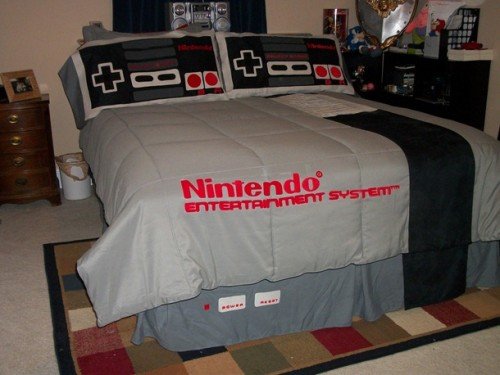
Next I proceeded to /v/, the video games section.  While the blue color scheme suggested it would be SFW (safe for work), I was greeted with what appeared to be a transvestite about halfway down the page.  Other than that one picture, the rest of the image threads seemed on topic, including a NES-themed bedspread (link) complete with NES controllers for pillows, a nostalgic (for me at least) picture from a Spyro game, and a thread about your favorite video games past and present.  After viewing the threads posted in this image board, my opinion of the 4channers of /v/ increased quite dramatically (except for the one who posted that NSFW pic).  Also of note was that almost all people in /v/ posted as Anonymous as opposed to people in /k/, many of whom posted using a name with a “tripcode,” or pseudo-authentication mechanism.

Before I take the final leap into /b/, I thought I would just point out that there is an indecently exposed anime-styled female on the top of the /v/ page with a miniaturized 4chan logo and name.  I didn’t know 4chan outright sponsored that, especially in /v/ but whatever floats their boat, I guess.

And then there was /b/:  Allow me to say that the name random was pretty appropriate for the content I saw on the site.  Pictures included everything from image macros, troll faces, boobs, mazes, x-ray goggles, and disfigured bodies to boobs, naked women, more image macros, math problems, and boobs.  As for the text of the comments: well, I didn’t read most of it.  I can say it was pretty similar to what I’d seen on other boards, although possibly more hostile.  Apart from the porn, there were also some images that made me say “Oh God,” shudder, and move on.  I didn’t end up spending much time on /b/.  Because of its random nature, it wasn’t incredibly entertaining.  Still, I feel like I saw what was there to see.

The following are a list of my conclusions after visiting 4chan:

  • It’s not as bad as I imagined.  I guess most of my image of 4chan was based on the bad reputation of /b/.  The other boards I glanced over looked reasonable and were often somewhat funny.
  • It’s not something I plan to take part in any time in the future, although it sure looks like a way to kill a couple of hours.
  • Through my exposed to online culture, I was able to understand most of the goings on of 4chan
  • The community of 4chan isn’t as hostile to each other as one might be lead to believe, and most of them have a good sense of humor.

I survived the browsing of 4chan with my sanity mostly intact.  For anyone that hasn’t looked at the site yet, I suggest you at least take a look at the rules and FAQs to get a better understanding of how the site works.

Wikipedia: Creating a Generation of Thinkers – by “Laure F”

I’m not sure how many times a day I refer to Wikipedia.  Maybe 10-15 times on an average day.  A glance through my Internet history in the past week reveals Wikipedia searches as varied as Scientology, Cauchy’s Theorem, Twyla Tharp, and Queen (band).

Everyone seems to be using Wikipedia these days. It is the automatic go-to source of information whenever people are faced with a question or a cultural with which they are unfamiliar. Famously, even Rush Limbaugh (not that Rush Limbaugh should be taken as any kind of indicator of national trends) who has often told his listeners not to believe what they read on Wikipedia was caught referencing information obtained from Wikipedia.  The information, which was about a federal judge, later turned out to be false, having been posted by some Wikipedia prankster.  The misinformation was corrected shortly after it was posted. Limbaugh simply had the misfortune of checking the site while the false information was still posted (I never thought I would see the day when I would feel sympathy for Rush Limbaugh).

http://www.nytimes.com/2010/09/16/us/16judge.html?scp=1&sq=wikipedia%20rush&st=cse

In talking to people over the last few days about their experiences with and attitudes towards Wikipedia, I have found that people’s feelings about Wikipedia are pretty uniform.  The first reaction I got from everyone was how useful Wikipedia is.  They all told me how they use Wikipedia for random factual searches as well as for writing papers. People talked about how often they use it for classes: whether for math classes, science classes, English classes, or sociology classes.  It seems to be the number one resource used for questions like: “Now what is exactly is the formula for integration by parts?” as well as for questions like: “Now how many years has it been since Patrick Swayze died and what kind of cancer exactly did he have?”

However, with all of the people that I talked to, they immediately followed their praise of Wikipedia’s usefulness by adding that Wikipedia cannot be trusted.  They all went on at length about the problems of letting anyone edit a page. Many people talked about how companies and individuals could edit their own Wikipedia pages to portray themselves in a positive light.  Some people even showed me examples of pages that were clearly taken from company promotional materials or pages that were simply poorly written and lacking in impartiality.  (For an example, check out the Pierson College Wikipedia page http://en.wikipedia.org/wiki/Pierson_College.)  Everyone seemed to have some kind of anecdote about the untrustworthiness of Wikipedia.  Many of them admitted to having purposely changed Wikipedia articles to make them contain false information. However, when pressed, they conceded that the pages they had edited had quickly been restored to their former form.

I find this contrast incredibly fascinating.  People do not trust the accuracy of their main source of information and yet they continue to use it because nothing else can compare to Wikipedia in terms of breadth of information and easy accessibility. General wisdom says that this contrast is a bad thing.  Everyone I talked to went on at length about how bad it is that Wikipedia has found such a strong foothold in our society when one cannot trust the veracity of all of the statements it makes. However, I beg to differ on this point.

Before the days of Wikipedia, when people had a question about something they turned to news media or encyclopedias. However, in actuality, these sources really aren’t any more trustworthy than Wikipedia is. A recent study (albeit a controversial one) found that articles on Wikipedia on average had the same number errors as equivalent articles in the Encyclopedia Britannica. Similarly, news media gets things wrong all of the time and is incredibly biased in its presentation of things. Whenever I have seen a news story about something I actually know about, I have been horrified at the inaccuracies of the story.  I can only assume that the stories I don’t know anything about are just as inaccurate.

In my mind, this not only demonstrates that people are learning to navigate the world of Wikipedia, thus better detecting areas of false information and so helping to make Wikipedia a more reliable source, but that Wikipedia in being the main source of information for a lot people, is helping to produce a generation of critical thinkers.  It is creating a generation of people who don’t just blindly accept information, but who remember that all of the information with which they are presented whether on Wikipedia or in the news is presented by people, people who may not always be the most trustworthy sources.

Thus, I think Wikipedia has done an enormous service to society in more ways than one. Yes, creating a vast database of easily accessible up-to-date information is important and incredible and worthy of all kinds of praise. But I think that another one of the really important legacies of Wikipedia is one that people don’t think about much. That is, that Wikipedia has created a generation of critical thinkers.  It has created a generation that questions where information comes from and is fluent at fleshing out areas of bias and inaccuracies.

I think Wikipedia teaches people incredibly important skills, namely the ability to ask: Who is writing this, what are their motivations, what might they not be saying, is this really true, what evidence is there to support this statement? These are skills that people then apply to other areas of their lives.  I think this generation, when watching a news story, or reading blog, or even reading a textbook—all resources whose accuracy people normally might not have questioned—now asks these same questions.  Wikipedia has thus created a generation that does not just blindly accept, but analyzes and criticizes and thinks.  And I think that is the true legacy of Wikipedia.

Two love letters to Wikipedia – by “Joel S”

May 2010:

Dear Wikipedia,

As a senior in high school, about to close the book on this remarkable journey, I feel the pressing need to profess my deepest adoration and gratitude for you. Frankly, you have been an indispensable asset, nay, a lifesaver throughout these past four years. I would be remiss if in thinking about the end and all who helped me get here I didn’t acknowledge you.

Seeing as I have no background in technological law, I care not about the legal questions that your services beg. Instead, I concern myself only with what you provide for me – a seemingly endless bounty of information, free of charge, and full of knowledge. You are an ostensibly omniscient being, providing information on almost any topic, be it acalculia, a calculator, or calculus. From the extensive to the esoteric, no topic seems too big or too small for your cavernous amphora of genius. Time and time again, topics, theories, and historical figures have bemused me. After flipping through the book, scouring the Internet, and nearly giving up, you are so often the one who helps me find what I’ve been searching for.

You’re also a time saver. Take that assignment in US history for example; remember all the way back to junior year? We had to identify less well-known civil war generals whose names were scattered throughout hundreds of pages of text. Rather than sift through the book, I consulted your services, and found all of the information that I needed for every last one of the generals – brigade commanded, side for which they fought, battles in which they participated. I even threw in some extra information that the teacher regarded as going “above and beyond” what was asked for in the assignment. Yes, Wikipedia, you are a bastion of efficiency.

Additionally, you satisfy my intense thirst for knowledge. If ever I find myself in a situation in which I desire to know more about a specific subject, you are the source to which I turn. When I wanted to learn what the WHIP statistic measured in baseball, I read your page. When my comparative government teacher discussed Ad Nauseam about Weber’s Modernization Theory, your page helped make sense of what exactly it was she was talking about. And, just a few days ago, when I found out what residential college I had been placed into at Yale, your page convinced me that Trumbull is indeed the best college at the school. Thank you Wikipedia for providing me, and countless others, with a free and rapidly evolving database of both useful and inane trivia.

Teachers may question the veracity of everything that you say. They are incredulous that a website monitored and maintained by the public can consistently result in fair, unbiased, and useful information. I understand their concerns, but throughout our four-year relationship, you have yet to let me down. I just want to say, in closing, that I love you Wikipedia, and I’m so happy that we get to go to college together.

Sincerely,
Me

October 5, 2010

Dear Wikipedia:

It’s been a little while since we have last spoken. I did not mean to neglect you; it’s just that, well college work is different than high school assignments. Also, I’m taking this intro to law and technology class that is reshaping the way that I view the Internet. It’s not that my feelings about you are any different; I still love you. It’s just that, well, the reasons for my loving you have changed.

No longer do I consider you the ‘be-all-end-all’ source of knowledge. The constant refrain of my high school teachers was in fact true: you are a good starting off point. For high school assignments where a rudimentary understanding of basic concepts was normally sufficient, you were all that was needed. That’s all changed now though, as classes go deeper in depth on more specific topics. It turns out you’re not as powerful as I used to think you were.

Though, in a technological sense, you are a paradigm-shifting database. A true embodiment of the auspices of the free software movement, your survival relies on the work of countless volunteers. As a manifestation of peer production, your work is a true testament to the power of collaboration, and signals a substantial cadre of people hoping to use the Internet as a communal tool, rather than simply a source from which you can readily access desired information. Upon reflection and further research, you were created to act as a discussion board among scholars and students alike, working together to create fair and balanced articles on all subjects that merited recognition. Your administrators, editors, and viewers to a lesser extent have adopted an esprit de corps that is founded on trust, curiosity, and an investment of trust in Internet users. If nothing else, you serve as an interesting social experiment as to what benefits and detriments arise out of increasing the role of the average Internet user in shaping widely read material. In terms of pure technology, your function is basic but noble. You recognize the human desire for immediate updates, and the near instantaneous dissatisfaction that comes with obsolete facts. In essence, you create a program that enables technologically inept users (such as myself) to make a difference in a domain in which they know very little.

Legally speaking, you also are an interesting case study. It makes sense that one of the few instances in which you censor material is when users post material that is an infringement of copyright. You create a culture in which the public decides the reputation of individuals by eschewing any tampering of one’s own page. Though, many reputation wary individuals (politicians come instantly to mind) ignore this cultural law and tamper with pages to enhance their accomplishments and downplay their pitfalls. Many subsidiary companies have started up, contrary to the non-for-profit nature of your endeavors, and consistently attempt to buffer the effects of bad press by editing their client’s pages. This creates an interesting quandary for you, and I wish I could tell you of some panacea to make it go away. I will say though, that through it all, I admire your commitment to assuming that all who use your services do so in the best interest of the general public.

Additionally, as Zittrain points out, your editors hold true to a certain ethos when working on your site (http://futureoftheinternet.org/static/ZittrainTheFutureoftheInternet.pdf, p. 142). Your dedication to neutrality signifies that readers most often find articles devoid of any noticeable bias. While that is a near impossibility, the technical style in which your articles are written come close to representing a fair account of the subject. Also, your stance on verifiability ensures readers that, while they should still be cautious, the majority of information found in your most frequently read articles is cited. And lastly, as an organization that conducts no original research, you uphold the purpose of an encyclopedia, and aggregate the work of many into one convenient, central location

In closing, I want to thank you again for all of your help, both as a source of information, and a beacon of hope for the future of the internet. Hopefully one day soon, people will put truth above stature, and care more about the accuracy and fairness of information on your site rather than what way to best enhance their own image on your pages.

Until next time,
Me

Open Handset Alliance far from open by GNU standards – by “Bill T”

Like the previous blogger, I too am in love with my Droid. He is a Droid X. His name is Yeste (after the most famous swordmaker in all of Florin), and he runs Verizon/Motorola’s official OTA release of Froyo (Android 2.2) with Motorola’s MotoBlur skin on top of it. Motorola is a proud member of the “Open Handset Alliance” which is a group of 78 tech companies that seek to propagate Google’s open-source mobile operating system, “Android”. Some of its members are wireless distributors seeking wider access to smart phones, others are phone manufacturers looking to decrease some of its costs, others are developers excited about a popular mobile platform with a low bar for entry. All of them are in the business of technological advancements. All of them are in the business of making money. Many of them are competitors.

Google has set a tone of openness not entirely unlike that in GNU’s copyleft standards, but that tone ends at the conveyance of Android. As the leading producers of Android handsets, Motorola and HTC are the most capable of upholding the attitude of openness begun by Google. Motorola and HTC add the custom skins “MotoBlur” and “Sense UI” respectively  to Google’s stock form of Android, a practice Google adamantly defends, and one clearly aligned with GNU’s policy of allowing modification and redistribution (not that GNU’s rules apply to Android).

HTC has been moderately good about maintaining openness when conveying Android. Though they’ve added Sense, it’s possible to turn off most of it’s features and return to stock Android. Users seeking superuser access will still need to “root” their phones in order to load new firmware, but HTC hasn’t done much to prevent that. In fact, it’s become as easy as downloading an app to root HTC’s phones.

Motorola on the other hand, has shown a proclivity towards limitations on this openness. In order to remove MotoBlur, one must root one’s Motorola phone.  While rooting the Droid X and Droid 2 is possible, it is very difficult in comparison to other Android phones due to Motorola’s inclusion of a “Locked Bootloader” which, though it doesn’t “brick” the phone, takes very strong measures to prevent rooting. This ardent anti-circumvention measure would unquestionably violate copyleft standards, if they applied, and as a result, lowers the bar for openness among members of the Open Handset Alliance.

So what accounts for the difference between Motorola and believers in copyleft? Yes, Motorola is in the business of making money, but profit is not something the GPL disdains, indeed it embraces it by clarifying its definition of “free” as regarding freedom (which MotoBlur lacks) rather than price (which Motorola is happy to include). As the leading manufacturer of handsets, it can’t be that Motorola lacks interest in technological progress. Indeed, many consider Motorola’s Droid to be the first real “iPod Killer.”

Perhaps it’s the desire to beat the competition at either of these factors that drives Motorola’s desire to lock things down. While GNU supports gaining from modifications on open software, it doesn’t appear to support competitive enterprising. While GNU supports technological progress, that is not its primary tenant. Motorola’s desire, first, to lead the way rather than to contribute primarily to the customization of the Android platform is what pushes it so far away from the copyleft standard. Motorola doesn’t seem to want us to truly own the software on our phones.

I’m very happy with my MotoBlur-running Droid X, and even when given the warranty-preserving options of downloading MotoBlur-replacing apps like Launcher Pro or Handcent SMS, I’ve stuck with Motorola’s stock apps. I may not be better off for that, but I’m happy with those functions as they are. I don’t really need free tethering or mobile hotspot capabilities. With the ability to tether via Bluetooth to my MacBook Pro which can use its Airport as a hotspot, I’m satisfied. I don’t plan to root any time soon. Having said that, every once in a while I come across a cool app that says “requires root,” and wish that that wasn’t necessary. None of the apps have been worth voiding my warranty or taking the chance that I’ll brick my phone by screwing up the complicated process of circumventing eFuse, nor have they even been worth remembering. But as members of an Open Handset Alliance, perhaps Motorola should still consider democratizing superuser access.

After all, is there any good to the consumer from such a locked-down device?

Why Open Source is the future and how to stop big corporations from destroying it – by “Maria A”

This blog entry is being typed using Open Office. When I bought my macbook in 2008, I was both too lazy and too cheap to download Microsoft Office (I was also at the stage where I was rejecting Microsoft and the thought of a windows application for a mac was a bit unnerving). Open Office looked like Microsoft Office down to the file menus and fonts, but it still took time to get used to. Besides, it had a tendency to crash sporadically (Read: every day), which since then has been fixed in OpenOffice3.2.

Since then, I’ve been trying to advocate the use of Open Office to many of my friends. I’m usually met with skepticism followed by a request for the link to download Microsoft Office through Yale. Well, I truthfully don’t even like Open Office that much. But I believe that open source programs are the future of the internet sharing community.

First developed in 1998 by such individuals that later took over the Linux systems and Netscape, open-source programs are different from their closed-source predecessors in many ways. These programs are usually free and open to download for the entire public (though in some cases, donations are encouraged). Websited like sourceforge.net also provide the entirety of the code that goes into the development of the infrastructures and also allows third parties to develop and build upon the concepts. Most importantly, few open-source are copyrighted, giving the public free reign over the use and distribution of this software.

Such software such as Open Office, Firefox (which was debuted in 2005 by Mozilla Inc. and in August of 2010 accounts for 45% of all web traffic), WordPress, and Ubuntu has become almost ubiquitous in everyday life. However, the concept of Open Source is still yet to reach the general public. Many download Firefox without thinking much about it; others think that operating systems such as Ubuntu are for tech geeks and can’t be used by the general public.

Now that’s all fun and good, but what does open-source software have to do with copyright and the law? Am I just using this blog to shamelessly spread my affection for this type of programs?

Well, perhaps.

But there is also a fundamental debate taking place about the legitimacy of such software. One of the founding principle of open-source is that it will provide a free alternative to familiar software and allow others to build upon their ideas free of charge. And they’re pretty successful at what they do. According to the Standish Group of Boston, Open source programs take away an approximate $60 billion in revenue from companies annually . This figure is significant enough for the US Trade Representatives (USTR) to put such countries as Canada, Brazil, and Indonesia on the Priority Watch List merely for their support of open-source software.The USTR is, in fact, comparing the downloading of completely legal free programs equivalent to pirating licensed software.

The RIAA and the MPAA have already declared that Open source is equivalent to Piracy. They believe that new works are only to be distributed as for-a-fee, closed-source software, as the opposing side “weakens the software industry and undermines its long-term competitiveness by creating an artificial preference for companies offering open source software and related services, even as it denies many legitimate companies access to the government market” (They are basically angry that their money is not put into their own pocket).

Many companies are already investing significant capital and resources into battling piracy through the illegal downloading of their software. Now, they’re targeting companies that offer free alternatives to their own brands. And not only this, the USTR is saying that merely promoting open-source as the choice for software is enough to encourage piracy and that giving preference to these companies stifles innovation.

Now, back up a second. Copyright laws were created to be finite in order to promote competition and the creation of new ideas. They’ve since been abused into being laws that keep profit in the hands of a select few. The International Intellectual Property Alliance (IIPA) has its own agenda. One of its business organizations, the Business Software Alliance, is complaining over the lost revenue that open-source software brings.

Most of the market of the software produced by prominent companies comes from the trust and power of the brand name associated with them. People are reluctant to let go of their allegiance to software and venture into an unknown territory of new and little known developers. However, as the media revolution of the internet continues, many are breaking away from the norm and downloading free open-source in the stead of the more known brands. This is the threat that copyright-heavy corporations are trying to combat.

This of course makes me realize that I should stop using OS X and opt out for Ubuntu from that free disk that I got. But another part of me is reluctant. I also have a way to go before I learn.