Apple: The End of the WebKit Philosophy – A Move Towards Integration – by “Ian F”

When Apple emerged from near bankruptcy in the late nineties to target a niche market, it made open source a high priority. Now, we see Apple veering from that path. With mobile computing becoming more popular and the tablet market growing, we find ourselves witnesses to an all out war between Google and Apple. The result is Google portraying Apple as closed and guarded, preventing the public from contributing to and improving it. In a way, Google’s right. Over the last few years Apple has slowly been closing certain doors to developers and consumers. However, Apple argues that it has found a middle ground between open and closed source. It fights back at Google with the concept that fewer devices and software, and more  control is better.


The History of WebKit: When Apple Was Open Source

WebKit was Apple's original open source project

In 2003, Apple announced the release of its new web browser Safari. The company said it was built on KHTML, the rendering engine used by KDE Linux. Apple made improvements and added content to KHTML and then released its version of the code as WebKit.

Why would Apple allow public access to the source code of a valuable product like Safari? Because it had to by law. KHTML was partially developed by bedroom programmers and they licensed it under the Lesser GNU Public License (LGPL). The main idea behind the LGPL is: If you distribute a copy or modification of a code licensed under the LGPL, you have to give away the source code too (if they ask for it).

There were two real reasons Apple decided to build on open source software. The first and simplest answer is that creating a rendering engine from scratch would be a massive undertaking and Apple didn’t want to spend the time or money. The second is that Apple was worried about Microsoft. In the early nineties, Microsoft pushed Apple into an extremely small corner of the market using Internet Explorer (IE). The well-known browser became the standard for Internet interactivity and only came bundled with Microsoft Windows. Apple knew that a lot of websites required IE to work correctly so they pushed the adoption of an open standard: WebKit.

At the time, Apple was promoting open source and had no problem posting the code. But, they didn’t realize what WebKit would become and how their outlook would change. During the years following Safari’s release, Apple made continuous updates to WebKit. They also used it to create other applications like the Apple email client Mail and it soon served as a base for the wildly successful iOS mobile operating system. Eventually, other companies made the same choice Apple made in 2003; they wanted to use WebKit as a base for their own products. So we saw other WebKit projects emerge (especially in the mobile genre): Windows’ game distribution software Steam, parts of Adobe CS5, Google Chrome, the Palm Pre interface, BlackBerry Browser, and the Android web browser (to name the most popular)

Kindle Fire
The Kindle Fire runs on Android, a WebKit based OS, and is direct competition for Apple's iPad

So, some WebKit based software is in direct competition with certain Apple Max OSX and iOS software. To take it a step further though, some companies have started porting these softwares to hardware devices that conflict with the Macbook, iPhone, and iPad Tablet. For example Google’s Chromebook, any Android equipped smart phone, and now Amazon’s new tablet the Kindle Fire.


Apple Slowly Closes the Doors

Apple became a great open source alternative to Microsoft, promoting innovation and growth in the industry. But soon, Apple started withdrawing some of its open source efforts, it started limiting privileges and how its devices could be used.

Apple was forced to sacrifice it’s open source roots to sell the iPod. Apple had to include DRM on iPods and had to advocate the DMCA if they wanted to convince the music industry to sell on iTunes. Then, Apple restrictions continued. In September 2007, Apple started adding a checksum hash to iTunesDB files (the files needed to sync libraries to iPods). This encrypted the files and made it impossible to use third party software like Winamp and Songbird. The open source community was angry with apple and the hash was hacked. A constant progession of updates and new workarounds eventually ended when Apple issuing a DMCA takedown against iPodHash, a BlueWiki group.

The trend of limiting third-party developers continued with the App Store. One reason the iPhone was so successful is the plethora of useful (and pointless) apps. There was something for everyone, made clear in Apple’s advertising campaign “There’s an App for that”

But, developing apps for Apple devices is becoming a more demanding process. There are constant updates to the rules that determine whether an app is allowed into the store. In fact, it’s possible for a developer to spend months of time working on a project, only to have it rejected by Apple’s rigorous review process. This means third-party companies and individuals are taking their products to platforms where they know they’ll published. The same is the case for the new Mac OSX App Store. We could see in the near future, an operating system supported only by apps bought through the store.

The most extreme and conclusive evidence that Apple is moving away from open source was a failure to release WebKit code in a timely manner. Both iOS and Android have roots in WebKit so both Apple and Google have to update the source code when they release updates or new versions of their operating system. Apple has been taking longer and longer to do so. Apple has waited as long as six months after an update to release source code. That was only after an outraged blog onslaught by the open source community.


Apple: Integrated, Not Closed

Google is promoting itself as open source and by doing so, casting a shadow on Apple. The competition between iOS and Android is important and Google is trying to portray Apple as closed and hoping to do so in a negative light. However, Apple makes a good argument and tries to reword the dilemma:

We think the open versus closed argument is just a smokescreen to try and hide the real issue, which is, “What’s best for the customer – fragmented versus integrated?” We think Android is very, very fragmented, and becoming more fragmented by the day. And as you know, Apple strives for the integrated model so that the user isn’t forced to be the systems integrator. We see tremendous value at having Apple, rather than our users, be the systems integrator. We think this a huge strength of our approach compared to Google’s: when selling the users who want their devices to just work, we believe that integrated will trump fragmented every time.

…So we are very committed to the integrated approach, no matter how many times Google tries to characterize it as “closed.” And we are confident that it will triumph over Google’s fragmented approach, no matter how many times Google tries to characterize it as “open.”

—Steve Jobs

Here, Apple tries to turn the tables and portray Google in the negative light. Apple’s version of vertical integration  is smart business. It means using Apple software and hardware in sync to create a seamless user experience. Apple claims that Android has already been ported to too many devices to allow integration.


Wait And See

It will be interesting to see where this battle of two tech giants goes. Will Apple be too restrictive in the future? Will they eliminate the very characteristics that made Safari and iOS so successful? Or will it be the case that the user experience is so simple and entertaining that everyone owns four Apple devices?


Game and Watch – by “Bryan B”

Back in 2007, a forum known as Something Awful popularized a form of video game walkthrough known as a “Let’s Play,” termed so because of the subforum they were hosted on. Today, you can find a plethora of these types of videos on sites like YouTube  and dedicated sites like the Let’s Play Archive.

(If you still don’t understand what might constitute a “Let’s Play” video, watch one of my favorites to provide some context for this discussion)

On the surface, these kinds of videos don’t seem any different than what you might be doing when you’re at a friend’s house watching them play a copy of the game they own. “Let’s Play” videos also don’t appear to differ much more than the format in the cult classic Mystery Science Theater 3000.

Some people just don't know when to shut up.

But they aren’t exactly similar, or at least, they aren’t treated similarly. The potential problem with “Let’s Play” videos lies in the way most of these videos are made.  Although not always explicitly stated, many “Let’s Play” videos implicitly suggest the use of an emulator and ROM (hint: the ability to use and load save states is typical of emulators). For those who don’t know, video game emulators are programs that allow a computer to mimic a video game console, while ROMs are the copied data from a video game cartridge or disc. Essentially, emulators and ROMs are programs that allow you to turn your computers (or even now, smartphones) into a NES, PS2, and even now, a Wii.

Why anyone would want to torture themselves by trying to beat Contra again is beyond me.

The advent of video game emulators and ROMs on the internet has, however, worried some video game publishers. Moreover,  many websites hold that ROMs are inherently illegal, even if you actually own the physical game. The basic argument is that emulators and ROMs, by lacking anti-circumvention measures present in video-game consoles and removing the need to actually own the hardware and software, promote piracy. It is difficult to play pirated games on normal video game consoles without the aid of extra software or modification to the hardware, which is currently illegal. Unforunately, while “Let’s Play” videos would certainly hold up as fair use (they are overwhelmingly used noncommercially and are substantially transformative through their commentary), the use of emulators to create them puts “Let’s Play” creators at risk.

A Link to the Past

People who use DVDs for critique, comment, remixing or educational purposes, once faced a similar conundrum. Even if a use of the movie itself constituted fair use, many were breaking the law by cracking through the anti-circumvention measures on the DVDs. That law has since changed, and now many seeking to use movies for the aforementioned purposes enjoy several rights.

So are the people who create “Let’s Play” videos breaking the law by using emulators and ROMs to produce their videos? Currently, the law enables circumvention in the event that a program with protection be obsolete or no longer supported or readily available for repair in the current market.  Publishers like Nintendo have explicitly abandoned support for older video games and consoles. Though they argue that you may still play some games through Wii’s Virtual Console, the selection is often very limited, often promoting only the most popular games. Still, a few “Let’s Play” videos use these very popular titles, which doesn’t much help in that regard. Rather, a different argument might be needed.

Sometimes no amount of blowing will help you play your old NES games.

!

A more growing problem in the video game industry is the growing DRM and anti-piracy measures, which seem to be moving towards limiting what you can do with your software (often by limiting how often you can install the software or when you can play). Nintendo and other companies would argue that, even if you owned the video game,  having and playing a ROM of that game is illegal.  Although having a backup copy of a video game you own is completely legal under fair use, going further by having a ROM is not. Companies like Nintendo want to limit how you can use your product.

As DRM and anti-circumvention measures develop further and video game companies begin to crack down on emulator and ROM users, we may face the stifling of a new artistic medium. Not only are “Let’s Play” videos at risk, but also other video types that necessitate the use of emulators, such as Tool-Assisted Speed Runs.  Time will come for either the law to change or kill the medium, but with the power of the internet and the notorious difficulty in fully removing something from it, I doubt we’ll see the latter. Times are already changing now that video games are accepted as art, and so it will only follow that they receive the same protections as art forms like movies and for uses of their DVD counterparts.


Pirates, and Copyrights, and Torrents! Oh My! – by “Nick D”

Let’s set the scene. An endless sea vista opens to the sound of waves and a slight breeze. A large wooden boat comes into view, silhouetted on the ruddy orange sky.

Queue epic, driving music.

Enter, The Pirate Bay.

TPB

What is the Pirate Bay and how does it work?

The Pirate Bay claims to be the largest BitTorrent tracker online and has been described as the most visible facilitator of illegal downloading. The Pirate Bay was created in 2003 by Piratbyrån (“Pirate Bureau”), a Swedish anti-copyright organization, and was then run independently by a group of individuals starting in the later part of 2004. The site is currently run by an uber-shady company registered in the Seychelles, an island nation northeast of Madagascar in the Indian Ocean.

From The Pirate Bay in the Seychelles to the World: Catch us if you can!

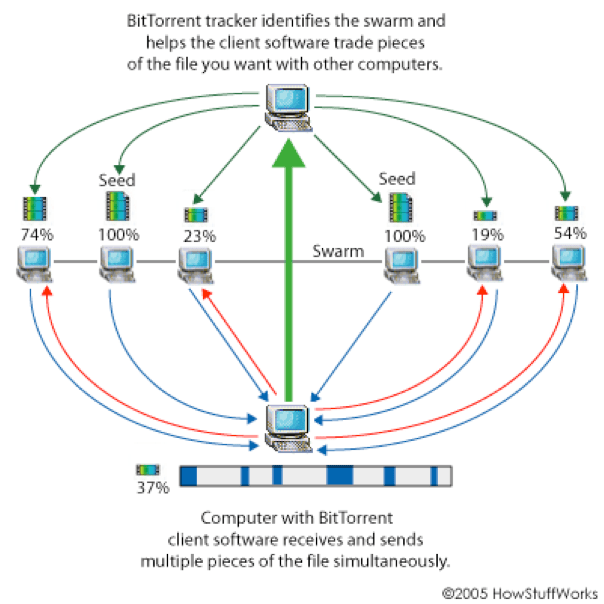
BitTorrent is a peer-to-peer, or “P2P” protocol, which is used to distribute large amounts of data online and allows for rapid download times. BitTorrent relies on the torrent, which is a file containing information on a target file’s component locations. These component pieces are spread across many hosts. When a user requests a download of a particular target file, the torrent seeks each of these components to piece together the target file for the user, which can be opened when all of the pieces have been assembled. This results in very fast download speeds of large files (movies, TV shows, etc.).

For those of you that are interested in how this relates to client-server download processes…

Client Server Download Process
BitTorrent Download Process

BitTorrent file sharing accounts for 28.40% of peak time aggregate traffic in Europe and 17.23% in the US, where it was only recently overtaken by Netflix (for peak time aggregate traffic). According to an MPAA report, the worldwide motion picture industry estimated a loss of more than $7 billion as a result of Internet piracy in 2005 alone.

Torrent downloading services offered by The Pirate Bay are free, and uploading/commenting capability only requires free registration. The Pirate Bay justifies their lack of censorship by noting the “broad spectrum of file sharers” that use The Pirate Bay. This means that everything from Barney and Conan O’Brien episodes to pornographic material can be downloaded using The Pirate Bay. And of course, most (if not all) of this is copyrighted material.

 
And then Conan O'Barney walked in...


Legal Lash-Back

How, you might ask, can they do this?

Simply put, they do.

The Pirate Bay takes no responsibility for the copyrighted material that is illegally dispersed thanks to their service. The following argument is readily posted on their website:

“Only torrent files are saved at the server. That means no copyrighted and/or illegal material are stored by us. It is therefore not possible to hold the people behind The Pirate Bay responsible for the material that is being spread using the tracker. Any complaints from copyright and/or lobby organizations will be ridiculed and published at the site.”

The Pirate Bay is notorious for this last part; putting up for public display takedown notices it receives from everyone and their grandmother, as well as the (usually vulgar, crass, inappropriate, and hilarious) response they send back. To acquaint you with the type of sentiment that The Pirate Bay typically responds, below is a medium sized cornucopia of phrases excerpted from various responses to Dreamworks, EA, Warner Brothers, and others’ Take-Down Notices:

  • We demand that you cease and desist sending letters like this,
    since they're frivolous and meaningless.
  • It is the opinion of us and our lawyers that you are ....... morons.
  • stop lying.
  • you should please go sodomize yourself with retractable batons.
  • We demand that you provide us with entertainment by sending more
    legal threats. Please?
  • The DMCA is a US-specific legislation, and TPB (The Pirate Bay)
    is hosted in the land of vikings, reindeers, Aurora Borealis
    and cute blonde girls.
  • Go fuck yourself. 


Quite a list of colorful phrases we have here! (if you would like some more, there is a whole list here)

But, you might wonder, why hasn’t The Pirate Bay been prosecuted and shut down?

Well, the Swedish government tried. After a criminal complaint was filed by the Motion Picture Association of America (MPAA), the Swedish Police executed a raid of The Pirate Bay, confiscating servers and shutting down the website in 2006. Dan Glickman, CEO of MPAA said in a statement, “Intellectual property theft is a problem for film industries all over the world and we are glad that the local government in Sweden has helped stop The Pirate Bay from continuing to enable rampant copyright theft on the Internet.” Problem solved? Absolutely not. In three days after the raid, the website was back online, with the following graphic:

Take That MPAA!

So much for the raid…


And Now, Some Commentary…

First, it is important to note that these guys founded the Pirate Bay:

The Real Pirate Bay

Gottfrid Svartholm (left) and Fredrik Neij (right) have both been charged (along with Peter Sunde and Carl Lundström) with “assisting [others in]copyright infringement” due to their association with The Pirate Bay. While in the process of an appeal, each defendant was sentenced to 1 year in prison and required to pay damages totaling 30 million SEK (US$3,620,000) (this verdict will only be upheld after all appeals have been processed according to Swedish Law).

Good with computers? Absolutely.

Creepy Looking? Sort-of.

Digital-Pirates in deep $#!%? Looks like it.

But they probably see themselves as modern-day Robin Hoods, stealing from who they consider as the rich (MPAA) and giving to those they consider as the poor (the swath of users on The Pirate Bay). However, while Robin Hood stole from a disillusioned, powerful king and gave back to the people who the king stole from, the users of The Pirate Bay haven’t been preyed upon. We operate in a (largely) capitalist world. If the public wants what MPAA and the rest of the entertainment industry produces, by all means the public is entitled to what they want and the entertainment industry is entitled to the profits generated by that demand.

Dispersing copyrighted material is illegal and/or immoral however you slice it, because it denies the producers of a good from their due share of benefits. It is stealing. The Pirate Bay provides the perfect conduit for this to occur. It is difficult for them to make the argument that they are not at fault for the illegal dispersal of copyrighted material because they aren’t the ones that hold the digital files – just the links to them… They call themselves the PIRATE bay for god sakes.

Yes, PIRATE I say!

Most people would agree that what The Pirate Bay facilitates is illegal, but where does it fall on the spectrum of illegal dispersal of copyrighted material?

If someone makes a DVD recording of a playlist and gives it to their friend, it is an isolated case. Sure, the friend could go home and make another copy and give it to his or her friend and so on and so forth, but the infrastructure is such that there is both time involved and physical transport of tangible objects that are required to share copyrighted material. This by the way, is still illegal, but does not make front-page news like The Pirate Bay.

The reason why The Pirate Bay’s activities are so criminal is because of the scope of individuals that can illegally acquire copyrighted material online. BitTorrent allows for anyone with internet access to download the latest piece of entertainment of their fancy. The infrastructure is designed to allow for maximum dispersion and minimal effort for the user. As opposed to a single DVD copy, which for all purposes will not hurt the entertainment industry, a BitTorrent file of the same movie makes the copyrighted material available to anyone on the internet – and all you need is enough hard-disk space to store the target file!

The Pirate Bay would, by this argument, fall on the far end of the illegal spectrum…

The (Illegal) Spectrum

The only reason that the Pirate Bay can get away with this is because they hide behind international disagreement when it comes to copyright law. With the company currently running the site in the Republic of Seychelles, they only need to abide by Seychelles’ copyright law. This highlights a gaping hole in the current international copyright system. What are some countries solution? Block thepiratebay.com. Denmark, Germany, Greece, Ireland, Italy, Malaysia, Netherlands, Norway, China, Sweden, and the UK have all experimented with blocking thepiratebay.com at some point in the recent past (according to Wikipedia).

What can countries, interested in protecting its citizens’ works but not interested in internet censoring, do? Not much (as of now) against sites like The Pirate Bay. Perhaps getting on good terms with countries where infringers hide and convincing the country to take action (like in Sweden) would work. How about against downloaders and uploaders using a site like The Pirate Bay? If they are within the borders of your country, huge fines would probably do the trick.

If they are outside your borders?

Tap your heels together 3 times and repeat “There’s no place like home”; with the current international copyright conundrum, there’s not much else you can do.

Art in an Age of Interactivity – by “Amanda C”

Manovich’s Claim

Not only have new media technologies… actualized the ideas behind projects by artists, they have also extended them much further than the artists originally intended. As a result, these technologies themselves have become the greatest art works of today… [The] computer scientists who invented these technologies… are the important artists of our time, maybe the only artists who are truly important and who will be remembered from this historical period.

Is Manovich on the Right Track?

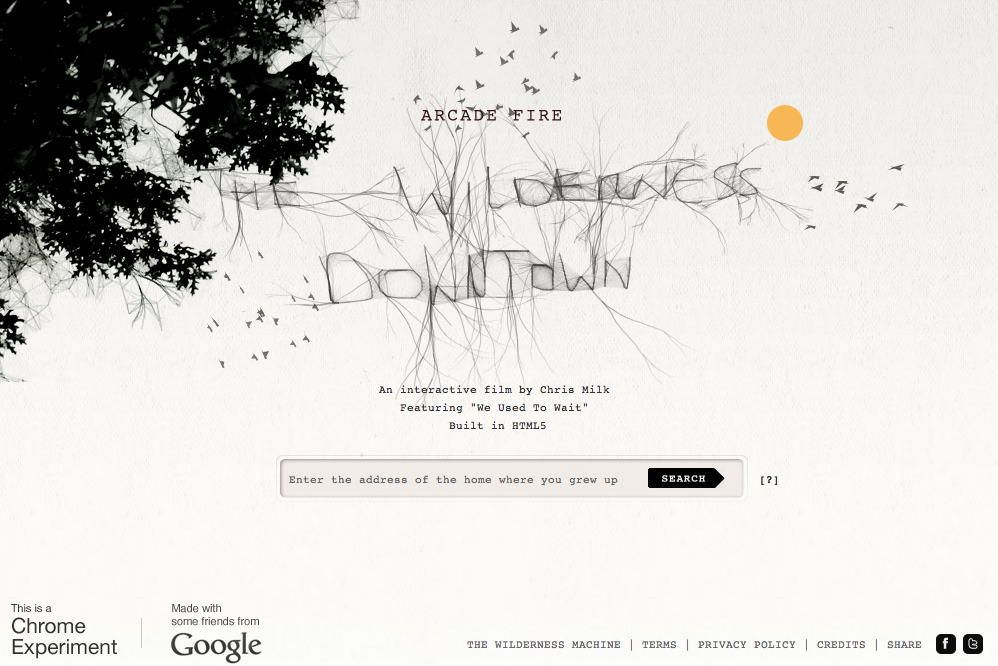
In order to address Manovich‘s statement from his 2003 essay “New Media from Borges to HTML,” I’d like to bring up one of my favorite pieces of digital art—”The Wilderness Downtown.” On its homepage, “The Wilderness Downtown” claims to be both a “Chrome Experiment” and an “interactive film.” The essence of the program is inventive—it inputs the address of the audience’s childhood home and creates a music video to Arcade Fire‘s “We Used to Wait” centered around that address.

The film’s credits are particularly fascinating; they credit the members and managers of Arcade Fire, the film production team, the interactive production team, and the Google tech team. Think about how the final product would have changed if any one of these teams had been removed. “The Wilderness Downtown” was a joint effort, and it now serves as a perfect example of interdisciplinary art. Without musicians and filmmakers, “The Wilderness Downtown” would simply be code, but instead it’s an experimental (and revolutionary, in my opinion) interactive film. So digital art is interdisciplinary, by nature. And Manovich was half-right: computer scientists are artists, but they’re very clearly not the only ones.

Sensory Marriage

It’s generally accepted that we, as humans, possess five senses: sight, hearing, taste, smell, and touch. Certain art forms feature certain senses. Visual arts feature sight. Music features hearing. Music videos feature sight and hearing—the two senses are expected to compliment each other. And “The Wilderness Downtown” works touch into the equation, by having the audience members enter their childhood addresses into the text box prominently featured on the page and write themselves letters. Interactions with art in physical manners are made more and more possible by advances in technology, so much so that now we’re getting used to touching the art that we see and hear.

The Internet is for Conversation

In an age where the Internet dominates, people’s opinions are overwhelmingly prominent. News articles, blogs, and videos all allow for comments, and often times the comments are more insightful than the original work. YouTube, the platform on which many videos are originally posted, has a built-in feature for Video Responses. In an age where physical interaction with art is increasingly prominent, how can we criticize for remix?

Mashup artist Girl Talk appears to agree. In his interview with the New York Times, he states:

I think a lot of artists are used to their music being reused online and have come to accept and embrace it. You have a generation who go on YouTube and remake and remix music online all the time. They remake and upload songs and videos, and then other people remake the remakes; it just keeps going.

Regarding copyright law:

It is clearly in a gray area but I believe it should fall into fair use under copyright law. I feel like people are not listening to my music instead of buying a CD or album of an artist I feature. Instead, people find new musicians because of a sample on one of my records.

Commercial impact is one of the factors used in determining fair use, and in my opinion the only important one. Should filmmakers and musicians be able to make a living off of their work, without having it stolen? Of course. Commercial success staying equal, should we stop people from remixing works in an age where art is inherently interactive? No. Are the remix-ers artists as well? Yes.

Should copyright laws be reformed for today’s society? Considering the interactive, multisensory nature of digital art—yes.

FindingSolo.com – An exploration of De facto Privacy and Online Data Mining – by “Sebastian P”

We’ve all seen the SNL skit for the “Damn it, my Mom is on Facebook filter,”  but what if the filter actually existed? Plenty of moms are on “the Facebook” and it certainly would be cool if there was an automated way to protect them from some of your more tasteless Facebook moments. On the other hand, similar software may allow advertisers to determine race or socio-economic status directly from photos or quickly determine what sports teams you follow based on wall posts and comments.  Employers could automatically pull suspicious content without the manpower needed to manually “stalk” potential hires. We explore the possibilities of such a filter at our site: FindingSolo.com.

On FindingSolo.Com, you’ll find two main products. The first, as our domain name implies, finds solo cups!

Coded in MATLAB, our solo cup detector knows when you’ve been partying. You simply run an image through its code and it’ll identify any solo cups present and replace them with more mom-friendly beverage containers.

We also created the Facebook Data Miner and Questionable Content Finder. A Google Chrome extension, the Facebook Data Miner adds a “Mine!” button to your Facebook page. Click “Mine!” to search for any questionable content on any profile page or news feed.

All of our code is released as an open-source project under GNU General Public License v3 (for more information about this license please click here). We have code repositories on code.google.com as well. You can find the links to them at http://www.findingsolo.com. On the website you can also view some cool screencasts demonstrating the software and giving instructions on how to download it for your own use.

Thanks, we hope you enjoy.

FindingSolo.Com Team:  Matthew Everts, Cameron Musco, Christopher Musco, Sebastian Park.

The Exploration of a Phenomenon: The Chin2 Meme and its Development – by “Stephanie R”

Introduction to Law and Technology Final Project

Joel Sircus and Stephanie Rivkin

When three former PayPal employees launched YouTube in 2005, they irreversibly revolutionized the digital world. With the company’s founding, everyone with access to a computer and Internet connection instantly became capable of writing, directing, and producing videos, then disseminating their creations to an audience on the order of one and a half billion people. Internet users started taking advantage of this interactive service, creating videos by the millions. What materialized was a culture of creators; a growing cadre of people who made movies running the full gamut from inane to genius. The Internet video meme – a movie posted to the Internet that accrues a large following and catalyzes many adaptations – became one of the pillars upon which YouTube achieved its unrivaled success.  While the creation of YouTube sparked the Internet meme boom, 2005 was not the movement’s genesis. Long before the do-it-yourself video posting service went live, perspicacious Internet users found alternate ways to create and broadcast videos, partake in the idolatry of the idiosyncratic, esoteric cultural movements, and, en masse, create numerous adaptations of these aforementioned movies.

Looking specifically at the development of one meme, entitled Chin 2, we question what are the underlying intentions of those who propagate and adapt these, at times, mindless videos? What, if anything, about a specific meme contributes to the fecundity of the original creation, and what do the adaptations say about the original meme? Lastly, what does this increasingly popular Internet trend say about us as a society and the path down which we are headed vis-à-vis our sources of entertainment and our searches for intellectual enrichment? By analyzing the original Chin2 video and many of its bastardized versions, we hope to shed light on what exactly defines an Internet video meme, why they are originally created, and how one specifically catches fire and is catapulted into digital stardom.

Through our research we communicated with the creators of two adapted versions and we filmed a video of our own.  Enjoy!

Original:

Our version:

Keller v. EA – by “Bill T”

Intro to Law and Technology Final Project from Nate Blevins on Vimeo.

Background on Keller v. EA: Samuel Keller is formerly the quarterback of Arizona State University’s team. He is suing Electronic Arts, the makers of several sports video games, for infringing several of his (and thousands of other college athletes’) rights in the production of NCAA Football. Through the creation of a realistic digital environment simulating everything from stadiums to weather to players uniform styles (though they omit players’ names), EA seeks to immerse its customers in the experience of college football. Keller alleges that the realistic models of players used in the game violate his Right to Publicity according to California Civil Code 3344. He further alleges that by enabling its users to share self-created rosters via “EA Locker” that they induce infringement of this right. Additionally in consideration in this case is the NCAA’s non-endorsement policy prohibiting its players from profiting from their images as football players. The case is currently before the US 9th Circuit court on appeal from the district court’s decision to deny EA dismissal for anti-SLAPP purposes. This project is an exploration of the policy-based arguments on both sides of the case.

Don’t Mess with that CSS – by “Daniel C”

Final Project Fall 2010

Don’t Mess with that CSS (feat. B-Rad)

Artists: MCSS and MC++

Don’t Mess with that CSS

Group Members: Logan Mohs, Jennifer Flynn, Jamie VanDyck, Adam Fishman, Maria Altyeva, Daniel Choi

Some background on the project:

Where we got our idea: We decided to make a modern version/parody of the original “Don’t Copy that Floppy” video from 1992.  (http://www.youtube.com/watch?v=up863eQKGUI)

Background on CSS:

CSS is a system incorporated into almost all commercially produced DVDs.  DVD players have a CSS Decryption system to recognize and allow the playing of these DVDs.  In 1999, Norwegian software engineer Jon Johansen created a decryption code called DeCSS that reverse engineered the algorithm.  DeCSS quickly became available to the public and DVD CCA (Copy Control Association) began suing individuals who helped distribute the source code and eventually arrested Johansen.  Some argued that DeCSS code belonged under First Amendment rights.  Ultimately, the Norwegian Supreme Court acquitted Johansen on all charges.  The court decided that Johansen was entitled to access information on a personally purchased DVD, and was therefore entitled to use DeCSS to break the code.  But don’t be mislead.  The bottom line is that DVDs should not be ripped for distribution, and should not be ripped if they are not your own DVD that you purchased.

Lyrics:

(intro)

[B-Rad]: Dude! Look what DVD I found! (Holding Along Came Polly)  Let’s copy it onto the computer!

[MCss]: (In agitated voice) Hey, man! Drop that DVD.

Verse:

Listen up B-Rad and be glad,

It’s only me mad, otherwise you’d find yourself in quite some trouble.

(B-Rad: Who are you?)

I go by the name of MCss,

My job is to make students like you second guess,

And realize that CSS is here to protect,

Before the Feds come and make you a criminal reject. (O-o-o-o background)

[MC++]: Um… wait a second I’d like to interject

[B-Rad]: Wow, another guy! And who are you?

[MC++]: (Rewind sound effect) Yo! Call me- MC++

When it comes to cracking code

I’ll show you wussup.

I run Clinics in linux,

I save Apples© for picnics,

I deCipher DOS scripts,

like Ancient hieroglyphics. (Wow!)

I’m like the architect of the Matrix,

I’ll take you back to the basics,

my coding is tenacious—let’s face it.

[MCss]:

Alright I’ll face it, his logic is tasteless,

And at best, his rap skills are only nascent.

In defense of Anti-circumvention, I need to mention

Salaries and pensions are incentives for invention.

A lot of work goes into a movie production,

Directors, actors, in conjunction to function,

Stiller and Aniston aren’t the only ones to suffer,

Think Friends without Rachel ([B-Rad]: but I love her!)

[Chorus 1] (lyrical in a minor key)

Comp hackers- don’t mess, don’t mess with that CSS,

Code Crackers, protest- Fight for your rights, if you know what’s best.

(harmonized) DON’T! Don’t mess, (Don’t Mess!) Take your hands off the keys and avoid arrest.

Disk Jackers, don’t mess, Let the Beat rest (beat drops—a cappella) and take a Moment to process.

[B-Rad]: (beat drops) But what is CSS?

[MCss]: (beat starts again) CSS is an acronym for Content Scramble System,

It’s a protective 40-bit stream cipher algorithm,

When you rip the system making movie incomes victim,

You break the key used for DVD authentication.

[MC++]

But it’s so easy; just use that DVD Rippa-

Put the movie on your hard drive and I’ll give you a sticka-

Don’t worry the code is protected under the First Amendment, (Is it?)

Now you can save a trip to Blockbuster and not have to rent it.

First take the DVD and convert to AVI,

Then maybe I, with Richard Stallman can help to legalize,

Software defying government Tony Stark style,

So that you can convert movies to versatile files.

My homie Seth Schoen wrote a CSS haiku,

He threw some writtens down like a verbal tycoon.

(MCss: Huh, Programming, poetic? Man that’s pathetic!)

[MC++]: Man, if you’z smarter you’d listen to my rhet’ric.

Now the Curse has been lifted and the Power has shifted,

we’re unLocking the content you greedy Fuckers encrypted.

Oh, what was that? Your DRM has been breached? (THAT’S RIGHT)

And you can’t do shit, cuz my Code is free speech

Put yo’ hands up (echo, PAUSE) in the air for generativity,

Creativity in code is expressive novelty,

Sorry b, if I offended you, you will soon see,

that the tides are shifting for expressive technology.

[MCSS]: Don’t listen to him B-Rad it’s not worth it!

[Chorus 2]

Comp hackers- don’t mess, don’t mess with that CSS,

Code Crackers, protest- Fight for your rights, if you know what’s best.

(harmonized) DON’T! Don’t mess, (Don’t Mess!) Take your hands off the keys and avoid arrest.

Disk Jackers, don’t mess, Let the Beat rest (beat drops—a cappella)

[B-Rad]: I need a moment to process…

[MCss]:

He says he can decode DOS like hieroglyphics,

But really he’s not thinking about you and missing the specifics, ([B-Rad]: You’re right!)

Since you found this DVD and personally don’t own it,

I can’t condone it, If I haven’t shown it, already.

Don’t distribute this DVD, that’s the take home lesson,

An authenticated DVD in your personal possession,

Is the only case, in which you can deface, erase, (Okay!)

The CSS for yourself and copy what’s encased.

Think about it. Is Along Came Polly really worth it? (What, What on the offbeats)

26 (percent) on rotten tomatoes, I would rather jerk it,

Shirkin’ your responsibilities with law isn’t workin’

Fill the shoes of movie workers; your mindset needs reworkin’

**violin vs. guitar battle** (G-minor trade-off)

[B-Rad]:

All right thanks you guys, I think I’ve heard enough,

This decision was real tough, you guys made it rough,

I’ll start with MC++, wussup, (MC++: Wut upp?!)

I’ll go over what you said—without the fluff.

I see your perspective that coding isn’t wrong,

That under free speech is where computer code belongs.

But I should use reason, And I should be heedin’

The advice of MC double S…yours is misleadin’

It’s not benign any more when it’s a crime,

Is it worth it to pay a fine for what isn’t mine?

I probably shouldn’t cheat and make movie workers resign,

This DVD isn’t mine so I shouldn’t this time.

I found this DVD in professor Torrent’s class,

I was walking down the aisle when I saw Lawrence flash,

A bunch of DVDs and he took his cash sash and last

-ly told me fast not to tell anyone as he passed.

All this DVD ripping is making me hectic,

And listening to all this rap is really infectious,

I didn’t know I had such miracle lyrical rap tricks,

Who needs Blockbuster anyways, I hacked my friend’s account on Netflix…WHAT

(Beat fades)

Brad’s friend: Are you serious man?!

B-rad: Yeah man, you’ve had the same password since like the 2nd grade…

In Between Technology and Creativity – by “Brian R”

Our current system of education—specifically below the college level—mediates the relationship between technology and creativity. While creativity has been one of the engines behind the progress of our technology and has generated the new ideas that manifest themselves as innovation, the mere growth of technology has led to the propagation of an education system that discourages divergent thought. One could almost say that creativity has facilitated the diminishment of its own role within society, and although this may be true, it most certainly should not be the case as we move forward.

Ever since the Industrial Revolution, our American society—and many others around the world—has felt the need to have ever more “educated” citizens in order to feed the machines of industry, in order to sustain technological growth. Because of this, we have erected a sprawling education system that molds the minds of our youth, teaching them laws of science that were proven hundreds of years ago, shedding light on math corollaries authored by people long since dead, and so on and so forth.

In large part, this system has helped to maintain and speed up the progress of our nation and of the world. Just consider these facts for a second: in America in 1905, the literacy rate was 80%, the high school graduation rate stood at 6%, there were 8,000 primitive cars on the road, and 8% of homes had a telephone, which was then the most advanced means of communication (see http://dailyreckoning.com/100-years-of-progress/ for more facts). Contrast this with 2010: our literacy rate stands at 99%, 75% of American adults have graduated from high school, and, well, I think we can all see how saturated our society has become with similar technologies.

The fact that the increase in education has corresponded so directly with the rise of technology suggests an inherent connection between the two. Although there are undoubtedly other factors at play, a more educated citizenry has facilitated an increase in the sophistication of technology because every bit of education places people on a higher intellectual ground. For example, even basic math skills are essential to the production of today’s supercomputers. But our education system does have its limits, as people such as Sir Ken Robinson (http://sirkenrobinson.com/skr/who) are quick to point out. By condemning wrong answers and placing the arts at the bottom of an implicit hierarchy of subjects, the system stifles the types of creative and divergent thinking that have the most potential to revolutionize society.

In Robinson’s opinion, we are nearing a point where our system will bump up against its limits, where the discouragement of creative thought will finally begin to impede our technological progress. This is because our technology is evolving at an ever-increasing rate, so the jobs that our schools are preparing people for are vastly different from the jobs many people will actually have; a classic example is that, if you were to tell someone twenty years ago that they were going to work for Google, they would have looked at you like you were crazy, only partly because Google was founded in 1998. In these “new” jobs, classical knowledge only gets people so far and is secondarily important to adaptive and creative thinking. And because these new jobs are becoming ever the more common, the importance of these two skills, among others, will only increase as time marches onward.

In essence, our system of education may be too effective for its own good: the exponential growth of technology is outmoding the system of education that we put in place to foster it. In order to ensure that we can continue our growth, we need to revamp this system—below the college level, that is—and place a higher value on original thought. Only then can we ensure that we will not run out of ground-breaking technologies.

Here are some of Sir Ken Robinson’s Talks on this subject:

Changing Education Paradigms

Ken Robinson Says Schools Kill Creativity

Technological Advancement – by “Jennifer W”

When I began thinking about this blog post, I thought I’d find some fabulous article or research to post about. Then, I got a phone call asking me to be on a television show taping on the other side of the country; left the classroom for an ice rink and CBS television city; and began my own technology adventure — Skyping into classes, emailing assignments, overnighting art projects to campus, and generally exploring my studies as a ‘virtual’ student. And so, I sit down to write this blog today and it occurs to me, what better experience to write about than my own?

I’m experiencing a virtual education today. I awoke at 5am(PST), emailed my ‘bring to class’ assignments, turned on my Skype, and eagerly awaited my professors’ video calls. During class I used my chat box to send messages to my peer review group as they spoke back to me about both my drafts and theirs. In art class I viewed projects on my computer screen as my classmates critiqued them [hanging on the wall in front of them]. The only difference between being on campus and virtually present was the interaction with my classmates walking between buildings. For even when my instructor took a pole of students that had chosen a particular topic, via his computer screen, he saw me raise my hand.

Never has technology been as exciting as it is today. While interacting one-on-one with classmates is one of the most valuable experiences on campus, the ability to access vast wealths of resources is invaluable for those who encounter opportunities or struggles that limit their access to the on-campus experience. I for one know that there is nothing I’d trade for my education at Yale, but I also know that, as we heard many times in opening day speeches, we should not ‘let school get in the way of our education’. And education comes in many forms. The better able schools are to provide logistical help when it is needed via technological means, the more educational opportunities will be realized in society.

While there are many pitfalls to the online educational opportunities, both for the student and for the professor and institution, there are many benefits as well. The academic world will always need great institutions but mediocre establishments may, and possibly should, be feeling the pressure of technology bearing down on them as great intimations spread their ‘virtual wings’. No longer will working students be bound by their city limits in accessing great lectures or forced to pay for sub-par instruction simply because that is all that is locally available. The internet is bringing the opportunity for education to the masses. Those that choose to take that opportunity and run with it can success like never before.

I am thankful for the internet and the generous understanding of my professors and advisers in allowing me to fit other exciting opportunities into my schedule. I’ve not taken the help lightly, no exceptions from assignments have been requested. Instead, I’m present at every opportunity, if sometimes only virtually. From my stand point, I’d love to be in the chilly fall air of New England, but if that can’t happen, I guess I’ll have to listen to lectures from a hotel in sunny California.

“Them’s the Breaks!