Final Project: Stop SOPA at Yale – by “Mollie D”


       Our project was to plan and implement an advocacy and awareness campaign concerning the Stop Online Piracy Act. This piece of legislation, currently being debated in Congress, would place severe restrictions on Internet activities and free speech. The act also restricts Americans’ ability to obtain affordable prescription drugs from abroad. SOPA is the culmination of entertainment and pharmaceutical industry pressure on Washington to place stringent protections on intellectual property, and the resulting draconian measures threaten to undermine the fundamental principles of Internet freedom. The Internet has grown at such an astonishing rate because it has largely rejected harsh restrictions on user activity. SOPA violates the theoretical pillars necessary to the Internet’s functionality, and breaking the Internet in such a fashion would bear negative consequences for individuals and businesses that rely on the Internet’s facilitation of free information exchange.

       In formulating our project, we decided that a campaign aimed at students and tailored to their concerns would maximize the effectiveness of our efforts. We thus chose to use Internet and social media based methods of communication, and we concentrated our substantive content on issues most relevant to college students. We did not limit our coverage to these issues though, as we aimed to provide a breadth of information about the bill’s negative consequences. By using social media platforms, traditional media outlets, and two different blogging platforms, we were able to spread our message to many Yale students and provide valuable information about SOPA’s Internet-breaking policies to the campus. We hope the lasting impact of this campaign will not only be to facilitate continuing interest in SOPA’s progress, but also to engender a general sense of vigilance in the form of participatory democracy concerning free speech and Internet regulation that resonates well into the future.

Part 1: Launching a Campaign

       Our primary goal of this project was to spread awareness of SOPA and hopefully rally others around opposing it. In order to do this, we tried to appeal to many different groups by using a variety of platforms (Facebook, Twitter, WordPress). We also attempted to broaden our appeal by using satire and humor in addition to more pointed intellectual critique of the legislation. We tried to tap into the very things that SOPA would likely cut into: user-generated content, memes and places where you can share links. While we created a lot of our own content, we also tried to post relevant and interesting articles and sites that others had made. One particularly enjoyable and interesting story involved “The Megaupload Song” that received a takedown request, presumably automated, from some RIAA-related entity (Universal Music Group) because it featured many RIAA artists even though Megaupload (a major file-sharing site) owned all the rights to the video. If you’re curious, the (quite catchy) song can be found on Youtube, and there’s more information here. Also, if you’re into remixes, check out this link.

       A major challenge for our group in promoting the anti-SOPA movement was fighting the general Yale apathy and our generation’s apathy that comes with having people constantly inviting you to do things (spamming you). This challenge was exacerbated by finals period, and consequently, we weren’t able to get an Op-ed published in the YDN (as they stop publishing early in December). However, we were able to raise a good amount of awareness as many Yalies hadn’t even heard of SOPA prior to our outreach. Through explaining SOPA’s specific relevance to college students as well as posting some of the amazing articles and content available around the web, we were able to educate (and hopefully inspire) a lot of people.

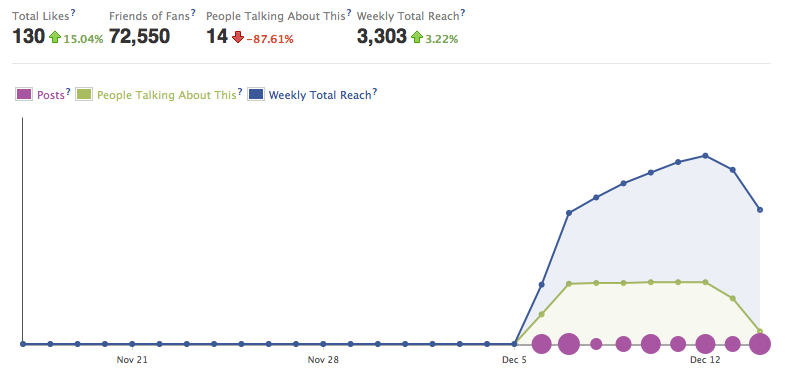
       As of this writing, our Facebook page has 130 likes which is equivalent to about 3 percent of the Yale Undergraduate population.  While this number is fewer than we would have liked, we speculate that many people for political reasons and/or page like accumulation effects were reluctant to like our page. However, our Facebook page insights seem to indicate that many people still benefited from and engaged with our content. As we see below, our weekly total reach (the number of unique viewers who saw our content from 12/8/11 to 12/14/11) was 3,303 and peaked at 5,191 for the weak ending 12/12/11. Thus, a large percentage of Yale undergraduates likely read something we posted and learned more about SOPA.
 

       To complement our Facebook and WordPress, we created a Twitter account, @StopSopaYale, to complete our social media approach. The Twitter was useful in that it let us keep a small but interested group completely up to date on every #sopa happening. Additionally, the Twitter account was useful because it let us retweet other people’s views and comments on the SOPA debate. This allowed us to combine other people’s opinions with our own and give a lot of different viewpoints on the topic. The Twitter page was also an interesting foray into trending topics and extremely concise posts, a nice contrast to the more drawn out and in depth arguments of our WordPress blog.  Currently, we have 20 Twitter followers and we are on the list of one anti-SOPA advocate.

       In our opposition to SOPA we took both the pragmatic path into what specifically the SOPA legislation said and would do immediately (and why their is concern about intellectual property protection) as well as the somewhat hyperbolic path, wherein we demonstrated the absurdity of how broadly SOPA is written and speculated on the potential consequences that SOPA could have. In this way, we provided our audience both with a quick draw in (the two line memes and absurd scenarios depicted in videos) as well as further information if they were interested in understanding the issue on a deeper level.

Part 2: A Creative Approach

       In raising awareness within the Yale community about the flaws of SOPA, we aimed to create original content which would specifically appeal to Yale students, both in addressing issues relevant to our audience and by presenting this material in an entertaining form.  Thus, we created internet memes, videos, an op-ed for the Yale Daily News, and a blog.  Additionally, we wrote an anti-SOPA form letter for Yale students to send to their members of Congress which was tailored to reflect a Yale student’s perspective.  Finally, to make all of this content easier to access, we either linked the material to the Stop SOPA at Yale Facebook page or we created static HTML pages for the material with corresponding tabs to our Facebook page.

Internet Memes:

       The use of internet memes provided an effective and engaging way to point out the ridiculous elements of SOPA.  In generating our anti-SOPA memes, we drew from internet memes which were already popular and recognizable, such as the Lazy College Senior or Futurama Fry.  Thus, Yale students would be able to easily recognize the humor which we aimed to convey. Plus, internet memes can be easily shared and transformed.  Consequently, we hoped that our fans would not only share our anti-SOPA memes, but would also craft similar memes themselves.  Some topics which our memes addressed were the possible end to interactive websites such as Facebook and Wikipedia, the end to fair use online, and the halting of future innovative online start-ups.

Video Posts:

       Similar to the internet memes, the videos which we created aimed to point out insensible aspects of SOPA in a humorous way.  However, through videos we could portray these aspects in a more in-depth form to help our audience gain a better understanding of the problems created by SOPA.  For instance, the video entitled SOPA Courtroom Battle illustrates the extreme changes SOPA will make in criminalizing copyright infringement.

Form Letter:

       By creating an anti-SOPA form letter, we hoped to encourage students to be active participants in the Stop SOPA at Yale campaign, rather than just passive followers.  While creating awareness on campus about SOPA is important, it was equally important to us to inspire a response to the bill.  As mentioned above, we tailored the form letter to address the concerns of Yale students.  This form letter, with instructions on how to send it, was posted both on our Facebook page and our blog so that it could be easily accessed.

Op-Ed:

       As another form of outreach on campus, our group wrote an op-ed piece to be published in the Yale Daily News.  Unfortunately, it was too late in the semester for the op-ed to be published immediately, but it can currently be found on our blog and an updated version will be posted in the YDN early next semester.  Like our other creative content, the op-ed piece exemplifies many of the problems with SOPA and the article’s sarcastic, comical tone aims to keep our readers engaged and entertained.  Also, the op-ed piece directs our readers to visit our Facebook page, AmericanCensorship.org, and Wired for Change.

Blog:

       The Stop SOPA at Yale blog provides a forum for our group to express our opinions about SOPA extensively and provides a space for our followers to contribute their own viewpoints.  Similar to the op-ed, the blogs are written with the goal of being both informative and compelling.  Our blog posts touch on a variety of topics, ranging from the different camps of anti-SOPA supporters to the effect SOPA can have on healthcare.  In addition, three of our members held a live blog session to cover Congress’ markup debate of SOPA.  Through the blog, our group elevates our position in the anti-SOPA movement: not only do we provide a channel of information to Yale students, but we are also contributing to the online voices against SOPA.

Part 3: Becoming a Part of the Action

       One of the more interactive aspects that we integrated into Stop SOPA at Yale was our creation and operation of a live blog. After learning that there would be Congressional debate held to discuss the SOPA legislation on Thursday, December 15 (which just so happened to fall in the middle of our SOPA campaign), we realized it presented a great opportunity to add very direct and significant value to our campaign efforts. We would have been foolish not to somehow take advantage of the fortuitous timing of the most defining event to take place regarding SOPA to date. Sooo, we decided to conduct a continuous live blog during the House of Representatives’ Full Committee Markup. For the sake of clarification or if you are not really sure what a markup is, it is “The process by which congressional committees and subcommittees debate, amend, and rewrite proposed legislation.”

       Up to that point, the majority of our campaign’s content was based upon content published online, in the news, by political commentators, activists, etc. We had yet to really dig deep into the real diplomatic activity and reality of what was actually happening with SOPA on Capitol Hill, or among the politicians who will ultimately dictate the bill’s fate. We knew that by monitoring and providing commentary on the live debate IN CONGRESS, it would add a heightened level of authentic value to our campaign.

The very nature and benefits of maintaining a live blog carried unique advantages that fundamentally differed from the other aspects of our campaign (Facebook page, normal blog, memes, creative scenes, op-ed, etc)….

       Live blogging gave us a channel to portray not only our opinions about SOPA and why people should take a stand against it, but also the ability to present a discussion based on the statements made by representatives in Congress to support our previously published content. Furthermore, as proactive “Anti-SOPAs,” conducting this event forced us to seriously pay attention to what is ACTUALLY going on with SOPA in the political sphere. When participating in a public protest, it is very easy to get caught up in the overwhelming flood of public opinion online and in the media. Blogging live on the congressional hearing during which political figures delivered their positions helped us stay grounded.

       The main goal of our campaign was to engage Yale students in a compelling way. We believed that a live blog would be (relatively) more captivating (to the extent that a live blog really can be) than other forms of content. Our idea was that a live blog on the Congressional markup would attract more attention to the issues we were trying to convey to the student body. We also realized this would make the substance of the debate more accessible. Essentially, we sought to accomplish two campaign goals: 1) more exposure for our campaign, 2) heightened attention and knowledge to students about the bill itself.

       We believe we were able to bring the experience of the House debate in an appealing way to those who may not have followed it live, but wanted to have a taste of what went on. The live blog was an aspect of our campaign that probably linked closest with the “real-life” implications surrounding SOPA. The most fitting conclusion I could provide about this endeavor would be – POLITICAL PARTICIPATION AT ITS FINEST!

Part 4: A Rewarding Experience

       Ultimately, we deemed our advocacy campaign a success. As is discussed above, our data shows that our Facebook page reached a large number of individuals, both those inside and out of the Yale community.  We believe that we helped further the anti-SOPA cause and exposed the weak points of the legislation. It was especially exciting to be involved with the anti-SOPA activity at this particular stage, when the bill is one of its most hotly debated points. This allowed us to piggyback off of other anti-SOPA campaigns’ publicity and allowed us to run a live-blog of the bill’s mark-up in Congress.

       It was an extremely rewarding experience for us all, both in terms of educating others about the dangers of SOPA and learning ourselves about the controversial bill, as well as about other related debates regarding the freedom of the Internet. The project also allowed us to gather (or hone) many different skills using technology that we might have never been exposed to, including creating and running a blog (and live blog), creating memes and other internet videos, writing simple HTML, and using and linking Twitter, Facebook, and blog pages. The project was therefore a perfect culmination of our semester in Introduction to Law and Technology, reinforcing and combining new technological skills with knowledge about current Internet debates that in the future will allow us to be better informed and more active citizens of the Internet world.

Mollie DiBrell
Charles Gyer
Sam Helfaer
Nicholas Makarov
Zachary Tobolowsky
Will Kirkland

Final Project – by “Benjamin H”

We mixed popular songs to make a mix that contains pairs of opposites: day and night, American boy and American woman, Monday and Saturday, etc. The mix highlights the fact that many popular songs touch on the same common themes but often from divergent perspectives. In this sense, our video is akin to the art of vidding. Francesca Coppa defines vidding as “an art in which clips from television shows and movies are set to music to make an argument or tell a story. The song is used as an interpretive lens; the music and lyrics tell us how to understand what we see.” In this case, our video juxtaposes songs about similar themes and the images are used to draw the viewer’s attention to the argument. For instance, the successive images of a calendar month showing “July” and one showing “August” highlight the opposing lyrics of the two songs paired with them.

We think the music in the video constitutes fair use. The Copyright Act allows copyrighted materials to be used if “for purposes such as criticism, comment, news reporting, teaching (including multiple copies for classroom use), scholarship, or research.” This video arguably falls into both the criticism and comment categories; it juxtaposes parts of songs to comment on the nature of popular music more generally and in doing so is a type of cultural criticism. The other factors considered in fair use also seem to confirm that the music used in our video falls under fair use. For instance, the purpose of the video is not commercial, and though the material used is copyrighted only a small portion of each song—about ten seconds—is used. It seems reasonable to conclude that people would not listen to the music in this video instead of any of the individual songs. The effect of our video on the potential market value for the originals songs is minimal; people can appreciate the argument made in the video and still listen to and enjoy popular music, and the video might even expose people to music they hadn’t before heard and subsequently buy. Last, though the song clips aren’t themselves transformative, their placement of opposite songs next to one another makes the video generally transformative. The purpose of the original music is entertainment, whereas the purpose of the video is commentary or argument. Ultimately, the purpose of copyright laws is to promote the progress of science and the useful arts. We think this is a useful commentary on popular music, and it’s unlikely that the video, even if it went viral, would negatively effect the production of music generally or any of these songs specifically.

Although the music probably falls under fair use standards, the images used in the video may not. The images used aren’t transformed from their original contexts, as they appear just as they did when first displayed. They are also used in their entirety, as many of the images appear by themselves in their original contexts. Moreover, the purpose of the pictures is arguably also not transformative. Assuming they were originally intended for entertainment, they are also used in our video for essentially the same purpose. They do aid in the argument posed by the video—as the contrasting images highlight the contrasting lyrics in the songs—but they also serve as a pleasant visual complement to the songs that isn’t actually necessary for the argument in the first place. However, the other factors considered under fair use standards are still largely met. The purpose of using the images is noncommercial and it’s unlikely that the use of the images in this video will affect the market for the original images. Despite their aiding a cultural argument, then, it seems like the images would not fall under fair use.

Will Horowitz, Amarto Bhattacharyya, William Smith

Final Project: Defamed (Part 1) – by “John G”

As a suite, we decided to write a rap as an educational piece, lecturing small children about the risks involved in hateful speech and defamatory claims against an individual/others. The introduction begins with a terse explanation of defamation in U.S. law and common defenses in court. Transitioning into the topic of defamation per se, the rap speaks about the difference of defamation per se as compared to regular defamation, specifically, that damages are assumed for defamation per se.

Utilizing celebrity cameos, the rap introduces the four specific instances of defamation per se and continues to provide detailed circumstances under which each could be found applicable or a notable exception. Explicitly, the four categories are allegations or imputations injurious to one’s profession, of criminal activity, of loathsome disease, and of unchastity, which is duly noted in the rap’s chorus.

In addition to the four instances of defamation per se, Internet libel laws are also discussed as a means of exhibiting the relevance of defamation laws in modern culture and technology.

We aptly decided to construct this project as a rap song in order to cast the subject matter of defamation into the medium of aggressive hip-hop, a genre which is often plagued with defamation within its context, thus creating a parody of the genre and of defamation itself – allowing us to discuss and commit speech acts that might otherwise be construed as defamatory.

With much serendipity, we invited many famous artists from the hip-hop industry to spit their game on this track. In a surprising turnout, we were able to have featured performances by The Ying Yang Twins, Chris Ludacris Bridges, Nicki Minaj, Rick Ross, Eminem, T-Pain, Dr. Dre, Jamarius Brahamz, Gangreeeeeeen, and Notorious B.I.G. (posthumously). Unfortunately we could not produce a promotional video due to scheduling conflicts and the fact that one individual is currently deceased. Much to our surprise, our producers have signed a contract for another track to be released in the near future. Follow us on twitter @twitter.com/FratCity.

Here is the link to the song: http://soundcloud.com/defamed-part-1/defamed-part-1-final

Jamar Bromley
Matthew Prewitt
John Greenawalt

Final Project: Mental Health on the Go – by “Bryan B”

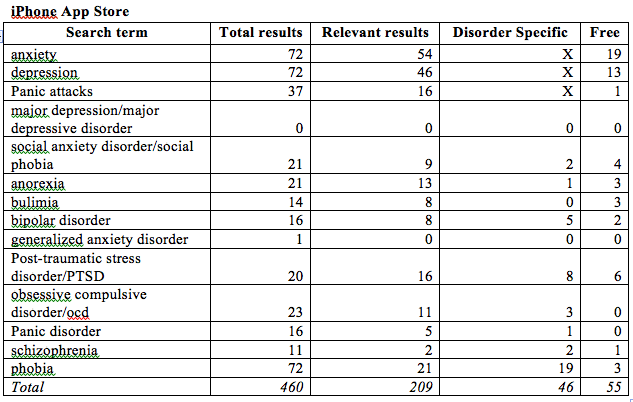
As part of my final project, I was interested in the way health care and health care related information is provided on smartphones. Because I am interested in mental health care, I looked at apps relating to mental health care in particular. Moreover, because Google’s Android system and Apple’s iPhone currently dominate the majority of the smartphone market, I compared the results of my project on both markets. One purpose of my research is to investigate how people access apps in pursuit of mental health services. To investigate this, I compared results for various search terms related to popular mental health concerns. These included general symptoms such as depression, anxiety, and panic attacks, as well as specific searches for ten of the most common mental disorders, such as major depressive disorder, social anxiety disorder, and anorexia.

Once the search was initiated, I took inventory of several factors: total apps returned, total relevant apps returned, total apps that were free, and for the specific disorder searches, a count of how many apps were directly related to the disorders in question. The most important results of my project are here:

Graphical Results
Side by side comparison of results between the Android Market and the iPhone App Store. Average utility refers to the number of relevant apps compared to total apps for all searches.
Android Full Results
iPhone Full Results

First, the Android surpassed the iPhone in how many total apps were produced for each search term and in each search category. This reflects the fact that, for each search term, I found that the Android was generally much more responsive to general terms in producing associated applications, however, the iPhone was better at returning more relevant apps, as indicated by it’s higher utility value.

Though the Android was much more generally responsive to search terms, it appears as though the iPhone was much better at only returning relevant apps. It seems as though the Android may bloat the number of relevant apps presented to the individual conducting a search. This could frustrate users seeking help, which in turn may repel individuals seeking help from doing so on the Android platform. iPhone users, and in turn, developers, may appreciate the ease of use and lack of clutter provided by the App Store.

Apple's App Review Guidelines may have something to do with this. The Android Market currently has no equivalent.

Another important result to highlight is that the Android surpassed the iPhone in the availability of apps tailored to the alleviation of a specific disorder. In nearly every case, the Android returned more overall apps than the iPhone did. The case of GAD and Major Depression were most notable in that the iPhone failed to recognize any relevant results, while the Android proved mildly successful. Because the iPhone did respond to and produce results tailored specifically to “depression,” this may not reflect an availability issue, but rather an accessibility issue with the way the search engines return information.

Because there were significant differences between both platforms, and some clinicians acknowledge this to promote the use of one platform like the iPhone, there are several potential implications. A clinician I work with told me that the iPhone is the preferred platform, for him and for others, in releasing mobile mental health care services mostly because of the ease of use and accessibility of the iPhone. But Apple products are typically more expensive than Android equivalents, and this difference in population may further promote the divide between individuals who seek mental health care. Financial concerns are one of the obstacles to accessing mental health care. If the iPhone comes to dominate the use of mobile mental health care, then this could alienate individuals who seek access to mental health care on apps but for whom financial troubles prevent access to both the iPhone and professional mental health services. In this regard, it is also worth mentioning that the Android market provided more free apps. If developers move to the iPhone, accessibility for those who have an Android device may further decrease.

Though these apps may be useful, developers must be cognizant of demographics of iPhone and Android users

Moving forward, one thing that would be important to look at is issues of legitimacy of apps like these. In professional mental health care, government law and agencies, high barriers to entry into mental health care fields, and peer review processes help us determine who is a trusted clinician and what forms of therapy are valid. For example, Twitter provides an excellent example of this: Twitter allows users to mark their profiles as “Official” in order to prevent fraud or misattribution of information. Such a similar feature could likely be presented in the future for apps mental health apps, as they are a sensitive issue. For now, however, most likely most people will rely on proxy sources like official consumer reviews and news, such as from the New York Times, and suggestions from doctors or therapists on which applications to seek.

The Latest Buzz in EU Privacy Regulations: The Right to be Forgotten Online – by “Jonathan H”

Out of a flurry of fights in recent years over online privacy and personal data in the European Union has emerged an interesting – and extremely popular – concept: the right to be forgotten online.  Essentially, the right to be forgotten online is the right to force a website to cease hosting, linking to or storing personal information about yourself.  According to a recent poll commissioned by the European Union, 90% of Europeans support the right to be forgotten online.

Warning label distributed with this right: you may forget who you are without a Facebook profile to remind you (image created by Flickr user Guudmorning!)

So what exactly does the right to be forgotten online mean for Europeans?  According to the latest draft of upcoming changes to the EU data privacy regulations, it is:

the right that their personal data will be erased and no longer processed, where they have withdrawn their consent for processing or where they object to the processing of personal data concerning them.

More concretely, it is also defined in the draft as:

the right to obtain erasure of any public Internet link to, copy of, or replication of the personal data relating to the data subject contained in any publicly available communication service

On its face, this sounds like a good thing!  People should have the right to remove their personal data from public circulation, right?  Google’s Global Privacy Counsel Peter Fleisher suggests that the right to be forgotten is not the answer, pointing out:

  • This right raises difficult-to-resolve issues of personal privacy vs. freedom of expression in cases where others retweet or repost something you have put online and later regretted – for example, it could be a photo of you and a friend, which the friend then reposts.  When you ask Facebook to remove the photo from your friend’s album where he reuploaded it, citing it as your personal data, how does Facebook decide whether to support to your right to be forgotten or your friend’s right to free speech?
  • What about journalism and the historical record?  Where does one draw a balance between public interest in knowing the news and the personal “right” to anonymity – and should it really be up to the content provider to decide?
  • To whom should these regulations apply?  To websites hosted in the EU?  To companies with headquarters in the EU?  To websites with users in the EU?  The regulations may be so difficult to enforce as to be worthless.

Although the right to be forgotten online sounds noble and is extremely popular, it is fraught with difficult moral questions, the burden of which current draft regulations place squarely on the shoulders of content providers.  It is encouraging that EU citizens are enthusiastic about their privacy online, but it is clear that more work is needed before the right regulatory solution is found.

Final Project: What are our reasonable expectations of privacy? – by “Carla G”

My project was set up as an experiment to test our awareness and expectations of online privacy. My hypothesis was that Internet users are largely unaware of the amount of information accumulated and aggregated about them online. We have an “anonymity of Manhattan” mindset: we believe that no one will pick us out from the crowd of billions of users. Everyone publishes their name, email, birthday, and address for sign-ups. Everyone has incriminating pictures on Facebook, follows the Jersey Shore cast on Twitter, buys embarrassing books on Amazon, and looks up basic concepts on Wikipedia. We seem to think that it is a slim chance that someone, one day, would use our information against us. And even if they did, the cost of this chance does not outweigh the multitude of benefits the Internet gives us. For this reason, I predicted that while most people hope for some level of privacy online, they are largely apathetic to understanding and enforcing it.

To test that hypothesis, I focused on the privacy policies of five websites: Gmail, Facebook, Twitter, Amazon, and Wikipedia. I chose these sites for two reasons. First, they are all, of course, in the top 10 most visited sites globally. Second, searching myself on a site called PeekYou, which helps you find people online, I discovered a profile of myself that included links to my Google+, Facebook, Twitter, and Wikipedia accounts, as well as a list of my most recent Amazon purchases (and for $39.99 I could order a full background check on myself). Bewildered by how this information had been leaked on to PeekYou (and what could possibly be in my background check), I decided to focus on the policies of these five sites—I found these policies to be overwhelming similar.

I then wrote a survey on the website SurveyMonkey of 29 yes/no, fill-in, and multiple-choice questions, designed to be easily and quickly completed. Questions were divided to address four issues: demographics, knowledge and awareness, descriptive activity, and normative opinions. 173 responses were collected and I then underwent simple statistical analysis on Excel to identify possible correlations as well as discrepancies with the relevant privacy policies.

The results confirmed that we have very different assumptions about websites than their privacy policies stipulate and, overall the project  provides a basis to begin answering the broader question of how we can engineer norms, laws, and code to make the architecture of the Internet fit our descriptive and normative desires, and not the other way around.

Happy holidays! -Carla

Final Project: Search and Seizure Cases Illustrated – by “Will P”

Some of the readings for the search and seizure cases were rather dense, so I made some animations to get across the major points quickly and memorably.  I’ve completed “overviews” for two cases so far and hope to get more in before the final deadline.

Link to YouTube channel:

http://www.youtube.com/user/searchplusseizure?feature=watch

Cases:

Kyllo v. United States

Katz v. United States


-Will Pitler


Final Project – YouTube & 15 Minutes of Fame – by “Colby B”

(Updated 12/17/2011)

YouTube’s 15 Minutes of Fame

Hey Guys!

Check out this link to our final project! It’s centered around the continually changing nature of YouTube fame and its real-life consequences. This project is meant to explore  ‘heap paradoxes’ like those we discussed in class and the inapplicability of binaries we used to describe fame before the Internet.

We tried to choose videos for our project that show something non-existent in traditional media and therefore unique to online video. Dramatic vlogs, ridiculous online-series, independent musicians and unintentional home videos number among the examples we selected. These videos show that online fame, notoriety, obscurity or any mix of the above is much different than anything we’ve encountered before.

Beyond the changing nature of fame we also wanted to investigate the perspectives that YouTube viewers hold of the content they are watching . We especially wanted to probe into the importance of reality and authenticity to viewers. Our perceptions of authenticity and in-authenticity have become skewed to the point that we pay homage to actors presenting a personality and yet we often ignore the real life consequences that online attacks have on real people. We seem to entertain the notion that much of what we see on YouTube is real, but oftentimes success seems to be either strongly tied to well-performed personas (inauthentic) or correlated with attacks on real-life individuals who end up as victims in the end. Of course there are counter examples, but we think this is a strong trend in viral video.

Anyways, we hope you all enjoy the video!

Make sure to share this with all your family and friends 😉

Happy Holidays!

YouTube’s 15 Minutes of Fame
Josh Eisenstat
Ted Papalexopoulos
Colby Brown
David Meierfrankenfeld

Final Project: My Big, Fat, Vaugely Acquainted Network – by “Charlie C”

People are getting smarter about their privacy online. By now we all (hopefully) know to restrict our profiles so that only friends can see our personal information. But after 3, 4, 5+ years of social networking, how many people still know ALL of their Facebook friends? For our final project, we set out to design a fun, interactive website that would work to remind Facebook users of their overly extended networks.

Playing WhatsHerFace-book.com

After launching this weekend, we’ve seen over 700 users (Mostly college age students) tag 35,000 friends, and it turns out that the average player only knew 70% of their Facebook friends presented. Now, of course, the term “average user” is very skewed given our user base. Facebook reports that the average user has 130 friends, while our average player has boasted a whopping 880.

We argue that anything under 100% recognition of your “friends” should raise some privacy red flags. Every one of your friends can share your information with third-party apps (in fact it’s this that allows our app to function); we are able to pull all of your friends photos, without their permission–that is, unless they’re smart about their privacy settings.  Even if you can’t bring yourself to defriend a long-lost acquaintance, at the very least you should consider creating managed friends lists with restricted privacy settings.

Results from a round of WhatsHerFace

We also hope to remind people to consider their audience when sharing content. “Friends of Friends” is never a good idea. For the average Facebook user, that’s 17 thousand people you don’t know, and why would they need to see your information anyways? Entire networks are generally a bad idea as well. You have no idea how large those networks can be, and with companies asking alums to Facebook stalk you on their behalf, does all of Yale really need to see you with your solo cups?

You probably think you know all your friends. Maybe you even pruned the list recently. But you had names and faces, and it’s so much easier to identify someone with a name. Try out whatsherface-book.com and you’ll understand just what we mean when whatsherface from freshmen year comes up and you’re forced to think, “Who the hell is that?


Charlie Croom
Bay Gross

Check out our SOPA Live Blog – by “Nick M”

Hey Guys!
As part of our group project on creating awareness to stop the upcoming SOPA bill from passing, we just wanted to let you know that Charlie, Zach and Nick will be live-blogging the bill’s markup in Congress tomorrow. The session starts at 10:00 am, but we’ll get started at around 9:30, so check in early for insightful coverage and our witty banter.

The link to our blog is here.