Crowdfunding and the Potential of an Infinite Public Domain – by “Brendan S”

I first stumbled across the concept of ‘crowdfunding’ in the form of the site Kickstarter, a “new way to fund creative ideas and ambitious endeavors.” There are many similar sites (Fundable [unfortunately now closed], SellABand, Kachingle, and a host of others), all of which raise small amounts of money from large numbers of donors to encourage creation – art projects, albums, websites, and more. This method comes in varying flavors of generosity – users can give money in return for a future stake in the creative product, rewards designated by the creator, or simply a nice warm fuzzy feeling. This practice is similar to, say, a radio station pledge drive, but the powers of the internet have vastly redefined the scale, making it possible for individuals with great ideas to raise capital in order to create. In this way, it’s similar to the (super-old) idea of artistic patronage, but redefined and democratized.

In “The Public Domain,” Boyle relates Thomas Macaulay’s opinion that there are only two ways to remunerate authors: copyright and patronage. Macaulay rejects patronage out of hand, declaring that a system in which creation is subject to the whims of the elite is “fatal to the integrity and the independence” of the artist. The notion of crowdsourcing this patronage likely never occurred to Macaulay, as the technology to enable such a system has only recently become viable, but I think it presents an interesting and attractive third alternative.

Under the crowdfunding model, funding comes from people who believe in the potential of an idea to be made into a creative product; the implication is that a successful and popular work provides incentive to fund the next. It is a sort of patronage, but turns the system around a bit – rather than a patron directly commissioning a work, the creator ‘commissions’ their patrons – the ultimate self-promotion. If a certain goal isn’t met, the creator’s project may not get completed. What appeals to me about Kickstarter’s system, in particular, is that it personalizes a donor’s stake by offering rewards of low cost to the creator, but potentially high value for the donor (a customized song, a postcard, a signed print), giving it features of a barter system.

On his blog, Paul Watson discusses the basic features of a successful crowdfunding endeavor: 1) Build a base of true fans. 2) Free-up the abundant; charge for the scarce. 3) Continually engage with people who like your work. This is a fairly simple system – hard to make work in practice, of course, but so are current methods of selling intellectual property. In this model, those who pay do so because they care about your work and are invested in its quality, not because they value it only as a commodity.

Now, of course, to the public domain implications of this model: under a system where this were the norm for distribution, copyright as we know it would cease to be necessary; the public domain might even become the only domain. All creative works could exist in a commons, a shared cloud of resources for the entertainment, education, and inspiration of the masses – and material to be incorporated into the next generation of works. With artists preemptively compensated for their work, they wouldn’t have to carefully guard its distribution, but rather spread it to as large an audience as possible. Kickstarter’s multiple levels for support would act as a form of price discrimination, with high-level donors receiving non-monetary rewards for subsidizing a work’s availability to moochers. (Though the artist could, after being funded, offer the product through a traditional marketplace as well.) The only copyright measures necessary under these circumstances are along the lines of the ones those suggested by the Budapest Open Access initiative: control over the integrity of a work, and the right to be properly acknowledged (like the Creative Commons attribution license).

The parallel of this mode of distribution with the Open Access initiative is an apt one, if we consider creative products to inherently be a form of knowledge. These products are knowledge in that they increase our cultural literacy; they benefit both the individual, in providing a shared currency for communication and future creativity, and the public, in increasing collaboration, innovation, and understanding of the world.

I’m writing as an artist, not a lawyer or economist, so I realize that this system might not make sense to everyone. I would personally be satisfied with having enough funding to complete projects that interest me, and I think I could work in such a model. Many people (scientists, academics, even some artists) currently receive funding from public and private organizations to do work that is deemed important; it seems perfectly reasonable to enable people to give money directly to creators, bypassing largely unnecessary intermediaries and stimulating creation directly. If, as Boyle says, the public domain is undervalued, expanding it as much as possible seems to be the best thing we could do, for the greatest public good – not just wealth and ownership, but freedom to learn, use, express, and create.

I admit, many issues, including piracy, would still have to be resolved, but I think it’s significant that this system would put more power in the hands of an individual to acquire the resources necessary to sustain their creativity. One problem in the cultural landscape is production-end entities conditioning the viewer/listener/audience  to consume particular types of products based on their spectacle, popularity, etc. Whereas I have no guilt (though maybe a little shame) about downloading 2012 via torrent, I would willingly pay to support intriguing projects with the assurance that my money is going directly to the creator. The sales experiments of artists with established fan-bases such as Radiohead and Girl Talk show this model can work; crowdfunding opens it to unknown artists, with the above sites allowing new talent to be discovered.

The current prevalence of appropriating, recycling, adopting (or what have you) of copyrighted cultural materials points to both the necessity and inevitability of that use for modern discourse. Landes and Posner are correct that the public domain provides a “source of free inputs” for creation, but they fail to see that, in our digital age, anything and everything must be fair game. Crowdfunding of course won’t come close to solving everything, but I think it could help.

We are all remixers now – by “Brendan G”

If you come to the Net armed with the idea that the old system of copyright is going to work just fine here, this more than anything is going to get you to recognize: you need some new ideas.

–Lawrence Lessig on ThruYou

With hundreds of thousands of videos uploaded every day, YouTube represents a vast resource for mashup artists, producers, and now even consumers to sample, remix, and invent new contexts for existing visual and audio works. Sampling and remixing has been in wide practice for decades now, but new end-user mashup tools are changing both the speed and exposure of the medium, as even relative amateurs are able to produce and disseminate remixes without complex software or technical knowledge.

There are already an increasing number of artists working exclusively from user generated, or amateur, content sourced from YouTube and other media sharing websites. An often-cited example is Kutiman’s ThruYou, a site built entirely from existing YouTube clips. The site’s design even references YouTube as seen here:

ThruYou

There are also artists such as DJ Mike Relm who use YouTube to remix both songs and video live. Although most of the examples I found seem to rely on a lot of pre-prepared material the concept of live djing with YouTube as your infinite record crate is a promising one.

In the past year, new websites have made this kind of remixing even simpler, allowing anyone with access to a web browser to create mixes of multiple YouTube clips on the fly. I was first made aware of this phenomenon through YouTube Doubler, shown here with a mashup of Usher’s Papers with the widely trafficked Man Goat meme:

A similar site, twoyoutubevideosandamotherfuckingcrossfader.com, provides the same basic functionality but allows the user to control the mix between the two clips. As these tools become increasingly sophisticated, it will become more and more difficult to police the Internet to the standard set forth in Bridgeport v. Dimension.

I believe sites such as YouTube Doubler would not be subject to copyright law, as they are merely linking to existing content hosted on YouTube. For example, if Usher’s record label wanted to remove his song from the mashup cited above, they would likely have to make their case against YouTube. And to be clear, uploading Papers verbatim to YouTube is not, and probably should not be, considered fair use. But the mashup of this content could be considered parody and therefore should be protected by the first amendment.

The issue becomes complicated, however, by the fact that the instance parody exists only on the end-users computer, where both clips are played simultaneously. Although each clip may be subject to copyright protection, it is through the resulting combination that a new, transformative, work is generated.

Fair Abuse – by “Zak J”

It’s not likely news to anyone that graffiti and its amorphous offspring, “street art”, are and for years have been highly marketable aesthetics. While this long standing trend has produced much commercial collaboration with and imitation of graffiti and street artists, it has also led to some contentious use of existing works.

For example, Banksy, a widely recognized but still anonymous British artist is often imitated, if not simply reproduced without permission in an ad or on a product, as seen here:

(Above: stencil by Banksy and t-shirt design by Agui Design. Images and story found at youthoughtwewouldntnotice.com)

Of course, the work of many less famous artists is subject to similar use, like this stenciled work that was picked up for a club flyer. Here’s a t-shirt graphic apparently composed in part from a wall in Milan. Notice that the text in the speech bubble on the t-shirt has been changed to say “copy of copy”. A knowing commentary on their appropriation?

Considering these cases, I’m wondering if and how copyright applies to illegal work. US Code seems to say that graffiti, as an “original work of authorship, fixed in any tangible medium of expression“, has copyright protection. Is work created outside of the law also subject to it’s defense and support? If so, how are questions of fair use dealt with? Since arbitration requires a court, artists would have to appear, revealing their identity and admitting breaking the law. This, as well as the financial burden of such an undertaking, seems to be built in protection for any and all use of illegal creative work.

– – – – –

A separate but related thought regarding legal graffiti and street art: There may be an assumption by would-be reproducers that the work is illegal or that the artist is anonymous or unaware of copyrights. Here’s an article in the New York Times on that issue—a photographer made a book of images featuring graffiti murals without contacting or crediting the artists. Here’s a similar situation where a photograph of commissioned work by well known artist ESPO is being sold at Crate & Barrell. Just one more!

Mashup: A Fair Use Defense – by “Ryan B”


Mashup, a style of music that combines samples from various songs, would appear to many to be the epitome of copyright infringement. In fact, a 2005 court case, Bridgeport v. Dimension, deemed the unauthorized use of even one second of a sample to be copyright infringement. Since mashup blends several samples over the course of any one song, it must certainly be copyright infringement. Right? Not so fast.

Judges do make mistakes, and no court decision is set in stone, so it is worth considering whether a legitimate legal defense could be made on behalf of the mashup artist. In establishing such a hypothetical defense, let’s turn to the fair use doctrine, which permits the unauthorized use of copyrighted materials under certain circumstances.

Fair use is a legal doctrine meant to protect works deemed valuable for society, often shielding works involving first amendment expression, such as parodies. When reviewing a fair use defense, courts consider such things as how “transformative” the work is, the substantiality of the portion used, and the effect on the market for the original work. With this in mind, could a fair use defense be made on behalf of the mashup artist?

I will now show one reason why mashup could be considered fair use. While this particular argument will certainly not apply to all mashup music, I think that it at least demonstrates that Bridgeport’s blanket prohibition of sampling does not leave space for the sort of legitimate behavior that the fair use doctrine was meant to protect.

For this hypothetical fair use defense, let’s delve into the transformative nature of mashup music. To start, mashup artists frequently splice up samples while editing the pitch, tempo, and the mix of the original work. At the end of the day, however, samples are usually meant to be recognizable. As a result, the extent of these edits is typically held within limits.

Nonetheless, mashup can be incredibly transformative for another important reason. By pairing up samples from different songs, mashup can provide an entirely new context for the original works. In this way, mashup artists can provide critical commentary on those works, expressing their own perspectives on the songs being utilized. This can spur valuable conversations that construct new perspectives, a similar process to that triggered by an SNL parody, for example. As a result, mashup can yield the sort of first amendment expression that the fair use doctrine was meant to protect.

To see this argument in action, consider the mashup artist, Milkman’s song “All About It,” which samples the vocal track from Pitbull’s “Go Girl” (listen below; the Pitbull vocal track starts about fifteen seconds in to Milkman’s song). Pitbull originally blended his vocal track with an instrumental that had a dirty feel through its use of a base drum and a repeating flute line. Milkman, however, eliminated this “dirty” sound entirely by pairing up Pitbull’s vocal track with a 90s pop song, Real McCoy’s “Another Night.” The pop context that Milkman provides the Pitbull vocal track reveals how silly Pitbull’s lyrics really are. In this way, Milkman’s sampling of Pitbull’s song acts as a sort of critical commentary on that work, and therefore could be considered worthy of the type of first amendment protection that the fair use doctrine was intended to offer.

Pitbull – Go Girl


Milkman – All About It

Do mashups always provide critical commentary on the samples they use? Probably not. Nonetheless, the Milkman example does seem to show that a mashup could be worthy of fair use protection under certain circumstances. As a result, the Bridgeport decision, which deems all sampling to be copyright infringement regardless of the particular use, seems to be going too far.

The Disconnect: The law, Human Intuition, and the Internet – by “Matthew C”

There’s a lot of talk about how copyright laws do not fit with the digital age – and a lot of the talk is quite convincing.  It does seem strange that with a few clicks a suburban teenager can commit six figure copyright infringement, or that artists like Girl Talk can be lauded as visionaries by some and common thieves by others.  It certainly is true that a disconnect exists, but I would argue that the greater disconnect is between human intuition and internet, not the law and the internet.   And this disconnect goes a long way towards explaining why our common sense notions of property fall apart online.

The internet is fundamentally beyond the scope of human intuition.  That’s because biologically, we’re no different from cavemen who didn’t even have a system of writing, let alone Facebook accounts to waste it on.  As a result, we don’t feel a natural connection to our actions online.  It’s like how snakes, which have always been around, make me shudder, yet the sight of a much more significant but modern danger like a gun provokes no such visceral response.  Similarly, antisocial behavior online does not provoke a guilty visceral response.  I can download songs and movies all day without really feeling too bad about it and I know that I’m not even close to alone on this.  Sure I know the intellectual arguments against those actions, but I don’t feel those arguments.  On the other hand, if I were to steal physical property, even from someone who had so much that my theft was insignificant I would certainly feel something.

The internet further disconnects us from our actions by means of scale and anonymity.  If no one knows what we’re doing and what we’re doing is only a tiny drop in an ocean, it becomes a whole lot easier to do all sorts of things that might not be so easy in the physical world in front society’s judging eyes.

The result of all this is that violation of property rights becomes so easy that it doesn’t feel wrong.  We don’t have to go through any of the steps that our ancestors did to commit many of the same crimes and our consciences are not naturally programmed to connect clicking a mouse with any sort of moral transgression.

But then what’s the point of all this?  It leads to the question of whether we can actually allow our intuitions about property to shape our laws and values.  On the one hand remix artists are violating property laws but they do so without any of the physical visceral experience of taking.  And, although I can’t remix, if I could, I doubt my conscience would put up much of a fight. This is where things get a bit dicey.  If it doesn’t feel like a crime, then shouldn’t we treat it differently? After all we have a criminal code that makes huge distinctions based on intent.  It becomes necessary to look at why the other side is so upset.

Obviously it comes down to profit. If record companies are losing profit because people are remixing songs then I believe they have every right to be mad.  But in fact I would say that they are not losing profits.  Not from the act of remixing, at least.  Record companies hold onto traditional notions of property that do not function in a digital setting.  They believe that because remix artists use their products without authorization, they must be subverting the system and therefore a part of the problem.  Girl Talk, as extraordinarily biased as he is, has claimed that he is constantly asked the source of some of his samples which naturally leads to people purchasing the source songs.  Or maybe they know this and that explains the lack of a lawsuit?

Of course my novice economic analysis is highly flawed and it is a product of my intuitions on the subject – intuitions which I’ve claimed are also flawed.  Ultimately I think the connection needs to be made between physical property and digital property.   Although we may not feel the effects of our online actions, they do have consequences in the real world.  The laws on the books ought to reflect the real world consequences of online action, not the feelings or self-interested opinions of actors.

Project Update: High School Class – by “Anna L”

classroom

For our midterm project, Alex and I taught a law class at James Hillhouse High School. The school is located less than a mile from Yale (on Sherman Parkway and Henry Street). Over a thousand students attend the high school; 88% are black, 10% are Hispanic, and 2% are white.1 Hillhouse High has historically been an underperforming school but has improved in recent years. Now 63% of students are proficient in writing (a 17% gain from 2007) and 47% of students are proficient in reading (an 11% gain from 2007).2 However, even though student performance has improved, Hillhouse High School students are still performing below the national average.3

The instructor for the class we taught, Mr. Paulishen, informed Alex and I that many of the students don’t have internet access at home. Those applying to college have to stay late at school to work on the school computers, because most colleges ask that applications be submitted online. The students who own computers at home often have to use the school printer because they don’t have a printer or can’t afford ink.

When Alex and I originally designed the lesson plan, we took a lot for granted. All the high school students we knew frequently used websites like Amazon.com and Wikipedia. We also assumed most students had been exposed to concepts like copyright and social networking before. We found out quickly that we needed to do a lot more explaining than we had originally planned, and so we decided to cover less in order to make sure that what we taught was understood well.

We taught 8 students who were enrolled in a class called Educational Law. We taught the class by sitting in a circle. It was discussion-oriented, and all of the students participated at least once. We chose to talk about topics we had discussed in Intro to Law & Technology that could be useful for them to know.

First, Alex discussed Facebook. Most of the students had Facebook accounts (only 2 didn’t). He talked about what information is safe to display, privacy settings, Facebook quizzes, and terms of use. He also pointed out that that college admissions officers and employers often view Facebook pages, and Facebook employees can see who you view and how frequently you view them.

Next, I discussed Wikipedia. Only 2 students said they were familiar with Wikipedia. I talked about how Wikipedia works, its guiding principles (no original research, verifiability, etc.), its reliability, its usefulness as an educational tool, how to edit it, and the incident with Jimmy Wales and the David Rohde kidnapping. We even inspired the class to create a Wikipedia page on their own high school in order to learn further about some of the ideas we had discussed.

Finally, we discussed fair use. We talked about what “copyright” means, what can and can’t be copyrighted, and digital sampling. We also listened to a few songs and discussed whether the samples taken from different songs and used in others were fair use. For example, we compared these two songs:

Bittersweet Symphony—The Verve

Ridin Solo—Jason Derulo

We discussed issues like whether Derulo’s song has the potential to affect the market value of Bittersweet Symphony, which is one important factor in U.S. law used to determine whether a beat or digital sample can be considered fair use.

The class went well, and even though we didn’t get to cover everything we wanted, we hopefully exposed the students to some new issues they hadn’t considered before.

We recorded the class. It can be viewed here: http://michaelg.us/Fayette.MOV

-Anna and Alex

1. http://www.publicschoolreview.com/school_ov/school_id/15879
2. http://newhavenindependent.org/archives/upload/2008/07/CAPT%20test%20%20results%202008.doc
3. http://www.yaledailynews.com/opinion/staff-columns/2009/12/03/brill-dealing-worst/

The Economy of Exclusivity – by “Heather R”

Publish or perish. Academics need to continually publish work to keep their jobs. Universities evaluate their faculty based on how often they publish work and, often more importantly, where they publish that work. In each field there is a hierarchy of journal prestige, which is used by universities to evaluate the work of their faculty. Ideally the university would also review the work itself, but it is much easier to trust the peer review process of prestigious journals. This system can be side stepped of course, like when Grigori Perelmann published his proof of the Poincaré conjecture online and later refused the Field’s Medal. Clearly, prestigious journals are not a necessary component to groundbreaking research. Although it is possible to publish online without dealing with journals, most academics don’t. Most academics use the journals precisely because they are prestigious.

So why are these journals prestigious? In most cases they are very old publications with a history of publishing important research. Assuming that the prestige of the journals is merely a result of reputation within a community, there is no reason why these publications cannot be moved online and made available to the public.

The journals will of course resist this move, because they make a lot of money on subscription fees. If the journals won’t move online and become open access, then perhaps academics should abandon those journals completely.

Of course academics can’t abandon the publication system because they need the recognition of those prestigious journals. There are respectable online journal options, especially for developing fields, but it is more difficult to develop online, open access journals that need to compete with an existing journal. The online journal will always be seen as less valuable because if it is free and open to the public. If the work is worthwhile, then why is it being given away?

The idea that something is more valuable if it is expensive or exclusive is an element of human nature. In 1944, C.S. Lewis delivered a speech to King’s College entitled “The Inner Ring”. The inner ring is that ever elusive group of people that are cooler or smarter or more informed than we are. Some inner rings, like the cool kids at the lunch table, don’t serve any purpose other than to make their member feel superior. Other inner rings, like a group of respected academics, seem more justified. Journal publication is a fine way to increase one’s prestige within the academic community. There is nothing evil about academics pursuing prestige and respect, but the fruits of their work should not be confined to an inner circle. The research published in those journals should be available to everyone. Knowledge should not be confined to an inner circle. Restricting knowledge to those people who have the means to pay for it reinforces economic and intellectual divisions in society.

Social inner circles will never be eradicated. People will never stop trying to distinguish themselves from their peers. This may or may not be a productive element of society, but it’s not going anywhere. We can’t remove social inner circles, but we can eradicate economic inner circles that make information unavailable to those left outside.

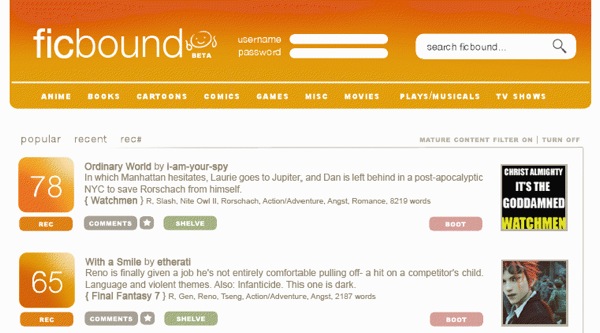
Project: FicBound – by “Eric F”

ficbound
While fanfiction has been around for decades, the Internet has provided a new gathering place for fans to share their passion and creativity with others.  As we have seen in class, remix culture is entering into mainstream consciousness and “remix literature” will undoubtedly begin to play a bigger part as well.  However, because fan work violates the current laws protecting copyright and has been subject to cease-and-desist, the fan community has an uneasy relationship with publishers and original copyright owners.

In the past, fans often congregated around centralized archives, such as fanfiction.net.  Currently, much of fan activity has moved to LiveJournal and LiveJournal communities.  While great for authors, allowing them to have better control over their content, it has lead to the decentralization of fanfiction and an increasing difficulty of navigating each community.

Our solution, FicBound, would serve to provide a platform for discovering new fanfiction to those new to the community, as well as provide the community tools for rating and organizing fanfiction.  Structured much like Digg, FicBound would be adapted to the fanfiction community’s needs, thus integrating social as well as publishing and sharing elements.  The content itself would remain on the LiveJournal and archive accounts of the users, thus allowing them to maintain full control.

FicBound hopes to build on Clay Shirky’s insight that “Conversation is king.  Content is just something you talk about.” While recognizing the difficult issues surrounding fanfiction, we nonetheless hope to build an useful platform to facilitate conversations around content for fans.

For those who wish to view our paper in full, please go to: https://docs.google.com/Doc?docid=0AYPnJLMOxStCZGhwZDJzczRfNDk0YzkzMm5mZjU&hl=en

– Eric and Crystal

Project: Collaborative Education – by “Aditya K”

The internet has made it easier to access, share, and create content. This truism has huge implications for education; with access to the Web, educators and students have escaped the confines of the classroom. The ability to share lesson plans, collaborate on lessons, and peer produce projects is exciting—but with it brings many potential effectiveness issues, infrastructural issues, and copyright issues.

We interviewed teachers at Amistad, a New Haven charter school, regarding their thoughts on collaborative education and fair use, and gleaned interesting insights. After examining their comments and doing some research, we broke down collaborative education into three main systems, and analyzed each: An intra-school-network system of sharing lesson plans; a system where teachers sell lesson plans; and a system where teachers share lesson plans freely. Each system had quite a few pros and cons.

Alongside Nick Bramble at the Yale ISP, we submitted these analyses to the FCC. We also worked with Nick to help draft a piece addressing fair use issues in education. With new technologies and no clear rules, fair use in education is a topic that must be addressed and made clearer. With regards to our project, sharing materials and lesson plans online creates a vibrant atmosphere that, unfortunately, is setting itself up for abuse/lawsuits. If educational copyright issues aren’t made clearer, the potential that this peer-to-peer atmosphere creates may be stifled.

To see some of our contributions, check out this document (.doc).

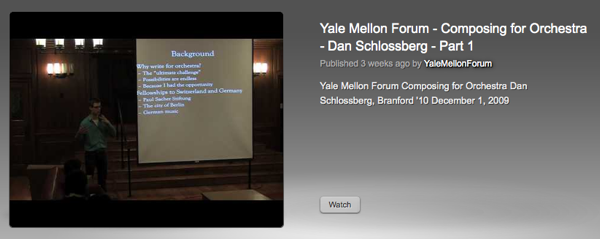
Mellon Forum Project – by “Evin M”

mellon

Yale has always been committed to the open dissemination of knowledge, and the university has used begun to use recent advances in technology to distribute information easily and efficiently — for example, through open courses Yale is freely making many of its classes available online. However, as it stands professors are the primary benefactors of this technology, and students don’t have similar institutional support to share their own important work with the world. To further the goal of dissemination of knowledge as well as to allow students to participate in this global forum, we started a project to record videos of senior presentations in the twelve college’s Mellon Forums and then make them freely available online.

The Mellon Forums provide seniors with an intimate setting to present their thesis work to a group of their peers over dinner and dessert.  These forums are already an important platform for seniors to present their thesis research by giving them time to present and openly share their work with their classmates — otherwise most seniors’ research would be mostly hidden from view. One limitation of this, however, is that by their nature the forums must be small and presentations are given to a very restricted audience despite the fact that many people (friends from other colleges and years, family, and curious outsiders) are particularly interested in the work these students are doing. Putting videos of these presentations online would not only make this knowledge available not only to other students, but also to all the world. Taping a presentation might make it slightly more formal, but it also heightens the energy and impact of the presentation. And further, recording these presentations sends the message to students that yes, their research really is important enough that the university believes it is worth showing to the world.

Check out our site here. We’ll continue updating it!

-Evin, Paul, & Paulo