Why Open Source is the future and how to stop big corporations from destroying it – by “Maria A”

This blog entry is being typed using Open Office. When I bought my macbook in 2008, I was both too lazy and too cheap to download Microsoft Office (I was also at the stage where I was rejecting Microsoft and the thought of a windows application for a mac was a bit unnerving). Open Office looked like Microsoft Office down to the file menus and fonts, but it still took time to get used to. Besides, it had a tendency to crash sporadically (Read: every day), which since then has been fixed in OpenOffice3.2.

Since then, I’ve been trying to advocate the use of Open Office to many of my friends. I’m usually met with skepticism followed by a request for the link to download Microsoft Office through Yale. Well, I truthfully don’t even like Open Office that much. But I believe that open source programs are the future of the internet sharing community.

First developed in 1998 by such individuals that later took over the Linux systems and Netscape, open-source programs are different from their closed-source predecessors in many ways. These programs are usually free and open to download for the entire public (though in some cases, donations are encouraged). Websited like sourceforge.net also provide the entirety of the code that goes into the development of the infrastructures and also allows third parties to develop and build upon the concepts. Most importantly, few open-source are copyrighted, giving the public free reign over the use and distribution of this software.

Such software such as Open Office, Firefox (which was debuted in 2005 by Mozilla Inc. and in August of 2010 accounts for 45% of all web traffic), WordPress, and Ubuntu has become almost ubiquitous in everyday life. However, the concept of Open Source is still yet to reach the general public. Many download Firefox without thinking much about it; others think that operating systems such as Ubuntu are for tech geeks and can’t be used by the general public.

Now that’s all fun and good, but what does open-source software have to do with copyright and the law? Am I just using this blog to shamelessly spread my affection for this type of programs?

Well, perhaps.

But there is also a fundamental debate taking place about the legitimacy of such software. One of the founding principle of open-source is that it will provide a free alternative to familiar software and allow others to build upon their ideas free of charge. And they’re pretty successful at what they do. According to the Standish Group of Boston, Open source programs take away an approximate $60 billion in revenue from companies annually . This figure is significant enough for the US Trade Representatives (USTR) to put such countries as Canada, Brazil, and Indonesia on the Priority Watch List merely for their support of open-source software.The USTR is, in fact, comparing the downloading of completely legal free programs equivalent to pirating licensed software.

The RIAA and the MPAA have already declared that Open source is equivalent to Piracy. They believe that new works are only to be distributed as for-a-fee, closed-source software, as the opposing side “weakens the software industry and undermines its long-term competitiveness by creating an artificial preference for companies offering open source software and related services, even as it denies many legitimate companies access to the government market” (They are basically angry that their money is not put into their own pocket).

Many companies are already investing significant capital and resources into battling piracy through the illegal downloading of their software. Now, they’re targeting companies that offer free alternatives to their own brands. And not only this, the USTR is saying that merely promoting open-source as the choice for software is enough to encourage piracy and that giving preference to these companies stifles innovation.

Now, back up a second. Copyright laws were created to be finite in order to promote competition and the creation of new ideas. They’ve since been abused into being laws that keep profit in the hands of a select few. The International Intellectual Property Alliance (IIPA) has its own agenda. One of its business organizations, the Business Software Alliance, is complaining over the lost revenue that open-source software brings.

Most of the market of the software produced by prominent companies comes from the trust and power of the brand name associated with them. People are reluctant to let go of their allegiance to software and venture into an unknown territory of new and little known developers. However, as the media revolution of the internet continues, many are breaking away from the norm and downloading free open-source in the stead of the more known brands. This is the threat that copyright-heavy corporations are trying to combat.

This of course makes me realize that I should stop using OS X and opt out for Ubuntu from that free disk that I got. But another part of me is reluctant. I also have a way to go before I learn.
Artist + Record Label + YouTube + UGC + Promotion + Copyright Law = …Confusion? – by “Mark B”

On September 12, Lady Gaga picked up eight awards at the MTV Video Music Awards in Los Angeles.  She is arguably the first real superstar musician of the digital age.  She continues to tour relentlessly, capitalizing on the tremendous wave of commercial success that she is riding and, in doing so, is working hard to ensure her continued ubiquity.

Her acceptance speech for the ‘Best Female Video’ award was, typically ludicrous costume aside, especially notable for one line in particular.  After thanking various parties for their assistance and support in producing the video, she makes a point of paying special tribute to “all the gays for remaking this video over and over again”:

MTV VMAs 2010 – Lady Gaga Best Female Video Acceptance Speech

Of course, it’s not just “the gays” who have provided a take on the song in question.   A simple search for the phrase ‘Bad Romance’ on YouTube returns a veritable slurry of user-generated content uploads from an intriguing blend of celebrities (Joseph Gordon-Levitt), other bands (30 Seconds To Mars), acapella groups, aspiring singer songwriters, the kids from the TV show “Glee” and various groups of individuals of all shapes and sizes parodying or paying tribute to (depending on your interpretation) her version of the song.

Harmless, right?  Well, it essentially depends on your interpretation of “fair use”.  The question of whether or not each of these unauthorized video posts that are now all over the internet constitutes a breach of copyright protection is the subject of a degree of legal ambiguity.  Amongst the considerations for determining what constitutes “fair use” listed under the Copyright Act is a clause that allows consideration for the “effect of the use upon the potential market for or value of the copyrighted work.”  This is a somewhat subjective measure of determination.

Having worked for two major record labels, with a number of recording artists and a corporate law firm to date, I can just imagine the mixed reactions that each party might have had to Lady Gaga’s expression of thanks to those who have remade her song and shared it on the Internet.  Some will see it as a straightforward breach of copyright (artist or record company owns copyright, user makes public his own version of the song without permission from the copyright owner thus breaching copyright) but taking legal action against such users might come at the expense of a degree of promotion for the song in question.  After all, the viral nature of such videos undoubtedly adds to the aforementioned ubiquity that such artists as Lady Gaga enjoy in the digital age.

How then do you reasonably draw a distinction between those user-generated videos that help promote the song, increasing demand for it, and those that might instead have a negative effect on demand or that might be more damaging to the artist’s reputation more generally.  Should it be the copyright owner’s right to decide?  Should record companies step in to play the role of ‘monitor’ on behalf of the artists that they represent?  Should an artist be encouraging such user behavior?  Should Lady Gaga (given her 6.3 million Twitter followers, 18.2 million Facebook ‘likers’ and audience of 11.4 million at the VMAs) be advocating her view on the issue given that other owners of similar copyrights (such as Prince, as detailed in the case of Lenz v. Universal Music Corp.) might well not feel the same?  Should the law draw up a more concrete definition of “fair use” to set a blanket standard or should the determination of “fair use” remain circumstantial?  Who is right?  With whom should responsibility lie?  You decide…

The Ultimate Showdown: Blumenthal v. Craigslist – by “Thad D”

“Seeking Partner In Crime”

“looking for fun”

“Looking for some ACTION!!!!!!”

Ranging from apparently harmless to incredibly graphic, the “Adult Services” section of Craigslist has long provided people far and wide with the ability to search for and find others looking for “adult services”, whatever that may mean.  That is, until last week, when Connecticut Attorney General Richard Blumenthal, along with 17 other state attorneys general, told Craigslist to permanently remove their adult services section worldwide.

Before delving into the obvious issues with censoring Craigslist (net neutrality, questions of jurisdiction, website application immunity), it’s important to understand what Craigslist is and its history.  Founded in 1995 by Craig Newmark, Craigslist is a website that serves as a sort of virtual bulletin board for local postings.  With subdomains for major metropolitan areas around the world, users can post solicitations for anything from old TV’s, to job inquiries, to requests for relationships.  Listed as the most used classifieds service in any medium, Craigslist sustains its operating revenue mostly from small fees required to post job openings in major metropolitan areas.  The site’s annual net income is undisclosed.

However, the seemingly noble intentions of Craigslist have not stopped many from abusing its site.  For example, in early 2009, Julissa Brisman, a young masseuse, was murdered in a hotel room by a man who hired her through Craigslist.  Then, earlier this year James Sanders, a father and devout Christian, was gunned down in his home by criminals who responded to an ad he posted on Craigslist to sell his wife’s diamond ring. (Credit to NBC and NewsRoomJersey)

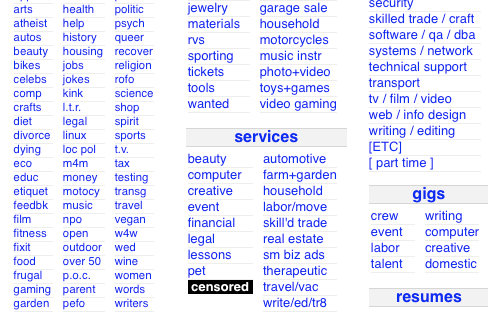
Three weeks ago, 17 state attorneys general jointly wrote to Craigslist telling owner Craig Newmark to permanently remove its adult services section worldwide.   Two weeks after that, four other private, Washington D.C. based non-profit organizations spoke out about their disapproval of the site’s adult services. In response, this past week Craigslist put a black and white “CENSORED” bar where the adult services hyperlink had previously been.  However, as of today, the black and white bar has officially been removed and there is no adult services section on the site’s home page.

Craigslist Adult Services Section Censored
Wait, You Didn't Want to Remove Your Adult Services Section?

So, now that we’re all on the same page, I would like to throw something out there: I believe Richard Blumenthal is putting up this huge front in order to be elected to the U.S. Senate.  What?  “No!” You cry out, “This cannot be!”  Well, consider the following conversation between two average voters:

Joe the Plumber: Gosh, the Senate election is coming up, soon.
Bob the Builder: Well, who’s running?
Joe the Plumber: Looks like it’s **Googles for ten seconds** Linda McMahon and Richard Blumenthal.
Bob the Builder: Wasn’t she a wrestler?  And who is Richard Blumenthal?
Joe the Plumber: I don’t know.  But apparently **Googles for five more seconds** Blumenthal is really against prostitution and human trafficking on Craigslist.  And Linda McMahon never said she didn’t like prostitution or human trafficking.  Looks like I know who I’m voting for.
Bob the Builder: I second that.  I am no fan of the Internets or prostitution.

Take it for what it is, that is my personal opinion.  Beyond the questions of political pandering and insincerity raised by the timing of his attack on Craigslist, Blumenthal’s offensive raises several other important issues.  Unfortunately, I do not have time to discuss all of them, but I would like to discuss what I think is the most important: net neutrality.

What do we mean when we use the term net neutrality?  Generally network neutrality means that for any network (be it peer to peer or the Internet), the principal service provider (i.e. Comcast, Charter), the government, or any other regulatory body should have no right to censor the content posted by members of the network.  In fact, the original design choices of this Internet such as decentralization and the FCC’s Broadband Policy Statement lend the Internet to being an open, neutral network.

Blumenthal and the attorneys general joining his suit are directly challenging the fundamentals of net neutrality by forcing Craigslist to remove its adult services section.  I want to make a very clear and unequivocal distinction.  Telling Craigslist it needs to seek out and remove postings soliciting illegal activities such as prostitution or human trafficking is NOT challenging net neutrality.  Without the rule of law, the Internet would become a safe haven for criminals and create an environment no one would feel comfortable entering.  However, Craigslist should not be told to remove a whole section because certain users abuse the site’s services.

If users demanded content controlled by a single source, with government interference and site material changing based on mere political whims, everyone would still be getting their Internet content from Compuserve.  Think I’m wrong?  Why do we have Google, Facebook, MySpace, Amazon, ESPN.com, streaming video of any sort (thanks porn industry), or all of the amazing web applications we have today?

For now, Blumenthal will not let sleeping dogs lie.  Although Craigslist has removed the whole adult services section Blumenthal insists, “Simply removing one portion of your site where you permitted and profited from prostitution ads is insufficient if ads go elsewhere.”  (Credit to The Associated Press)

Vinton Cerf, father of net neutrality and, the best thing it brings with it, competition on a previously unparalleled scale, we salute you.  Richard Blumenthal may be thinking that Craigslist is “thumbing their nose at the public interest”, but let’s be honest: since when did a 64 year old whose alma maters include Yale and Harvard ever represent the public interest?

Kahn v. HPD – TV Court — Meet Real Court! – by “Brad”

While we see plenty of lawyers on TV, and there is no shortage of shows about lawyers (new or syndicated), it’s rare to see the TV-court world collide with the real-court world.  But in Kahn v. HPD, an attempt to use “testimony” from an episode of “The People’s Court” by an administrative officer did NOT sit well with the New York Supreme Court Justice Francois Rivera**.  In relevant part:

“The People’s Court” is not a court, body, agency, public servant or other person authorized by law to conduct a proceeding and to administer the oath or cause it to be administered. It is a television show with a production manager, crew, support staff, editors, and actors. Like any other television show, it is supported by its advertisers and its objective is to entertain its audience. It is also edited to allot time for commercial breaks and to complete the show within a designated broadcast time slot. The show has voluntary participants, who are not actors, who speak about disputes on a stage that resembles a court. The words or statements uttered by the these participants are not testimony. They are neither sworn nor reliable. Furthermore, the statements made on the show have no more probative force than the words of an actor reading from a script in a play. The only difference between the two is that the participants of the show may freely ad-lib their lines.

Here, [the administrative hearing officer] gave tremendous weight and probative force to words and statements allegedly uttered by the petitioner on “The People’s Court” television show. He described the utterances as “sworn testimony” and “compelling admissions”. This view of the utterances petitioner allegedly made on the show is irrational. The court uses the adverb allegedly because the DVD submitted, which allegedly contains petitioner’s utterances, does not include a certified transcript of its content. Nor did it contain a certification that it is a true and accurate copy of “The People’s Court” segment that it purports to be.

**In New York, the “Supreme” court is the trial court — the highest court in the state is the Court of Appeals.  Cases go from the Supreme court to the Appellate Division, and from the Appellate Division they may be appealed to the Court of Appeals.  In this case, the result of an administrative proceeding was being challenged in the trial court.

KAHN v HPD (FULL OPINION)

ADVERTISING A STATEMENT: Google AdWords with agendas – by “Evin M”

The PR machine at BP has picked up on a recent trend, which utilizes the Google AdWords service as a soapbox from which to launch a damage-control blitz.

Open another window and Google “BP.”

Odds are, you found this too. How about “oil spill”?

Same link? Me too.

Google AdWords is the moneymaking machine behind the world’s most popular search engine. This product selectively displays advertisements alongside search results, allowing advertisers to market to users already interested in specific terms. AdWords launched in 2000, and has since become more than just another billboard. By associating text advertisements with search terms, AdWords clients are able to deliver increasingly sophisticated messages to intended audiences—as BP is demonstrating right now.    Never before has a campaign had this potential to target its message with such speed and precision–though that potential comes with a price tag, one that is subject to open bidding.  In addition to advertising themselves in a more traditional sense, Google AdWords now empowers wealthy companies to command eyeballs searching for select keywords toward editorial content.

In September 2009, AdWords became a platform for PR damage control when the front page of the New York Times reported that New Zealand fisheries were overharvesting the hoki, a species known to most palates as the McDonald’s Filet-o-Fish. In response to this article, the New Zealand Seafood Industry Council bought up Google AdWords like new zealand hoki, hoki new york times, and William Broad (the author of the article). These search terms triggered links to a page refuting the Times’ accusations, and included emails from the Times science editor as well. Jim McCarthy of PR firm Counterpoint Strategies, who spearheaded this spin technique, has applied a similar strategy on behalf of the National Fisheries Institute and the Formaldehyde Council, in reaction to journalists’ criticism of these organizations. He seems to have started a trend by representing his clients with Google AdWords and links.

Facebook Business Model 2.0: Infringe Now, Ask Questions Later – by “Thad D”

Well This Zucks...

Welcome to the new business model: infringe on your privacy first, ask questions later.  Now before I fully delve into the issue of Facebook’s new user privacy settings, I should note that I have always been a proponent of Facebook’s right to pursue what it feels is a profitable and satisfying business model.   Capitalism at its finest.  I have defended Facebook using what I have termed “The McDonald’s Defense”.  Often, consumers demand that businesses comply with outrageous orders.  For example, consider the following conversation:

McDonald’s Employee: Welcome to McDonald’s, may I take your order?

Customer:  Yes, hi.  I would like to order, uhm, a large double unsaturated soy mocha float, and two uncooked vegan tofu gluten-free eggs.

McDonald’s Employee:  Uh, sir, we don’t sell those-

Customer:  Oh and could those eggs be fried in omega-3 monopolyunsaturated fats from a Komodo dragon?

McDonald’s Employee:  **Confused Look**  May I help the next customer?

Of course, such a scenario seems ridiculous, but I use it to illustrate the fact that McDonald’s (i.e. Facebook) has the right to refuse service based on what it offers.  If you don’t like the way Facebook organizes its privacy controls, or any of its other features, go to Burger King (maybe, MySpace?).

But, what happened to me the other day was not a matter of asking for unreasonable privacy controls, but rather having my privacy infringed upon with a deceptive “opt-out” system.  Facebook now has a new “Instant Personalization” feature that allows partner websites to access personal information stored on Facebook’s servers without you knowing.  That’s right: FACEBOOK GAVE NO NOTICE OF THIS SERVICE, the only “warning” they gave was a small blue box at the top of each person’s home page that said privacy settings had changed.  Only after clicking “Learn More…” and digging to the very last section did I discover the feature.  Then, when I tried to disable it, I was confronted with the following confirmation page:

The More You Share, The More You Care (For Facebook's Wallet?)

Note that, although I have some of the strictest privacy settings on Facebook (no public search and the only things people who aren’t my friends can do are message me or add me as a friend), I was automatically opted into this Instant Personalization module.

So Facebook, where does that leave us?  You’re probably right, the “richness of the social interaction” from these new features is probably worth the hassle of a slight loss of anonymity because they provide so much convenience.  But why make it so hard to opt out?  Why not notify us about these changes?  WHAT INFORMATION ARE YOU GLEANING FROM THESE PROGRAMS THAT MAKE YOU WANT US TO PARTICIPATE SO BADLY?  WHAT IS “THE MAN” PAYING YOU?

Please, Mark Zuckerberg, get back to me on that.  You know how to reach me: just add “Thaddeus Diamond” as a friend, and click “Share”!

Free as in Software: An Exploration of Free Open Source Software – by “Michael W”

Free Open Source Software has played a critical role in the emergence of the digital age. For my final project I decided to examine this phenomenon from a few different angles. First, I built a website using only free open source software. This was, not surprisingly, exceedingly easy. The widespread availability of open source software and the vibrant health of online programming communities have contributed immensely to the explosion of innovation on the web. Next, I captured this precise point (inadvertently, I should add), by stumbling into a situation in which I needed to ping the FOSS community for help, and they ultimately answered beyond my expectations. I used Facebook and its pending FOSS alternative Diaspora to illustrate the subtle differences between “free” versus “free software” versus “freeware.” And finally, I wrapped up with some thoughts about the future of free open source, as it applies to software and perhaps even beyond. You can view the project at FreeAsInSoftware.com.

Free As in Software
FreeAsInSoftware.com

Walking on Eggshells: Borrowing Culture in the Remix Age – by “Ryan B”

“Walking on Eggshells” is a 24-minute documentary about appropriation, creative influence, re-use and intellectual property in the remix age. It is a conversation among various musicians, visual artists, writers and lawyers, all sharing their views on why and how we use and create culture, and how intellectual property law, originally designed to provide people with incentives to create, sometimes hinders creative production far more than it enhances it.

Watch the full film as a Youtube playlist here: WALKING ON EGGSHELLS

OR click HERE to view the film in its entirety on Vimeo!

(Make sure to switch to view in HD once each clip starts!)

DIRECTED AND PRODUCED BY:

JACOB ALBERT
RYAN BEAUCHAMP
BRENDAN SCHLAGEL

INTERVIEWS WITH (IN ORDER OF APPEARANCE):

ECLECTIC METHOD
DJ EARWORM (JORDAN ROSEMAN)
JOY GARNETT
MICHAEL CUNNINGHAM
DUDLEY ANDREW
DJ RIPLEY (LARISA MANN)
JONATHAN LETHEM
E. MICHAEL HARRINGTON
EDGAR GARCIA

Creative Commons License
Walking on Eggshells by Jacob Albert, Ryan Beauchamp, Brendan Schlagel is licensed under a Creative Commons Attribution-Noncommercial-Share Alike 3.0 United States License.

-Brendan, Jacob, and Ryan

Privacy Matters; will it always? – by “Ben L”

In recent history, we have seen a plethora of companies arise based on the aggregation and selling of personal information. Spokeo, ChoicePoint, Intellius, ZabaSearch, Acxiom are just a few. Spokeo, the most recent one however, provides the most information for free, and the cheapest price if you do decide to pay. The concern is that since all of these sites use essentially the same underlying information, there is no way for the user to prevent dissemination. This has led to a number of cries for congressional restriction. A good start might be to extend the Fair Credit Reporting Act to other kinds of data collection and sale.

In the meantime, what does this mean for society? Are we going to undergo a privacy based cultural revolution? I do not think this will happen anytime soon. Currently, the information available on the websites is horribly inaccurate. Generally, you only know if the person you’ve found is correct based on name and address, and many people are not searchable. Once you have found the correct person, further information is generally not helpful. Spokeo says my father, the only family member who shows up, as having several interests and lifestyle facts, “has children” and “enjoys entertainment.” Now I wonder who doesn’t enjoy entertainment. The rest, while inaccurate, do reveal the potential for extensive information: the only reason I can think of for them to suspect my Dad enjoys home decorating and home improvement is the time we spent remodeling, which was thoroughly not enjoyed by anyone at all. Does that mean that Spokeo has some way of knowing what we are buying? It is not getting Dad’s interesting from linked facebook pages, though I don’t doubt website will soon be mining that, so where is it coming from? Spokeo hasn’t disclosed its sources, so it will be interesting to find out. Spokeo also claims my Dad is not intersted in Politics, when in actuality he votes in and follows every election. He does not run a home business as advertised. There are also personality descriptions like “self-driven,” which, without knowing the sources, and given the general inaccuracy, seem  dubious.

I haven’t found any sites or testimonials claiming these aggregators are particularly useful or accurate. Given that, it seems hard to believe they represent a real disruption. Even if they are somewhat right, what good is that to a stranger, who cannot tell whether a particular fact goes in the wrong category or the right one? It seems to me that if privacy deteriorates for the majority, it will have nothing to do with people invading it, but rather information being freely disclosed, or allowed to be easily accessed. The current generation is growing more accustomed to sharing everything with everyone. This class in general knows more about facebook and internet privacy than a few handfuls of people. Yet how many of us keep facebook? More than that, how many people keep “likeing,” things, and forming public “connections,” which describe ourselves and our tastes? If everyone is going to keep doing this, then one of two things will happen: people will either get used to presenting their “public face,” on the internet, or we will learn not to care so much whether another’s interests (supposed, self disclosed, reported, whatever) disagree with our own. The inaccuracy of current databases will contribute to a distrust and dismissal of information found online. When it does get more accurate, we will be so used to not caring that we won’t start.

There have been a number of criminal investigation based on wrong information, where it is especially dangerous in law enforcement. Governments should not be trusting these sites to do their investigation for them, and rather than pass laws mandating higher accountability the solution is for criminal investigations to be investigatory rather than a matter of buying the information. It is and should be the responsibility of the police to find and apprehend the correct person. If we do pass laws mandating that information databases be more transparent and correct, this will hasten the future in which we are more tolerant. but there is no sign of this happening amongst the current crises.

Lastly, I leave you with an illustrative graphic of the progression in disclosure. How long before other websites share information like facebook does, or are all connected, or these stop being the default settings and become the only one? Will we really give up our social networks?