GLAAD with Facebook – by “Malory W”

Last week Facebook announced new efforts to respond more quickly to hate speech that violates their terms of service. In the past couple of weeks Facebook has worked with members of GLAAD, the Gay and Lesbian Alliance Against Defamation, and other LGBT organizations to remove harmful and offensive posts that have plagued many of Facebook’s public pages. This effort comes on the heels of recent tragedies involving different forms of cyber bullying resulting in suicides such as in the case of Rutgers freshman Tyler Clementi who ended his life after his roommate used the Internet to shame and harass Clementi over his sexual preference.

GLAAD initially got involved in cleaning up Facebook after receiving complaints from various members of the gay community about a Facebook page that was established in memory of victims of anti-gay bullying that became covered with derogatory hate speech and images. The organization responded by reaching out to Facebook and starting a dialogue on effective measures to control offensive and hateful posts. Facebook responded quickly, partnering up with GLAAD to clean the site of anti-gay hate speech. Supporters of Facebooks initial steps have ranged from Jarret Barrios, President of GLAAD, down to Perez Hilton, the controversial celebrity blogger.

While the case of this memorial page to bullying victims may have been pretty clear-cut hate speech, some cases could be and probably have been proven to be more difficult to classify. Facebook has consistently said that they prohibit any kind of hateful content and that they have mechanisms in place to remove harmful posts as quickly as they can. However, they also emphasize that their users are allowed to express unpopular opinions and that there must be a careful balance between free speech and removing hateful content. It seems likely that these two would occasionally, if not frequently, come into conflict.

While these are steps in the right direction in an attempt to curb cyber bulling and harassment, I can’t help but wonder how long it would have taken for Facebook’s own “mechanisms” to target this page had a large and widely respected group such as GLAAD not stepped in? With Facebook users generating millions of new pieces of content every hour, it seems highly unlikely that Facebook can effectively monitor its content without massive help from Facebook users themselves. Thus, is there real hope for strict control over cyber bullying and Internet hate speech? Possibly. As long as Internet users themselves take an active role in reporting offensive actions. However, the conflict between defining something as free speech or hate speech will always leave some content unresolved.

Get a life, Shirvell. – by “Daniel C”

UMich recently inaugurated its first openly gay student body president, Chris Armstrong.  For the past month, Mich. Assistant Attorney General Andrew Shirvell—with no previous relation to Armstrong—has been running a highly offensive smear campaign against the student body president.  The front page of Shirvell’s blogger.com has “RESIGN” written across Armstrong’s face, accompanied by a rainbow Nazi swastika.  Additional comments refer to Armstrong as a “radical homosexual activist” and “Satan’s representative on the student council.”

Shirvell claims he has a problem with the “radical” gender-neutral housing policies that Armstrong is pushing for, while ignoring Armstrong’s other platforms to extend dining hall hours and financial aid.  He also attempts to justify his words by calling himself a rightful Christian citizen and a concerned alumnus of UMich.  Yet he does not know Armstrong personally and seems to be taking the agenda of the Michigan student government far too seriously.  He is a state official, and the policies of Armstrong have no relation to him, as he is no longer a student at UMich.  This obnoxious example of cyberbullying shows that more needs to be done to punish perpetrators like Shirvell, who overstep their boundaries to free speech online.

Other than public humiliation, little has been done to punish Shirvell.  Attorney General Mike Cox has not fired his assistant.  When asked why, Cox says that he unfortunately cannot do anything because Shirvell “writes his blog during after-hours and is protected by the First Amendment.”  If what Shirvell says is true—that he only publishes some of the information from other postings online such as from his Christian community—Shirvell is unfortunately provided some immunity by Section 230 of the Communications Decency Act.  However, Section 230 also states that it is the policy of the United States to “punish trafficking in obscenity, stalking, and harassment by means of computer.”  Shirvell is guilty of all three.  He has been seen obnoxiously screaming, “Nazi!” at Armstrong’s political campaigns and has stood outside Armstrong’s house to videotape.  Even Armstrong’s family and friends have received abusive emails and Facebook messages.

Common law also shows a precedent in McEvoy v. Spencer. McEvoy was demoted from Deputy Chief to Captain because of speech activities that were harmful to the public workplace.  In order to mitigate the negative effects to the workplace, his employers, Mayor Spencer and Deputy Chief Christopher, were justified in demoting McEvoy to Captain.  Andrew Shirvell has one of the most public positions in the state of Michigan.  If he can’t be fired, he should at least be removed from his position.

Please watch the following video to get an idea for what Andrew Shirvell is like.  An entertaining, but frustrating video interview on AC360˚:

http://www.youtube.com/watch?v=PwObjKZg9Jw&feature=player_embedded#!

Shirvell is acting like an immature teenage blogger with an advanced vocabulary.  Thankfully his blog is now private.  He has taken personal leave from office, and only faces a disciplinary hearing upon return.  But he should be fired completely.  Otherwise, maybe the government should give him some more work to do; clearly the Assistant Attorney General has too much free time on his hands.

A Bitter Juice from JuicyCampus – by “Jeanne S”

On February 4, 2009, Matt Ivester, the founder and CEO of JuicyCampus.com, announced that JuicyCampus would be shutting down due to plummeting online ad revenue. In an ensuing Q&A, he insisted that a shortage of funds was the sole reason for the shutdown; no charges were ever brought against JuicyCampus for defamation, and the site did not lose any significant revenue from being banned at a few campuses.

While JuicyCampus may never have been brought to court, it was not for lack of trying. A 3/25/08 YDN article detailed efforts by the New Jersey and Connecticut attorney generals to submit JuicyCampus to investigation under consumer fraud laws, claiming that the site misleads its users by failing to enforce its own terms and conditions. According to the attorney generals, the site claims that users may not post defamatory comments, but does not provide a mechanism for preventing them. Indeed, many hateful threads were created and sustained by Yale students about other Yale students, referencing looks, weight, sexual experience, etc. And while Dean Salovey remarked in the YDN article that he did not believe “censoring a web site [was] consistent with Yale’s free expression policies,” some of the comments were on a level of defamation similar to those detailed in Doe vs. Ciolli, and could possibly have fallen under Connecticut statutes against defamation if individuals targeted on JuicyCampus had brought their cases to court. However, the process for bringing that case to court in the first place would have been painfully difficult, if not impossible, given JuicyCampus’ protection against liability and refusal to give up identities of anonymous posters without a subpoena.

I will admit that in my hours of procrastination, I occasionally clicked around on JuicyCampus. At its best, it was entertaining, with threads like “hottest guy on campus,” “worst hookup story,” etc. But at worst, I came across a thread with the name of one of my close friends in the subject line, and some of the comments weren’t pretty (or remotely true). I didn’t tell her about the thread, and I’m not sure she ever knew. But this friend of mine is applying for jobs right now, and if that thread were still in existence on JuicyCampus, she might have suffered irreparable damage in her job hunt because of some bored kid who had nothing better to do than post hateful, anonymous comments about her — comments which JuicyCampus made no effort to monitor, despite its promises in its terms of service.

JuicyCampus has since segued into CollegeACB, which claims to host a “higher level of discourse” than JuicyCampus. It also employs a user-moderation button, allowing users themselves to report inappropriate posts to the webmaster, rather than forcing the webmaster to serve as gatekeeper himself. It also requires you to create an account with your .edu email address. Perhaps luckily, CollegeACB never caught on at Yale the way JuicyCampus did. But on the flip side, the lack of Yale users means that the user-moderation button is effectively useless. As I scrolled down the list of threads just now, someone initiated a post on 9/1/10 titled “N***ers” that read “Stop coming to Yale. You are ruining this school.” I tried to report the thread, but I was asked to create an account first, which I have zero interest in doing. Has CollegeACB risen above its predecessor? I think not.

International Network Neutrality – by “Christopher M”

Of course, the network neutrality policy debate in the US deals with a very particular set of players and circumstances. Amongst other factors, we have to consider the current structure of competition between Internet service providers, the ability of existing market conditions and regulatory avenues to address concerns over neutrality, and the precedence for new legislation on the issue.

Naturally, each of these factors differs significantly across national boundaries. For example, we see that even the dominance of various high-speed Internet technologies (DSL vs. cable vs. fiber-optic) varies widely between countries at similar stages of technological development and even in close geographic proximity. This simple difference largely affects the competing interests an ISP might face and thus the actions that might warrant regulation in the name of neutrality (are ISP’s also phone companies and thus interested in limiting VoIP traffic, or are they cable TV companies and thus interested in video content?)


Broadband Connections by Type (2007) – Review of Network Economics (Vol.8, Issue 1 – March 2009)

However, when considering the pros and cons of various regulatory (or anti-regulatory) schemes, it’s still important to examine what strategies have been employed to address concerns over net neutrality in other countries. Examining past case law and loose economic precedence simply can’t provide the practical analysis necessary to fully understand this issue.

That said, I had very little luck finding countries where network neutrality has been dealt with effectively. If anything, international policies tend to be inconsistent, even contradictory, and many countries are still stuck in the same policy limbo as the US. Since no clear solution can be agreed upon, yet practical problems arising from ISP content control or anti-competitive activity have been very limited, like the US, governments around the world seem hesitant to act. Google and Verizon received quite a bit of flack for neglecting to address network neutrality in the wireless sphere in light of “the competitive and still-developing nature of wireless broadband services.” Although allegations would point to ulterior motives behind this statement, perhaps the message is still helpful. Until broadband technology (wired and wireless alike) stabilizes and real problems from content blocking and prioritization begin to arise in greater number, it may be difficult for any country to reasonably decide whether or not to protect network neutrality and how to manage any regulation addressing the subject.

Nevertheless, I’ve included some notes on the state of net neutrality policy in two countries below. If one thing is consistent about these policies, it is that they are constantly being reworked or changed all together. Let me know if anything I’ve reported is now out of date (or just plain wrong) and I’ll do my best to make any necessary updates.

South Korea:

Lauded as perhaps the worlds most connected nation (very high broadband penetration and average connections speeds 10-40x times that of US broadband), South Korea has always been considered a model for Internet policy makers around the world. However, its net neutrality policies are mediocre at best.

The government claims to fully support network neutrality, which Korea’s ambassador to the US recently endorsed in a speech, explaining that it, “can encourage competition, protect consumers and foster growth in services and applications.” And in fact, South Korea has done a lot to encourage the policy, if not through direct regulation. First, as part of the 800 million dollar “Korea Information Infrastructure plan,” the government invested strategically in the development of a variety of broadband technologies, including DSL and fiber optic networks.  As seen in the figure above, these technologies now compete fairly equally for control of Korea’s broadband market, an achievement that the government believes discourages monopolistic behavior amongst ISP’s. Its difficult for network companies to discriminate against certain content without risking the loss of their consumer base, which can easily switch to alternative broadband providers.

Additionally, Korea forcibly decoupled telecom network companies from ISPs when broadband networks were first created (network infrastructure companies could only lease bandwidth to independent internet providers). Although this policy is no longer in place, its legacy ensures that there is still ample ISP competition within single networks. Additionally, the country still considers network companies “common carriers” so they have not been able to discontinue bandwidth leasing.

However, several South Korean policies have directly contradicted its commitment to promoting competition and thus network neutrality. First, in an obvious move to protect South Korean VoIP providers, the government has established a policy of blocking traffic from any VoIP carrier that is not federally licensed. Skype and Vonage are included in the companies that have been blocked under this anticompetitive policy. Furthermore, in 2006 several cable broadband providers blocked traffic from HanaTv, a new Internet video-on-demand service, claiming that it used too much traffic. However, many claimed that the speed of most Korean networks could easily handle the traffic and the block was motivated by a desire to prevent HanaTv from competing with cable television offerings. Although the Korean government eventually forced ISPs to renegotiate bandwidth contracts with HanaTv, it hesitated to act and did not condemn the anticompetitive action outright, which some say shows a lack of commitment to network neutrality when large corporate interests are at stake.

http://www.techpolicyinstitute.org/files/wallsten_unbundling_march_2009.pdf
http://www.networkworld.com/news/2009/021209-international-net-neutrality.html?page=1
http://www.asiamedia.ucla.edu/article.asp?parentid=55961

Germany:
Germany is interesting in that it has been slow to adopt policies to promote network neutrality; even while the European Union and most of is neighboring countries support the issue. This largely stems from a desire to promote continued infrastructure development and innovation – a consideration that is also important to the US network neutrality debate.

Almost all German broadband is serviced through DSL, a result of the joint monopoly Deutsche Telekom used to hold over both cable and telephone networks. With little incentive to upgrade in a non-competitive market, the cable network remains extremely outdated and its usefulness for broadband is limited. Although DT’s monopoly has since been regulated, no new market entrants are large enough to make substantial infrastructure contributions to Germany’s cable network. As a result, the government has, in a sense, turned back to monopoly.

In 2006, a law was passed to temporarily wave all decoupling regulations on DTs newly developed fiber-optic network, with the hope of providing the company with increased incentive to expand this key DSL alternative. Although this deregulation certainly raised concern amongst net neutrality advocates, who warn that a lack of intra-network competition prevents natural market policing of content blocking and prioritization, it is hard to argue that it was not at least temporarily beneficial in promoting the expansion of broadband internet. DT’s investment plan was directly contingent on the government’s decision to deregulate and no other companies where prepared to make any significant infrastructure investment under decoupling.

The law was eventually overturned in 2009 by the European courts – a step inline with increasing EU concern over network neutrality. Like South Korea, the EU has trended towards the promotion of ISP competition and away from direct regulation in the hope that market solutions will arise to deal with most net neutrality concerns.

Nevertheless, Germany showed continued hesitance to adopt network neutrality as national policy in a recent article published by parliament, raising concerns that technology is shifting too rapidly to make concrete policies and that net neutrality might stifle innovation and infrastructure expansion. Interesting, T-Mobile, which is owned by Deutsch Telekom, recently blocked Skype traffic in Germany to reduce mobile competition, so the countries stance on the issue should be tested once again in the near future.

http://blog.ipoque.com/2010/04/net-neutrality-coming-to-germany/
http://www.nytimes.com/2009/12/04/technology/companies/04telekom.html
http://en.wikipedia.org/wiki/Deutsche_Telekom

Tea Party and Net Neutrality? – by “Joshua K”

In this blog, Eliza Krigman at Nextgov argues that the Tea Party could actually help advance the cause of network neutrality by supporting Rep. Henry Waxman’s (D-CA) proposal, which basically would have restored the pre-Comcast status quo without requiring a reclassification of broadband under Title II of the Communications Act. Though Tea Party activists would like to see no new federal regulation of the Internet, according to Krigman, many of them view the Waxman bill as the lesser of two evils by limiting the FCC’s authority to reclassify broadband  and thus impose more extensive regulations. As conservative blogger Neil Stevens puts it at Redstate, “We need [legislation] to stop this ever-expanding scope that the FCC is claiming for itself.”

Politico released a list of 10 Tea Party candidates to watch, so I decided to check out their websites to learn the Tea Party’s stance on Net Neutrality.

  • Joe Miller-No mention
  • Jesse Kelly-No mention
  • Ken Buck-No mention
  • Dan Maes-No mention
  • Marco Rubio-No mention
  • Rick Scott-No mention
  • Raul Labrador-No mention
  • Rand Paul-No mention
  • Sharron Angle-No mention
  • Mike Lee-No mention

None of Politico’s list of most influential Tea Party candidates have a mention of network neutrality on their website. Seeing that Krigman’s piece references only think-tank analysts, it is hard to see if the actual members of the Tea Party, the voters and the candidates they support, will use their influence to advance network neutrality legislation in Congress. Since network neutrality requires some level of government interference in the marketplace of the Internet, I can’t imagine any serious Tea Party candidate supporting either the FCC’s or Rep. Waxman’s proposal. With Rep. Waxman’s proposal gaining little momentum in the current Congress, we can expect even less work to happen after the election and a likely Republican takeover. Nate Silver at Five Thirty Eight has the Republicans winning the House at 73 percent and 18 percent in the Senate. Thus the future of the Internet and network neutrality most likely now lies in the hands of the FCC and the Obama administration.

The biggest fear might be a Republican Congress actively legislating against any new federal regulations to enforce network neutrality. Senators Kay Bailey Hutchinson, John Ensign, Sam Brownback, David Vitter, Jim DeMint, and John Thune have already introduced an amendment to an appropriations bill that would block FCC funds from developing or implementing new Internet regulations. Though this attempt may have failed, under a different Senate, Hutchinson’s amendment might get passed. The network neutrality debate is far from settled.

Coffee and Filthy Words – by “Frances D”

I didn’t drink coffee until the end of high school. I had actually listened when my mom said, “Coffee will stunt your growth.”  Even though I was staying up late and waking up early, I wanted to be tall.  Put more articulately, I didn’t want to artificially constrain my growth.1 I feel similarly about language and culture, which develop through fluid, indirect, and subtle means.  Likewise, efforts to control verbal expression only artificially hamper the development of culture. Any legislative attempt to create a list of inappropriate words is like coffee to language—it stunts growth.

In FCC v. Pacifica Foundation, the Supreme Court upheld the Federal Communications Commission’s ability to regulate the afternoon radio broadcast of George Carlin’s monologue “Filthy Words.” 2 Its indecent content was broadcast during a time of day when children might overhear. What exactly made this 1,751 word monologue so offensive? To illustrate, I’ve removed the filler – the acceptable words of polite language – this is left3, 4:

Fuck…bitch…bitch…bastard…hell…damn…shit…piss…fuck… cunt…cocksucker… motherfucker…tits…fuck…motherfucker…fuck…cocksucker…sucker…cock…cock…cock…cock…cock-fight…shit…fuck… shit… shit… shit…shit…shit…Shit…shit… shit…shit…shit…shit …shit…shit…shit…shit…shit-house…shit’s… shit… shit… shit… shit…shit-eating…shit-eating…Shit…shit …Shitty… shitty…shitty …shit-fit…Shit-fit…shit…shit… shit… shit…shit… shit… shit… shit… shit…shit…Shit… shit-load …shit-pot …Shit-head… shit-heel… shit … shit…shit-face…shit…shit-face…Shitface …shit…fuck …fuck…Fuck. …Fuck…FUCK FUCK…FUCK…fuck …fuck…fuck…fuck…fuck… fuck…fuck…Fuck …fuck…Madfuckers…fuck …Fuck… fuck  …fuck…fuck …fuck…fuck… shit …shit…shit. …shit…shit…shit …shit …shit …shit …shit…shit …ass…shit… …fart…turd…twat…Fart…tits… Turd…twat… Twat!… twat…Twat…snatch, …box…pussy…snatch…pussy…box…twat…ass …ass

This monologue was created to be offensive in 1975. Yet in its offensiveness, it betrays its temporal nature. True, some words are still considered incredibly rude, but many no longer pack the same punch as they did in the 1970’s. Words fall along an acceptability spectrum. Over time, American culture relocates words within the spectrum. While words such as “colored” have become unacceptable with time, many swear words have transitioned towards acceptable. This transition along the acceptability spectrum occurs in one of two ways. First, a general exposure to a word can accustom a society; this method led to butt, ass, hell, and damn to be generally accepted.  The second method is the reclamation of the offensive word by the offended group.  The gay community has successfully reclaimed the word “queer” from its historical roots as a derogatory term for gay males. “Queer” is so widely accepted now that few people bat an eye at the show “Queer Eye for the Straight Guy.”

The fluidity of language will be fettered by legislative attempts to define what is acceptable and unacceptable for broadcasting.  Supreme Court and lower court rulings in FCC v. Pacifica Foundation and FCC v. Fox Television Stations have created a foundation upon which government can control offensive language in broadcasting.  The only stipulation is that these regulations must not be as vague as the regulation contested in FCC v. Fox Television Stations.  This possibility for future legislation could quickly lead to television and radio broadcasting that are permanently stuck in the time period that the legislation’s last amendment; it would be as if current television could only air Leave It To Beaver and I Love Lucy–esque dialogues. Therefore, the Supreme Court missed a great opportunity in FCC v. Fox Television Stations—namely, the opportunity to create the foundation for cultural fluidity by overturning FCC v. Pacifica Foundation and declaring the regulations unconstitutional, instead of leaving the constitutionality to be determined by a lower court.

1) I’m aware now that coffee does not actually stunt growth. Looking back, I realize my mom probably just didn’t want to deal with a twelve year old hyped up on caffeine.

2) “Filthy Words by George Carlin.” UMKC School of Law. Web. 13 Oct. 2010. <http://www.law.umkc.edu/faculty/projects/ftrials/conlaw/filthywords.html>.

3) No modification was done to the transcript besides replacing the polite words with ellipsis. All emphasis is original.

Facebook Memes: Where do you like it? – by “Luke H”

Facebook, when contrasted to the plethora of social media sites out there, has an incredibly vast output of and a potential for the creation of memes. Facebook today is a massive influx of information and opinions regarding social lives and ideas, and it is only natural that some of these ideas are found amusing or funny etc, and subsequently are imitated by others, and variations are made of it. The funny thing about Facebook is as wide ranging and encompassing as it is, it still is quite limiting when it comes to the structure of its memes. Far and away the most common is the status update. Status updates on Facebook assist people in identifying, learning, and comprehending their friends and the people around them. It is a brief window into the individual; it lets us in on what they are thinking, what they are doing, and how they are feeling. Another staggering part to status updates is their rampant popularity: Every day, hundreds of thousands of people across the world write new updates, using millions upon millions of words to describe one thing or another. The memes that take place here can offer an interesting take on all of the things thoughts and feelings that connect people.

Take a trend that began earlier this month on Facebook that consisted of a flooding of updates that spelled out where women “like it”. (Although some people claim the “it” refers to purses, and where they like to put them, I don’t think I have to spell out for you what was implied by these posts.) Evidently, all these posts were supposed to go hand in hand with National Breast Cancer Awareness month (this October!) to promote awareness, to encourage efforts for the search for a cure, and to egg women on to get breast exams.

Some criticism and disapproval has been levied against the posts, and on one level, it’s very difficult to fight against breast cancer awareness. How does one voice their opinion against these posts without sounding far too prim and proper? Is it even possible to voice opinion against these posts without sounding against breast cancer awareness? But on the other hand I don’t necessarily like the feeling of using breast cancer awareness as a front to make funny, sometimes mocking jokes on Facebook. It doesn’t feel right, it doesn’t carry the right message, and it really isn’t even related to breast cancer awareness.

The incredible thing at hand here is the polarization, and immediate judgment making and opinion forming that takes place all because of a silly little meme on Facebook. People and advertisers have been putting out their opinions and products into the open for a very long time, with everyone competing for attention. The creation of memes – that is, ideas that replicate themselves in the common social collective – has been harnessed by people everywhere to spread their ideas.  The question is, are memes like the ones we can find in Facebook valuable? Are they taken seriously enough to force you to think about X, Y, or Z? Do they last long enough to even have an impact in our lives? I suppose only time can tell.

My First Vist to 4chan.org – by “Matthew E”

Anyone familiar with internet culture has heard of the infamous 4chan.org.  Many are probably equally familiar with the sort of content that comes out of 4chan.  As a member of other online communities (namely gaming forums), I have encountered numerous memes and image macros, many of which have originated at 4chan, including the list from Meme Factory in the New York Times article we read for class: Boxxy, David After Dentist, Star Wars Kid, “Downfall,” Advice Dog, “Imma chargin mah lazer!” Crasher Squirrel, “This is Sparta!”  I even went to see moot at the Calhoun Master’s Tea last year as well as Meme Factory’s presentation in Davies Auditorium.  Yet I have never actually visited 4chan.org.  That having been said, I’ve seen screenshots of a typical thread.  But I decided that, for the sake of my blog post, I would boldly go where most internet goers dare not go.

Once I had typed the URL into Chrome’s browser bar, I was greeted with a tame-looking page.  With a friendly-looking four-leaf clover logo on top, a list of the image boards, and a sample of recent images and posts, everything looked pretty normal.  The recent images posted included an animated pig with a sock, a Gundam-looking mech, and a Canadian flag (probably the most offensive thing on the page).  The recent post and popular thread list didn’t include any posts or threads from the hentai or random (/b/) boards.

I clicked open the rules in a new tab before I proceeded into any image board.  There were 14 global rules that applied to all image boards as well as board specific rules.  The rules looked to be well-ordered and similar to rules you would find at any reputable site with one notable exception, Global Rule #3.  “Do not post the following outside of /b/: Trolls, flames, racism, off-topic replies, uncalled for catchphrases, macro image replies, indecipherable text (example: “lol u tk him 2da bar|?”), anthropomorphic (“furry”), grotesque (“guro”), or loli/shota pornography.”  Hmmm, I thought, this is more of what comes to mind when I think of 4chan, and especially when I think of /b/.  I should also mention that some of the board-specific rules were quite funny, including: “ZOMG NONE!!!1” for /b/, “There is to be no discussion of Ayn Rand” for the literature board, and “GOTTA CATCH ‘EM ALL.  This will be severely punished and strictly enforced” for the Pokémon board.  I then moved on to the FAQ’s for the website, which were also written in a helpful, light-hearted tone.  I couldn’t help noticing the Culture section of the FAQ’s, especially the humours entry for “Who is ‘Anonymous’?”.  You can read it for yourself here.

Having read the required documentation, I continued into the weapons board /k/. I decided I would work my way up to /b/ and I figured /k/ wouldn’t have anything I didn’t want to see.  .  Upon entering the page, I found a relatively humorous thread with the following picture and the comment “post your shoops.”

/k/ image

Being the savvy internet community user I am, I expected some funny Photoshopped (shooped) pictures.  I wasn’t disappointed when I found pictures of the guy holding a large tuna fish, a golden gun, the broom from the picture, and (the least safe for work image on the page) an oversized black dildo.  My assessment of the image board is that the posters posted in good taste, using language comprehensible to most people.  The images posted were in good taste and not anything worse than I’ve seen posted on other forums.  While I noticed the occasional foul and bigoted remark on the board, I reminded myself that this is the internet.  I’m just as likely to find that in the Fox News comments section.

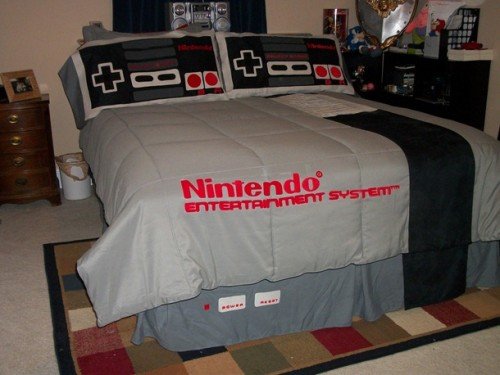
Next I proceeded to /v/, the video games section.  While the blue color scheme suggested it would be SFW (safe for work), I was greeted with what appeared to be a transvestite about halfway down the page.  Other than that one picture, the rest of the image threads seemed on topic, including a NES-themed bedspread (link) complete with NES controllers for pillows, a nostalgic (for me at least) picture from a Spyro game, and a thread about your favorite video games past and present.  After viewing the threads posted in this image board, my opinion of the 4channers of /v/ increased quite dramatically (except for the one who posted that NSFW pic).  Also of note was that almost all people in /v/ posted as Anonymous as opposed to people in /k/, many of whom posted using a name with a “tripcode,” or pseudo-authentication mechanism.

Before I take the final leap into /b/, I thought I would just point out that there is an indecently exposed anime-styled female on the top of the /v/ page with a miniaturized 4chan logo and name.  I didn’t know 4chan outright sponsored that, especially in /v/ but whatever floats their boat, I guess.

And then there was /b/:  Allow me to say that the name random was pretty appropriate for the content I saw on the site.  Pictures included everything from image macros, troll faces, boobs, mazes, x-ray goggles, and disfigured bodies to boobs, naked women, more image macros, math problems, and boobs.  As for the text of the comments: well, I didn’t read most of it.  I can say it was pretty similar to what I’d seen on other boards, although possibly more hostile.  Apart from the porn, there were also some images that made me say “Oh God,” shudder, and move on.  I didn’t end up spending much time on /b/.  Because of its random nature, it wasn’t incredibly entertaining.  Still, I feel like I saw what was there to see.

The following are a list of my conclusions after visiting 4chan:

  • It’s not as bad as I imagined.  I guess most of my image of 4chan was based on the bad reputation of /b/.  The other boards I glanced over looked reasonable and were often somewhat funny.
  • It’s not something I plan to take part in any time in the future, although it sure looks like a way to kill a couple of hours.
  • Through my exposed to online culture, I was able to understand most of the goings on of 4chan
  • The community of 4chan isn’t as hostile to each other as one might be lead to believe, and most of them have a good sense of humor.

I survived the browsing of 4chan with my sanity mostly intact.  For anyone that hasn’t looked at the site yet, I suggest you at least take a look at the rules and FAQs to get a better understanding of how the site works.

Are funny memes impeding on our fun? – by “Kate F”

A couple of years ago, Nicholas Carr wrote an article in The Atlantic about how the internet changes the way people take in information and think about it.  In fact, the way you read my last sentence may well have illustrated his point: if you’re an average modern internet-media-consuming reader, you may well be reading this sentence as the article loads in the next tab, preparing to read about a page of the article, click on some more links in it, skim those, and (I hope) somehow find your way back here.  In fact, according to a University College London study that Carr cites, the average user of a research site only reads about 1-2 pages of any given article before bouncing off to another one.  Arguably, Google and hyperlinks are making it hard for us to focus on serious, lengthy books or even full blog posts.  Ironically, the more information we have easy access to, the harder it is to really use it.

But so what, you might ask?  For the purposes of this blog post, let’s concede that the internet isn’t the best research tool.  You could still argue that the internet is a veritable trove of music, trivia, funny pictures, funny videos, audio recordings of guys messing with telemarkers, and status updates from everyone you’ve ever met.

Yet I wonder if perhaps these vast resources of fun suffer the same pitfall that Carr attributes to the internet’s research tools.  Does this wealth of entertainment options make us incapable of engaging with lengthier entertainment, or even of focusing on any one option?  Anecdotally, I for one have realized lately that I struggle to focus for the duration of a tv show, let alone an entire movie.  When I watch tv online, I might start browsing some Texts From Last Night or checking my email or reading the newspaper in the next tab during a particularly slow scene. A good portion of the time, I get distracted and never even return to finish what I was watching.  In fact, I can’t make it through a Youtube video without getting distracted by the “suggested videos” on the side panel.

It’s an odd experience, because I don’t “have to” do any of those things, so it’s not as though I’m trying to more efficiently work my way through my entertainment to-do list.  Presumably, if I’m rational, the only reason I’d be multi-tasking during my leisure time is if twice as much media means twice as much fun.  But oddly, I’m not so sure that’s the case.  My tendency to multi-task online feels almost like a compulsion, as if the “new tab” button is calling out to me at all times against my own will.  The more I accustom myself to bounce through lots of quick blips of fun, the less I remember how to home in on just one leisure activity even if I wanted to.

Of course, blippy fun exists in the real world too (for example, comics), and the internet contains more developed entertainment as well (for example, feature-length films streamed online).  By definition, a “meme” is merely an idea, which could be about anything from weighty subjects like religion to trivial ones like LOLCats.  Yet I think it’s fairly clear that the entertainment-related memes that go viral online do not tend to be the long, time-consuming ones.  The most popular Youtube videos are almost always only a few minutes long; the viral email jokes your grandfather forwards to you are not book-length.  Perhaps the internet could theoretically help hour-long TED talks go viral to the general public, but in practice, it doesn’t.  We come to the internet for immediate laughs.

This desire for some instant humor as a break in a busy day isn’t in and of itself scary.  What I find frightening is that this might increasingly be the only type of pleasure and humor that we can appreciate.  I used to think there was something enjoyable about watching a sitcom every week, about knowing the characters and their histories and personalities in depth.  I feel that I’ve lost something when my entertainment comes primarily from a constantly changing cast of new, funny characters (Hoodrat kid! Fake Hitler! Miss Teen South Carolina!) or, alternatively, ripoffs of characters I came to know and love back when I actually read books and watched tv.  It’s only because I committed the time to read all 5,000 pages of Harry Potter fifteen times, gaining a nuanced and intimate understanding of Hermione’s psyche, that a parody video on YouTube makes sense.  It’s only because I watched a lot of Sesame Street that the irony of an obscene Count von Count is funny.  Parody is the fodder of many popular internet memes, and it feeds on the sorts of deeper-level cultural knowledge that a population with an attention span of 3 minutes can never gain.  What can we parody when we can no longer focus for long enough to really engage with characters in their original works?

I won’t argue that it’s bad to enjoy the occasional YouTube video.  But I will argue that if our enjoyment of short, popular memes on the internet shortens our attention spans to the point that it’s difficult for us to enjoy books, movies, and even tv, we are suffering a real loss.  At least for now, that claim isn’t scientifically proven, and I recognize that I rely primarily on anecdotal evidence in this discussion.  Hopefully further research will shed more light on the effects of blippy entertaining memes on the way we enjoy our free time.

But hey, perhaps by the time someone publishes an article about it, we’ll be too busy watching a baby sing Taylor Swift medleys in French to care.

Wikipedia: Creating a Generation of Thinkers – by “Laure F”

I’m not sure how many times a day I refer to Wikipedia.  Maybe 10-15 times on an average day.  A glance through my Internet history in the past week reveals Wikipedia searches as varied as Scientology, Cauchy’s Theorem, Twyla Tharp, and Queen (band).

Everyone seems to be using Wikipedia these days. It is the automatic go-to source of information whenever people are faced with a question or a cultural with which they are unfamiliar. Famously, even Rush Limbaugh (not that Rush Limbaugh should be taken as any kind of indicator of national trends) who has often told his listeners not to believe what they read on Wikipedia was caught referencing information obtained from Wikipedia.  The information, which was about a federal judge, later turned out to be false, having been posted by some Wikipedia prankster.  The misinformation was corrected shortly after it was posted. Limbaugh simply had the misfortune of checking the site while the false information was still posted (I never thought I would see the day when I would feel sympathy for Rush Limbaugh).

http://www.nytimes.com/2010/09/16/us/16judge.html?scp=1&sq=wikipedia%20rush&st=cse

In talking to people over the last few days about their experiences with and attitudes towards Wikipedia, I have found that people’s feelings about Wikipedia are pretty uniform.  The first reaction I got from everyone was how useful Wikipedia is.  They all told me how they use Wikipedia for random factual searches as well as for writing papers. People talked about how often they use it for classes: whether for math classes, science classes, English classes, or sociology classes.  It seems to be the number one resource used for questions like: “Now what is exactly is the formula for integration by parts?” as well as for questions like: “Now how many years has it been since Patrick Swayze died and what kind of cancer exactly did he have?”

However, with all of the people that I talked to, they immediately followed their praise of Wikipedia’s usefulness by adding that Wikipedia cannot be trusted.  They all went on at length about the problems of letting anyone edit a page. Many people talked about how companies and individuals could edit their own Wikipedia pages to portray themselves in a positive light.  Some people even showed me examples of pages that were clearly taken from company promotional materials or pages that were simply poorly written and lacking in impartiality.  (For an example, check out the Pierson College Wikipedia page http://en.wikipedia.org/wiki/Pierson_College.)  Everyone seemed to have some kind of anecdote about the untrustworthiness of Wikipedia.  Many of them admitted to having purposely changed Wikipedia articles to make them contain false information. However, when pressed, they conceded that the pages they had edited had quickly been restored to their former form.

I find this contrast incredibly fascinating.  People do not trust the accuracy of their main source of information and yet they continue to use it because nothing else can compare to Wikipedia in terms of breadth of information and easy accessibility. General wisdom says that this contrast is a bad thing.  Everyone I talked to went on at length about how bad it is that Wikipedia has found such a strong foothold in our society when one cannot trust the veracity of all of the statements it makes. However, I beg to differ on this point.

Before the days of Wikipedia, when people had a question about something they turned to news media or encyclopedias. However, in actuality, these sources really aren’t any more trustworthy than Wikipedia is. A recent study (albeit a controversial one) found that articles on Wikipedia on average had the same number errors as equivalent articles in the Encyclopedia Britannica. Similarly, news media gets things wrong all of the time and is incredibly biased in its presentation of things. Whenever I have seen a news story about something I actually know about, I have been horrified at the inaccuracies of the story.  I can only assume that the stories I don’t know anything about are just as inaccurate.

In my mind, this not only demonstrates that people are learning to navigate the world of Wikipedia, thus better detecting areas of false information and so helping to make Wikipedia a more reliable source, but that Wikipedia in being the main source of information for a lot people, is helping to produce a generation of critical thinkers.  It is creating a generation of people who don’t just blindly accept information, but who remember that all of the information with which they are presented whether on Wikipedia or in the news is presented by people, people who may not always be the most trustworthy sources.

Thus, I think Wikipedia has done an enormous service to society in more ways than one. Yes, creating a vast database of easily accessible up-to-date information is important and incredible and worthy of all kinds of praise. But I think that another one of the really important legacies of Wikipedia is one that people don’t think about much. That is, that Wikipedia has created a generation of critical thinkers.  It has created a generation that questions where information comes from and is fluent at fleshing out areas of bias and inaccuracies.

I think Wikipedia teaches people incredibly important skills, namely the ability to ask: Who is writing this, what are their motivations, what might they not be saying, is this really true, what evidence is there to support this statement? These are skills that people then apply to other areas of their lives.  I think this generation, when watching a news story, or reading blog, or even reading a textbook—all resources whose accuracy people normally might not have questioned—now asks these same questions.  Wikipedia has thus created a generation that does not just blindly accept, but analyzes and criticizes and thinks.  And I think that is the true legacy of Wikipedia.