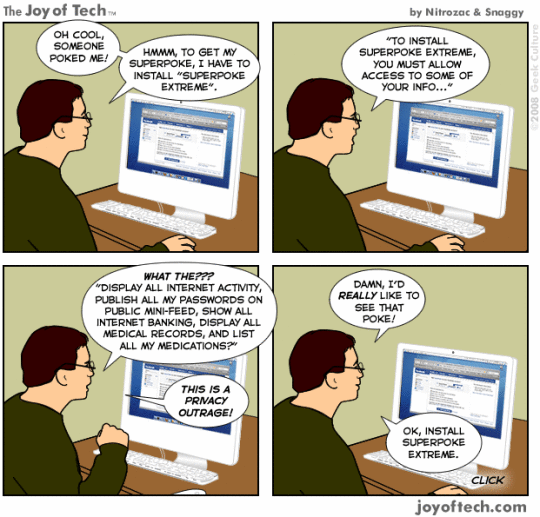
Privacy is for Meatspace – by “Max C.”

Agent Smith: orly?
Just because you're in an avatar doesn't mean you aren't accountable.

Any online projection of your meatspace avatar should have no private details. For all online material traceable to you in real life, you must expect it to represent you to people that you haven’t met in real life (note: not the Pirate Bay’s definition of real life). Ignore the illusion of Facebook privacy settings: anything on there should be something you are okay with anyone seeing. Any non-encrypted email you send out you stand behind, legally and socially (unless you’re Eric Schmidt). A click, a screenshot, or more realistically an automated tracker has already saved it for all time. Get used to it.

the only embarrassing search is World of Warcraft
There's only one embarrassing search here...

It starts with a simple question: when is privacy important? Privacy is valuable if you don’t want other people knowing things about you. All digital material is easily distributed. Anything put online, therefore, should pass a simple test: is it okay if everyone in the world has seen it?

hi brad
Don't worry about creepy strangers. Only your friends want to look at your ugly mug anyway.

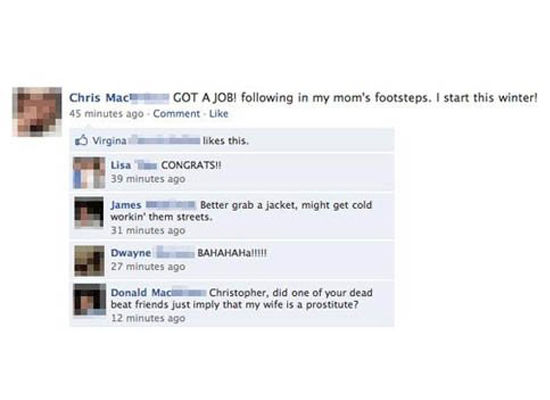
Frankly, most things we do are so mundane and outrageously uninteresting to others that you don’t care if other people know. But keep the sex, illegal acts, and medical history off your Facebook, Twitter, Myspace, and whatever else you have registered to your true moniker. Practice self-censorship, but also be proud of every word you tap out in your boring little status updates.

omg im at a party! brb buzy bein' cool
This is my Facebook profile picture. I chose it because it makes me look hotter than I am in real life.

I’m willing to put my privacy where my big mouth is. I don’t have a Twitter or Myspace. But I’ll upload my entire Facebook for anyone to download. Disclaimer: I deleted my Facebook messages. Other people that send me messages imagine that Facebook messages are private, and therefore I won’t force them to stand by their secret words.

disappointingly demure
A true patriot takes one for the young people of America.

We will one day live in a world that doesn’t find scandals in every teenage indiscretion, sext, or hit off a bong. Until that day comes, societal standards for “appropriate behavior” must be gradually eroded one sex tape at a time. Kim Kardashian did her part. Why aren’t you?

Stalking 101 – by “Xiyi X”

In high school, I came home one day to see an envelope thumb-tacked onto my front door. Interesting… I thought, and proceeded to open it. Bad idea. The letter contained information from private (or so I had naively thought) Facebook messages regarding a boy on whom I had a crush, various photos of me that someone had printed out, and–the creepiest of them all–the words: your so pretty, C… i saw your mom on your driveway this morning. she was looking good, i can see where you get it from. why won’t you spend some time with me instead of [name redacted]? leave me your response under your doormat.

I had a bona fide stalker on my hands.

Stalkers are nothing new, but social media sure is making it a lot easier for stalkers to do their job nowadays. Stalking used to be a rather difficult task, believe it or not. When I think about it, I realize that my High School Stalker must have put in a lot of effort into harassing me. He had to find, download, and print the pictures; stake out my house to deliver letters to my front door without being seen; loiter around my house more in order to receive my replies, which were under my front porch’s doormat; go back to his house to type up and print out another letter; and then go back to my house, wait for a time when no one was there, and tack it onto my front door again. That’s a lot of time spent just waiting outside of my house.

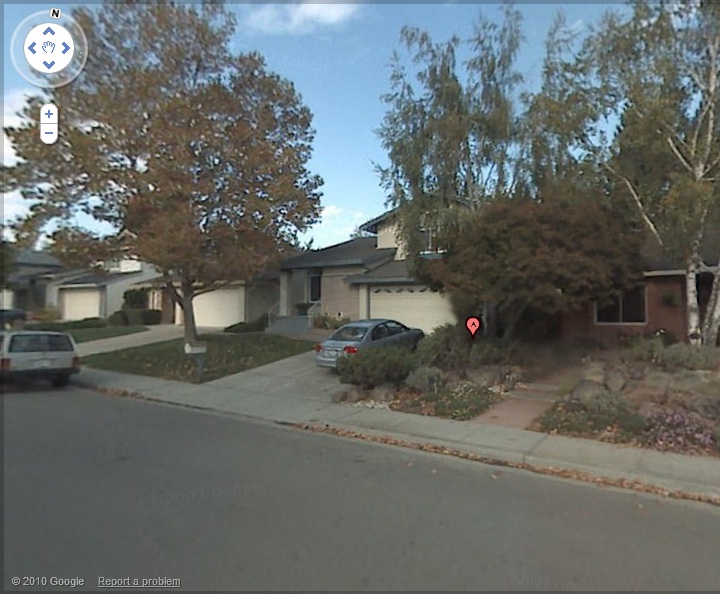
Courtesy of Google, now you can see my house, too!

Now, thanks to Foursquare, Facebook Places, Twitter, or what-have-you, stalking has become much more accessible for the general public. It doesn’t even take that much effort to stalk anyone anymore. People practically advertise their whereabouts and actions through these platforms, almost asking to be stalked. Stalkers have their work cut out for them, too–all they have to do is visit your Facebook, take a look at your recent status updates or event RSVPs or Foursquare posts, and that would give them a pretty good idea of where to find you. It’s that easy.

Once they’ve gathered information about you, it’s even easier to harass you with it. Gone is the era when stalkers stealthily waited outside houses for opportune times to deliver letters! Thanks to anonymous services such as being able to leave anonymous blog comments and Formspring, harassing someone without fear of repercussion only takes a couple taps on the keyboard and a click of Submit. Any drunken idiot can do it. And I do mean any drunken idiot.

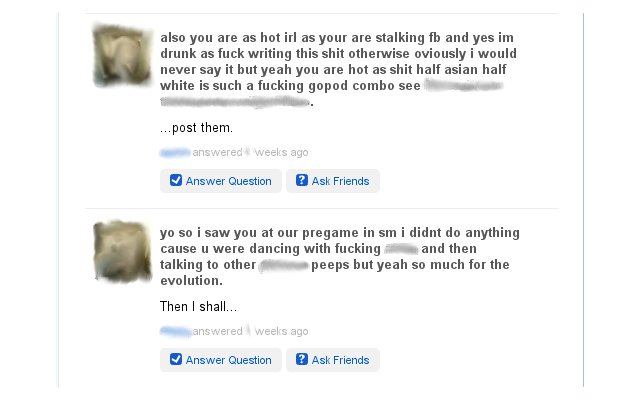
Case in point, from a friend’s Formspring (I apologize in advance for the language and poor spelling):

This actually isn't even the creepiest or most hostile comment, just the most that I could get away with in a class assignment.

There are two things that are clear here: 1) The anonymous commenter spotted my friend somewhere and 2) then decided to communicate to her that she was seen and is as attractive irl as through Facebook stalking. This is stalking made easy in the Web 2.0 age. Web 2.0 allows any random person to find out something about you (location, in this case) and then immediately disseminate that information to everyone else on the Internet. Not only do you have to be concerned about your own privacy, but you now also have to worry about some random stalker’s lack of discretion! Since stalking requires so little effort in the digital age, more and more people are willing to expend that little amount of effort it takes to be anonymously creepy. The result? We now have an ever-increasing population of lazy creeps.

It really makes me miss my High School Stalker. At least he had class and put some effort into being creepy.

’cause it’s a jungle out there ♪ – by “Russell K”

In all likelihood, I was not the only one last class who wanted to discuss further the issue of online identity and privacy. I tend to agree with Kashmir Hill in her suggestion (in class and in her website) that our sense of privacy will change. Yes, in a more transparent era, or perhaps just for a younger generation, last Friday’s embarrassing moment will remain just that and no more, despite and perhaps in part due to online evidence.

This perspective may be comforting, but we should qualify this comfort. It is a small, finite comfort.

The comfort lies in the realization that our own mistakes will not be as damaging as we might initially fear. Mr. Scalia (who often seems to be assigned in readings at Yale at his expense!) if little else in our readings does seem to remind us that the idea of the law protecting every little fact about us is absurd. Kashmir Hill suggested that more openness might lead to more comfort. And indeed, for stuff like what happened last Friday that a friend posted with you tagged in it, it might be less silly to turn to social norms than to turn to law. Social norms are formed online — we all have seen this happen in our generation — and we can expect a great deal of such online exposure to be made safer by online social norms, without overprotective, “silly” legislation. We can all simmer down now because the privacy FUD problem is solved.

If that leaves you less than satisfied, I’m with you. “Online exposure” can go far beyond being tagged in a Facebook pic. Specifically, your online exposure is not necessarily of your own doing, or even your friends’ doing.

Daniel Solove’s blog post in this week’s reading suggested an interesting term: Aggregation. Solove uses this term to describe a way that gathering data on someone can lead to violating his/her privacy, essentially by connecting “innocuous” points into a “detailed portrait of our personalities and behavior.” We can ask a sort of philosophical question: What other effects might the Internet bring about to data about you?

Like Seth Godin’s list of ways things can get broken, my list of privacy FUD is sure to be incomplete. Please comment and add your own!

1. Aggregation – Connecting innocuous dots can lead to an uncomfortably detailed big picture. For an example, do the readings.

2. Dis-gregation – Less is more — more harmful.

What if an online journalist or a Facebook friend isolated a couple (true) facts about you and leaves out other relevant facts?

3. Context Distortion – Taken out of context, new implications begin to arise.

I thought of this last class when I discovered searching for my name leads to a porn website. No, I don’t have a porn star double life! But in 2009 I did help promote Yale and other US colleges to Japanese students, and the Japanese term 中高生 (middle and high school students) landed links to YouTube versions of our video footage filled the greater part of a fuchsia-colored website. (Incidentally, if you’re being naughty and trying to find this website, at least on the page with my name in it there was nothing graphic, let alone anything involving minors.)

4. Unplanned Anti-Obsolescence – It’s forgotten by now, right? No, it’s in the Net’s hands now.

A friend thought he’d put up a silly status update, and delete it 30 minutes later. It wasn’t something he wanted everyone to know, but having a few know would have been acceptable to him. He had it planned out that way. But when another friend found it hilarious and re-posted it as his status, control over it had changed.

5. Promulgation – Data that’s out there, but in small circulation, can become less innocuous by gaining popularity.

A funny story shared to friends might not be best when shared on the Internet, where there are less degrees of separation from total strangers who might interpret it differently. Cyber-bullying examples come to mind as well — a few enemies at school is a smaller problem when they’re not enlisting online comrades. Or what if RapLeaf had sold (“inadvertently”) data about your online behavior not to a dozen advertisers, but hundreds? What if they also sold data to your workplace, school, or to the government?

I am sure there are more effects we could talk about, but the bottom line is that an embarrassing Friday should not be our only concern. Even if greater transparency helps establish social norms online, we shouldn’t ignore that it’s becoming easier and easier for the Internet to affect info about you. What you post about yourself or reveal to marketers tracking you is really just where that data might start off – really we’re talking about the potential for that data to take on a life of its own. Much of this seems difficult for the law to prevent, but I suspect we’re more eager to turn to the law rather than social norms when we consider that it’s not just about our own mistakes confined to a few popular sites.

These boots are made for… following me? – by “Cynthia W”

The gray suede boots that I drooled over last week are following me, chasing me around the internet as fast as I can click. During my morning news-perusing, the coveted shoes swirl around the top of the stories I’m reading, taunting me, “buy us!!” Conveniently, accompanying the frenzied boots is an enthusiastically-blinking link to Zappos.com, where I originally admired and then abandoned them. I felt ever-so-slightly creeped out by this. How does the banner ad know who I am? And why are the gray suede boots following me?

A cursory Googling revealed that Zappos is one of the many clients of Criteo, an award-winning advertising company which specializes in behavioral retargeting following people with a product until their last ounce of willpower dissipates. As it turns out, I’m not the only one who has been followed across the net by a vengeful piece of merchandise. This blogger was chased by a pair of shorts, and this one by some brown loafers.

What it comes down to is that I WANT THOSE BOOTS. Criteo knows as well as I do that the more times I see them, the more tempted I am… and the more likely I will be to buy them. Is it a great advertising strategy? Of course! But is it totally weird? Perhaps.

As it turns out, Criteo collects nothing but browsing behavior on their clients’ websites, storing a simple cookie. From Criteo’s FAQs:

What does Criteo know about me through the ads they serve?

We do not know who you are. We do not know your name. We do not know where you live, where you work, your gender, your age, your email address or any other personally identifiable information about you. We do not collect any information from the publisher website on which you may have seen our ads. We do not store your IP address. We do know that the Internet Browser you are using has visited one of our partner sites (probably an online retailer) in the last 30 days, and we have seen which products you were interested in on that site.

Here are some screenshots from the Take a Tour section of Criteo’s website:

Criteo basically keeps track of which items a user visits on their clients’ websites. Then, when a user fails to be “converted”— and approximately 98% of users are not converted on any given visit— Criteo displays those same browsed items through dynamic personalized ads across a vast array of websites. Images of the viewed items float around Criteo’s banner ads until the user finally caves, or becomes so frustrated that he or she takes the time to go to Criteo’s website and opt out.

Companies like Criteo are well within the limits of what is technically acceptable in terms of privacy. They store simple cookies, which users can block by changing their browser settings, and users can choose to opt out on Criteo’s website. These behavior-targeting companies are certainly less egregious than companies like Facebook and Google, which store much more than a simple tracking cookie, similar to the ones which are stored at almost any other website. But the visceral reaction that I and other bloggers have had to Criteo’s ads comes from the age-old adage that ignorance is bliss. I, like millions of other web users, like to pretend that I’m not being tracked and recorded with every virtual footstep that I take. Seeing my browsing history displayed across a banner ad on a totally unrelated website shatters the illusion of privacy. What I’m trying to say is: I don’t like being reminded of what they know about me and my behavior. I’d like to believe that the only one watching me shop for the gray suede boots was me.

Facebook v. Gmail: What they know about you and whom they’re telling – by “Nicki C”

It’s now common knowledge that Facebook has been less than perfect in terms of protecting its users’ privacy. But do people really know how unprotected they are? Do you? A comparison with Gmail’s privacy policy reveals stark differences and illustrates how a site with similar functionality can respect users’ privacy.

While Gmail and Facebook obviously don’t share exactly the same purpose (as Facebook is primarily a social networking tool and Gmail is primarily an email provider), there is, in fact, much overlap. Facebook has private message exchanges, Gmail has contact lists and Google Buzz, and both have an online chat function and current status update capabilities. Thus it is both useful and meaningful to compare the privacy policies of the two sites.

First, Facebook and Gmail differ in what extraneous information they collect. Facebook collects information “about your browser type, location, and IP address, as well as the pages you visit (emphasis added).” Gmail does not collect information on what pages you visit, but instead, limits its collection to relevant information such as IP address, browser type and language. At the risk of sounding biased, I ask you to consider what nefarious reason Facebook has for collecting information on what other sites you visit and what they are doing with this seemingly irrelevant information. They can get quite enough information for targeted advertisements from your listed interests and activities, as well as from your general information (age, location, gender, etc). (As a side note, although Google took some heat for supposed privacy violations in Google Buzz, this application had to be opted-in, and has since been updated to a better policy, and thus stands apart from the default and continuing privacy issues of Facebook.)

Second, the sites’ policies differ in scope. Both sites involve third party applications or affiliated sites. Whereas information provided to affiliated Google Services on other sites falls under Gmail’s privacy policy, information provided to popular third party applications on Facebook (even those pre-approved by Facebook) is subject to those applications’ privacy policies, which, as you can imagine, may not be all that respectful of your privacy.

Third, a friend’s settings on Facebook can affect the leakage of your private information:  “If your friend connects with an application or website, it will be able to access your name, profile picture, gender, user ID, and information you have shared with ‘everyone.’”  In Gmail, a contact’s privacy settings have no effect on your information.

Finally, there are various reasons why privacy on Facebook is worse than on Gmail in terms of Facebook-specific activities. If a friend on Facebooktags you in a photo or video or at a place, you can remove the tag, or you can limit who can see that you have been tagged on your profile, but you cannot prevent the person from tagging you in the first place. If they publish the tagged media to their news feed (which is often the default option), many people will likely see the offending picture/video/location before you get the chance to remove the tag yourself.

Another issue deals with Facebook’s default privacy settings. These settings allow “social ads” to use your picture in advertisements that your friends see, unless you opt-out. Gmail has no such egregious misuse of your information. Similarly, Facebook may store information about a payment source account that you use for transactions on Facebook (such as buying a virtual gift for a friend’s birthday). Again, Gmail does not store your bank account information. (While no analog features to social ads and virtual gifts currently exist in Gmail, they easily could be implemented, but tellingly, haven’t been).

There have also been issues with breaches in Facebook’s already lenient policy. Such leaks may allow apps to sell your information to ad companies and to track your online behavior. As many people still consider the Web a place that makes anonymity possible, this online footprint may leave you feeling unsettled and a little creeped out. The fact that a company such as Rapleaf may have been tracking you through Facebook, compiling information on you and selling your information should make you reconsider how anonymous you think your online activity, especially on Facebook, really is. For example, some political campaigns may buy information from Rapleaf (including voter-registration files, shopping history, social-networking activity, real estate records, and your name and email) to better target their demographic.

Remember when people were really upset by the lack of privacy of the then-new Facebook mini-feed? It seems we’ve been desensitized to this particular invasion of privacy. Let’s not continue this apathetic trend to the point where Big Brother can convict us of google search crimes (thoughtcrimes of the digital age).

Privacy is an issue of responsibility not legality – by “Matthew K”

Internet privacy is a very controversial issue.  Is compiling already publically available information considered a violation of one’s rights? I would argue that this is not. However I also would argue that it is rather unnecessary to compile private information on individuals.

Lets take a look at the website Spokeo.com.  By typing in my uncle’s name I can find out where he lives, a photo of his house, how much his house is worth, his telephone number, his wife’s name, whether they have kids or not and lots of other seemingly personal information.

While one must realize that all of this information is public in one way or another, why is it necessary to compile it all into a single website? This allows an individual who simply knows another persons name to obtain information about their home and their family.

Consider an extreme example in which a child molester is seeking a future target.  A website like Spokeo.com could facilitate the child molester’s search.  While the issue is not that of invasion of privacy from a legal standpoint , the issue is why is it necessary to make it so easy for an individual to gain this information by simply searching one’s name.

Consider the real life example of the home invasion of the Petit Family in Cheshire, CT.  In this particular case the individuals responsible were looking for money. The two assailants had kidnapped the Petit family and forced Mrs. Petit to go to the bank and withdraw money from her bank account.  In addition the two assailants raped Mrs. Petit and her daughter.  A website like Spokeo.com could facilitate the horrible acts committed by these individuals by making it easier to obtain information.  An individual could identify someone within the community such as Dr. William Petit and suspect that he was wealthy.  Logging on to Spokeo.com would be able to confirm such a suspicion as information about one’s wealth is displayed.  Also an interactive picture of the house from Google Maps is provided that would allow an individual to plan a home invasion from the comfort of their home.

Scalia brings light to this point that despite being legal, it is unnecessary to provide a database that reveals private information. Scalia said, “It is not a rare phenomenon that what is legal may also be quite irresponsible.”  Perhaps the concept of an individual’s privacy on the Internet should be considered from the perspective of the moral responsibility to protect an individual rather than the viewpoint of legality.

In tern we as users of the Internet must have an obligation to protecting ourselves to the best of our abilities.  Choosing to use social networking sites such as Facebook makes it rather easy to gain information about an individual if proper steps aren’t taken to make this information private. A website like Spokeo.com uses information that is publically available from websites such as Facebook to build an individuals Spokeo profile. As a user of the Internet it is important to read the privacy policies of the websites being used to understand if and how your individual information is protected.

The Internet has made our lives easier in many ways and more difficult in others. Internet security is one of the main problems with the Internet since its birth. Although websites take precautionary steps to protect our information it is important to also protect ourselves and not offer private information over the internet.

Anonymity Online is Impossible – by “Logan M”

Thomas Pynchon has disappeared. He has not actually disappeared, of course, but very few photos of him have been taken in the past forty years and almost no-one, even his most devout fans, recognize him if and when they see him on the street. Pynchon has achieved an almost unfathomable level of anonymity – and we think he is insane for it.

Thomas Pynchon on the Simpsons

All media require a yielding of some information in order to transmit their data. The spoken work means that the content of our message is no longer private to the individuals involved. We take precautions against eavesdropping if we have reason to do so, but these actions themselves show that we accept this loss of privacy in return for the convenience of the spoken word. Similarly, when we communicate using the medium of the mail (physical, not electronic), we give up the privacy of the recipient of the message. Return addresses are not mandatory, but I challenge anyone to send a letter with no delivery address listed. In sending a letter we reveal to those who handle the mail as well as anyone and everyone near the delivery address that our intended recipient is being contacted. We give up the privacy of who is being contacted in return for the convenience of the postal service.

Logo for PostSecret - A Program Where People Send Letters to Frank Warren

The internet is simply another medium through which data is transmitted. However, because of how the system is designed, one must be connected to a central hub (an ISP) before one can transmit data. This connection, and the fact that the ISP routes all signals coming to and from it, means that the ISP knows everything that you do online (whether or not a specific individual at the provider does). This is the privacy that you give up when you sign onto the internet – you lose the ability to act anonymously.

There are of course programs and systems like TOR, which allow you to make anonymous your internet activities to an extent. However, this is simply another part of the ongoing arms race between ISPs and sites attempting to control information and people attempting to conceal it. When people figured out that whispering made conversations less able to be overheard, other people designed amplification devices. When people developed codes for their ideas, other people cracked those codes. TOR and other similar programs are important in that they further this progression of technology and work to set up a balance between groups of people. What they do not offer is perfection; anyone seeking perfection must avoid the system entirely.

Amish Couple

My girlfriend does not have a Facebook account. She does not use LinkedIn, Blogger, or otherwise put her information online. This does impact her life negatively because she is unable to interact with her friends using this medium, but, for her, the desire to remain private is more important than these benefits. For now, this is an understandable view, and in fact the correct action for someone who wishes to remain anonymous and private. I wonder how long it will be, though, before society moves on to the point where a virtual recluse is viewed in the same light as Thomas Pynchon – someone to be mocked on TV and called out on blogs for being, as I said earlier, insane.

Our future

What are the kids up to these days? – by “Paulina H”

Breaking news! The internet isn’t just for porn! Actually, the internet is full of bullies. That’s right. Cyber bullying is the real issue for kids these days.

When we think about cyber-bullying, we think about the libelous attacks that people post anonymously on websites like AutoAdmit or the now defunct Juicy Campus, where posts are almost entirely uncensored and unmoderated. Short of a court-ordered subpoena, in fact, it’s nearly impossible to convince these website owners’ to remove damaging posts, and even when they do, the attacks still exist in cached files on search engines, leaving an indelible mark on the internet. Really, it’s no wonder that cyber-bullying is so damaging to its victims. So, why do nice, ordinary people make such disparaging, thoughtless comments online?

Well, people can be meaner online (Kashmir Hill). It’s true. It’s the 21st century version of talking trash behind someone’s back instead of saying something to their face, except that in this instance, that person can just Google themselves and find out what you’ve been saying. Oops. From the point of view of trash talking poster, it’s okay, because these were anonymous comments. How could anyone possibly find out who they are? Off the internet, yeah, it might be difficult to trace the origins of a rumor, but the internet’s memory is a lot better than our own.

The issue seems to be one of social credit and personal reputation – offline, when you’re spreading rumors about someone, you’re careful who you talk to, because you don’t want to damage your own “stock” of social credit. Nobody wants to be labeled as a gossipmonger. Online, and anonymously, however, there is no credit to be worried about…or so you think. The reality, however, is that anonymity is in short supply on the internet. Moreover, people are apparently forgetting that defamation is always illegal, on- and offline.

Just because you have a pseudonym on a message board doesn’t mean that you’re actually anonymous, since there is a physical link from your computer to the Internet (ISP Providers, anyone?). If you go through proxies like TOR or VPNs like ItsHidden, then you might be more anonymous, but your internet connection can get slower, and if you’re using something like Anonymizer, the moment the server gets too busy, it will automatically shut down and then you’ll be exposed once more. However, the average internet user really isn’t that aware of how vulnerable they are, and how difficult it is to keep things private.

For example: is there really any privacy on Facebook anymore? Apparently, people still think that’s the case. A couple weeks ago, a few girls at Choate Rosemary Hall created their own “burn book” on a Facebook thread. When we think about cyber-bullying, we think about anonymity, but on Facebook, there really isn’t any anonymity to be had, since your online profile is tied to your personal identity. So, really, a new question arises – how much of your privacy is protected?

If these new “See Friendship” pages (which are incredibly creepy, by the way) are any indication, there is practically no privacy on Facebook whatsoever, even if you are extremely careful about who you friend and what people can see on your page. And yet, incidents like what happened at Choate, or what happened to Filipino actress Krista Ranillo, do occur. They’re rarer than your average cyber-bullying case, because to a certain extent, most Facebook users are aware of the fact that they really don’t have much privacy. Nonetheless, libel on Facebook is a serious issue – if you send someone a private message full of damaging accusations, it’s not really private, since it exists somewhere in Facebook’s massive data archives. Would those girls at Choate have said the same things if the medium hadn’t been a message thread, but a status update? Probably not. However, they thought that that thread would never be seen by anyone it was targeting.

Alas, if only they’d been better educated about their privacy options. In general, perhaps if people were more aware of how easily they and their words can be traced on the internet, the rate of cyber-bullying might be lowered, since social credit would become a factor again, and that’s definitely a huge deterrent. After all, nobody actually wants to be labeled as a gossip, right?

“EVERY WHITE PERSON IS A RECIST?” (or my morning on Youtube) – by “Adam F”

This morning started like any morning. Try to wake up at 9:15, roll over and sleep almost another hour. Stumble out of bed, open my computer, and watch the video for Justin Bieber’s hit song “Baby.”

Sometimes, I even scroll down and read the comments, hoping to find a like-minded soul, someone who is lost between irony and truth, and in between the two has found something of a love for a tween sensation. Instead, I found this:

“<- STUPID INDIAN TESTICLE MUNCHER PUSSLIM SHIT NIGGER

TAKE A FUCKING BATH BEFORE COMMENTING HERE YOU STUPID INDIAN GORD-GORD FUCKASS OR ATLEAST USE ELEPHANT URINE!

I FUCKING SHOVE INDIAN FLAG UP MY ASS”

For a video largely targeted at pre-teen girls (not yet women), there are some pretty vile things said in the comments. Of course, the usernames are pretty much entirely anonymous. Names range from “iTrolledABearOnce” to “12345668587,” but none of them reveal a true identity. There are new posts literally every couple seconds. Does this mean that people spend their lives sitting in front of the Justin Bieber video waiting for the opportunity to write something inflammatory? Yes. Yes it does.

I constantly find myself questioning these people. Does the internet dick theory apply to every person? I have never in my life anyone short of clinically shout such horrible profanities. Does that make the post-er a dick? Does (s)he really mean what (s)he wrote? I would guess not.

Still, think of the children who watch this video (and presumably made its view-count exceed the population of our country) and think of the artist who posts the video. To sounds like a fool for a moment: how does Justin feel? He started his career with youtube videos, so one can expect he still checks his view count and reads the comments. Are comments like “BABY BABY BABY OUUUH IM GAY NOOOOOOOU BABY BABY OUHHHHHH MY DAD WILL BE MINE !!!! SIALALA JUSTIN BIMBER GAY !!!!! HOMO” hurtful to a teenage boy? Probably. If not, he has an ego of steel.

All of this is to illustrate another instance of cyber-bullying fueled by anonymity. I highly doubt Justin or his family would send a subpoena to find out who every single user is, but maybe they should. Comments about him are just as disgusting as the comments about the Law School students.

This type of cyberbullying, however, has another unfortunate consequence. The little kids who, with parent supervision, watch this video learn a lesson beyond the wholesome delivered about first love. They learn that people, when hidden by the mask of the internet, are vile. For me, these people are scarier than anything I saw this past weekend, dead or undead. I can only imagine how scared I’d have been at age 9 (the age of Willow Smith, “singer” of the now ubiquitous song “Whip My Hair”).

So I ask: why do we allow this type of anonymity? If a blog so utterly tasteless as “Skanks in NYC” can be considered horrible enough to warrant publication of the author’s name, why aren’t we protecting everyone, especially Children, from this type of online garbage? If nothing else, why is there no filter on youtube to block use of the words fag, nigger, testicle, etc? I sometimes wish these post-ers on youtube could taste their own verbal spew. Show these posts to their wives, their children, or their parents. See if they still feel brave enough to talk about testicle munching and how Justin Bieber’s greatest dream is to have sex with his father.

My biggest question is: why is this even an issue? Everyone, including most of the post-ers, know these types of words are wrong. Anonymity gives us the power to speak our minds, this much is true, but the courts have the power to root out hateful, libelous, material. Why is there no system to prevent it from happening in the first place?

“@DeepThroat stop it dude, shut ur trap” -@TrickyDickNixon – by “William S”

In the May 2005 issue of Vanity Fair, Mark Felt, former Associate Director of the FBI, revealed that over thirty years earlier, he provided Bob Woodward with information implicating President Richard Nixon in the notorious Watergate break-ins, finally revealing himself to be the infamously secretive whistleblower, “Deep Throat.” Woodward was completely tight-lipped about his informant’s identity, and Felt repeatedly denied any speculation directed his way. But what would have happened if “Deep Throat” revealed such explosive information not through a reliable journalist in 1972, but, say, on an anonymous Twitter feed in 2010?

One can’t say for sure – an FBI investigation was going on that would ultimately confirm Woodward’s claims, but initially, Nixon’s White House denied the allegations. Today, perhaps the White House would serve up a CyberSLAPP and sue Twitter, as Marty Thomas did on a much more minor scale for an anonymous STD allegation. Of course, for a real suit, the White House would have to prove “Deep Throat’s” allegations were slanderous or libelous in nature: but perhaps in the frantic cover-up that followed the break-ins, the White House would have been to able to put sufficient, convincing pressure on Twitter, and cause them to cave. Perhaps Mark Felt would have been uncovered, and made a scapegoat. Perhaps he would have been tried for perjury. Ironically, the anonymity of confiding face to face in another human being was safer for Felt than anonymously posting online might have been.

The rise of WikiLeaks has allowed for modern analogues of “Deep Throat” to do what they do with relatively little disturbance, but the question of online anonymity is still very much present for the rest of society. If someone had asked me a year ago if I thought anonymity on the web was positive, I would have said no: it allows for a faceless, filterless, cowardly mass of people to unflinchingly harm others. After seeing m00t of 4chan.org speak a few weeks ago, however, my thoughts have shifted: anonymity on the web is not necessarily good, but it is ultimately necessary. For better or for worse (and admittedly often for worse), people need that outlet. 4chan is built on anonymity, but as m00t said, in a handful of serious legal cases, they have had to step in and provide information on their posters. This, in many ways, reflects the way society so frequently works: networks of people often remain tightlipped about one another, unless legal circumstances strongly demand otherwise. Face-to-face human communication, as Felt experienced, is not dependent on a third party provider that may or may not protect you. While it may not keep everyone happy all the time, having anonymous outlets like 4chan on the web keeps the internet grounded in a real, human world.