Free Software: Not Just Operating Systems – by “Benjamin G”

GNU/Linux is the poster child for the free (as in speech) software movement. It is highly reliable and capable software that has beat out proprietary operating systems in fair competition, proving that people will in fact produce software even without the incentives provided by copyright law. If there’s a bug in the program or a missing feature, someone will be annoyed enough and competent enough to fix it out of self-interest, and everyone will benefit from the improvement. At least, that’s how GNU/Linux developed, and the theory is that the same principle will apply to any sort of free software. But does it? Will people voluntarily improve any program they use?

Games are probably the kind of program that would work least well with the free software model. Nobody has to play a game, so nobody will be forced to fix a bug in order to do his job. And if the sum of the experience of fixing the program and then playing the amended version isn’t better than the experience of playing the game as it is, it won’t be worth it for anybody to work on it.
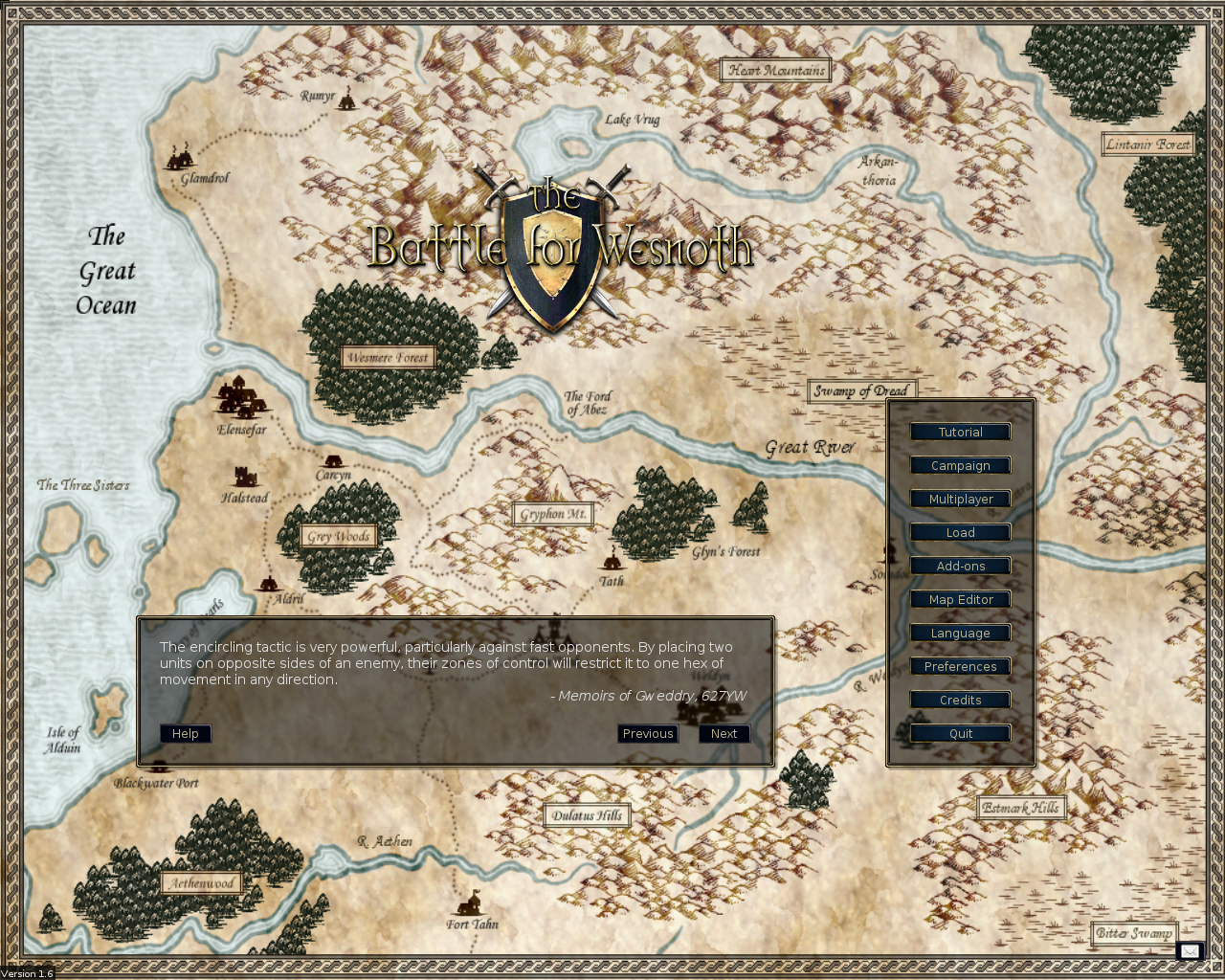
wesnoth_main_menu

There are free games, though, some of which are apparently pretty good. Battle for Wesnoth, for example, is a free, turn based stragegy game licensed under the GPL. It is “the most played turn-based strategy game on the Linux platform, being probably the most polished, full-featured and addictive game in its category.” I’m not surprised that a turn-based strategy game has been successfully developed as free software; the programming challenges are less about window-dressing and more about the underlying gameplay. And that kind of coding can be fun in itself.

I am by no means an expert coder, but a few years ago I did write a blackjack game. I wasn’t collaborating with anybody, but the free software model did apply, to an extent. I found a shortcoming in the existing software (most computerized blackjack games shuffle the deck after each hand rather than dealing out six decks of cards before randomizing) and I took the time to fix it. I tried to build as many features as I could, but I’m sure I missed some; I’m also sure that, if I put the source code online, someone would be interested enough to fix it. (I’m glad to distribute the source code [it’s written in Java] if someone tells me the best way to do so)

I’m less sure that someone would take the time to design a really good GUI. To me, at least, designing user interfaces is labor intensive and boring- not worth the time. I may just be projecting my own biases here, but I suspect that fewer people will voluntarily work on the tedious but necessary tasks that are necessary for some types of games.

Of course, with a large enough user base, there will be some people who really enjoy doing graphics. But still, on average, free software will be weaker in these areas. There’s a certain amount of boring but necessary work that must be done, and most of the time that means you have to pay someone to do it.

Free software can be produced by paid programmers. Quake and its sequels are an example of software licensed under the GPL but produced by a commercial company. My point is only that the model of “the users will do a better job than any defined group of developers” works better for some tasks than for others.

What’s Going on with DRM? – by “Daniel P”

A few years ago, my friend copied a bunch of music from his brother’s hard drive to his new iPod. His brother has awesome taste in music, and since my buddy didn’t have to pay anything for it, I thought he got a pretty sweet deal. We were talking about this while driving around and listening to the White Stripes.

“Dude!” he said all of a sudden. “This sucks! I can’t play blue orchid on this iPod cuz I don’t have the license for it.”

“Ah shit man,” I replied. “It’s because of DRM.”

“DRM sucks.”

Yup. It does. Used to be that if you bought a CD you could do whatever you wanted with it. Listen to it anywhere, let your friends burn it, or burn it yourself and hand out the tracks. Music CDs (not CD-ROM media) by definition cannot have DRM applied to them because its not standards compliant. Guessing the music industry didn’t like this too much and was getting ready to release another CD technical standard with built in DRM.

But they didn’t have to. People dropped their CDs and started using digital files. When online music stores appeared on the scene, they just limited they ways you could use the files you bought from them. Let’s look at how:

Exclusivity – If I download “Fell in Love with A Girl” on x music downloading site, I can only play it on user end hardware or software affiliated with that site. For a while (maybe still now) music downloaded using Kazaa could only be played on Windows media player. Music from the Wal-Mart and Napster stores can only be played on products with Microsoft “plays for sure” certification, something iPods don’t have. iTunes’ version of DRM, fairplay, limited the number of devices an individual song could be stored on. Apple also only allowed files downloaded through iTunes to be played on Apple products and a select few Motorola phones.

Fees – Copies of music have a price. Napster charged an extra $5 dollars per month if you wanted to play the music you downloaded through it on a portable music player. Good thing I can fit my laptop in my pocket when I got to the gym. Napster actually had the worst deal ever: you lost access to all the files downloaded using it if you didn’t pay your monthly subscription fee. That’s just lending music on a monthly basis.

A lot of music stores recognized that DRM-free music has its price. Apple initially sold such files at an elevated price. Now all files on iTunes are DRM free and popular songs cost $1.29, thirty cents more than the standard price per song the store was unveiled with. Napster’s done away with its DRMed wares too.

I’m sure there’s someone out there asking, “Where did you go, DRM’d music? I miss you.” I’ve got a few guesses. Stores probably realized that DRM’d music is really annoying for users. It limits where and how they can play it and makes copying your music from your old computer to a new one really painful. They also realized that people would be willing to pay a bit more for music without DRM. In Apple’s case, thirty cents more. And I bet there’s some calculation out there that says the extra thirty cents generates enough money to outweigh revenue lost due to piracy. The last reason is the iTunes stores. It’s got 25% of the digital music market in the U.S. If it doesn’t have DRM’d music then any site that does is going to lose to it. Also, don’t forget the iTunes store’s buddy, the iPod. It has a whopping 74% of the U.S. mp3 player market, further cementing Apple’s hold on the stuff we’re listening to.

Looks like Apple is calling the shots in the online music market. But at $1.29 per song, who’s using it? Look at the numbers again.

iTunes market share = 25%
iPod market share = 75%

Most people who download music have a music player. Most people with iPods use iTunes. If most people with iPods bought music from iTunes, its market share would be far more than 25%. A lot of pirates still in town.

46 DC EA D3 17 FE 45 D8 09 23 EB 97 E4 95 64 10 D4 CD B2 C2 – by “Ben S”

Is this image illegal?
A "PS3 Flag", an homage to its predecessor, the "Free Speech Flag"

On January 3, George Hotz, or geohot as he calls himself, a hacker previously involved in the effort to jailbreak the iPhone, released the private key to the PlayStation 3, using techniques described by the group fail0verflow at the 2010 Chaos Communication Congress.  Essentially, possession of the key allows users to create and run signed software on their PS3s without the use of any sort of external USB device–i.e., to run the software as if it had been distributed by Sony.

There is every indication that this is why the parties involved exploited the, well, exploit–so that they and others would be able to use the machines that they own to run whatever software they want to write for it or share with each other (fail0verflow claims to have developed the hack in order to allow PS3s of all firmware versions to run Linux).  Of course, one of the side effects of the release of the key is that users can now, if they so choose, use it to run pirated versions of PlayStation 3 games on their machines, which Sony is loathe to allow.

In a response eerily reminiscent of that of Universal and its cohorts following the release of DeCSS and of that of the MPAA and AACS LA following the release of the AACS cryptographic key (the key that protects Blu-Ray DVDs), the corporate machine leapt into action (after one embarrassing gaffe on Twitter), and fired off lawsuits against both fail0verflow and geohot, causing the latter to start a legal defense fund.

This case lies much closer to that of AACS than that of DeCSS–the court ruled, in Universal v. Corley, that DeCSS was not protected speech because, among other things, the DMCA’s restrictions on circumventing technologies was “content-neutral,” and DeCSS seemed to have been distributed for the purpose of redistributing copyrighted DVDs, at least according to the District Court.  In the case of the AACS key, while the MPAA and AACS LA issued numerous DMCA takedown notices (notably to Digg), this was the only legal action taken: no lawsuits were filed, and the legal status of the key remains up in the air.

In the case of the PS3, the stated purpose for circumventing the “technological measures” that “effectively control” access to the PS3 was to get the machine to run Linux–undoubtedly, this is not in violation of any copyright law.  But will this be its primary use? The court tells us in MGM v. Grokster that we must consider not only whether a noninfringing use exists, but its relative frequency compared to that of infringing uses.

Will most users use the key to play pirated games?  More importantly, does it matter?

Similar to the avalanche of posts of  “09 F9 11 02 9D 74 E3 5B D8 41 56 C5 63 56 88 C0” on Digg following the MPAA’s response to the release of the key, a…flurry? of “46 DC EA D3 17 FE 45 D8 09 23 EB 97 E4 95 64 10 D4 CD B2 C2” posts appeared on Reddit in the aftermath of geohot’s publication of the key.  Both communities felt a sense of injustice that posting a 128- or 160-bit key, a number short enough to scrawl on the back of one’s hand, should subject the poster to prosecution.

On the other hand, the DeCSS program, in its shortest incarnation, is only 434 bytes, or 3472 bits, only about 20 times as long as the AACS and PS3 keys, and the court found that it was illegal–just as a clever Digg user created a flag using the hexadecimal key, or how I shamelessly copied the idea to make a flag of my own, so too did protestors of the DeCSS decision create MIDIs, plays, and even a haiku of the program.

When everything is expressed in terms of numbers, anything can be expressed in terms of anything else.  The court has ruled that some numbers are illegal, so where exactly is the line?  If I write some protection protocol with a cryptographic key of “1”, can I go around issuing DMCA takedown notices to every website that has the audacity to post a “1” somewhere? Would that even count as an effective technological measure? Probably, since knowledge of the key is generally not enough to crack the code–one must also know where to put it, which requires some amount of proficiency with computers (arguably more proficiency than most users possess).

So where is the line? Is it at 10 bits? 100? 1000? We already know it can’t be any greater than 3472.  The problem is, wherever the line is drawn, it will be arbitrary–any attempt to exclude some kinds of speech from protection will, when taken to its logical extent, inevitably result in some sort of restriction that seems ridiculous and unfair.  There will always be some tricky end case.

And programmers are great at coming up with tricky end cases.

Let e-Books be e-Books – by “Lynn W”

Having used Yale library for the past four years, I’ve come to accept as fact that the wonderful invention of the e-Book allows all library users to bypass the logistical obstacles that accompany the borrowing of physical books – unavailability when checked out by others, the trip of physically finding and retrieving the title from its shelf, the revulsion of thumbing through dilapidated  volumes with unidentifiable stains. More than once, I’ve taken Yale classes in which professors have assigned books that are available online from the Yale library. The strategy for those readings has always been to click on the link whenever I want, at my own pace and timing. The only “hassles” were perhaps that the pages cannot be printed, and that some versions do not allow electronic markings or highlights. Small price to pay for the convenience offered.

Interestingly, and much to my dismay, this universal access model to library e-Books does not extend much farther beyond the university setting. Although e-Books are not yet widespread among public libraries, the ones they do occupy maintain heavy restrictions on usage, as if these electronic files were physical objects.

Take the New York Public Library as a case study. Although the library has 100 titles in e-Book format, it offers them in very limited quantities. For example, currently there are just two e-copies of Blackveil (published Feb. 2011). Both are unavailable, with two “patrons” on each waiting list. The older, but more popular Artemis Fowl (published Aug. 2009) is even more scarce; there is just one currently unavailable copy, with eight on the waiting list.

Perhaps even more ludicrous are the policies on checkout and return. There are no standard lending periods, as these can vary from title to title depending on individual licensing agreements. Furthermore, two of the three provided e-Book formats (OverDrive and Mobipocket) “cannot be returned early. They are automatically returned at the end of the lending period.” So assuming that Artemis Fowl has the standard library lending period of three weeks, I’d have to wait until September 2011 for three weeks of access to a PDF copy? What???

Oh wait… I just got it here.

Granted, this version is in a much plainer font, and there are no page numbers. But the content is exactly the same. How did I find this? By Googling “artemis fowl pdf” and clicking the third search result. Clearly, DRM is not serving its purpose. Is it really necessary to ensure that libraries abide by DRM for their e-Books when cases of circumvention abound so prolifically on the Internet?

Functionality aside, the more important question is whether DRM has a place in the public library domain. The whole point of libraries is to offer communities a local learning center for free. Specifically, the New York Public Library aims to “inspire lifelong learning, advance knowledge, and strengthen our communities.” The digitization of books should, if anything, only help accelerate this mission of educating the community. Why, then, is the new medium of communication being subject to the same delivery constraints of old media? Why, when electronic files can be accessed instantaneously and multilaterally, should people have to wait for months to take their turn?

Library e-Books belong in their own category, separate from print books, and they deserve their own lending policy – one that makes use of the advantages that they offer in speed and plurality of transmission. The Yale model of universal access isn’t necessarily ideal for all public libraries, but the old print model of lending for e-Books simply needs to go.

Yes, we have no scarcity. – by “Nathan B”

It’s almost as if the law of gravity had stopped working.

For centuries, the law of supply and demand has been one of the foundational concepts of modern economics; it was the beginning of every high school econ class, a ubiquitous term as broadly-understood as the notion  that matter gravitates toward other matter. What, then, are we to make of a world where this fundamental tenet of the free market (or at least half of it) simply ceases to exist?

Demand for goods, services and information is unlikely to dissipate any time soon- supply, however, is another story. The entire notion of supply is built on scarcity, because  the limitations of resources and manpower mean that only so much can be produced and offered to consumers. Modern technology is changing that. Though it may sound ridiculous, the principle of a “post-scarcity” world is in some respects oddly intuitive, because when things like  information are reduced to ones and zeros and their cost to reproduce and distribute is virtually nil, why should it ever be in short supply or even have a cost at all?

The answer is an idea called “artificial scarcity,” a principle which says that even though we can produce more than enough of something to go around, we shouldn’t. This is nothing new, as it forms the basis for the entire notion of intellectual property- access to information must be controlled, because if anyone can have it for free, how can it ever turn a profit? Or, more simply, infinite supply and finite demand is a great deal for consumers, but not so much for producers.

One could go on at length (or perhaps even teach a seminar) about the ways in which access to artificially scarce information is regulated and monetized, but it goes further than that. For now, it’s primarily information which is subjected to this treatment, but what happens when you don’t need to buy a computer, a phone or even a sandwich, because your 3D printer can make them all for you? Is there a way to get out of this jam without placing untold restrictions on the spread of information?

Yes, but it might not be pretty. Welcome to the world of post-scarcity anarchism, a phrase coined by author Murray Bookchin in his book of the same name (available here and here, ironically in both artificially scarce and readily available versions, respectively) to describe a world where capitalism and the state have no purpose, as there are enough resources for everyone. Information is shared freely and services are provided in pursuit of prestige, not profit. Ridiculous? Possibly. Utopian? Definitely. Impossible? Maybe not.

The question comes down to consumers- will they continue to pay for goods and services which they can get for free with ever-increasing ease, or will they begin to break down one of the basic building blocks of capitalism? For now, it seems that a mixture of both is preferred, try though copyright-holders may to stem the tide of things like file-sharing. Still, online communities like Wikipedia, Slashdot and Reddit are growing at stunning rates as users elect to contribute to a communal, readily-available pool of information for free. If more and more of society really is moving online, perhaps freely-offered, user-generated content will come to replace the copyrighted materials of old.

Nonetheless, producers can and will continue to fight against the natural erosion of scarcity, but as they say: in the end, gravity always wins.

A Pirate’s Life in Sweden – by “Dennis H”

Gary Fung is no small potatoes, but the real big fish in the BitTorrent pond is The Pirate Bay. The Swedish site reached 25 million unique peers way back in November 2008, and now counts itself among the 80 largest websites on the entire Internet. Pirate Bay works just like any other BitTorrent site, allowing users to search the web for the newest torrent files of music, film, video games, and porn — but unlike other torrent sites, it has the good fortune to be stationed in the world capital of Internet piracy: Stockholm, Sweden.

Sweden: A Pirate’s Paradise

Pirate Bay founders Gottfrid Svartholm and Fredrik Neij never tire of pointing out the differences between Swedish copyright law and its American counterpart. One of their favorite forums for doing so is their own website, where they routinely post DMCA takedown notices they receive from American-based law firms, along with their own hilarious and colorful replies. In response to this DMCA takedown notice from the legal counsel of DreamWorks (TPB users had been pirating an unauthorized copy of Shrek 2), Svartholm, who goes by the web alias anakata, had this to say, in an email dated August 2004:

As you may or may not be aware, Sweden is not a state in the United States of America. Sweden is a country in Northern Europe. Unless you figured it out by now, US law does not apply here. For your information, no Swedish law is being violated.

Please be assured that any further contact with us, regardless of medium, will result in

(a) a suit being filed for harassment

(b) a formal complaint being filed with the bar of your legal counsel, for sending frivolous legal threats.

It is the opinion of us and our lawyers that you are ……. morons, and that you should please go sodomize yourself with retractable batons.

Please also note that your email and letter will be published in full on http://thepiratebay.org.

Go fuck yourself.

Clearly, anakata and the gang believed themselves for quite a long time to be living under a rather benevolent copyright regime. Elsewhere, in response to a takedown notice from EA (for an unauthorized copy of The Sims 2), anakata responds, in September 2004:

Hello and thank you for contacting us. We have shutdown the website in question.

Oh wait, just kidding. We haven’t, since the site in question is fully legal. Unlike certain other countries, such as the one you’re in, we have sane copyright laws here. But we also have polar bears roaming the streets and attacking people :-(.

As Napster, Grokster, SuprNova, and LokiTorrent began toppling in the United States in 2004 and 2005, TPB just kept firing off these off-color replies to DMCA takedown notices, boasting about the state of “sane” Swedish copyright and inviting American lawyers to sodomize themselves. Secure in the presumption of Swedish sanity, TPB executives had no reason to think themselves vulnerable.

But Then Things Got Real

In retrospect, anakata’s confidence in the Swedish government had reached its peak in the summer of 2004. In July 2005, the Swedes began enforcing anti-piracy laws under the European Union Copyright Directive, which had made it illegal to distribute software with the purpose of promoting copyright infringement. On May 31, 2006, Swedish police raided the Stockholm offices of anakata and friends, confiscating TPB servers and detaining three TPB associates for questioning on the suspicion of facilitating violations of copyright law. “The actions taken today in Sweden serve as a reminder to pirates all over the world that there are no safe havens for Internet copyright thieves,” said MPAA chairman Dan Glickman after the incident. (Note: To TPB’s credit, the site was up again three days later: a quicker recovery time than for other catastrophes of similar magnitude.)

A few years later, in 2009, Svartholm, Neij, and two other TPB executives found themselves in trial for promoting copyright infringement. The plaintiff was a consortium of intellectual property groups, chief among them the International Federation of the Phonographic Industry (IFPI). When all was said and done, the four pirates were sentenced to a year in prison and tagged with a fine of 30 million Swedish kroner. That’s a lot of bottles of rum.

The state of Swedish copyright remains unclear after that decision. All four TPB defendants have appealed the verdict, alleging bias on the part of judge Tomas Norstrom — the same judge who had ordered the raid on TPB servers three years earlier. Swedish media soon uncovered the fact that Norstrom had connections to several intellectual property organizations, through which he had previously become acquainted with several of the representatives for the entertainment industry.

Pirates in Politics

Whether or not the verdict is ultimately overturned, however, Sweden seems to have a strong grip on its status as cultural capital of Internet piracy. One remarkable indicator of the robust culture of Internet piracy in Sweden is the birth of the international Pirate Party movement — an up-and-coming group since its foundation in 2006. The Pirate Party is now officially registered in 18 countries, including the United Kingdom, Spain, Italy, France, and Canada. The Pirates control five city council seats in Germany, three municipal councilors in the Czech Republic, one city council seat in Switzerland, and — most importantly — two Swedish delegates to the European Parliament. The Piratpartiet stole more than 7 percent of the Swedish vote in the 2009 elections, winning the party its second seat and a strengthened claim to worldwide political legitimacy.

Amelia Andersdotter, now 23, assumed office in December of 2009, becoming the youngest member of the European Parliament. Captain Hook, Jack Sparrow, and Blackbeard would all be proud.

On Dodd @ the MPAA and COICA – by “Bill T”

Rumor has it that Chris Dodd will be taking over the leadership of the MPAA’s policy operations, despite his claims (and the legal obligation) that he’d not become a lobbyist after leaving his 30 year time in the Senate.

The MPAA’s agenda last year ended in a wash, as the Combating Online Infringement and Counterfeits Act was stalled in the Senate. This bill would have made it easier for the government to shutdown websites which were “obviously” directed at distributing copyrighted material, though it also has the danger of unfairly targeting perfectly legitimate websites.

Dodd’s potential ascension leads me to wonder where the MPAA’s efforts will be directed next. Under interim leader, Bob Pisano, the priority has been very clear: stop piracy. The MPAA’s ardent support of the COICA is a clear reflection of that. But Dodd’s history as a legislator may indicate a much needed shift in the forthcoming MPAA legislative agenda. Dodd’s prior support of net neutrality is clearly at odds with the MPAA’s concern that a neutral internet is also a piracy-friendly internet.

Perhaps Dodd’s conflict with his potential future employers will lead both to consider a new approach to current issues in file sharing and copyright infringement. In focusing so much of its efforts on directly stopping filesharing, the MPAA has ignored the fact that the websites the COICA and other measures seek to eliminate are simply individual heads of a hydra, and without cauterizing the hydra’s wounds (by adapting to the new contours of the movie business), the problem simply won’t go away, and only the consumers will be left battered and bruised by overbroad protective measures.

The MPAA, and its counterparts in other industries need to understand that their industries have changed. They do not need to give up on the powers of copyright, but neither ought they hold on to the dominance of an increasingly obsolete top-down hierarchy. Regardless of the illegal origins of the new attitude toward creative works, consumers are simply no longer willing to pay nearly as much as they used to for movies and music. The businesses need to adjust their own models and meet the consumers where they are now, rather than hope that they can ultimately fix the problems with the free exchange of copyrighted materials on the internet. It’s hard to compete with free. But it’s not impossible.

Envisional Estimates Infringing Use – by “Wesley W”

Piracy Report 2011

NBC Universal commissioned Envisional, a business specializing in protecting other businesses from fraud and piracy, to analyze bandwidth usage on the Internet. Their goal was to determine what percentage of that usage infringed upon copyright. The report was released in January 2011. The report studied global internet usage and internet usage in the United States.

Blame it on the P2P

The report estimated that p2p traffic accounted for most of the copyright infringement on the Internet traffic. Specifically Bittorrent is estimated to account for 18% of all Internet traffic and of that traffic 63.7% was infringing material. This suggests that 11.4% of the global Internet traffic was non-pornographic copyright infringement conducted through bittorrent.

The bittorrent traffic was followed by cyberlockers such as MegaUpload and RapidShare. The infringing content of cyberlockers were estimated to account for 5.1% of all internet traffic. Other forms of P2P file sharing like Gnutella, eDonkey and Usenet were estimated to contain mostly infringing content. 86.4% of the content was infringing and non-pornographic and totalled 5.8% of global Internet traffic. Video streaming brought up the rear with a measly 5.3% of all video’s being infringing totaling 1.4% of global internet traffic. As you can probably tell from the charts above the numbers for Internet usage in the United States is about the same.

Of Porn and Piracy

For the most part, the report excludes data on pornographic content because they had difficulty discerning the copyright status of the content. When the top 10,000 torrent links were investigated and sorted by type the report found that 35.8% was porn, 35.2% were films and 12.7% were television shows. The remaining 16.3% was a combination of software, PC games, music, console games, anime, sports, books/audiobook and unknown content. This confirms that bittorrent P2P is mostly used for copyright infringment and porn videos.

Pirates anyone?

While the majority of content on p2p networks was found to be infringing it was interesting to note that music was no longer the most pirated material on the Internet. The numbers and chart above were for global Internet usage but the numbers for just the U.S. are pretty similar. The whole report can be read here.

IP in an Aggregation Age – by “Ryan W”

Aggregators are on the rise. It’s really nothing new— Google search is an aggregator after all. However there there is an important distinction between a massive, comprehensive search like Google and the new breed of content aggregators that are popping up as the go-to ‘portals’ for media and genre-specific consumption. As this occurs, places like Metacritic, Google News or Hype Machine, and their somewhat shadier contemporaries SurftheChannel, and Movie2k are organizing, analyzing and sometimes generating a host of copyrighted content and in turn a host of conflicts with content creators.

Why go to the NY Times website to read movie reviews when you can go to Metacritic and read every review by every source, an averaged rating, and reader reviews all in one place? Ideological affinity  with Steven Holden. Narrow mindedness?  It seems natural to want as many points of view as possible in order to build the most informed opinion you can about a film. However, when does the interest of the provider of such an index come into conflict with the indexee? A search engine or an aggregator is a commercial technology, not an altruistic venture. What rights does the aggregator have when it comes to displaying copyrighted content? And what if that content is explicitly intended for unauthorized, illegal access be it downloading or streaming?

In 2006 AP sued Google news for displaying images, headlines and copy from its articles. Upon pulling their content from Google, AP CEO Tom Curly said “We will no longer tolerate the disconnect between people who devote themselves — at great human and economic cost, to gathering news of public interest and those who profit from it without supporting it.” Google and the AP struck a deal in 2007. It was also decided in 2006 that thumbnails created by search engines qualify as fair use.

Take another example: HypeMachine. For its first few Years HypeMachine aggregated MP3 files from music blogs en masse. All you had to do was search for an artist’s newly leaked album and you’d instantly be linked through to a number of sites providing a track or two (or sometimes more). Last year HypeMachine signed a deal with Sound Cloud to detect streaming sound cloud players in blog posts. Sound Cloud is a centralized site that artists can use to provide authorized streams of their tracks while tracking details analytics about listeners. This year it announced it’s up to 3 million users. The deal with Hype Machine posed Sound Cloud for a major expansion of it’s blogosphere presence. Together the two companies are forging new methods of online music consumption. A hugely popular aggregator paired with legal, data mining content distribution — an ethical music consumer’s dream? Plus, analytics and data mining enable charts, which enable music discovery. The downside is that I generally don’t get to add the mp3 files to my iTunes library, which is traditionally the end game of online music consumption.

Much murkier are streaming television and movie aggregations sites like SurftheChannel, SideReel and Movie2k. All of these sites are arguably generic technologies, protected by Safe Harbor status, that aggregate user submitted links to content that is hosted through a litany of file transfer services. However, SurftheChannel and Movie2k explicitly induce visitors to access copyright infringing content. Movie2k for instance has a section dedicated to ‘Cinema’ movies and often features handheld camera recordings of movies the day they are released. Unlike the landscape of music consumption, where supply and demand are much more equally abundant, demand for film is asymmetrically proportioned to a scarce supply of high production film. 3rd party file hosts such as MegaVideo deliberately incentivise piracy by paying 1500 dollars for every 1 million views of content uploaded to its services which are registered in Hong Kong. iTunes movie rentals and network hosted TV show streams interspersed with ads cannot effectively counter the instantaneous pirating of movies— especially after inducing and seducing the public into desiring them through extensive and often intrusive marketing campaigns. In this case, the proverbial hype machine of the film and television industry is in fact an engine for piracy which provides immediate access to content.

Aggregation is important because it creates a more relevant internet. Aggregation sites use the traditional mechanisms of search paired with analytics and social driven ranking and organization to display content that has meaning for the visitor beyond the externally-curated content dashboards of web 1.0 portals. However, the tools and filters for generating relevance have a tendency to take on a life of their own and a problematic position in relation to content creators. If the Hype Machine is any example of a collaborative solution, then it shows a need for ethical partnerships between aggregators and content providers — be it music bloggers, or file transfer websites.

Liveblogging Students for Free Culture NYC – by “Max C.”

I’m here at the Students for Free Culture NYC Conference. Here are some of the speakers’ big ideas.

Pablo Ortellado

90~% of university students in Brazil have household incomes under $2800 a month, and a year of textbooks can cost them over $2000. People just can’t afford books, so they photocopy them. The publishers are pushing back, but Ortellado makes the argument that the publishers are benefiting off of public dollars and therefore should permit greater access. Most of the textbooks are written by professors working at public universities, and the publishing companies don’t pay any tax (under a free speech justification). Oretllado makes the case this is a public subsidy both in content and in production, and therefore the publishers’ desire for profit is outweighed by the public need for access to materials and education.

Open Access

The big idea: knowledge doesn’t fit a supply demand curve. Knowledge pricing set is arbitrary, supply is infinite, reproduction costs are near zero. Universities should put their materials online for free, for everyone. Why would a university want to put their material online for free? Open courseware doesn’t compete with the educational experience, and therefore are separate products that don’t cannibalize. “Transparency earns respect and trust.” Improves teaching: professors that put their materials online and are videotaped tend to produce better and more recent information.

Random aside: MIT Professor Lewin’s open courseware photo is hilarious.

Wow, Open Michigan courseware is fantastic. Want to make your open courseware like theirs? They have tutorials. The tutorials look maybe a bit intimidating though. My take? Don’t sweat the details, just dig in and get started. Ask professors if you can put a course online, set up a video camera. Go wild.

Reputation: professors (and artists) can improve their reputation with freely available content. (My question: journals currently establish reputation, how do you convince professors that the number of people visiting their paper online is the same as being published in Nature?

Fashion
Fashion is a “limited intellectual property rights” atmosphere, like jokes or rules of games, or smells of perfumes, or chef specials. How do creative people feel about not owning their works?

What is it that makes an item authentic?

Best quote: “You can’t sue the vast shadow economy of China.”

Susan Crawford internet czar

The Big Idea: The Choice of One among ISPs is endangering our bits! Wireless can’t compete with wired. (Shannon’s Law) 60% of the country has no competition with cable.

The Internet is like the train system: a public good that needs to be regulated.

There has to be a business model, and some of the time government intervention is needed to allow new transport systems to fight off old transport systems.