Creative Commons, Lolcats, and the New Copyleft – by “MNQ”

Say you did a Wikipedia search for the history of electropop dance music, out of curiosity for its origins and sudden rise to prominence in the early late 2000s, and, finding no intuitive visual timeline describing key events, you decide to make your own. When you’ve finished, you find it so useful that you think it belongs on that Wikipedia page – maybe this way, some unknown day in the not too far off future, when somebody similarly curious happens upon the history of electropop, they find your awesome timeline and are better off for it. Your contribution has added some amount of knowledge to the human digital commons, or something like that. So, you, our intrepid Wikipedia contributor, prepare to upload your work. Upon doing so, however, you’re confronted with a choice, and not a trivial one – a choice upon which the entire utility and visibility of your timeline hinges. You must select a license.

From http://icanhascheezburger.com/2010/05/01/funny-pictures-stoopid-cop/

In 2009, Wikipedia chose to move to the Creative Commons Attribution-ShareAlike (CC BY-SA) license as the default license for all user uploaded media on Wikipedia and other Wikimedia-operated websites. You can check the permissions & license of any media file uploaded to Wikipedia. As more and more of traditional media made the move from analog to digital, it became clear that there were no sufficient licenses to protect legitimate sharing and, so to speak, “standing on the shoulders of giants,” perhaps the linchpin of human knowledge and progress and liberty and all that good stuff. The GPL and BSD licenses were all well and good for software, but computers were not just for programs, programmers, and users anymore. Creative works expanded to include media, articles, documents – you name it. There needed to be a non-software creative works equivalent of software licenses like the GNU General Public License (GPL), and various schemes stepped up to the plate, including the GNU Free Document License (GFDL) and the Creative Commons license suite.

Creative Commons shares a methodology with other free software and document licenses – namely, fitting a system for protecting certain uses of a [mostly] copyrighted work within the existing digital copyright framework. No licensing system, or rather, no successful licensing system, purports to replace or circumvent existing copyright law (as far as I know). This seems to beg a question, however – what makes a licensing system successful? We could look at this in several ways. A license could be legally successful, in that it has been upheld in a court of law; and/or a license could be socially successful, in that it has been adopted by and is supported by content creators; and/or a license could be ideologically successful, in that it tends to augment and bolster arguments in favor of some ideology, in this case, free media & documents.


The CC License Spectrum


But then that raises another issue – is Creative Commons a license? In short, no. Creative Commons is an organization, and a family of 6 related, but distinct, licenses. When evaluating a Creative Commons license, for legal, social, and ideological success, we must do so for each license, since each has its own strengths and weaknesses, supports and critiques. I won’t get too into each license, since Creative Commons itself actually puts a lot of work into translating its licenses from legalese to normal English.

From http://icanhascheezburger.com/2009/01/23/funny-pictures-press-2-for-lolspeak/

What I really want to measure here is the relative success of each license, insofar as there’s some evidence available. With that in mind, here’s a quick rundown of each Creative Commons license:

1. Attribution – CC BY


What does it do?:
“This license lets others distribute, remix, tweak, and build upon your work, even commercially, as long as they credit you for the original creation. This is the most accommodating of licenses offered. Recommended for maximum dissemination and use of licensed materials.”

Legally successful?: Not in the US. Someone did sue over improper use of a photo under CC BY, but the case was thrown out for lack of jurisdiction, so it hardly counts as a test of the license itself.

Socially successful?: If nothing else, it does help promote what we might call a “citation culture” outside of academia. In other words, it encourages people to give credit to others where it’s due, no matter how many wild arbitrary changes they make to the original work. (Granted, the authors might not even want to be associated with the derivations…)

Ideologically successful?: Sort of. One test we can apply here is the “What would Richard Stallman say?” test (this test will use his testimonial from the given link to evaluate the ideological success of a license). In this case, he would probably say that the fact that it doesn’t require derivative works to use the same license makes it essentially worthless for the cause of free media. But hey, you get your name on stuff!

2. Attribution-ShareAlike – CC BY-SA


What does it do?:
“This license lets others remix, tweak, and build upon your work even for commercial purposes, as long as they credit you and license their new creations under the identical terms. This license is often compared to “copyleft” free and open source software licenses. All new works based on yours will carry the same license, so any derivatives will also allow commercial use. This is the license used by Wikipedia, and is recommended for materials that would benefit from incorporating content from Wikipedia and similarly licensed projects.”

Legally successful?: Not in the US. Wikipedia has been sued for other reasons, but their use of CC BY-SA was never challenged.

Socially successful?: Well, it is the license used by Wikipedia, and closely reflects free software licenses. Additionally, any work that makes use of Wikpedia articles must use the CC BY-SA license, which is pretty key.

Ideologically successful?: Yes! This license most closely resembles the GPL[link], in that it tries to ensure that derivative works remain as free as the works they’re based on.

3. Attribution NoDerivs – CC BY-ND


What does it do?:
“This license allows for redistribution, commercial and non-commercial, as long as it is passed along unchanged and in whole, with credit to you.”

Legally successful?: Not in the US.

Socially successful?: With the ease of manipulation of digital works, it is unlikely that this is actually adhered to at all.

Ideologically successful?: Richard Stallman would probably say: No, because it doesn’t allow any changes to the original work, stifling free creativity. True that.

4. Attribution-NonCommercial – CC BY-NC


What does it do?: “
This license lets others remix, tweak, and build upon your work non-commercially, and although their new works must also acknowledge you and be non-commercial, they don’t have to license their derivative works on the same terms.”

Legally successful?: Not in the US.

Socially successful?: For example, this is a very common license for works released by academic institutions that want to freely share knowledge without others profiting from it, so yes.

Ideologically successful?: Richard Stallman would probably say: Somewhat, but it doesn’t allow anyone to profit from the distribution of derivative works (which makes it more restrictive than the GPL), and it also doesn’t guarantee that derivative works will be similarly free.

5. Attribution-NonCommercial-ShareAlike – CC-BY-NC-SA


What does it do?:
“This license lets others remix, tweak, and build upon your work non-commercially, as long as they credit you and license their new creations under the identical terms.”

Legally successful?: Not in the US.

Socially successful?: Unclear if it’s as socially successful as #4, since ShareAlike adds an extra burden on the author of the derivative work.

Ideologically successful?: Richard Stallman would probably say: Somewhat, but it doesn’t allow anyone to profit from the distribution of derivative works (which makes it more restrictive than the GPL), but at least it requires that derivative works use the same license, which makes it a bit more ideologically successful than #4.

6. Attribution-NonCommercial-NoDerivs – CC-BY-NC-ND


What does it do?:
“This license is the most restrictive of our six main licenses, only allowing others to download your works and share them with others as long as they credit you, but they can’t change them in any way or use them commercially.”

Legally successful?: Not in the US.

Socially successful?: This license is often used and abused by companies looking to prevent commercial derivatives of commercial works. So, in that sense, yes.

Ideologically successful?: Freedom to distribute, but no freedom to make changes or improvements, not even for personal use. Imagine buying a book and not being able to write notes in it – this is quite restrictive. In this sense, it defeats the purpose of free media.

Ultimately, it’s hard to judge Creative Commons’ legal success in the US, because it just hasn’t been tested enough in US courts, if at all. Notice too that, at their root, all of the licenses share a bare minimum of Attribution in common. So, it could be said that the licenses form a sort of spectrum from not terribly restrictive to very restrictive, or, from Attribution to “Credited Verbatim Distribution” (that is, sharing is cool as long as the author is credited and no changes are made and the work is never used for commercial purposes). If any broad critique of Creative Commons were to be made, it would necessarily have to find conflict with Attribution. And actually, Attribution does pose several challenges: 1) How do you prove authorship of a work? 2) Once proving authorship, how significant must a change be for it to count as derivative? 3) How are authors to be credited in derivative works? Especially for question 3, take this for example: someone remixes a book, keeping the title and general themes, but changing the entire plot so that the ending is completely different from the original. Should the original author be credited by saying “Inspired by so and so,” or would that imply some sort of approval on the part of the author?

What about the lolcats?


You know, speaking of Lolcats, where might they fall on the Creative Commons license spectrum? Lolcats are perhaps most obviously a great example of fair use, but I wonder where they might fit into a supplemental license scheme, just, perhaps, for the lols, so let’s take a look. Icanhazcheezburger’s legal policies only specify that users can’t upload others’ copyrighted work (except for where it counts as fair use), but that’s all it says really. So we have some room here to speculate about current lolcat use and, based on that, what feasible licensing options Icanhazcheeseburger would have with Creative Commons.

Lolcats can’t possibly fall into any of the licenses requiring No Derivatives or No Commercial Use, since building new lolcat captions off of others’ lolcats is a feature built-into the site, and since commercial derivative works are readily available for purchase on Amazon. So that knocks 3-6 off the list, leaving CC BY and CC BY-SA. I think, quite clearly, lolcats would necessarily fall into CC BY-SA – creators  of lolcats, upon submission, must consent to the eternal remixing of their work, since it is a feature of the Icanhazcheezburger community, and derivations cannot be made without crediting the original author. That said, Icanhazcheezburger does allow uploads derived from “unknown” sources – something that users could potentially exploit (ie. knowingly making derivatives of works under a license preventing derivatives by not crediting the original). This is all, of course, within the Icanhazcheezburger network, but I’m just speculating based off usage and norms in the lolcat community, not necessarily how they’re used on the internet outside of that.

Creative Commons – A Success Story?


Is Creative Commons successful? Well, you decide; but, I think clearly the answer is both yes and no – successful socially, debatably successful ideologically, and as of yet untreated legally. But really, if not a licensing system like Creative Commons, what else? Sometimes the most powerful legal tool is the convenient one that is seen to have some social weight. And really, it’s better to have a license than no license if you value your workmanship even a little, since the absence of copyright is public domain cut and dry, and anyone can do anything with whatever you make as they please. Creative Commons seems to underline an important tendency we have as humans – we like getting credit for things. And, getting credit for things encourages us to be creative, especially if we know that we’ll get credited for our creativity. Maybe a vicious cycle, maybe a bit self-centered, but would art exist without it? What about science? A slippery slope indeed. That said, licenses like this establish Attribution over property – meaning that getting credit for something takes precedence over owning that something. That could set a very interesting philosophical precedence for future content creators – under licenses like these, you would know that you are giving up your digital “property rights” for attribution rights, for the sake of the common good of collaboration. Not a bad common good, I think.

From http://icanhascheezburger.com/2007/12/20/cute-kittens-pictures-teamwork/


P.S. If this kind of thing interests you, there are two excellent posts on this blog, one exploring a Wikipedia without borders, and the other treating different notions of copyright in a “free world”. This is all, of course, only a starting point.

P.P.S. Not coincidentally, all the images used in this post are protected under either fair use or a Creative Commons license. So is this blog post.

Creative Commons License
This work is licensed under a Creative Commons Attribution-ShareAlike 3.0 Unported License.

Apple: The End of the WebKit Philosophy – A Move Towards Integration – by “Ian F”

When Apple emerged from near bankruptcy in the late nineties to target a niche market, it made open source a high priority. Now, we see Apple veering from that path. With mobile computing becoming more popular and the tablet market growing, we find ourselves witnesses to an all out war between Google and Apple. The result is Google portraying Apple as closed and guarded, preventing the public from contributing to and improving it. In a way, Google’s right. Over the last few years Apple has slowly been closing certain doors to developers and consumers. However, Apple argues that it has found a middle ground between open and closed source. It fights back at Google with the concept that fewer devices and software, and more  control is better.


The History of WebKit: When Apple Was Open Source

WebKit was Apple's original open source project

In 2003, Apple announced the release of its new web browser Safari. The company said it was built on KHTML, the rendering engine used by KDE Linux. Apple made improvements and added content to KHTML and then released its version of the code as WebKit.

Why would Apple allow public access to the source code of a valuable product like Safari? Because it had to by law. KHTML was partially developed by bedroom programmers and they licensed it under the Lesser GNU Public License (LGPL). The main idea behind the LGPL is: If you distribute a copy or modification of a code licensed under the LGPL, you have to give away the source code too (if they ask for it).

There were two real reasons Apple decided to build on open source software. The first and simplest answer is that creating a rendering engine from scratch would be a massive undertaking and Apple didn’t want to spend the time or money. The second is that Apple was worried about Microsoft. In the early nineties, Microsoft pushed Apple into an extremely small corner of the market using Internet Explorer (IE). The well-known browser became the standard for Internet interactivity and only came bundled with Microsoft Windows. Apple knew that a lot of websites required IE to work correctly so they pushed the adoption of an open standard: WebKit.

At the time, Apple was promoting open source and had no problem posting the code. But, they didn’t realize what WebKit would become and how their outlook would change. During the years following Safari’s release, Apple made continuous updates to WebKit. They also used it to create other applications like the Apple email client Mail and it soon served as a base for the wildly successful iOS mobile operating system. Eventually, other companies made the same choice Apple made in 2003; they wanted to use WebKit as a base for their own products. So we saw other WebKit projects emerge (especially in the mobile genre): Windows’ game distribution software Steam, parts of Adobe CS5, Google Chrome, the Palm Pre interface, BlackBerry Browser, and the Android web browser (to name the most popular)

Kindle Fire
The Kindle Fire runs on Android, a WebKit based OS, and is direct competition for Apple's iPad

So, some WebKit based software is in direct competition with certain Apple Max OSX and iOS software. To take it a step further though, some companies have started porting these softwares to hardware devices that conflict with the Macbook, iPhone, and iPad Tablet. For example Google’s Chromebook, any Android equipped smart phone, and now Amazon’s new tablet the Kindle Fire.


Apple Slowly Closes the Doors

Apple became a great open source alternative to Microsoft, promoting innovation and growth in the industry. But soon, Apple started withdrawing some of its open source efforts, it started limiting privileges and how its devices could be used.

Apple was forced to sacrifice it’s open source roots to sell the iPod. Apple had to include DRM on iPods and had to advocate the DMCA if they wanted to convince the music industry to sell on iTunes. Then, Apple restrictions continued. In September 2007, Apple started adding a checksum hash to iTunesDB files (the files needed to sync libraries to iPods). This encrypted the files and made it impossible to use third party software like Winamp and Songbird. The open source community was angry with apple and the hash was hacked. A constant progession of updates and new workarounds eventually ended when Apple issuing a DMCA takedown against iPodHash, a BlueWiki group.

The trend of limiting third-party developers continued with the App Store. One reason the iPhone was so successful is the plethora of useful (and pointless) apps. There was something for everyone, made clear in Apple’s advertising campaign “There’s an App for that”

But, developing apps for Apple devices is becoming a more demanding process. There are constant updates to the rules that determine whether an app is allowed into the store. In fact, it’s possible for a developer to spend months of time working on a project, only to have it rejected by Apple’s rigorous review process. This means third-party companies and individuals are taking their products to platforms where they know they’ll published. The same is the case for the new Mac OSX App Store. We could see in the near future, an operating system supported only by apps bought through the store.

The most extreme and conclusive evidence that Apple is moving away from open source was a failure to release WebKit code in a timely manner. Both iOS and Android have roots in WebKit so both Apple and Google have to update the source code when they release updates or new versions of their operating system. Apple has been taking longer and longer to do so. Apple has waited as long as six months after an update to release source code. That was only after an outraged blog onslaught by the open source community.


Apple: Integrated, Not Closed

Google is promoting itself as open source and by doing so, casting a shadow on Apple. The competition between iOS and Android is important and Google is trying to portray Apple as closed and hoping to do so in a negative light. However, Apple makes a good argument and tries to reword the dilemma:

We think the open versus closed argument is just a smokescreen to try and hide the real issue, which is, “What’s best for the customer – fragmented versus integrated?” We think Android is very, very fragmented, and becoming more fragmented by the day. And as you know, Apple strives for the integrated model so that the user isn’t forced to be the systems integrator. We see tremendous value at having Apple, rather than our users, be the systems integrator. We think this a huge strength of our approach compared to Google’s: when selling the users who want their devices to just work, we believe that integrated will trump fragmented every time.

…So we are very committed to the integrated approach, no matter how many times Google tries to characterize it as “closed.” And we are confident that it will triumph over Google’s fragmented approach, no matter how many times Google tries to characterize it as “open.”

—Steve Jobs

Here, Apple tries to turn the tables and portray Google in the negative light. Apple’s version of vertical integration  is smart business. It means using Apple software and hardware in sync to create a seamless user experience. Apple claims that Android has already been ported to too many devices to allow integration.


Wait And See

It will be interesting to see where this battle of two tech giants goes. Will Apple be too restrictive in the future? Will they eliminate the very characteristics that made Safari and iOS so successful? Or will it be the case that the user experience is so simple and entertaining that everyone owns four Apple devices?


Game and Watch – by “Bryan B”

Back in 2007, a forum known as Something Awful popularized a form of video game walkthrough known as a “Let’s Play,” termed so because of the subforum they were hosted on. Today, you can find a plethora of these types of videos on sites like YouTube  and dedicated sites like the Let’s Play Archive.

(If you still don’t understand what might constitute a “Let’s Play” video, watch one of my favorites to provide some context for this discussion)

On the surface, these kinds of videos don’t seem any different than what you might be doing when you’re at a friend’s house watching them play a copy of the game they own. “Let’s Play” videos also don’t appear to differ much more than the format in the cult classic Mystery Science Theater 3000.

Some people just don't know when to shut up.

But they aren’t exactly similar, or at least, they aren’t treated similarly. The potential problem with “Let’s Play” videos lies in the way most of these videos are made.  Although not always explicitly stated, many “Let’s Play” videos implicitly suggest the use of an emulator and ROM (hint: the ability to use and load save states is typical of emulators). For those who don’t know, video game emulators are programs that allow a computer to mimic a video game console, while ROMs are the copied data from a video game cartridge or disc. Essentially, emulators and ROMs are programs that allow you to turn your computers (or even now, smartphones) into a NES, PS2, and even now, a Wii.

Why anyone would want to torture themselves by trying to beat Contra again is beyond me.

The advent of video game emulators and ROMs on the internet has, however, worried some video game publishers. Moreover,  many websites hold that ROMs are inherently illegal, even if you actually own the physical game. The basic argument is that emulators and ROMs, by lacking anti-circumvention measures present in video-game consoles and removing the need to actually own the hardware and software, promote piracy. It is difficult to play pirated games on normal video game consoles without the aid of extra software or modification to the hardware, which is currently illegal. Unforunately, while “Let’s Play” videos would certainly hold up as fair use (they are overwhelmingly used noncommercially and are substantially transformative through their commentary), the use of emulators to create them puts “Let’s Play” creators at risk.

A Link to the Past

People who use DVDs for critique, comment, remixing or educational purposes, once faced a similar conundrum. Even if a use of the movie itself constituted fair use, many were breaking the law by cracking through the anti-circumvention measures on the DVDs. That law has since changed, and now many seeking to use movies for the aforementioned purposes enjoy several rights.

So are the people who create “Let’s Play” videos breaking the law by using emulators and ROMs to produce their videos? Currently, the law enables circumvention in the event that a program with protection be obsolete or no longer supported or readily available for repair in the current market.  Publishers like Nintendo have explicitly abandoned support for older video games and consoles. Though they argue that you may still play some games through Wii’s Virtual Console, the selection is often very limited, often promoting only the most popular games. Still, a few “Let’s Play” videos use these very popular titles, which doesn’t much help in that regard. Rather, a different argument might be needed.

Sometimes no amount of blowing will help you play your old NES games.

!

A more growing problem in the video game industry is the growing DRM and anti-piracy measures, which seem to be moving towards limiting what you can do with your software (often by limiting how often you can install the software or when you can play). Nintendo and other companies would argue that, even if you owned the video game,  having and playing a ROM of that game is illegal.  Although having a backup copy of a video game you own is completely legal under fair use, going further by having a ROM is not. Companies like Nintendo want to limit how you can use your product.

As DRM and anti-circumvention measures develop further and video game companies begin to crack down on emulator and ROM users, we may face the stifling of a new artistic medium. Not only are “Let’s Play” videos at risk, but also other video types that necessitate the use of emulators, such as Tool-Assisted Speed Runs.  Time will come for either the law to change or kill the medium, but with the power of the internet and the notorious difficulty in fully removing something from it, I doubt we’ll see the latter. Times are already changing now that video games are accepted as art, and so it will only follow that they receive the same protections as art forms like movies and for uses of their DVD counterparts.


A Convenience Approach to Curtailing Music Piracy – by “Zack RW”

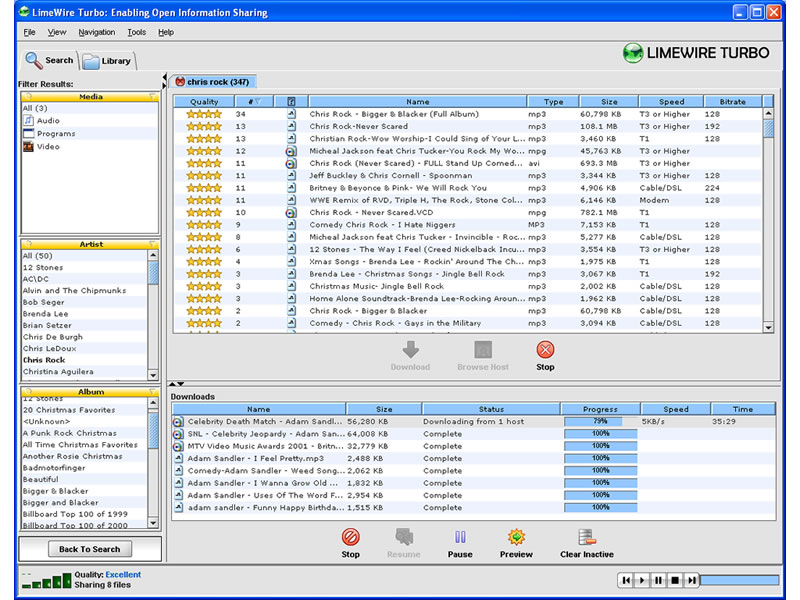
Music piracy is on the decline in recent years. At the high point near the close of 2007, 16% of internet users relied on a P2P service to download music. But by the end of 2010, that figure had fallen to 9% just after LimeWire, probably the most popular P2P service at the time, was forced stop operating by a court injunction. This decline, which many suggestwas largely a result of LimeWire’s cessation, looks at first glance like a big win for copyright, and it is. However, more curious is exactly why it had such an impact, as internet-goers are far from unable to pirate music without LimeWire. LimeWire was, in addition to a direct P2P filesharing network, a torrent client, which people use to quickly download files—often music files—from other users around the world who are “seeding” them (sharing them, making them available for download). Other torrent clients include (but are not at all limited to): uTorrent, BitTorrent, BitComet, Deluge, FrostWire, Vuze, and Transmission. Anyone with even an ounce of determination can still illegally download music for free.

LimeWire in action

Just as the drop in overall illegal P2P downloading was unlikely a result of incapacitation, it is improbable that the Recording Industry Association of America (RIAA) managed to significantly deter would-be and ex-pirates through lawsuits against individuals. Between 2006 and 2008, the RIAA spent over $64 million on lawsuits that earned $1.4 million in total settlements. And they went after only a small fraction of violators. The scope of the problem is too vast to attack on an individual level, and few pirates quake in their boot and peg-leg at the thought of the RIAA.

Cartoon Pirate

(Video links: an Anti-piracy ad and a semi-funny Parody to anti-piracy ad on YouTube)

So why did so many people stop infringing copyright when LimeWire disappeared? Perhaps a more reasonable explanation than incapacitation or RIAA crackdowns is that the shake-up caused people to reevaluate their most convenient listening option. LimeWire’s decline provided enough illegal downloading inertia for some users to realize that music was far more freely and legally available than it had been when they started using LimeWire. One could find almost any music video on YouTube, listen to any artist on Pandora or Last.fm, and track down any song through a subscription service like Rhapsody or the new Napster, or even through the Zune community (in theory—nobody actually has a Zune). For about a dollar a song, they could scour the vast library of iTunes, and download almost any song to well-organized and easily manipulable libraries and playlists. Legal access to music had become far more convenient since the days of buying CDs and waiting up to fifteen minutes for them to import into your library. Let’s take a closer look at a few of these champions of convenience.

Zune Community photo
The Zune Community

YouTube

Since its inception in 2005, YouTube has grown to serve over 3 billion videos each day, about 15% of which it monetizes through advertisements. It carries popular music videos, such as those legally posted by Vevo, and is a popular destination for on-demand music streaming.

iTunes

For those willing and able to afford it, iTunes is an intuitive and easy-to-use organization and storage option for music. Apple is also planning iTunes Match, which is currently in beta testing. ITunes Match, they hope, will monetize previously pirated music: for around $25 per year, iTunes will take all of your music (up to 25,000 songs), sync it with Apple’s higher quality versions, and keep it in the cloud for you. Stop paying the $25 each year, and your access to the music in the cloud disappears. However, anything you downloaded and store locally you get to keep.

Itunes Match

Pandora Radio

Pandora is a music streaming and recommendation service that allows users to pick an artist or a song and then plays a variety of music that the user is likely to enjoy based on its similarity to the original choice. Each of Pandora’s 100 million users can give “thumbs up” or “thumbs down” to each song, which Pandora factors into future predictions. Especially useful for discovering new tracks, Pandora is like YouTube in that it is most suitable for one-time listening, rather than for building a reusable and well-organized library.

Last.fm

With around 40 million users, Last.fm is another recommendation service known for its ability to work synergistically with other software. For example, it can extract play count data whenever an iPod is plugged in and use it to improve it’s recommendations. It is also integrated with the next and (I think) most exciting marker of how listening to music is changing, Spotify.

Spotify

Although it had no bearing on the piracy decline in 2010—it’s only two months old in the United States—Spotify, which was founded by the former CEO of uTorrent, Daniel Ek, might just be the service that gets people to really abandon torrenting for more “legitimate” music service. First off, it can automatically sync with a computer’s iTunes library, eliminating the hassle of transferring a whole library. It lets users access any song in its catalogue of over 15 million songs, form playlists, and integrate track plays into Last.fm, all for free. For $5 a month, ads disappear, and for $10, Spotify will sync all of one’s devices, allow for mobile use, and let users download songs to play while they are offline. Of the service’s 10 million users, approximately 1 million are paid users. When my free trial expires that figure of paid users is certainly going to increment.

Spotify
Spotify comes to the United States; spelling conventions remain across the pond

Part of the magic of services like Spotify rests in their ability to take advantage of the fact that music no longer needs to exist as a physical entity in the sense that CDs and cassette tapes did.

Boom box
Hi-Fi baby

Therefore, it is less important to own a physical copy of an album or a single, and much more feasible and convenient to settle for just having access to any song at any time, via the cloud. In effect, they are exactly the same thing from an internet-equipped user’s standpoint, except she doesn’t have to devote space on her own hard drive to keeping all the files. Optimists will reason that we pay subscription fees to talk on the phone, watch television, and surf the web; it’s only a matter of time before we do the same for device-independent access to 15 million plus songs.

Although it may satisfy a desire for self-righteousness to parade around promoting strict copyright penalties and efforts to shutdown websites that enable or promote copyright infringement, such an approach, for two reasons, is futile as the only strategy. Firstly, the internet is a highly globalized and free environment; copyright law is state-specific. Sites like The Pirate Bay can simply move camp to the Seychelles, and skirt U.S. authorities in the process. Secondly, enablement and promotion of copyright infringement are difficult offenses to define. Did I just infringe on EMI and Sony’s copyrights by providing an external link to The Pirate Bay, which can provide you with torrents of copyrighted works? Does Google infringe on copyright when I search “Rapidshare new Eminem song download.” In both cases, the answer is probably “no,” but the larger and more general point that these questions give rise to is that contributory and vicarious liability judgments are very difficult to make.

To wrap up, it is highly unlikely that illegal music downloads can be prevented completely without significant violations of privacy and freedom. The bottom line is that the illegality of music piracy is not enough to deter people alone, and it is too costly to police on an individual level. Instead of trying (and perhaps achieving similar results to other idealistic, non-solution-oriented ventures like abstinence-only sex education and the original “war on drugs“) let’s continue to create legal alternatives that are more convenient than pirating. And let’s nudge users toward checking them out as a piracy alternative by working to shut down specific mass violators like LimeWire. If it works, hopefully we’ll be looking at a world where everyone shells out $10 each month—$10 that far exceeds the opportunity cost of taking the time to assemble a comprehensive library of pirated songs—and in return receives a stocked and personalized library on all of her devices. Who’s down?

Pirates, and Copyrights, and Torrents! Oh My! – by “Nick D”

Let’s set the scene. An endless sea vista opens to the sound of waves and a slight breeze. A large wooden boat comes into view, silhouetted on the ruddy orange sky.

Queue epic, driving music.

Enter, The Pirate Bay.

TPB

What is the Pirate Bay and how does it work?

The Pirate Bay claims to be the largest BitTorrent tracker online and has been described as the most visible facilitator of illegal downloading. The Pirate Bay was created in 2003 by Piratbyrån (“Pirate Bureau”), a Swedish anti-copyright organization, and was then run independently by a group of individuals starting in the later part of 2004. The site is currently run by an uber-shady company registered in the Seychelles, an island nation northeast of Madagascar in the Indian Ocean.

From The Pirate Bay in the Seychelles to the World: Catch us if you can!

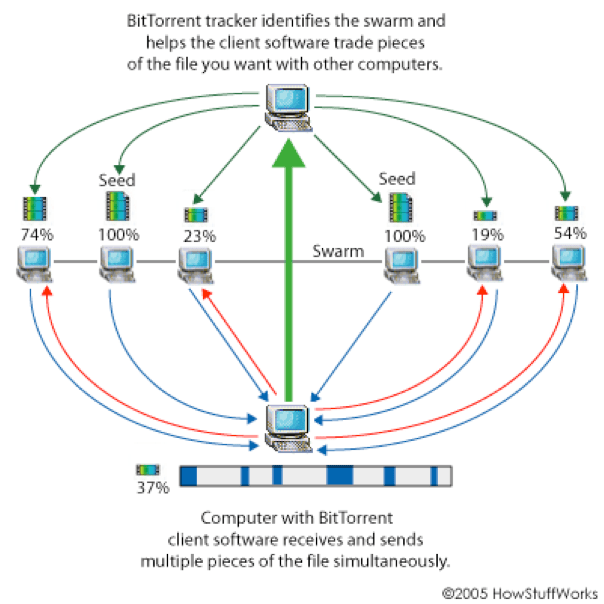
BitTorrent is a peer-to-peer, or “P2P” protocol, which is used to distribute large amounts of data online and allows for rapid download times. BitTorrent relies on the torrent, which is a file containing information on a target file’s component locations. These component pieces are spread across many hosts. When a user requests a download of a particular target file, the torrent seeks each of these components to piece together the target file for the user, which can be opened when all of the pieces have been assembled. This results in very fast download speeds of large files (movies, TV shows, etc.).

For those of you that are interested in how this relates to client-server download processes…

Client Server Download Process
BitTorrent Download Process

BitTorrent file sharing accounts for 28.40% of peak time aggregate traffic in Europe and 17.23% in the US, where it was only recently overtaken by Netflix (for peak time aggregate traffic). According to an MPAA report, the worldwide motion picture industry estimated a loss of more than $7 billion as a result of Internet piracy in 2005 alone.

Torrent downloading services offered by The Pirate Bay are free, and uploading/commenting capability only requires free registration. The Pirate Bay justifies their lack of censorship by noting the “broad spectrum of file sharers” that use The Pirate Bay. This means that everything from Barney and Conan O’Brien episodes to pornographic material can be downloaded using The Pirate Bay. And of course, most (if not all) of this is copyrighted material.

 
And then Conan O'Barney walked in...


Legal Lash-Back

How, you might ask, can they do this?

Simply put, they do.

The Pirate Bay takes no responsibility for the copyrighted material that is illegally dispersed thanks to their service. The following argument is readily posted on their website:

“Only torrent files are saved at the server. That means no copyrighted and/or illegal material are stored by us. It is therefore not possible to hold the people behind The Pirate Bay responsible for the material that is being spread using the tracker. Any complaints from copyright and/or lobby organizations will be ridiculed and published at the site.”

The Pirate Bay is notorious for this last part; putting up for public display takedown notices it receives from everyone and their grandmother, as well as the (usually vulgar, crass, inappropriate, and hilarious) response they send back. To acquaint you with the type of sentiment that The Pirate Bay typically responds, below is a medium sized cornucopia of phrases excerpted from various responses to Dreamworks, EA, Warner Brothers, and others’ Take-Down Notices:

  • We demand that you cease and desist sending letters like this,
    since they're frivolous and meaningless.
  • It is the opinion of us and our lawyers that you are ....... morons.
  • stop lying.
  • you should please go sodomize yourself with retractable batons.
  • We demand that you provide us with entertainment by sending more
    legal threats. Please?
  • The DMCA is a US-specific legislation, and TPB (The Pirate Bay)
    is hosted in the land of vikings, reindeers, Aurora Borealis
    and cute blonde girls.
  • Go fuck yourself. 


Quite a list of colorful phrases we have here! (if you would like some more, there is a whole list here)

But, you might wonder, why hasn’t The Pirate Bay been prosecuted and shut down?

Well, the Swedish government tried. After a criminal complaint was filed by the Motion Picture Association of America (MPAA), the Swedish Police executed a raid of The Pirate Bay, confiscating servers and shutting down the website in 2006. Dan Glickman, CEO of MPAA said in a statement, “Intellectual property theft is a problem for film industries all over the world and we are glad that the local government in Sweden has helped stop The Pirate Bay from continuing to enable rampant copyright theft on the Internet.” Problem solved? Absolutely not. In three days after the raid, the website was back online, with the following graphic:

Take That MPAA!

So much for the raid…


And Now, Some Commentary…

First, it is important to note that these guys founded the Pirate Bay:

The Real Pirate Bay

Gottfrid Svartholm (left) and Fredrik Neij (right) have both been charged (along with Peter Sunde and Carl Lundström) with “assisting [others in]copyright infringement” due to their association with The Pirate Bay. While in the process of an appeal, each defendant was sentenced to 1 year in prison and required to pay damages totaling 30 million SEK (US$3,620,000) (this verdict will only be upheld after all appeals have been processed according to Swedish Law).

Good with computers? Absolutely.

Creepy Looking? Sort-of.

Digital-Pirates in deep $#!%? Looks like it.

But they probably see themselves as modern-day Robin Hoods, stealing from who they consider as the rich (MPAA) and giving to those they consider as the poor (the swath of users on The Pirate Bay). However, while Robin Hood stole from a disillusioned, powerful king and gave back to the people who the king stole from, the users of The Pirate Bay haven’t been preyed upon. We operate in a (largely) capitalist world. If the public wants what MPAA and the rest of the entertainment industry produces, by all means the public is entitled to what they want and the entertainment industry is entitled to the profits generated by that demand.

Dispersing copyrighted material is illegal and/or immoral however you slice it, because it denies the producers of a good from their due share of benefits. It is stealing. The Pirate Bay provides the perfect conduit for this to occur. It is difficult for them to make the argument that they are not at fault for the illegal dispersal of copyrighted material because they aren’t the ones that hold the digital files – just the links to them… They call themselves the PIRATE bay for god sakes.

Yes, PIRATE I say!

Most people would agree that what The Pirate Bay facilitates is illegal, but where does it fall on the spectrum of illegal dispersal of copyrighted material?

If someone makes a DVD recording of a playlist and gives it to their friend, it is an isolated case. Sure, the friend could go home and make another copy and give it to his or her friend and so on and so forth, but the infrastructure is such that there is both time involved and physical transport of tangible objects that are required to share copyrighted material. This by the way, is still illegal, but does not make front-page news like The Pirate Bay.

The reason why The Pirate Bay’s activities are so criminal is because of the scope of individuals that can illegally acquire copyrighted material online. BitTorrent allows for anyone with internet access to download the latest piece of entertainment of their fancy. The infrastructure is designed to allow for maximum dispersion and minimal effort for the user. As opposed to a single DVD copy, which for all purposes will not hurt the entertainment industry, a BitTorrent file of the same movie makes the copyrighted material available to anyone on the internet – and all you need is enough hard-disk space to store the target file!

The Pirate Bay would, by this argument, fall on the far end of the illegal spectrum…

The (Illegal) Spectrum

The only reason that the Pirate Bay can get away with this is because they hide behind international disagreement when it comes to copyright law. With the company currently running the site in the Republic of Seychelles, they only need to abide by Seychelles’ copyright law. This highlights a gaping hole in the current international copyright system. What are some countries solution? Block thepiratebay.com. Denmark, Germany, Greece, Ireland, Italy, Malaysia, Netherlands, Norway, China, Sweden, and the UK have all experimented with blocking thepiratebay.com at some point in the recent past (according to Wikipedia).

What can countries, interested in protecting its citizens’ works but not interested in internet censoring, do? Not much (as of now) against sites like The Pirate Bay. Perhaps getting on good terms with countries where infringers hide and convincing the country to take action (like in Sweden) would work. How about against downloaders and uploaders using a site like The Pirate Bay? If they are within the borders of your country, huge fines would probably do the trick.

If they are outside your borders?

Tap your heels together 3 times and repeat “There’s no place like home”; with the current international copyright conundrum, there’s not much else you can do.

Art in an Age of Interactivity – by “Amanda C”

Manovich’s Claim

Not only have new media technologies… actualized the ideas behind projects by artists, they have also extended them much further than the artists originally intended. As a result, these technologies themselves have become the greatest art works of today… [The] computer scientists who invented these technologies… are the important artists of our time, maybe the only artists who are truly important and who will be remembered from this historical period.

Is Manovich on the Right Track?

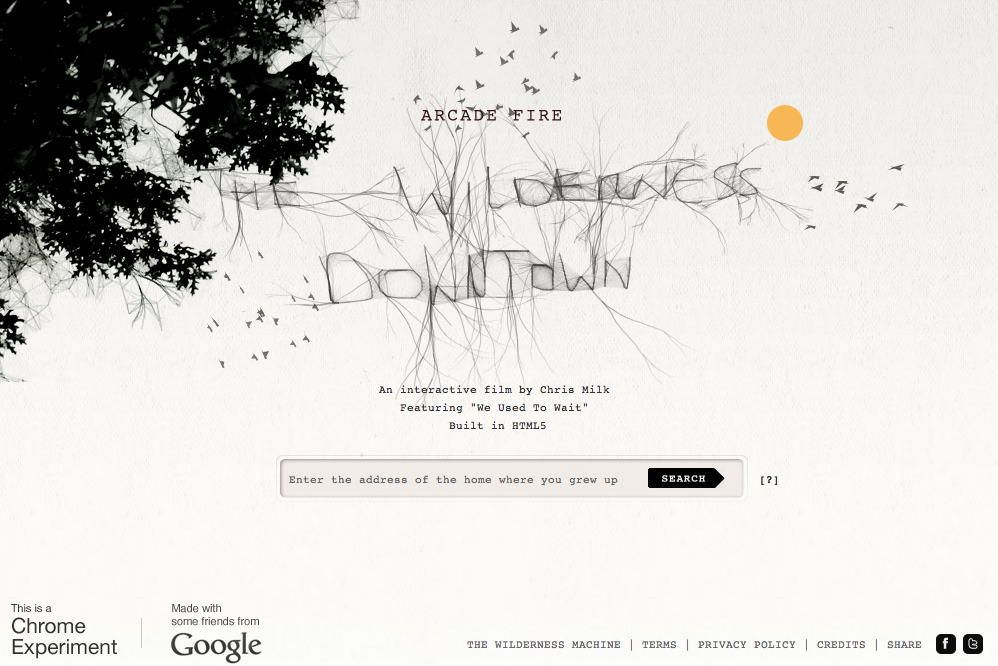
In order to address Manovich‘s statement from his 2003 essay “New Media from Borges to HTML,” I’d like to bring up one of my favorite pieces of digital art—”The Wilderness Downtown.” On its homepage, “The Wilderness Downtown” claims to be both a “Chrome Experiment” and an “interactive film.” The essence of the program is inventive—it inputs the address of the audience’s childhood home and creates a music video to Arcade Fire‘s “We Used to Wait” centered around that address.

The film’s credits are particularly fascinating; they credit the members and managers of Arcade Fire, the film production team, the interactive production team, and the Google tech team. Think about how the final product would have changed if any one of these teams had been removed. “The Wilderness Downtown” was a joint effort, and it now serves as a perfect example of interdisciplinary art. Without musicians and filmmakers, “The Wilderness Downtown” would simply be code, but instead it’s an experimental (and revolutionary, in my opinion) interactive film. So digital art is interdisciplinary, by nature. And Manovich was half-right: computer scientists are artists, but they’re very clearly not the only ones.

Sensory Marriage

It’s generally accepted that we, as humans, possess five senses: sight, hearing, taste, smell, and touch. Certain art forms feature certain senses. Visual arts feature sight. Music features hearing. Music videos feature sight and hearing—the two senses are expected to compliment each other. And “The Wilderness Downtown” works touch into the equation, by having the audience members enter their childhood addresses into the text box prominently featured on the page and write themselves letters. Interactions with art in physical manners are made more and more possible by advances in technology, so much so that now we’re getting used to touching the art that we see and hear.

The Internet is for Conversation

In an age where the Internet dominates, people’s opinions are overwhelmingly prominent. News articles, blogs, and videos all allow for comments, and often times the comments are more insightful than the original work. YouTube, the platform on which many videos are originally posted, has a built-in feature for Video Responses. In an age where physical interaction with art is increasingly prominent, how can we criticize for remix?

Mashup artist Girl Talk appears to agree. In his interview with the New York Times, he states:

I think a lot of artists are used to their music being reused online and have come to accept and embrace it. You have a generation who go on YouTube and remake and remix music online all the time. They remake and upload songs and videos, and then other people remake the remakes; it just keeps going.

Regarding copyright law:

It is clearly in a gray area but I believe it should fall into fair use under copyright law. I feel like people are not listening to my music instead of buying a CD or album of an artist I feature. Instead, people find new musicians because of a sample on one of my records.

Commercial impact is one of the factors used in determining fair use, and in my opinion the only important one. Should filmmakers and musicians be able to make a living off of their work, without having it stolen? Of course. Commercial success staying equal, should we stop people from remixing works in an age where art is inherently interactive? No. Are the remix-ers artists as well? Yes.

Should copyright laws be reformed for today’s society? Considering the interactive, multisensory nature of digital art—yes.

Fair Use of the Week: Trollface – by “Shirley B”

This week on Fair Use of the Week we will be talking about Trollface.  Yes, trollface.  If you haven’t heard of it, or at least seen it, then you’re probably eighty and not spending enough time on the internet.  “Trolling,” which originally was used to describe a fishing technique in which one would drag a lure through the water to bait the fish out, now, in the digital world, describes the act of goading someone to elicit a reaction.  Whether someone does it “for the lulz” or some other reason, trolling has become annoyingly common, and Trollface is its symbol.  But now, Trollface’s widespread usage is under attack by its purported creator, a deviant art user who goes by the username Whynne.  Whynne alleges that users of the link aggregation and social media website Reddit.com, specifically of the subreddit “F7U12,” or “FFFFFFFUUUUUUUUUUUU,” has used his copyrighted image in a manner “devastatingly injurious to its original iconic value.”

Whynne's email complaining of copyright infringement.

Trollface purportedly first appeared in one of Whynne’s comics, seen here.  This week, we will determine whether or not Trollface and its use in rage comics on Reddit.com is fair.  To do that, we will look at the history of the image itself and the nature of the images as they are featured in specifically on Reddit.

This case is different from many of the others we have covered because Whynne is bringing a complaint against both Reddit and a group of Redditors, rather than a single independent actor. Because it would be impractical and essentially impossible to look at every single rage comic with Trollface that has ever been created, we will speak in generalizations and primarily about the role that Reddit.com has played in the alleged infringement.

Factor 1: The Purpose and Character of the Use: As we always do in our analyses, for this factor we will look at whether the work is transformative enough to stand up to a fair use claim and whether or not the work is being used in a commericial way.  First, the individual creators of rage comics (hereinafter “F7U12 Redditors”) juxtapose a high resolution image of Trollface with a person’s face that allegedly resembles the image.  While this may seem transformative, it is questionable whether the juxtaposition imparts new meaning on the Trollface.  In fact, the Trollface is probably imparting the meaning onto the actual faces, thereby making the use of Trollface non-transformative.  Second, some F7U12 Redditors may receive advertising profit from their individual websites.  As such, the use of Trollface by F7U12 Redditors who receive advertising profit is commercial and, thus, presumptively unfair.  When taking all this into account, this first factor seems to disfavor the F7U12 Redditors.

Reddit.com’s use, however, falls even more strongly in the realm of non-commercial use.  Reddit.com hosts thumbnail images of the Trollface and only links to the high-resolution images.  The low resolution images hosted by Reddit.com have little commercial value, and the use of them is practically non-commercial.  As such, Reddit.com is, in many ways, a link aggregation and search site like Google.

To understand why Reddit.com’s use of Trollface thumbnails is transformative, one must understand how Reddit.com operates.  Harnessing the wisdom of the crowds, Reddit.com uses a system called “karma.”   “Karma” makes sure that good posts “float” to the top, while posts that people don’t like are buried.  Users comment on the posts, and, similarly, their comments “float” to the top in the way that popular posts do.  From this persecptive, Reddit.com’s “karma” system provides public benefit by identifying newsworthy posts.

Here, the posts in dispute incorporate thumbnail images of Trollface.  These Trollface thumbnails are juxtaposed with Reddit.com’s karma ranking plus the community’s comments.  This makes Reddit.com’s use of thumbnails highly transformative because Reddit.com imparts new meaning on them.  As such, the trollface thumbnails serve an entirely different purpose than what Whynne intended.  This transformative use, coupled with the public benefit of Reddit.com, means that the first factor weighs in Reddit.com’s favor.

Factor 2: The Nature of the Copyrighted Work: Whynne originally made Trollface without any commercial motivation.  Trollface is itself a fair use of another’s drawing.   As Whynne admits, Trollface was his own attempt to draw Rape Rodent, and Rape Rodent itself was an attempt to draw Mighty Mouse.  The drawing of Mighty Mouse came out looking so creepy it earned the monikers “Rape Rodent” and “Molester Mouse.”  However, Whynne has registered his image with the U.S. Copyright Office and thus removed his image from the public domain.  Whynne has a right to make derivatives of his original comic, and because Trollface is a derivative work from Whynne’s original comic, it is protected by copyright.  As such, this factor weighs against the F7U12 Redditors.  Similarly, because the photos appeared on the internet before Reddit.com used corresponding thumbnail versions in its social news website, this factor weighs slightly against Reddit.com.

Factor 3: The Amount and Substantiality of the Portion Used: Trollface first appeared not as a standalone image, but as a single panel in a comic. Users of Reddit do not replicate Whynne’s entire comic, but only take the face itself.  Still, they replicate the face in its high-rez entirety.   This means that this first factor weighs against the F7U12 Redditors.

Conversely, Reddit.com only hosts and displays thumbnails on its site.  The high resolution images are kept on websites that specialize in image hosting, like imgur.com, to which Reddit links.  The use of thumbnails by a search provider, as the court in Perfect 10 v. Amazon.com held, constitute a reasonable amount of copying.  Using something less than a thumbnail would be unhelpful to a computer user.  Therefore, this factor weighs heavily in favor of Reddit.com.

Factor 4: The Effect of Use Upon Potential Markets: It is foremost important to identify the potential harm to the relevant markets.  Whynne makes a profit on his illustration by licensing it for merchandise. For example, he licenses his image with Deviant Art, which sells shirts, hats, buttons, bags, and even keychains on its site.  Whynne also has a line of Trollface soaps with the British website soapier.com and has tried to have Hot Topic carry a line of Trollface t-shirts.  These pieces of merchandise utilize high-resolution images of Trollface.

Whynne alleges in his complaint that the use of Trollface by F7U12 Redditors has harmed his original comic’s “iconic value.”  If Trollface fans were buying comics by F7U12 Redditors, we would agree.  However, from our research, no F7U12 Redditors are selling their comics.  Nevertheless, to the extent that F7U12 Redditors are reproducing high-resolution Trollface images without a license and then profiting from such use, we do think that they are harming Whynne’s potential licensing market.  Yet, this distinction between for-profit and not-for-profit F7U12 Redditors is artificial because none of the F7U12 Redditors’ uses are transformative.  When there is no transformative use, there is a presumption of market harm, which means this fourth fair use factor weighs against all of the F7U12 Redditors.

On the other hand, Reddit.com’s use has hardly harmed the market for Whynne’s full-size images and Trollface licenses.  Reddit.com’s low resolution, thumbnail images were highly transformative, and any allegation of market harm would be purely speculative–especially since there is, arguably, no commercial market for thumbnail images.  Therefore, this fourth fair use factor weighs in favor of Reddit.com.

Conclusion: Weighing the fair use factors leads to the conclusion that the F7U12 Redditors’ uses were unfair as none of the factors weigh in their favor.  But weighing the factors also leads to the conclusion that Reddit.com’s use was a fair one, especially in light of the public utility served by its “karma” feature and the transformative nature of its use.

Fair Use of the Week: Obama, Son of Strelka, and a New Genesis – by “Aditya K”

Barack Obama’s voice is something else. It’s calming; it’s soothing; and it’s powerful. Dan Warren was listening to Obama’s 2005 audiobook Dreams From My Father when inspiration struck him: What if he utilized Obama’s “grandiose, epic language” and taletelling timbre to create his own story?

And thus, Son of Strelka, Son of God was born. The story—a creation myth like no other—tells the story of Stanley, the son of the creator. Stanley travels far and wide, his tale narrated seamlessly by our very own POTUS.

(Animation done by Ainsley Seago. Story and music by Dan Warren.)

I recently stumbled upon this amazing work via an article on Slate Magazine’s website. A major question surrounding this new piece was whether or not it infringed on the copyrights of the audiobook it drew from. The article’s author, David Weigel, mentions that artist Dan Warren did not worry too much about the legality of the remix:

If there was any question about fair use, he had an answer. “It could be seen as commentary on Obama’s story,” he explains. “People did think he was going to remake the world. I thought he was going to remake the world! Although maybe in less dramatic terms than in this story.”

When Warren first released his creation on the Something Awful forums, he stated: “It’s almost certainly fair use, but that doesn’t mean that there wouldn’t be legal hassles if I tried to sell it.” In our latest installment of Fair Use of the Week, we’ll explore exactly how and why Son of Strelka, Son of God qualifies for fair use protection.

Fair Use Analysis
As we’ve done in past Fair Use of the Weeks, I’ll don my faux judicial robes and analyze the four factors that help determine whether or not Son of Strelka, Son of God is a fair use of copyrighted works. If these factors, laid out in §107 of the Copyright Act, weigh in favor of fair use, then Dan Warren is not liable for copyright infringement.

Factor 1: The purpose and character of the use. This factor centers on the idea of how transformative the new work is. A transformative work, generally defined as having new expression or meaning, is protected by fair use.

Son of Strelka, Son of God consists of segments of Barack Obama’s audiobooks spliced together to give a whole new meaning. Warren rearranged Obama’s words and phrases over original musical tracks to create a novel myth. This repurposing of the audiobook’s recording should be enough to mark Son of Strelka as transformative; however, Warren poses a further argument. As he mentioned in his Slate interview, the new artistic meaning could be a commentary on the public’s conviction that Obama was going to remake the world. By presenting Obama as a storyteller of a new Genesis, Warren is doing just that.

Another aspect of this first factor regards the commercial nature of the use. Son of Strelka, Son of God is available for free online. (Warren himself figured that selling his work would probably bring more legal troubles.) Releasing his work for free strengthens the argument that his work was a good faith fair use of a copyrighted work for the sake of commentary.

Factor 2: The nature of the copyrighted work. The second factor pertains to the copyrighted work that was sampled from or reappropriated. In this case, the work is Barack Obama’s audiobook, Dreams From My Father. Though the audiobook itself is a derivative work based on a preexisting work—Obama’s original book—Section 106 of the Copyright Act gives the copyright owner exclusive rights “to prepare derivative works based upon the copyrighted work.” Section 103 guarantees this new work, however, its own independent copyright. Son of Strelka probably is transformative enough to not violate the original book’s copyrights—portions of text were jumbled together out of context—so the question of fair use centers on the recorded portion of the audiobook. Regardless, both the audiobook and the original text are copyrighted, widely published, and sold, so this factor weighs against fair use.

Factor 3: The amount and substantiality of the portion used in relation to the copyrighted work as a whole. The idea behind this factor is somewhat logical: the more of a copyrighted work you use, the less of a chance it is a fair use. This is especially true when the bulk of the use is unchanged or verbatim.

With Son of Strelka, Son of God, lines of Obama’s audiobook were taken out of order and spliced together into a new context. In total, the new story is 32 minutes long, but a relatively small percentage of the original work was used—in total. Only a few sentences, if not a few words, were used at a time, and Warren’s finite use was enough to create a truly transformative work. I believe this limited use allows for the third factor to fall in favor of fair use.

Factor 4: The effect of the use upon the potential market for, or value of, the copyrighted work. This factor tests whether the use of the copyrighted work has an appreciable effect on the original work’s market. Essentially, if the fair use competes directly with the original work, it is harder to make an argument for fair use; if the new work complements the copyrighted original, fair use becomes a more viable argument.

Son of Strelka, Son of God does not appear to harm the potential market for Barack Obama’s audiobook, Dreams From My Father. This is not because Son of Strelka is noncommercial; just because something is free does not mean it wouldn’t harm the original’s market. Both works are audiobooks, so there is a potential market substitution. However, the nature of Barack Obama’s work—a nonfictional narrative performed by the current President of the United States—is quite different from the nature of Son of Strelka—a fictional, mythical tale. A simple factor such as difference in genre leads me to believe that market effect, in this case, is not an issue.

Another aspect of the fourth factor is whether the use hurts the potential market for derivative works. I might be wrong, but I don’t believe there is a large market for derivative works when it comes to audiobooks. Unlike musical works, audiobooks are rarely sampled or licensed. For these reasons, I believe that the fourth factor sides with fair use.

Conclusion Even though they are public figures and their actions and statements may be newsworthy, presidents are entitled to all of the protections of copyright. That being said, their public persona makes them easy targets for fair uses of their copyrighted works—parody, criticism, news reporting, and other transformative works. Presidential mashups are not new, nor will they go out of fashion any time soon. In the case of Son of Strelka, Son of God, Dan Warren is completely justified in his assertion that his use of Barack Obama’s voice is fair and allowed according to the law.

Fair Use of the Week: Friends With Benefits v. No Strings Attached – by “Julie S”

Summer movies can range from epic cinematic prequels of beloved comics to formulaic rom-coms created to feast on the money of bored teenagers and pining singles.  One YouTube trailer that was a hit this week mocked the last type of blockbuster by using copyrighted materials from No Strings Attached and Friends With Benefits to create a mash-up trailer satirizing the painfully obvious formulas of the movies, and it is this mock trailer that provides the subject for this week’s fair use analysis.

When analyzing whether a mash-up is covered under fair use, we once again look to the four fair use factors set forth in §107 of the Copyright Act. We will examine each of these four factors to determine whether fair use protects BlindFilmCritic Tommy Edison’s mash-up, Friends With Benefits v. No Strings Attached.

Factor 1: The purpose and character of the use. The purpose of this trailer is non-commercial and for entertainment purposes only, intended to provide a “humorous & unique perspective on movies.”  In the mash-up trailer we examine today, Edison used bits of both movies and cut them together to show their similarities.  He interspersed the clips to highlight the similar characters and plot, and he even made new captions in the font used for Friends with Benefits to help make his mash-up seem like a more authentic mock trailer with funny captions like “same sidekick friend” “same wacky parents,” “same random gay jokes,” and “same camera angles.”

By putting clips from each film in the context of the other, the trailer transforms both of the original trailers, shedding new comedic light on the similar plotlines of these two predictable romantic comedies and making an even broader point about the lazy formulaic trend of the movie business. In Video Pipeline v. Buena Vista the Court acknowledged that there is valuable creativity fostered by choosing the snippets of a trailer, even while denying fair use to Video Pipeline (albeit because the trailer in that case was commercial nature whereas the one here is for entertainment purposes only).  Edison’s creativity is made all the more valuable  with the added captions and the obvious satirical and critical take on the two movies. Because of the importance of fair use to the fostering of creativity and the safeguard of free speech (parodies and criticism), the first factor favors fair use.

Factor 2: The nature of the copyrighted work. In his mash-up, Edison uses snippets from Friends with Benefits (the trailer) and from No Strings Attached (the trailer and other parts of the movie, e.g. the clip of Ashton Kutcher complaining that his father is dating his ex-girlfriend).  Because trailers are promotional and easily available it may not seem that they are commercial, but as it turns out they are derivative of the movie and protected by its copyright. Both No Strings Attached and Friends With Benefits are copyrighted and commercial in nature and so are the official trailers weighing the second factor against fair use.

Factor 3: The amount and substantiality of the portion used. The mash-up consists almost entirely of copyrighted materials but that doesn’t necessarily mean that Edison used an excess of copyrighted material to conjure up the work he was commenting on. He used enough materials to create a trailer-length mash-up to show rather than tell the audience of his opinions on the similarities of the two movies in a visual method of commentary that was both effective and funny.  Edison used just enough copyrighted materials from both films to accomplish this goal, and no clip lasted for more than a few seconds at a time. While the amount of copyrighted material comes out to a high percentage of the entire mash-up, each clip is short and on its own remains unsubstantial.  As a result, this third factor weighs in favor of fair use.

Factor 4: The effect of use upon the potential market. It’s possible that the mash-up could discourage moviegoers from paying to watch one of the movies by showing its audience that the movies seem to be interchangeable, potentially killing demand.  But we learned from Campbell v. Acuff-Rose that even when “lethal parody . . . kills demand for the original, it does not produce a harm cognizable under the Copyright Act.” So even if the mash-up discourages viewers from seeing Friends With Benefits in theaters or buying the DVD of No Strings Attached, that effect is not the concern of the uploader.  This fourth factor therefore seems to weigh in favor of fair use.  But since trailers are copyrighted as a derivative of the movie’s copyright we may want to examine whether Edison’s trailer replaces the derivative (namely the copyrighted trailers).  But unlike the copyrighted trailers for the two movies, Edison’s mash-up trailer is not intended to play in theaters or to replace the derivative works and so the fourth factor remains in favor of fair use.

With the court’s traditional emphasis on the first and fourth factors of §107 of the Copyright Act, and the critical nature of the mash-up, we believe that Blind Film Critic Tommy Edison’s mash-up is protected under fair use.

Google+ discourages oversharing – by “Zachary M”

We’ve all been hearing the …er, buzz… about Google’s new social network, Google+. As someone jaded by the oversharing and overall “bogged down” feeling of Facebook, I jumped on the opportunity to see if Google+ would be any different.  It’s still in its early stages, but I’ve been pleased by the tangible steps that Google has taken against oversharing.

First, the emphasis on “circles” makes you think about who is going to read what you post.  Circles are similar to the optional “list” function on Facebook.  But the operative word here is optional.  You need to go out of your way to customize who sees your statuses on Facebook, clicking the lock icon next to the “share” button, then going to a “Customize” menu.

facebook
Sharing options for Facebook posts

Clearly, Facebook doesn’t want you to think about who sees your posts.   For Google+, on the other hand, at the bottom of each post, you see who the post will be sent to (see below).  It’s similar to an email mailing list, except the ensuing discussion looks more like Facebook.  Now let’s think about this in the context of a useless post: “I just had some awesome pancakes for breakfast.”  It’s on my mind, so on Facebook, I’ll just type it in, hit enter, and it’s there.  On Google+, I’ll type it in, then go to select which Circles to share it with.  Because of this, I’m forced to ask, “who would care about this?”  Acquaintances are immediately unchecked.  Family? Nah, they wouldn’t care either.  Classmates? No dice.  How about “Close Friends”?  Come to think of it, why would they care about an above-average breakfast?  No one wants to know this, so I’m not going to end up posting it.  This is a perfect example of the power of defaults – two networks have the same options, but they feel fundamentally different since one integrates choice into the interface, while the other hides a default.

Sharing a post on Google+
Select who you share with.

Second, there is no wall.  This is a big move for Google, considering some form of public personal messaging has been a staple of both MySpace and Facebook, its precursors. There’s a complex psychology and sociology to the Facebook wall, but it just starts feeling weird after a while.  It’s akin to people holding a loud conversation in public – you don’t necessarily want to eavesdrop, but you can’t quite avoid doing it.  On Google+, if you want to direct a message at someone, you have two options.  First, you can make a post that you share only with the intended recipient; the person will get a notification about your post.  This is a bit odd, though, since it only appears in your “stream” along with posts not specifically directed at anyone.  Second, just email the person.  Depending on various privacy settings and whether you are Gmail contacts, Google+ profiles have an email link featured prominently under the profile picture. (Edit: You can control whether this link appears by going to your profile, then clicking “Edit Profile,” then the “Send an Email” icon.  When people click this link, they send you an email without actually seeing your email address.)   Either way, you’re encouraged to keep two-person conversations private.

It might seem surprising that the folks who brought us the Buzz disaster would discourage us from sharing too much, but they’ve clearly focused their network around what people don’t like about Facebook (and perhaps they’re trying to avoid the backlash they got from Buzz). Facebook has become inundated with information you never wanted to know from people you met once and became friends with out of politeness.  Even to many people who are “hooked,” Facebook has become more of a social burden than a welcome way to keep in touch with friends.    It’s hard to predict how Google+ will evolve as it scales up and is modified over time – after all, Facebook was once somewhat similar to the current Google+, but it incrementally eroded privacy to draw users in.  However, Google has an advantage that Facebook didn’t have.  It is already an established web resource with enough useful services independent of its social network to keep itself relevant for a good while. Google can continue to attract users by making Google a one-stop digital resource, leaving an unobtrusive social network intact.

Addendum: I should probably note that the “resharing” function leaves a privacy hole, but resharing itself requires that you think about who would want so see someone else’s post.  Though it amounts to no more than automated copy and paste, this is another example of the power of defaults; hopefully Google will allow users to turn off resharing by default before Google+ becomes open.  In general, the Google+ design allows you to limit the people you give information to, not what they do with it, which is really all you can hope for, anyway (see Hoffa v United States).